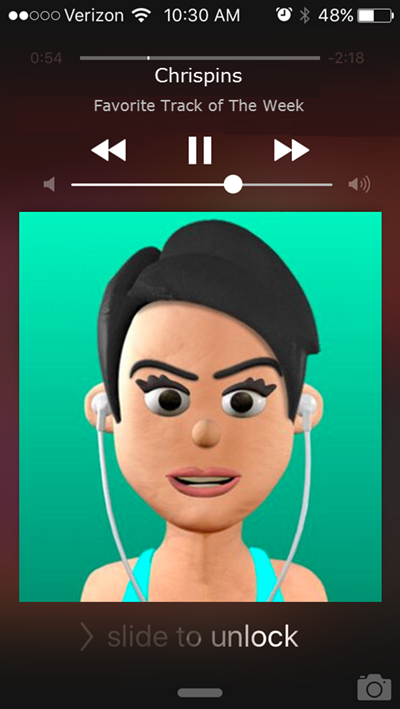
If you haven’t heard of Lindsey Sterling, you will definitely want to check out her music. She’s a violinist and she performs several different styles of music, including classical, pop, rock, and even electronic dance. Her album Brave Enough dropped today and it includes several songs that you’ll want to add to your next cycling playlist. Here are a few of my favorites:
Lost Girls-This one starts out slow, then picks up at about the one minute mark, then slows again around 1:40, only to pick back up at around 3:50. Great for intervals or rolling hills.
The Pheonix- I love the intensity that this song brings. This one would make a great flat road.
And last, try this one, featuring one of may favorites, ZZ Ward, for a flat road at around 100 rpm:
Premium Members can download this mix for free by following the links below:
[wlm_private ‘PRO-Platinum|PRO-Monthly|PRO-Gratis|PRO-Seasonal|Platinum-trial|Monthly-trial|PRO-Military|30-Days-of-PRO|90 Day PRO|Stages-Instructor|Schwinn-Instructor|Instructor-Bonus|28 Day Challenge’]
Right Click on the blue underlined link
Select “Download Linked File As”
Select a download location
Once file is completely downloaded, find it in the location you selected
Drag the file into your iTunes or Spotify library OR
Right Click on the file and Select “Open With”
From the drop down menu select “iTunes” or “Spotify”
File should begin playing and is now part of your iTunes or Spotify library
To download the above media on a PC:
Right Click on the blue underlined link
Select “Save Link As”
Select a download location
Once file is completely downloaded, find it in the location you selected
Drag the file into your iTunes or Spotify library OR
Right Click on the file and Select “Open With”
From the drop down menu select “iTunes” or “Spotify”
File should begin playing and is now part of your iTunes or Spotify library
Click here to watch a video on how to download media files from ICI/Pro.
Do you feel completely in touch with your hunger? Do you know exactly when you’re hungry? Or when you stop being hungry? And what to do with that info?
This short post is about an exercise for getting in touch with your hunger.
Why Is That Important?
Let’s cut to the chase. Every client who has completed this exercise ends up feeling absolutely clear about when she’s hungry and when she’s not, feeling completely in control of her appetite and her eating — and feeling great about herself.
Please don’t think hunger is obvious to everyone. I’ve heard clients say, “Well, I ate breakfast at 7:00 am and now it’s 1:00 pm, so I must be hungry.” Obviously, that’s a thought process, not hunger.
One client began to cry when I suggested the exercise because she thought she’d have to starve all day long.
Another client got angry because she thought she’d have to eat “diet foods” all day. I’m not even sure which foods she meant, or how she got that idea. The subject of diet foods had never come up in our nutrition appointments.
Okay, What’s This Amazing Exercise?
I read about this exercise years ago in a book that I simply can’t remember. As a PhD, I like to cite my sources and would be happy to give credit if I could. If anyone knows who created the exercise, please let me know.
That said, here it is:
– Pick a day when you have a light schedule. Your goal is to get hungry as often as possible during the day.
– As soon as you feel hungry, eat. But eat small amounts of food — just enough to take away the hunger. This will ensure many hunger experiences over the course of the day. If you follow these instructions, you might sometimes feel hungry within, say, 15 to 20 minutes after the last time you ate. (That’s the convenience of a lightly scheduled day.)
– Move away from your usual eating habits. Instead of eating first thing in the morning, for example, check in with your stomach to see if you’re hungry. If you’re not, wait until you are. Then eat.
– Avoid “preventative eating.” Don’t eat extra food now to prevent hunger later. As soon as you’re hungry later, you get to eat again.
– Don’t ignore your hunger signals and try to “tough it out” as long as you can. The idea is to cement the relationship between hunger and eating.
The natural hunger cycle is as primal as it gets: Hunger means eat. When hunger ends, stop eating. When hunger returns, eat. Repeat and repeat.
What This Exercise Is Not
Some mistakenly view this exercise as a weight-loss trick. It’s not meant to be. As explained, it’s designed to put you in touch with your hunger so there’s no question about how hunger feels, how much food is necessary to end the hunger, how it feels when it returns, and so on.
Still, eating in tune with your hunger may, over time, help with weight loss. Of course, you may want to increase the size of your portions to reach a point of “gentle fullness” so you don’t have to experience hunger so often throughout the day.
So What’s the Point?
Without a natural starting point for eating, we have no natural stopping point.
I’m convinced this hunger exercise is the most effective way for clients who lack awareness of their hunger and fullness to discover the wholesome, healthy connection between hunger and eating.
Whenever I’ve used this with a client, the result has always been an increase in the client’s confidence — no more confusion about when to start eating, when to stop, or even how much food to have.
Would you like help with normalizing your appetite and your food preferences? That’s what I help clients do — make painless food changes. Why not visit www.FoodAddictionSolutions.com/Coaching and request a Food Freedom session, absolutely free? Find out just how easy it can be to get your eating patterns on track — effectively and without struggle — so you feel fantastic.
It seems like just last month I was busy completing the last few of the 20 credit hours (2.0 CECs) I needed for my ACE group fitness Instructor renewal. Actually it was two years ago and at the time, I took advantage of the free CEC’s offered by Team ICG.
While I was scrambling again this year to complete all my credits, I figured I should share my bookmarked sources for relevant online courses with our ICI/PRO members. All of these educational offerings carry ACE CECs and credits with other certification providers.
$29.00 for these 0.4 CECs is a great deal!
Team ICG
While ICG’s CECs are no longer free, they are still a real bargain at $7.25 to $10.00 per credit hour. That’s about half what I’m used to paying. There’s a bunch of interesting study topics available like; periodization, music & motion, heart rate training and overtraining. Click over to www.teamicg.com/en/team-icg/education to learn more and you’ll need to scroll down to find the CEC courses.
Cycling Fusion
I’ve been a fan of Cycling Fusion for years (that’s me in the white do-rag) and they offer multiple, comprehensive online certifications. Existing instructors who want to learn to teach with Power will benefit from their excellent Power Training certification.
Parkinson’s Cycling Coach
Coach Kathy Helmuth’s online certification prepares instructors to successfully lead a Parkinson’s Cycling class.
The research is clear — physical activity has been shown to reduce the symptoms associated with Parkinson’s Disease, (PD for short).
Multiple studies point to the benefits of exercise in improving muscular strength, flexibility and balance with subsequent functional improvement in individuals with PD. However, the information in the literature suggests that physical activities require some specific characteristics for this population. Exercises focusing on strength training, balance, aerobic conditioning as well as the use of external cues during gait can result in overall improvement in motor performance and quality of life related to PD patients’ health.
If you’re on Spotify and you want to check out the newest music every week, follow their New Music Fridayplaylist! It’s a great way to find out what’s new! You can also find it by clicking on your Browse tab on the main sidebar of your Spotify page. Here are two standouts from this weeks playlist that you’ll want to add to your next mix:
The Things You Wish You Knew in Your First Indoor Cycling Class
We know cycling is a great workout, but very few are willing to brave down pours or gusting winds when the weather isn’t cooperating. Pedaling to great music encouraged by a motivating coach seems rather appealing.
While indoor cycling group fitness classes have been around almost 30 years now, the popularity is still increasing dramatically. Cycling specific studios are opening up all over the globe. All levels of fitness enjoy the heart pumping caloric burn workout from pushing the pedals around and around. This workout is also incredibly popular with those limited to doing low impact workout for their back, hip and knee joints.
Here are a few pointers instructors and facilities could make their potential participants aware of in order to get them in the door and then successfully through their first indoor cycling class.
Help, I’m not fit enough!
It’s amazing how fit and intimidating everyone looks in an indoor cycling class. Potential newbies will likely believe that they are not fit enough to even join the class let alone actually live through the hour to tell the tale. Many facilities offer orientations for beginners including what classes are most suitable on the schedule. Instructors are real people and the best instructors are approachable and will make everyone feel welcome.
Will the instructor or anyone notice me if I sneak in late?
It’s really not a good idea to arrive to class late. Arriving a few extra minutes early can set up for success even if it’s just to give you some confidence. This also means you can pick your spot and perform a bike setup with time. The best place is always in the front row, perhaps not necessarily in the centre though on your first ride!
What about clothing? Do I need a cycling team kit?
The most important thing to remember about clothing is that it needs to be comfortable. You don’t have to wear cycling shorts and jerseys to reap the benefits of an indoor cycling class. Padded bike shorts, however, are a lot more comfortable underneath and cycling jerseys are really effective at wicking away the perspiration and keeping you cool. Never wear running shorts or thong underwear if you want to keep from being embarrassed or getting chaffed down under. Cycling shoes are not mandatory but did you know that you can get injured from wearing a running shoe? Running shoes have a very flexible sole and this can lead to some participants getting plantar fasciitis over time.
Simple bike set-up
Great instructors will always include tips in their intro on how to set up your bike. Basic bike set up will have your saddle height the same as your hip height so that your knees have a 10-20 degree bend at the bottom of the pedal stroke. If you are new to indoor cycling and you suffer from low back, neck or shoulder pain then raise the handlebars but not so high that you look like you are riding a Harley Davidson motor bike! If you are not clipped in then please don’t put your toes all the way to the end of the cage as this could cause cramping. Try to figure out in your bike set-up if your seat is too high or too low. Too low, and you won’t be able to fully extend your legs, which detracts from the power of each pedal stroke. Too high, and your hips will rock back and forth to reach the bottom of each pedal stroke, which slows you down and can end up bruising your groin. To get the perfect seat height, stand next to the bike, hold your palm parallel to the ground, and place it at the top of your hipbone. The seat is the right height when your hand is in line with the seat and you can pedal comfortably.
What do all these terms mean?
It’s highly likely that you will hear words like resistance, RPM, cadence, functional threshold and power to name just a few of the common terms in an indoor cycling class. Experienced instructors will teach you what these terms but it is helpful to have a better understanding. Resistance refers to the amount of pressure on the flywheel or chain or what gear the bike is in. RPM stands for the number of pedal strokes or revolutions made per minute. This is also sometimes referred to as cadence. Functional threshold is maximal effort that one can undertake for 20 minutes without stopping. Power is also called watts and can be defined as a force multiplied by velocity.
There’s no wrong way to pedal, right?
“Most beginners focus way too much on pushing down. However, the upstroke is really what provides all the power concentrating on pulling up with each pedal stroke will increase momentum and make it easier to increase RPMs. And here’s a bonus for clip-in shoes: When you’re actually clipped into the bike, you can focus less on keeping your feet in place and more on your stroke, improving pedaling form, cadence and ultimately power output.
And don’t forget about your core: Just because your abs don’t touch the pedals doesn’t mean they’re not involved in every stroke. The core plays a major role in indoor cycling – which means actively engaging it could help you benefit from your workout even more. To do so, lengthen your spine, roll your shoulders back, and envision lifting your ribs off your hips. Proper form, as it happens, forces you to activate your core. Breathing correctly also helps, if you breathe from your chest instead of your belly it will be impossible to engage your core muscles. While seated or hovering over the saddle, use your abs as much as possible to help support your lower back. Try to keep your back straight (it’s OK if there’s a slight curve when you’re out of the saddle).
8. Don’t skip the stretch
There’s not too much science yet to prove that stretching reduces injury, helps muscles recover, or improves physical performance, according to L. Bruce Gladden, Ph.D., a professor of kinesiology at Auburn University in Alabama. But stretching out your hips, calves, and quads still feels really good – and you deserve to treat yourself after putting your body through the grinder. I encourage you to think of the post-class stretch as part of your 45-minute class. Even two minutes of stretching is immensely better than not stretching at all. Sealing your ride with a moment of calm is priceless.