Can an Indoor or Outdoor Cyclist measure their power using only Heart Rate?
I personally find it hard to believe, and yet CycleOps says their new PowerCal will do exactly that. Now if I had seen this advertised on some late night infomercial I wouldn't have given it a second thought, but CycleOps is one of the leaders in Power measurement for both Indoor and Outdoor Cyclists… so it must work – right?
I contacted Angie Sturtevant from CycleOps and she has connected me with their product specialist. Maybe I can get him on the Podcast to explain how this works.
In the mean time here is a short video from CycleOps discussing the PowerCal.
I'm like a kid in a candy store now that I have power in my Sunday 90 minute endurance class 🙂
Much of it, I'm sure has to do with the purity of the participants – which is to be expected from participants in a 90 minute anything… but there is more to it than just transitioning a 90 minute class without Power, to one with Power.
They get “it”
The people in my class are really smart! Once I explained everything they quickly understood how valuable the combination of magnetic resistance and power indication would be to reaching their fitness goals. Now when I talk about maximizing their time in class; get in and setup early, don't wait for me or waste 10 minutes talking to your neighbor – start your warm-up as soon as possible, as soon as your breathing calms get back to a flat road wattage, etc… they nod in agreement. Don't get me wrong, Heart Rate training is still important, but the instantaneous and member specific, information that comes with Power, makes Heart Rate training so 2000's.
They get “me”
“John, now it's all starting to gel together…” And gel it has! Being able to discuss Power and it's correlation with Heart Rate training zones has been very freeing and immensely satisfying, to me as an Instructor.
Today for example, I did my Nice Pull! ride. This is a simulation of working through a pace line of a group riding into a heavy headwind. Tucked in nicely, shielded from the wind, everything is manageable. Until BAM! The last rider in front pulls left and now you're hit hard with the force of the wind. Cuing / describing that feeling, to someone who's never ridden in a group, is very difficult. The challenge for the indoor rider is to immediately add load, at a level they can sustain for 2-5 minutes, without losing cadence. Tough to do on a conventional IC bike, working off of RPE or Heart Rate, but very easy and understandable when you have taking your class through some 5-8 minute intervals where you establish an estimate FTP – Functional Threshold Power. In an outdoor ride your pull at the front needs to be at a consistent pace. As soon as you can no longer maintain the pace you need to pull off… those who can sustain the pace, for an extended period of time, get a simple Nice Pull! as they slip toward the back. Having an average wattage number to maintain, for the whole 5 minute interval, replicated the feeling of pulling into a headwind more realistically than ever before. And the multiple, positive comments I received after class were just awesome. This could make a fun Audio PROfile 🙂
I don't have to feel like I need to compete with anyone, anymore!
And neither does Amy – and neither will you [wlm_firstname]. Lorrinda takes both of our classes and she told us both this weekend; You guys need to train all the other instructors! We are so far out ahead of all the “entertainment on bikes” crowd it's not even funny. Not everyone will want to make the transition, there will still be still be goofy housewife classes at 9:30 on Tuesdays, but the tide (at least where we teach) is a changing.
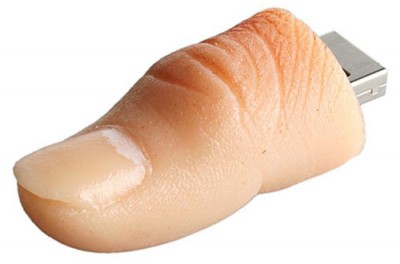
Both the FreeMotion S 11 series and Schwinn AC Indoor Cycles have the ability to record your ride data using a USB Thumb Drive.
This past Sunday I asked Alan ******, one of my regular students, if he would be willing to have his class performance data recorded so I could share it with you. Al is a long time cyclist and we first met back in 1998 while I was leading group rides for a local bike shop. He agreed and the process for collecting his information was a simple as plugging a Thumb Drive into the USB port before turning on the FreeMotion computer.
The data that's collected is:
Time – it takes a snapshot every second.
Miles traveled*
MPH*
Watts
Heart Rate BPM
Cadence RPM
My understanding is that Miles traveled and MPH are estimates based on research done by FreeMotion's engineers that measured the amount of power needed to sustain a given speed. As I type this I realize that I need a more comprehensive understanding so I can explain this better. You can download the .xlsx spreadsheet here.
Here's why both FreeMotion and Schwinn use a “Stage” button during class.
There is an enormous amount of data collected during a 90 minute class… Four Thousand, Eight Hundred and Thirty Nine lines of data to be exact.
The reason for only 116 minutes of total time is that we had a 14 minute warm-up, where no data is collected. More on this as I learn and experiment in the future.
Meet Emmy Ragali, the owner of Go Cycle Studio in Chicago IL. Emmy is the first Beta instillation site for the Top Power Display System from Performance IQ.
I wanted to learn first hand what Emmy's experiences were using the Top Power display to show the wattage and RPM of each Keiser M3 her participants are riding.
You may have concerns about bringing competition into your class and so do I. During the interview I asked Emmy some specific questions about how her class accepted the competitive atmosphere that develops by having everyone's data displayed on a big screen.
While I was reviewing the Go Cycle website I noticed this link to an evaluation form where participants can give feed back on the quality of the Instructor and their class – I see this as an excellent idea and Emmy explained to me that it has been very helpful to her and her Instructors.
Listen to the Podcast below to hear all about Top Power.
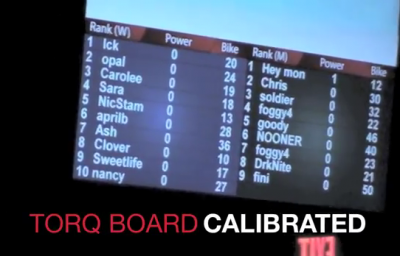
Flywheel's Torq Board – screen shot from youtube video
Updated: 11/23
Flywheel Sports is a chain of Indoor Cycling studios who started in New York city. They have had tremendous results and growth, now with 12 locations in three states; New York, Florida and Illinois. A big part of their success has come from a proprietary retro-fit system they have engineered to measure each rider's power and then display the real-time results on a screen. From their website:
… Additionally, for those who thrive on competition, Flywheel has developed the TorqBoard— an in-studio display that provides riders with the option to compare their performance against the rest of the class in real time.
The reason many students come to your class is for the community. Sure you maybe a great Instructor and include a lot of specific training into each profile you teach, but I'm convinced that the added element of friendly completion Flywheel's Torq Board brings is a big part of their success. Participants who are not achieving their personal fitness goals – read weight management goals – have a tendency to stop coming. We all understand that working harder (when appropriate) in class will increase fitness and burn additional calories. That's why so many of us are excited about power; for the first time our students can truly see what “working harder” feels like. Throw in the friendly completion part and you have the recipe for a fabulous sold out class
Beyond competition between riders, I see a remote display system like Flywheel's TorqBoard as solving multiple problems I'm hearing and seeing at clubs who have (or are considering) adding power based classes to their schedules:
Students have their heads down, completely focused on the display console – not on the instructor. With everyone riding with eyes forward they stay connected with you, the Instructor.
I can't see the display in a darkened class. A quick scan of your class will probably reveal an average participant age of 45-55 years old. Many of us (including me) have limited eyesight due to our age and when you dim the lights I'm nearly blind 🙁
Let's just add a constant back light to the console. Great idea until you realize that you will be replacing batteries at an even quicker rate than you do now.
Too many potential “computers” to fail. Henry Ford was famous for saying, “parts left off cause no service problems”. What if there was a system that eliminated the “computer” on each bike? Instead use a common system and eliminate some of the cost and maintenance concerns.
So let's say you think Flywheel's TorqBoard looks like something you would like to have in your studio… you can't have it. It's not for sale unless you are ready to become a franchised Flywheel Sports studio.
Enter Performance IQ and their new Top Power remote display system for studios using any of the Indoor Cycles with Power, including; FreeMotion S11.9, Keiser M3i, Schwinn AC or Spinner Blade Ion. Watch the shot video below to see this plug and play system at work at their second Beta site, Cycle Quest studio where I'm teaching. While it doesn't remove the existing “computer” on each cycle, it does solve the first three concerns I have listed above 🙂
To fully take advantage of Performance IQ's wonderful features, studios will want to offer a Bike Reservation system and data collection system that sends out those wonderful emails to each participant, showing them how many calories they burned in class.
What a difference a month makes… first they avoided the cycles with power – now they're nearly fighting over them.
I added a Saturday AM class at the Chanhassen, MN Life Time Fitness (LTF). The behavior of students I observed this morning was quite remarkable, compared to classes I attended earlier this summer. They're actually choosing the cycles with power now 🙂
This club shares the parking lot with Life Time's corporate headquarters. It's frequently used as the “Test Club” when LTF is developing new programming or where new products are tested before being rolled out to the other 90 clubs.
Back in June LTF replaced 50 NXT's with 35 Schwinn AC Performance and 15 Free Motion S11.9 Indoor Cycles. Of the 35 Schwinns, only 15 have the power consoles. They have all the Power cycles in the two front rows, the remaining Schwinns fill the back of the room.
I've taught and taken classes in this room for close to ten years. The typical pattern is for the back rows to fill with riders first and have a smattering of others in or near the front. There are stadium type raised levels and the back tends to be a bit cooler due to the way the ventilation is designed.
But not this morning. I walked in about 10 minutes before class and there was already 12 students warming up in the front rows while they played with their computers. Amazing! When class started there were 38 of us and just one was in the back row.
I'd love to tell you that this migration to the front was in anticipation of my arrival, but they had no idea I was coming. Seeing all this interest in the power meters I asked if they would prefer I leave the lights up. “NO – we use the back lights” was their collective response. And they weren't kidding. I felt like I was performing at a rock concert, as I watched consoles randomly light up, like so many cell phones (or if you are old enough) lighters.
It was Threshold Interval day (we follow a predetermined periodization schedule) and it was with great joy that I could communicate Power based intensities, instead of just HR Training Zones or breathing ques. I used Doug Rusho's mini functional power assessment he describes in Audio PROfile #172 and they really seemed to get it – based on all lit-up displays I saw at the end of the 3 minute test.
In case you missed the “Hey Mikey” bit in the title. Here's where that comes from.



 Both the FreeMotion S 11 series and Schwinn AC Indoor Cycles have the ability to record your ride data using a USB Thumb Drive.