With the battle raging in indoor cycling between scientifically proven training techniques and fun workouts, I believe there is a place for both.
The HIIT (High Intensity Interval Training) portion of the class will be structured intervals while the Party on the Bike portion will be music mapping to some classic “Happy Hour” tunes. Both types of interval sets will be performed at a high intensity.
Coach Dennis Mellon is a Certified Personal Trainer/Performance Enhancement Specialist through the National Academy of Sports Medicine, Certified New Leaf Metabolic Testing Specialist, as well as Certified Spinning, Schwinn Indoor Cycling, IndoRow and Energy Zone instructor.
Dennis was voted the Mountain West’s top Spin Instructor by Competitor Magazine in 2012. He has a Bachelors Degree in Physical Education and a Minor in Coaching from the State University of New York College at Cortland. Dennis has been working in the Fitness Industry since 1992 and has helped numerous clients and athletes of all abilities reach their fitness and racing goals.
Dennis has completed 8 ironman distance triathlons as well as ultra distance mountain bike events, marathons and shorter events like sprint triathlons and 5k’s. He's coached first timers to elite level endurance athletes. He is most proud of the fact that all but one ironman distance athlete he has coached has reached the finish line and many have set personal records.
Spinning® Instructor and music expert Chris Hawthorne provides our latest class profile that uses the four cornerstone movements in the Spinning program®:
Think of this profile like a square track. You will be taking your riders around the track four times. The first time around the track, each movement will be given 4 minutes. The second time around, 3 minutes. The third time around, 2 minutes. Your final lap will be 1 minute per movement.
Each square, or corner on the track is a ‘cornerstone’ movement:
Square One = Seated Flat (80-110 RPM)
Square Two= Standing Flat (80-110 RPM)
Square Three= Seated Climb (60-80 RPM)
Square Four= Standing Climb (60-80 RPM)
This to me is one of those profiles we all need to have in our “back-pocket” – and it will be perfect for a less experienced Instructor to use to teach a great class. As Chris says during the recording, her participants appreciate her simple & predictable profiles. Combined with her excellent playlist, Chris and I feel your class will enjoy Four Corners.
Not practicing the hand-off – but what comes next…
One of the many benefits of riding and training indoors, is not worrying about crashing and ending up on your head. So we practice our; pedaling technique, or Sprint form or whatever, without thinking about balancing or where we're going.
Now if we were riding our road bikes on trainers we could also practice reaching down, grabbing a bottle, taking a drink and then returning it safely into the cage. Not an easy task for many new (and a few old) outdoor cyclists.
Bicycle Safety Tip
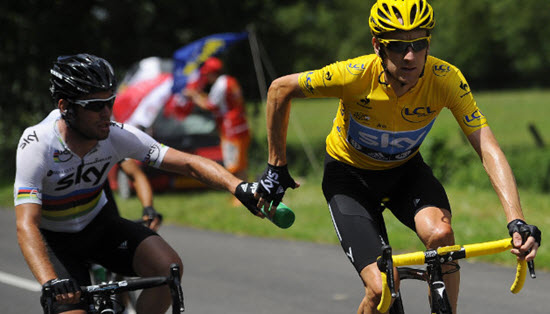
2012 Tour de France winner Bradley Wiggins pictured above/right may be an awesome cyclist with phenomenal bike handling skills. But he's not demonstrating proper hand position with one hand off the bars. The correct (safe) position for his left hand is on the cross bar, very close to the center / stem. Why not out at the end where he has it in the picture?
It's a matter of leverage. The further you hand is, away from the center/pivot, the easier it is to turn the bars. Without your other hand to counteract the force, riders with just one hand, on the outer end of the bars, tend to ride erratically = not in a straight line = dangerous.
Speaking of proper hand positions > I discovered this video while researching this article. Nothing to do with cycling, but it will get your heart rate up when you watch it 🙂
In celebration of today being the Super Bowl (the biggest sporting event in North America) we played drinking games. Not the typical; take a shot whenever an announcer uses some predictable cliche – that comes later today.
In class we played a different type of drinking game.
Although we're not on real bicycles, there's still a valuable technique we can safely practice during class; drinking at a high level of effort > @ or over FTP/Threshold/AT/Lt whatever you call it. More specifically; learning to regulate your breathing so you don't choke, launch into a coughing fit, swerve over and ultimately take down your riding buddy – or end up in the ditch.
NOT drinking enough during a long ride is the sure path to early fatigue. During a hard group ride there may not be a lot of breaks where you can recover and hydrate easily. So today we only drank during hard efforts, not during the recoveries when you would normally towel off and take a sip.
The first Sunday of each month is an FTP Assessment. Here's my class.
Class length 75 minutes + Cool Down
Warm Up — 10 minutes. 5 minutes of gradual increases in wattage. During the second 5 mins. we’re finding the wattage where everyone is first noticing a change in breathing; VT1 / Aerobic Threshold = the top of the Recover Zone. This establishes a rough understanding of a base wattage that we use throughout the rest of class.
3 x 30 sec. Hard / 30 sec. Easy – Openers to AT/LT. I cue these by first having everyone find the amount of load @ 70 RPM that has them feeling they should (not just could) come out of the saddle. The 30 sec. Hard is then simply accelerating to 90+ RPM which results in some pretty impressive power numbers. The 30 sec. Easy is back to 70 RPM — many will stand during the Easy portion.
1 minute rest – I encourage riders to focus on their recovery. Once they feel calm in their breathing, bring back the Base level work wattage.
3 min. Hard Effort — Here’s a “Best Effort” to establish a benchmark PTP Personal Threshold Power (top of the Perform Zone) or ride at 110% of FTP if known. It’s very helpful to riders to have that understanding of their personal upper wattage number. The “Best Effort” Threshold # + the Base Threshold # we found earlier form the three Power working zones I use in class.
2 min. Rest
3 x 1 min. Hard Effort x 1 min. Rest. These should be above the 3 minute average wattage.
3 min. Rest
20 min. TT / FTP Assessment effort – Quickly establish the average wattage at or near the 3 min. Interval. > Stage Button and then maintain. You may want to offer slight changes in cadence & load, while keeping wattage = to the initially established watts #. I was off the bike at the 10 min. to go, coaching, encouraging and then just watching them with a big smile on my face. This is a great group and they looked incredible — I’m so in my element with these classes
5 min. Rest
Base Wattage (aerobic) flat road to finish — use these time to congratulate everyone and give tell them a bit about what you have planned for them next week.
In keeping with the Nonlinear Periodization training prescribed by Coach Troy, today was a combination day of strength (climbing) and building endurance @ Threshold HR/Watts.
Experienced cyclists know what a real climb feels like. While Indoor Cycling may get close, nothing can truly replicate climbing outdoors, on a road bike, over a long, steep climb. This morning's profile includes 4 long climbing efforts; 2 x 8 min., 1 x 10 min. and the final 11.5 min. to the summit. The final 2:48 features “The Wall” – an all out effort paced to my favorite Black Sabbath track Paranoid. Only available from iTunes.
Long duration efforts, at reduced pedal cadences, offer time to work on other components of efficient cycling; pedaling technique, body position and breathing control. Today we focused on what I call disruptive breathing, i.e. consciously breaking each rider's innate breathing rhythm, for the purpose of bringing focus to each breath and making each as complete as possible.[wlm_private ‘PRO-Platinum|PRO-Monthly|PRO-Gratis|PRO-Seasonal|Platinum-trial|Monthly-trial|PRO-Military|30-Days-of-PRO|90 Day PRO|Stages-Instructor|Schwinn-Instructor|Instructor-Bonus|28 Day Challenge']
There's some interesting literature about this. Here's an excerpt from one article.
WHAT CAN YOU DO?
First, practice deep breathing. With a normal breath we generally use only 10 to 15% of our lungs capacity. And during exercise, we tend to increase the rate, not the depth of our breathing. Although deep breathing is more work, and uses a bit more energy, the pay off can be that 1 – 2% edge in a competitive situation. Here are 4 changes you might consider:
Exhale more completely. After a more complete expiration, it is easier to take a deep breath. The usual rhythm is exhale to a count of 3 followed by inhaling to a count of 2.
Belly breathe. As you concentrate on deep breathing, you will push your diaphragm down and thus the abdominal contents out. If you are doing it correctly, your abs will expand more than your chest.
Widen your hand position. A 2 cm wider hand position will open up your chest and decrease the difficulty of drawing in a deep breath.
Synchronize your breathing. Try to synchronize your respiratory rhythm to that of your pedal cadence. Remember the 3:2 ratio of exhale to inhale.
I cued variations on all four of these concepts throughout class.
Quick Tip: years ago I learned first hand how widening your hand position can improve your O2 uptake / power while cycling. My first road bike (Schwinn Paramount) came with somewhat narrow handlebars. Not knowing anything different, I rode with them for about a year. Until during one group ride one of the “Old Dogs” riding next to me asked; “why do ride with such narrow bars?” Not having a good answer, I just shrugged my shoulders and said they came with the bike. Taking the hint, that week I bought new bars in the width recommended by my team's sponsor/bike store. They made an amazing difference in my ability to breath and with wider width bars, I felt better in control of the bicycle.
Warm Up — 10 minutes. 5 minutes of gradual increases in wattage. During the second 5 mins. we’re finding the wattage where everyone is first noticing a change in breathing; VT1 / Aerobic Threshold = the top of the Recover Zone. This establishes a rough understanding of a base wattage that we use throughout the rest of class.
3 x 30 sec. Hard / 30 sec. Easy – Times Like These Openers to AT/LT. I cue these by first having everyone find the amount of load @ 70 RPM that has them feeling they should (not just could) come out of the saddle. The 30 sec. Hard is then simply accelerating to 90+ RPM which results in some pretty impressive power numbers. The 30 sec. Easy is back to 70 RPM — many will stand and walk during the Easy portion.
2:35 rest – The Best Is Yet To Come ~ Tony Bennett. I encourage riders to focus on their recovery. Once they feel calm in their breathing, bring back the Base level work wattage. I'm talking/motivating everyone about how important it will be for their “Best Effort” to be a BEST EFFORT!
3 min. Hard Effort — 4:03 Race Against Time ~ U2. Here’s the “Best Effort” to establish a benchmark PTP Personal Threshold Power (top of the Perform Zone) or ride at 110% of FTP if known. Song is @ 70 RPM – which is perfect to establish PTP at a climbing cadence. Have everyone find the tempo and add gears > STAGE Button about one minute in and I coach them off the bike during this hard effort.
1:16 Rest – Quick drink before we start Climb #1
7:58 Climb – Bermuda ~ Fluke. Right back to 70 RPM and have riders quickly establish their wattage to 10%-15% below the 3 min. “Best Effort” power. > STAGE Button and then maintain this average until the end. You may want to offer slight changes in cadence & load, while keeping wattage = to the initially established watts #.
4 min. Rest – Delirious ~ Prince
8:02 Climb – Tribal Force ~ Higher cadence @ 84RPM with the same wattage. This moves more of the work to the aerobic system and is a little less stressful on everyone's legs.
4 min. Rest – White Flag ~ Dido
10:03 Climb – Final Frontier ~ Juno Reactor. Back to 70 RPM and encourage riders quickly get as close to their 3 min. “Best Effort” as possible and sustain it to the summit. Many of your athletes are strongest now – help them take advantage of their full strength here!
2 Min. Rest – Last Impression
Final 11:33 Climb – Starts with Come together ~ Joe Cocker at 83RPM. This is more of a tempo effort in the middle of the Performance Zone / between the two power thresholds. Continues with Time Will Crawl ~ Bowie as the road steepens and pedal speeds slow to 63RPM > keeping the same watts, with a bigger gear, as we approach the the final challenge of the day…
The Wall – 2:48 Paranoid ~ Black Sabbath. The beauty of riding magnetic cycles is how simply accelerating a big gear = a huge increase in work. Those big pedals accelerating from 63RPM to over 80RPM should produce the biggest #s of the ride and at less than 3 minutes this should be achievable by everyone 🙂
Base Wattage (aerobic) flat road to finish — use these time to congratulate everyone and give tell them a bit about what you have planned for them next week.
Today was the official launch of the Life Time Fitness Performance Cycle Winter training series. These classes are hosted at many of the LTF clubs around the country and the plan is for all of us to deliver similar formats, following the same nonlinear (or is it non-linear) periodization training program.
If the concept of nonlinear periodization is new to you, join the club. I first saw the term used in some of the educational material from Coach Troy Jacobson that was provided to us. It essentially means you don't follow the rigid training periodization calendar we're all familiar with; Endurance > Strength > Speed > Anaerobic > Race.
Here's a good description of nonlinear periodization from trainingpeaks.com
Lydiard-style periodization is known as linear periodization because the various major training stimuli (aerobic, anaerobic, strength, speed, etc.) are largely segregated from each other in the training process and arranged in a line in which each gives way to the next. This approach is distinct from nonlinear periodization, in which the various major training stimuli are mixed together throughout the entire cycle and only the emphasis changes from period to period.
Most of the newer periodization systems–those introduced since 1980–are nonlinear. One example is the so-called multi-pace training method developed by David Martin and Peter Coe. In their book, Better Training for Distance Runners, Martin and Coe wrote, “One sensible method for injury-free performance progress over the course of a macrocycle involves harmonious interdevelopment of strength, speed, stamina, and endurance all during the year, never eliminating any of these from the overall training plan… We tend to disagree with coaches who prescribe large volumes of solely longer-distance running over an initial period of weeks, followed by a similarly concentrated bolus of solely higher-intensity speed sessions over succeeding weeks.”
When I hear Nonlinear Periodization I think NOT BORING! Perfect for our Indoor Cycling classes where we really don't know exactly what our Athletes in class need, so let's give them a combination of; Endurance > Strength > Speed > Anaerobic.
I discussed this with Coach Troy during an Instructor call last week. His said he felt confident that our riders will see good progress, working in multiple energy zones in the same class = no mind numbing Long & Slow classes… or at least Long & Slow combined with some Strength > Speed > Anaerobic efforts to break up the monotony of a long class.
Why haven't I heard about this before?
Good question…
As this was the official Kick Off – we started with Spinervals 27.0 Threshold FTP Test .
Here's my Spotify FTP Class Playlist which tracks well with Epic RaceDay Indoor Cycling DVD — which includes a very intense 30 minute criterium race that is the perfect motivation for a 20 minute FTP assessment classes.
Instructor Tip
You can time the criterium to end right on cue with the completion of your 20 minute effort for an awesome finish – complete with the cheering crowd and ringing cow bells! At the initial start/options screen, select 60 min SFX – (no music > just the sound effects). I run the video from the beginning, not really following it until the start of the Crit. When you have 15 minutes left in the FTP assessment use the Skip >> on the DVD player remote to move forward to the next section = the final 15 minutes of the Crit. I keep the DVD sound down until the last 5 minutes. It's bicycle racing magic when they ring the Cow Bell signalling last lap / one minute to go!
Class length 75 minutes + Cool Down
Warm Up — 10 minutes. 5 minutes of gradual increases in wattage. During the second 5 mins. we’re finding the wattage where everyone is first noticing a change in breathing; VT1 / Aerobic Threshold = the top of the Recover Zone. This establishes a rough understanding of a base wattage that we use throughout the rest of class.
3 x 30 sec. Hard / 30 sec. Easy – Openers to AT/LT. I cue these by first having everyone find the amount of load @ 70 RPM that has them feeling they should (not just could) come out of the saddle. The 30 sec. Hard is then simply accelerating to 90+ RPM which results in some pretty impressive power numbers. The 30 sec. Easy is back to 70 RPM — many will stand during the Easy portion.
1 minute rest – I encourage riders to focus on their recovery. Once they feel calm in their breathing, bring back the Base level work wattage.
3 min. Hard Effort — Here's a “Best Effort” to establish a benchmark PTP Personal Threshold Power (top of the Perform Zone) or ride at 110% of FTP if known. It’s very helpful to riders to have that understanding of their personal upper wattage number. The “Best Effort” Threshold # + the Base Threshold # we found earlier form the three Power working zones I use in class.
2 min. Rest
3 x 1 min. Hard Effort x 1 min. Rest. These should be above the 3 minute average wattage.
3 min. Rest
20 min. TT / FTP Assessment effort – Quickly establish the average wattage at or near the 3 min. Interval. > Stage Button and then maintain. You may want to offer slight changes in cadence & load, while keeping wattage = to the initially established watts #. I was off the bike at the 10 min. to go, coaching, encouraging and then just watching them with a big smile on my face. This is a great group and they looked incredible – I'm so in my element with these classes 🙂
5 min. Rest
Base Wattage (aerobic) flat road to finish – use these time to congratulate everyone and give tell them a bit about what you have planned for them next week.