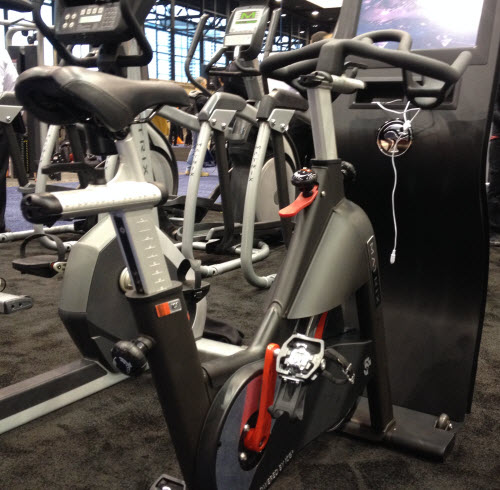
Think about all of the planning you did before launching your new cycling studio? How much are you doing today to keep your studio in top form?
We talk with Barbara Chancey and John Bogosian talk about the six signs of fitness studio sabotage. This podcast is a must listen for both studio owners and instructors and will help you take your studio to the next level or keep it at the top.
If you own a studio, or are considering opening one, I suggest grabbing a pen and paper, find a quiet spot and listen to the podcast below in it's entirety.
Fitness Connect from IDEA is something I feel all of us Group Fitness Professionals and Fitness Studio owners need to jump on soon. I'm scheduling an interview with IDEA's head of business development for a future Podcast. In the mean time if you are an Indoor Cycling Instructor with a Spinning® or other certification, Group Fitness Instructor, Personal Trainer or you own or manage a Fitness Club or Studio here are a few thoughts about why I feel you need a profile there.
1) Rise above the noise and be found by standing on IDEA's shoulders. The internet is an enormous place. Search engines sift through billions of web pages in their effort to deliver a relevant result to what could become your next client, member or student. Your profile on Fitness Connect has a much better chance of being displayed because www.ideafit.com is seen as a respected source by Google and other search engines.
How much planning did you do (or should you do), before launching your new cycling studio?
What research did you complete to understand the difference between successful studios and those that are struggling?
Fitness entrepreneur Callie Bowling has completed an exhaustive planning process in anticipation of opening a new Indoor Cycling Studio in Boise Idaho next fall. Callie interviewed over a dozen studio owners and she shares what's working… what's not and what she sees as the future of boutique Indoor Cycling studios.
This interview is an hour long, and needed to be to record much of what Callie has learned.
If you own a studio, or are considering opening one, I suggest grabbing a pen and paper, find a quiet spot (maybe with a hot tea) and listen to the podcast below in it's entirety, while taking notes – I consider this one of my top five episodes ever, it's that good 🙂
[wlm_private ‘PRO-Platinum|PRO-Monthly|PRO-Gratis|PRO-Seasonal|Platinum-trial|Monthly-trial|PRO-Military|30-Days-of-PRO|90 Day PRO|Stages-Instructor|Schwinn-Instructor|Instructor-Bonus|28 Day Challenge']
Update: This episode wasn't showing up in the podcast feed = I republished it and it appears fixed 🙂
[/wlm_private]
I was originally alerted to Callie Bowling by Amy – she had talked with her and was very impressed by how thorough she was in her business planning and the amount of research she had done via interviews with other studio owners.
So I reached out to Callie about possibly appearing on the show. This was her response 🙂
Let me give you a little background, so you can be thinking of questions on your end:
I have learned quite a bit actually, so much that just when my business plan and financials were all buttoned-up and ready to go – I was literally sitting across the table from my lender – I decided to go back to the drawing board to lay some more ground work (A MUST) and further examine my goals for my business and a smarter implementation strategy solely based on the experiences I obtained from interviewing eight indoor cycling studios across the nation. I learned a lot, the owners of these businesses were extremely generous with their time and the truly sensitive information they were divulging (the scary icky stuff like money)… lol, perhaps it's my degree in Psychology, but I've usually never had a problem getting people to open up around me… it's a double-edged sword 😉
I've learned this “dream” for us who wish to open these studios is always opened with the best intentions and out of a passion for the “sport”; we're all fitness enthusiasts who wanted to bring our passion to our communities and also make a fortune at it! I mean why not, the preliminary financials reflect success, which is a super simple function of attendance… it seems like a no-brainer right!? Get people in the door and become profitable… minimal overhead, no accounts receivables, cash based service industry, no inventory, etc. … the business model is set up for instant success! I'm sure you see I'm being simplistic and sarcastic, because nothing in life is ever that easy, and if it looks easy… take a deeper look, because you're probably missing something 🙂
With that said, there have definitely been some strong and shared commonalities amongst the failures and the successes amongst studio owners that can't be ignored… but, they're probably taboo to talk about so no one ever does, because no one likes to admit they've failed or fallen flat on their face… but, the truth is the truth, and in the same token no wants to invest their life's savings or nest egg into a business that might be doomed from the get-go, so we need to talk about it.
I will say, I don't know what came over me, but I emailed studios in XX, YY, ZZ, BB, NN, RR, and FF (on the podcast I won't disclose which states though to respect and maintain the anonymity of these studios, because in some states there is literally just one studio, so that would probably give it away, and the information they shared is certainly sensitive – we can just accurately say I reached out to studio owners across the nation) and I didn't know what to expect. I was equipped with my generic list of questions, but those soon fell to the wayside and the conversation became personal and very much a theoretical conversation about what it takes to survive as an entrepreneur in our industry and what those basic principles are.
Alas, we can go over all of this & more on the podcast, I'm loaded with info, lol, and honestly I think the things I am ready to touch on will be useful information not just for others in the “pre-startup” phase, but also for any studio owner in general that is perhaps struggling or “hemorrhaging” (as one studio owner stated) and can draw even the smallest parallels in their own business with what I have understood has also been choke holding others.
What do you think!??! 🙂
P.S. Here's the juiciest part… I think I see the future of our industry!!! lol… that may be a bit pompous for me to predict, but I've done a lot of research and there are signs and clues I'd love to cover!
Callie Kelley Bowling
Founder & CEO
CKB Fitness, Inc.
Click image to join our Facebook Group – everyone encouraged to join!
You’re passionate about fitness, you love indoor cycling and you may even be an outstanding instructor yourself. You recognize the amazing energy in a great class, and you’ve also seen a lot of poor or mediocre classes that frustrate you. Maybe you’ve wondered if a dedicated studio can make money?
Should you start your own studio? Great questions.
While not nearly as common as yoga studios, there are in fact a good many successful, dedicated cycling studios (and Spin® studios) around the country. We have worked extensively with a number of them, and in the right community, with the right model, these can be tremendous small businesses.
There is nothing more thrilling than waking every day knowing your decisions and actions are building a business, developing a community, making people healthy…….and generating a stream of profits!
Here is the first question we ALWAYS get asked. There is plenty of indoor cycling and Spinning® at gyms and health clubs in my area — why would people go to a new dedicated
studio?
4 reasons cycling studios are successful! – Free Registration Required – Click Here. Opens in a new tab.
[wlm_ismember]
Dedication.For the same reason there are thousands of successful Yoga studios, despite ample yoga classes at gyms and health clubs — a dedicated studio focuses
on one thing. It pays attention to the details and delivers a more consistently excellent product.
Atmosphere.
Many people, for a variety of reasons, prefer a small intimate studio
to the feeling of a big gym or health club. As evidence, look at the vast number of Yoga, Pilates and personal training studios — despite the availability of those services at gyms.
Pricing flexibility.
Studios typically offer a variety of programs including “unlimited classes” or “pay-per-visit”. This variety and flexibility appeals to a broad range of potential clients. This service makes it easy to set up online payments.
Community.
There is a community spirit in a small studio attended by dedicated cyclists with a common passion.
The notion of a successful, dedicated cycling studio is not just a concept — it is a reality in dozens of instances around the country. That being said, the number is miniscule compared to the opportunity, and there is very likely a need near you.
You don’t have to be an entrepreneur to eat like one.
My field is Psychoactive Nutrition. I use food to change brain chemistry and hormones.
It’s not about designing products to sell — or selling other people’s products. My clients eat ordinary foods they can buy at the grocery store, and I make food recommendations to help them think better, work better, flip their moods, perform better athletically, and stop being sick.
For a while, I’ve avoided the term psychoactive nutrition because I worried that folks would go glassy-eyed at the word “psychoactive”. But it feels like the right time to put that word on display and start telling people exactly how it can benefit them.
Let’s start with a simple definition of “psychoactive” from Taber’s, my favorite medical dictionary: “affecting mental state, such as a drug that has that action.”
Psychoactive nutrition uses different foods as the drugs that affect mental state.
Spoiler Alert: Foods also affect certain hormones, which in turn affect mental state. So hormones and brain chem may be linked.
Can Psychoactive Nutrition Make You an Entrepreneur?
Okay, psychoactive nutrition will not directly lead to a new career track. But it has been said that entrepreneurial tests are primarily mental. To the degree that how you eat can affect your work performance, you never know, right?
Too much excellent material has been written about the characteristics of entrepreneurs, so it wouldn’t make sense to write about that here. But it would make sense to mention a few traits that might be influenced by food.
An entrepreneur would want to have tenacity, think clearly, visualize goals and stay focused on them. She/he would listen and communicate well to avoid having to repeat instructions or redo tasks due to poor communication. These traits are among those influenced by the neurotransmitter dopamine. Eating to boost that chemical may in turn enhance the traits.
A good entrepreneur would also have the self-control to wait until he/she fully understood the situation before making important decisions, rather than going in a hasty, rash, or even destructive direction. In addition, she/he would show concern for fairness and avoiding harm to others. The neurochemical serotonin would enable these behavior traits.
What About Avoiding the 2:30 Slump?
Eating the right way can help you avoid energy ups and down, or the need for 2 or 3 cups of coffee to re-awaken you right after lunch. It may also eliminate that late-afternoon crash that makes concentration and focus difficult.
Think of the right lunch as enabling you to return to work as motivated as you were in the morning. (Let’s assume you ate right first thing in the morning!)
How Else Can Psychoactive Nutrition Help You?
Because of their effects on hormones, the foods you eat can help you manage — and even reverse — metabolic conditions. Those typically originate with insulin resistance. They include diabetes, hypertension, cholesterol, high triglycerides, and more. All of them are risk factors for heart disease.
Psychoactive nutrition can also help you control your appetite, your food preferences, and any food cravings you may have. In fact, it can help you eliminate cravings altogether. Eating to change your brain chemistry is one of the best ways to stop binge eating.
Sleep problems are often easy to fix with the right foods. And you can use psychoactive nutrition to stop mood swings and improve mood generally. Any of these may be related to either brain chemistry or insulin — or both.
So this post is neither a primer on how to eat nor a collection of recipes. My aim was to explain psychoactive nutrition and suggest that foods do more than provide calories and various nutrients.
Of course, they do that, but they also do much more.