Image from http://www.acefitness.org/prosource/71/
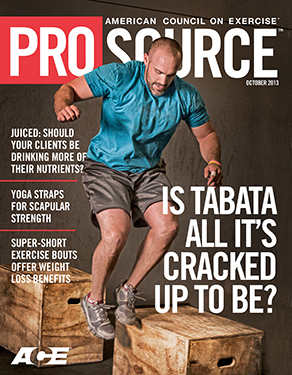
I just read a press release and accompanying article from the ACE – The American Console on Exercise PRO SOURCE magazine about their study to gauge the effectiveness of High Intensity Training (HIT).
“It seems like everything high-intensity is now called Tabata Training,” says John Porcari, Ph.D., head of the Clinical Exercise Physiology Program at the University of Wisconsin, La Crosse. “The original Tabata study was done on a bicycle, but people are now doing that 20-second/10-second format with resistance training, plyometrics, calisthenics…with almost anything.”
Because of all of this recent interest in Tabata-style workouts, the American Council on Exercise enlisted Porcari and his research team to gauge just how effective a Tabata-style workout really is.
THE BOTTOM LINE
“The great thing about Tabata is it’s a short workout–only 20 minutes–and it incorporates your total body, so it’s working every muscle group that you possibly can,” says Embert, referring specifically to the Tabata-style workout she designed.
But what to do during the remainder of your 60 minute class?
There was a trainer at Life Time who told me years ago something I've never forgotten; First give them (your class) what they WANT… and then give them what they NEED.
The WANT he was referring to are very intense/anaerobic intervals. There's no secret sauce IMO at SoulCycle > they're just teaching very intense classes because they know that's what people WANT.
The NEED is for solid aerobic training. Not necessarily base building, but solid work below threshold HR / FTP.
Instructor Kathy Palkaninec was a past winner of our profile contest and her profile follows a similar WANT & NEED format.
You may want to announce your intentions to crush them (WANT) during a 20 minute Tabata round that will start fifteen minutes into class. Don't worry about telling them what follows. Keep everyone focused on doing their best effort during the Tabatas.
Give everyone a full 5 minutes or more of complete recovery. It's during this time that I talk about the “Golden Hour” and how most of us have 90 minutes where we can really perform well, before fatigue really limits our performance. The Golden Hour doesn't begin for most of us until ~30 minutes in. At the end of the recovery we're only @ the 40 minute mark of a 60 minute class and I explain how we're only 10 minutes into our Golden Hour – just now ready to perform. It's here where you can coach them through a 10 or more minute sub-threshold effort (NEED) to conclude the class. Here's where you can put that stage button to work if you have one – encourage everyone to ramp up to a big number, Stage Button, now maintain it by keeping your instantaneous wattage at or above the average 🙂
Puppies always work… when you can't find a suitable image 🙂
Spinning® Instructor Krista Leopold is back with another of her awesome class profiles!
“There are two types of people: The ones who give you 50 reasons it can’t be done … and the ones who just do it.” — Hoda Kotb
Two Types of People Tabatas
I created this ride to help riders see themselves as the second type of people: those who just do what needs to be done, and do it well. It is high-intensity training with two distinct blocks of work, the second of which consists of 2 sub-blocks. For that reason, this profile can easily be picked apart and used for classes that are formatted as 30, 45 or 60 minutes.
Block 1 is 30 minutes long and is the foundation for Block 2. In block 1, riders perform 5 best-effort intervals that gradually decrease from 4 minutes to 10 seconds in duration. Using this progression, Block 1 helps riders discover their true “all-out” intensity.
Block 2 is also 30 minutes long and is broken into 2 halves, each half consisting of gradually increasing intensity, followed by performing the Tabata IE1 protocol on the bike, and then recovering.
Instructors who teach 30-minute classes can easily divide this ride into its 2 blocks of work to ride in consecutive classes. Instructors with 45-minute formats can use Block 1 and block 2a. The full profile clocks in just right for a 60-minute class.
At the end of Krista's presentation she references two past podcasts that featured Lawrence Biscontini.
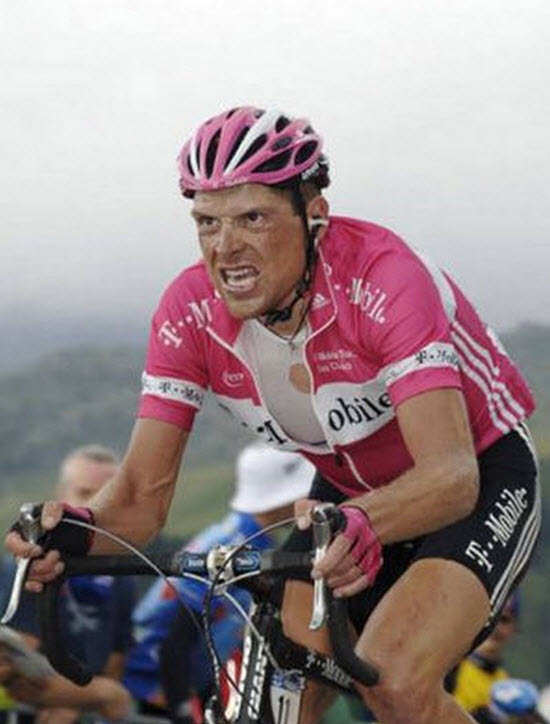
There are times when exercise can be painful*, especially when you're coaching or participating in, a HIIT or Tabata® training class. You know that. You might also be aware that the more you expose yourself to high intensity training, the feelings of pain / discomfort you experience diminish over time. Said another way; over time, you may develop a tolerance for the pain that accompanies HIIT or Tabata® type training. You knew that too… and now there's actual research that suggests regular exercise can reduce a person's sensitivity to most any type of physical pain.
I learned at IDEA that Tabata® is an actual brand name. Out of respect for them I've included the ®. I hope to have more about the new Tabata® Cycling certification they'll be offering in the near future.
Regular exercise may alter how a person experiences pain, according to a new study. The longer we continue to work out, the new findings suggest, the greater our tolerance for discomfort can grow.
For some time, scientists have known that strenuous exercise briefly and acutely dulls pain. As muscles begin to ache during a prolonged workout, scientists have found, the body typically releases natural opiates, such as endorphins, and other substances that can slightly dampen the discomfort. This effect, which scientists refer to as exercise-induced hypoalgesia, usually begins during the workout and lingers for perhaps 20 or 30 minutes afterward.
But whether exercise alters the body’s response to pain over the long term and, more pressing for most of us, whether such changes will develop if people engage in moderate, less draining workouts, have been unclear.
So for the new study, which was published this month in Medicine & Science in Sports & Exercise, researchers at the University of New South Wales and Neuroscience Research Australia, both in Sydney, recruited 12 young and healthy but inactive adults who expressed interest in exercising, and another 12 who were similar in age and activity levels but preferred not to exercise. They then brought all of them into the lab to determine how they reacted to pain.
Click the link if you'd like to read the entire article – here's the important conclusion…
The study’s implications are considerable, Mr. Jones says. Most obviously, he said, the results remind us that the longer we stick with an exercise program, the less physically discomfiting it will feel, even if we increase our efforts, as did the cyclists here. The brain begins to accept that we are tougher than it had thought, and it allows us to continue longer although the pain itself has not lessened.
So how can this help you as an Instructor or coach?
While at the IDEA fitness conference this week, I took the Tabata® Cycle workshop presented by Team ICG Master Trainer Mike Michels. During Mike's lecture he really emphasized how difficult it is to perform the series of 8, 20 second all-out intervals properly. So difficult in fact that Mike said none of us would be successful initially. But if we performed them regularly, over time we will improve. Beyond an increase in fitness we'll experience, some of that improvement will come from an increase in tolerance for the pain that's a part of HIIT.
I left the class thinking… I should start communicating – your incentive for working hard today, will come in the form of a less painful workout tomorrow. Then, when your tomorrow comes, take advantage of it 🙂
*Of course I'm talking about the pain felt when pushing yourself to your maximal effort, not localized pain that's indicative of poor form, improper bike set up or joint strain/injury 🙁