Recomended by ACE – The American Council on Exercise
I asked Master Instructor Tom Scotto for his thoughts on Part 1 – Part 2 and Part3 of Is a 20 Minute Threshold Field Test realistic for your class?
Specifically I wanted to discuss the third article where I introduced the Two Threshold / Three Zone (2T/3Z) Heart Rate training system. This is the system that ACE is recommending to Personal Trainers and Group Fitness Instructors.
This interview ran a bit long so I have split it into two parts. (my preference is to keep each Podcast to around 20 minutes when possible)
Love to know your comments on this.
Does the Two Threshold / Three Zone Heart Rate training system make sense to you?
Would you be willing to try it in your class?
Do you see this as a better of worse alternative to what you are using now?
Do you look up at a room full of smiling, fit, self-directed, endurance athletes?
Or does your class more closely resemble the population where you live?
In Part 1 I shared survey results that showed that a 20 Minute Threshold Field Test isn't realistic (maybe practical would be a better word) for where most of us we teach – which is primarily large health clubs.
I also stated that;
It’s well documented that a 20 minute Threshold Field Test is effective in determining an Athlete’s T2 (Anaerobic/Lactate Threshold) or FTP (Functional Threshold Power).
Are we training real Athletes in our classes?
I now see that asking an additional question on the HR training survey regarding class makeup would have been helpful in getting a true understanding of class makeup. So please permit me to make this assumption based on personal experience of 15 years teaching (and attending classes) at small studios, large “Big Box” clubs and conversations with hundreds of Instructors; the majority of our students are what could be described as “Club Athletes” who attend class or workout 2-4 times a week. My observation is that a very small percentage <15% are true endurance athletes. Of course every class or club is different. Class format and the time of year has a large bearing on class composition. For example my 90 minute endurance classes in the winter are > 70% endurance athletes… but then that class is designed specifically for them.
The purpose of a 20 minute field test is to determine an accurate Threshold HR for the purpose of setting HR training zones. These HR zones will be used to structure training intensities for weeks or months in the future.
In an early post I talked about using your Heart Rate Monitor as a GPS instead of a Speedometer. I was trying to reinforce something that you already know; maintaining an effort at, or very close to, Threshold for any length of time is painful and difficult for anyone. Like you, Amy and I fall somewhere in that upper 15%. If we choose to, we could ride at a consistent RPE that we feel is our threshold for 20 minutes, for the purpose of determining our Threshold HR and be pretty close.
But what about the other 85% of the students in our classes? How many could maintain a true Threshold RPE over a 20 minute Threshold Field Test?
What happens to the accuracy of the test if your students are finding, over the course of the 20 minute test, a HR average that's somewhere in the middle of T1 & T2?
Fast forward a week, post field test.
All right class, You tell them, I want everyone to build their intensity to Threshold and we will keep it there for 4 minutes. Those students who made it to your Field Test last week are watching the numbers climb on their monitors to their newly determined Threshold HR. Except they find after a few minutes, they aren't really feeling the Threshold signals you are describing. Do they:
A. Ignore the physical clues (RPE) and go with the HR number you told them was their tested Threshold HR?
or
B. Ignore the Field Tested HR and instead push harder till they are feeling the physical Threshold clues you described?
As I see it:
Option A. Has them under training = missing out on potential fitness improvements.
and
Option B. Causes confusion and has some questioning why they took the test to begin with.
I am continually fascinated at the results of the Heart Rate Training Survey over 600 of you completed.
It's well documented that a 20 minute Threshold Field Test is effective in determining an Athlete's T2 (Anaerobic/Lactate Threshold) or FTP (Functional Threshold Power). In the past I've played the cheerleader for using 20 minute Threshold Field Tests in class…
Except for one problem… I can't offer them to my class where I teach… and based on what I'm seeing in the survey results, neither can (or do) most of you 🙁
Which makes sense. The majority of us teach at a large club and the option to schedule and conduct a special Threshold Field Test class really doesn't exist. I know from experience that trying to do something “special” is very difficult to get approval for, from management. Digging a little deeper into the survey shows me that of the 5.6% who report conducting a regularly scheduled Threshold Field Test, the majority teach at a small independent studios. Instructors at small facilities also report a much higher ability to effect changes in class formats and schedules.
Now contrast that with what looks to me as a very high percentage of us who teach with an emphasis on Heart Rate.
What this shows me is that there is a big discrepancy between our intent to help students train effectively with Heart Rate vs the realities of using a 20 Minute Threshold Field Test to help these students determine some Metabolic Marker they can use to accurately set their HR training zones.
Could you ever hear yourself saying this? Don't worry if you missed the Field Test last week Linda… we'll be having another one in six months 🙂
Some anonymous responses to the HR survey:
I personally hold Threshold test 2X year.
We do a threshold test twice a year. I include the zones when I teach and they follow The other instructors do not use it.
FTHR testing is done every 6-8 weeks and we throw in LT rides to give them a sense of what this feels like. They are told specifically, “if you haven't done the FTHR ride, please go off of the RPE scale of 1-10.” I qualify LT as a 5-6.
Wouldn't this be of more value to your students?
Every class I try to establish where LT/AT is, how it feels to be at, below, or above it, and how to move around them. Executed through a combination of speaking, cuing, and guiding them through it as the class goes on.
Our commitment for this years ICI/PRO conference it to provide the absolute best fitness education available! As we finalize our roster of presenters I wanted you to meet someone new 🙂 Dr. Carl Foster is, as best I can determine, the most widely cited exercise scientist there is on the subject of Threshold based Heart Rate training. Dr. Foster's specialty is in Human Performance and many prominent coaching and endurance experts base their training techniques on the original research conducted by Dr. Foster at the University of WI – Lacrosse.
Carl Foster, Ph.D., FACSM, FAACVPR
Carl is the Director of the Human Performance Laboratory, is the Research Director of the CEP program, and teaches a number of courses in the curriculum (ESS 744: Laboratory Techniques in Clinical Exercise Physiology, EFN 730: Research Methods, ESS 780: Philosophy and Organization of Preventative and Rehabilitative Programs). Carl has over 20 years of clinical experience (at Sinai Samaritan Medical Center in Milwaukee) before coming to UW-L. Carl has a very active research program and has published ~250 scientific articles and chapters and 11 longer works (books/monographs/ position stands). Relevantly, he was a co-editor of the first ACSM Health and Fitness Facilities Standards and Guidelines and was on the writing task force for the joint ACSM/AHA Position Stand on Health and Fitness Facilities.
Carl is highly involved in both ACSM and AACVPR. He is a Past President of ACSM and was the chairperson of the Research Committee for AACVPR. Additionally, he is the Chair of the Sports Medicine/Sports Science/Drug Testing committee for U.S. Speedskating. He is a long-time member of the scientific support team for U.S. Speedskating and was the recipient of a research grant from the International Olympic Committee to conduct studies at the 2002 Winter Olympic Games. Carl was the recipient of the M.L. Pollock Established Investigator Award from AACVPR in 2006. He was also given the Citation Award by ACSM in 2009. He is the Editor of the International Journal of Sports Physiology and Performance.
I've heard Dr. Foster speak and I'm confident you will find him engaging and informative. The titles of his planned sessions are:
Designing a Training Program Worthy of Indoor Cycling 2.0 : You've already moved from “exercise” to “training”, now it's time to move from a 1 class mentality to a full season mentality. Instead of helping your students think about the objectives of a single class, help them see the significance of a single season. Dr. Foster, Ph.D. will teach you how to create a simple and straight forward approach to building a training plan that can work for you, your students and your health club.
The Talk Test: Your Free Key to Finding Your Threshold: Knowing your heart rate threshold is the key to establishing your heart rate zones, and forms the basis for any credible cardiovascular training program. Getting a metabolic test to give you fact certain readings is great, but the expense is, well… not for everyone. However, one thing is certain; if you don't do a proper assessment, you can't get started. Dr. Foster, Ph. D will take you through the eitiology of how he and his collegaues developed the talk test, and how incredibly reliable it is even though it is a free field test. This will be followed by a 30 minute on-bike application to experience it for yourself, and simultaneously see how it is taught.
The Magic of Measuring & Monitoring Training: You've heard the expression: “If you can measure it, you can improve it”. It is a vertible axiom in life and sports. While the Cycling Room has been the last area of the industry wide health club to get real training tools, the good news is that they are coming. If you bike doesn't have a computer or read out console of some kind right now, then chances are that the next time the club buys new bikes, that will all change. Dr. Foster, Ph.D. will explain the benefits of measuring and monitoring your training, as well as providing guidelines for getting your own program started.
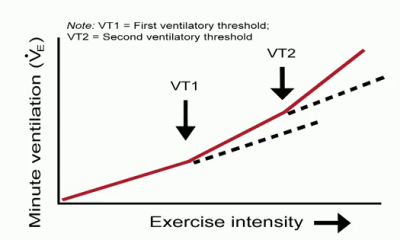
T1 & T2, The One-Two Punch of Cardiovascular (or Heart Zones®) Training: First there was Max heart rate training. Then there was an enlightened exercise physiology community that promoted Threshold training as the preferred approach to improving performance in aerobic sports. The existance and incorporation of the Two Threshold system of training (Low Threshold or T1 and High Threshold or T2) is the next evolutionary step in both understanding and applying excericise science to our every day physical fitness routines. Dr. Foster, Ph.D. is joined by Gene Nacey, MPH for this session. After Dr. Foster explains the rationale for T1 and the benefits of training relative to this biomarker, Gene Nacey shares multiple case studies where these two thresholds were identified, measured and monitored for before and after effects.
We are building in extra Q&A time for each of Dr. Foster's sessions, so you will be able to get all your questions answered.
I have opened early registration for those of you wanting to get a jump on everyone else. This year we are offering you the chance to make multiple payments, rather than one lump sum. Here is the link to register.
Last year the hotel sold out. Even if you are thinking about sharing a room I would suggest that you reserve a room here's the phone number to the hotel 978-750-7987 and tell them you are in the Indoor Cycling group. We will be helping connect those looking for room-mates. NOTE: Our block of reserved rooms extends from September 28th to October 4th for those of you wanting to come early or stay a day or two longer.
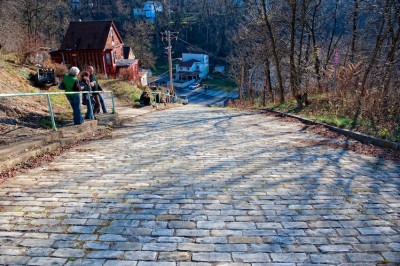
Training for improved climbing is one thing. Training for the Dirty Dozen is another. Given the fact that probably less than 1% of the hills one normally climb are as steep as those of the Dirty Dozen, it doesn’t make sense to train for this level of power requirement. That is, unless you actually want to survive the 5 plus hours in November as you climb more steep ascents in one day than you normally do in an entire season. Throw in the fact that I am prone to cramping if I don’t really keep the legs fresh, and this is not something I can take lightly.
When I put a training plan together for myself or a student, I’ve gotta’ work backwards. Where do we want to end up, and then back it up to where we are, and the rest will fill in by measured and deliberate progression. As an endurance rider, and someone who helps people do their first epic ride or century, we have the luxury of focusing on a slow periodized program from start to finish with more and more time in the saddle.
However, this total event is only about 50 miles in length, with 3 food breaks. Endurance is not what I need to train for. My focus needs to be on producing the required power for each grade of hill I will encounter, sustaining heart rates above threshold for varying amounts of time, and keeping the legs from siezing up in the process.
Consequently, instead of a 6 day a week riding schedule with rides between 1 and 3 hours long, I’ll be training 3 to 4 days per week where all but one of those days each week will be fairly intense; very little time in Zone 1 & 2, about 50% in Zone 4, and a progressive increase of time above threshold. In most cases, I will want a day off or activer recovery after each day of training.
I will be focusing on improving lactate buffering, and increasing my threshold. Starting my “pre-training” routine a couple weeks ago, I’ve already begun to feel an increase in my threshold, but I will do a New Leaf metabolic test this week to establish a true baseline.
While at first blush this doesn’t seem like a lot of training, the intensity creates a significant challenge. In fact, I’ve averaged over 1000 points per week just for the pre-training weeks. So, I’ll be using 1150 training load points as my starting baseline, and shoot for a 5% increase each week to keep the body honest. This will get to about 1800 points at the week I will begin to taper. I need to get fitter, stronger and more tolerant of the inevitable pain, and this seems to be the right approach.
So here’s the outline of the training plan:
3 days intense training: 2 days outside, 1 day inside
1 day of active recovery riding inside
1150 starting points, and % splits: Zones 1: 0%, 2:10%, 3:30%, 4:50%, 5:10%
Ending targets 1800 points, 20% in Zone 5, Threshold increase of 10 – 15 BPM




 Our commitment for this years ICI/PRO conference it to provide the absolute best fitness education available! As we finalize our roster of presenters I wanted you to meet someone new 🙂 Dr. Carl Foster is, as best I can determine, the most widely cited exercise scientist there is on the subject of Threshold based Heart Rate training. Dr. Foster's specialty is in Human Performance and many prominent coaching and endurance experts base their training techniques on the original research conducted by Dr. Foster at the University of WI – Lacrosse.