
by John | Dec 4, 2014 | Best Practices, Health and Wellness, Instructor Training, KEEPING IT FUN

If there was every a reason for Keeping It FUN in our classes – this could be it.
I just read a short article from the latest edition of the IDEA Fitness Journal – Think “Fun” When Exercising To Eat Less Later.
If clients could meaningfully impact ingrained eating behavior by subtly fine- tuning their thinking patterns about exercise, would you try to help them do that? Consider these new findings from the Cornell Food and Brand Lab as an opportunity to move people in the right direction.
Research published recently in Marketing Letters showed that if participants thought of exercise as “fun” or a “well-deserved break,” versus a “workout,” it significantly changed the way they approached postactivity food consumption. Those with fun top of mind ate less than those who viewed exercise as a workout.
Abstract:
Do consumers eat more when they exercise more? If so, the implications could ripple through the multi-billion dollar fitness and food industries and have implications for both consumers and health-care providers. Three studies–two field experiments and one observational field study–triangulate on this potential compensatory mechanism between physical activity and food intake.
The findings showed that when physical activity was perceived as fun (e.g., when it is labeled as a scenic walk rather than an exercise walk), people subsequently consume less dessert at mealtime and consume fewer hedonic snacks. A final observational field study during a competitive race showed that the more fun people rated the race as being, the less likely they were to compensate with a hedonic snack afterwards. Engaging in a physical activity seems to trigger the search for reward when individuals perceive it as exercise but not when they perceive it as fun. Key implications for the fitness industry and for health-care professionals are detailed along with the simple advice to consumers to make certain they make their physical activity routine fun in order to avoid compensation.
I had to look up the word hedonic to be sure I understood what they meant by; consume fewer hedonic snacks. According to this online dictionary:
Adjective
hedonic (comparative more hedonic, superlative most hedonic)
- Of or relating to pleasure
- Pursuing pleasure in a devoted manner
What I think they are referring to here is eating as a pleasurable reward, as in; I worked out today… so now I can treat myself to carmel roll/large vanilla latte, candy bar, etc…
All of us in the USA heard (or said) this last week during Thanksgiving – we're doing a “pre-burn” ride or “I'm doing the Turkey Trot Thursday morning”. The purpose of both is to give permission to indulge in hedonic eating, post workout. Problem is that even riding a hard, hour-long class will only consume maybe 300 – 800 calories. One small slice of pumpkin pie has around 300+ calories and that's without whipped cream.
So are we undermining our participants weight loss goals, with all of the metrics we offer?
by Joan Kent | Dec 1, 2014 | Engage Your Students, Health and Wellness
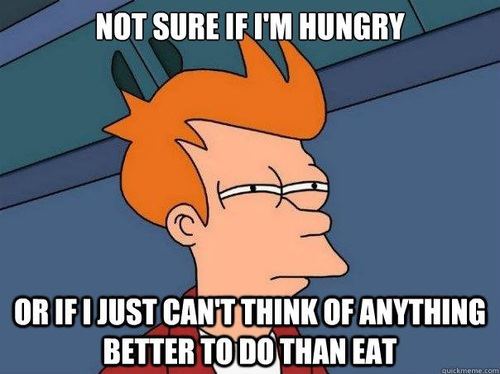
Have you heard about stomach hunger versus mouth hunger? Many nutritionists and dietitians talk about this. A client mentions eating Something Bad, and the practitioner asks, “Was it stomach hunger or mouth hunger?”
A variation on the question is, “Was it physical hunger or emotional hunger?”
Peak-performance motivator Anthony Robbins says, “If you ask bad questions, you get bad answers.” Asking a client whether she ate because of stomach or mouth hunger — or because of physical versus emotional hunger — is the classic Bad Question.
And it gets bad answers. Answers like “I don’t know” or “I’m not sure.” Sometimes the answer is another bad question: “How can I tell?” The client is trying to figure out if she was hungry for physical reasons or emotional ones.
Despite these rampant failures, the question persists. One book even uses the term “intestinal hunger.” Does anyone out there have any idea what that is? If I can’t understand it, what chance do my clients have?
Of course, if you’re not comfortable handling your participants’ food and eating issues, by all means refer to a nutritionist. This post is about awareness of what some of your participants may go through daily.
A Better Question
Here’s an idea that might be good for practitioners to adopt. I never use the term “hunger” for anything but physical hunger. Instead I ask, “Were you physically hungry, or did you just have an urge to eat?”
That question gets real answers and can uncover some important issues. People can tell the difference.
The urge to eat could have much behind it — emotions, stress, shifts in brain chemistry, shifts in hormones. Some clients might need coaching to explore the emotional component and retrain their responses not to involve food. Some may need to change their diets to change brain chem and/or hormones.
Real Hunger
Hunger is a specific, physical signal that the body needs food. I’ve explained in detail what hunger feels like to clients who don’t experience it.
Why don’t those clients experience hunger?
Some may not because, for years, they’ve been eating for reasons that have nothing to do with hunger:
– the clock says it’s mealtime
– everyone else is eating
– appetizing food is here now
– they ate too much at the last meal
– they’re stressed, depressed, anxious, or even happy.
Readers may conclude that the items in the last bullet show “emotional hunger,” but I’m suggesting that the word “hunger” causes the confusion. It’s more appropriate to use it only when physical hunger signals are present.
How Do I Know If I’m Hungry?
Clients who never feel hungry may be confused about how to determine hunger. If someone says, “I ate breakfast at 7 am, and now it’s 12:30, so I must be hungry,” that’s a thought process, not hunger. The best tactic is to help clients retrain their recognition of hunger through increased awareness of body signals.
It’s helpful to stay aware of misinterpreted signals. An obese client told me his hunger was “here” and placed his hand on his throat. Further questioning revealed that he actually had GERD (gastro-esophageal reflux disorder), which we alleviated in two ways. One was monitoring his work position after eating (he sometimes worked from home in bed). The other was taking an OTC remedy before the meal. (Don’t worry; I checked with his doctor.)
Clients who eat lots of sugar may not experience hunger. Despite research, I haven’t yet found a satisfactory explanation for that. Client symptoms, however, can typically be traced back to drops in glucose. If someone says, “I don’t get hungry, I get a headache,” that could be one sign of reactive hypoglycemia. Other examples exist.
So the absence of hunger could reflect lack of awareness, chronic overeating, or chronically high sugar consumption. When I uncover a solid explanation for the last, I’ll definitely let you know.
In the meantime, if you refer your participants to a nutritionist, please screen them and find one who doesn’t ask about mouth hunger.
by John | Jun 4, 2014 | Engage Your Students, Instructor Training, Master Instructor Blog, Promote and Build Your Class

I wish I had taken notes or recorded Barbara Hoots' presentation from WSSC last weekend. Barbara's session was entitled, ” Studio Design: Creating Emporiums to Increase Profits.” The room was filled with eager fitness entrepreneurs looking to open a new studio or remodel an existing one. What Barbara said in her introduction was priceless.
I'm paraphrasing her here:
Can we all quit bashing SoulCycle now? Without the excitement they've created, most of you wouldn't be sitting here, energized by the prospect of opening and running your own Indoor Cycling studio.
Now I don't have any firsthand experience with CrossFit, but I do understand that they have been similarly disparaged by various “fitness experts”, for a multitude of supposed sins toward their members. I came across this article CrossFit Bashers, Can You Be More Constructive? written by Eva M. Selhub, M.D. in the Huffington post today. As I read it, it became clear to me how you could easily interchange CrossFit with SoulCycle.
It opens with…
Apparently people like Erin Simmons, who hate CrossFit didn't read my article on how CrossFit saved my health, nor have they considered the broader implications of how this fitness program may be helping tens of thousands (and maybe more) of people get healthy and happy.
Erin is just one among many who have made headway bashing CrossFit as being a sport that causes too many injuries, is overwhelmed by poor coaching or thoughtless programming, and, oh yes, for being a cult. And though there is some validity to some of what I have read, and I am happy to stand corrected on any point, it seems to me that these opinions are personal, ego-based vendettas written by people who feel the need to shout out warnings on subjects that are not completely substantiated by research or fact.
It's really incredible to me. Really. I've been practicing medicine for close to 20 years and none of us have figured out a way not only to get people motivated to exercise and get fit, but to stick to it. CrossFit is not the problem folks, obesity is. We have an epidemic of obesity that is not only propelling the rising costs of healthcare, but also morbid problems like metabolic syndrome, heart disease, cancer and diabetes. The estimated annual medical cost of obesity in the U.S. was $147 billion in 2008 U.S. dollars. The medical costs for people who are obese were $1,429 higher than those of normal weight.
Dr. Selhub goes on…
Let's start with bashing factor number one: CrossFit (CF) is dangerous because of the injuries:
This seems to be the most popular, though there is no current literature that validates that CF causes more injuries than any other sport. You can get injured skiing, running marathons, playing football and yes, the new research is pointing to injuries from yoga.
I personally am more worried about the broad health implications of the increased morbidity and mortality associated with poor fitness and not being able to get up from sitting on the floor.
Perhaps it is more important to shine a light on the notion that injuries are occurring because people are actually exercising and talking about it? I don't know about you, but in my clinic, I hear more complaints of injuries people are sustaining from walking up the stairs because their knees can't handle carrying the heavy weight of their body.
If people actually like to run, do gymnastics, play basketball or become active in any sport, you are going to see more widespread injuries because being active and inactive come with risks, risks which can be avoided with proper education and learning to be mindful of one's abilities and the body's needs, instead of allowing the ego to run the show.
So if I were to pull out the value of this argument, I would surmise that the real concern is that novices and people who don't know their fitness levels are pushing too hard, too fast and getting injured. It seems to me that the solution is asking people to be more mindful and educated, to put their egos aside and understand their fitness level and set appropriate goals, and take into account that the fitness program also involves days of rest and recovery, appropriate sports and life nutrition, and self-care.
Oh wait a minute, CF already advocates that.
Read the rest here 🙂
