by John | Mar 3, 2015 | Big Box Instructor, Latest News, Promote and Build Your Class, Your Fitness Business
Totally random observation…
You know we've gone mainstream when a large advertiser like Gillette, begins connecting their products to Indoor Cycling.
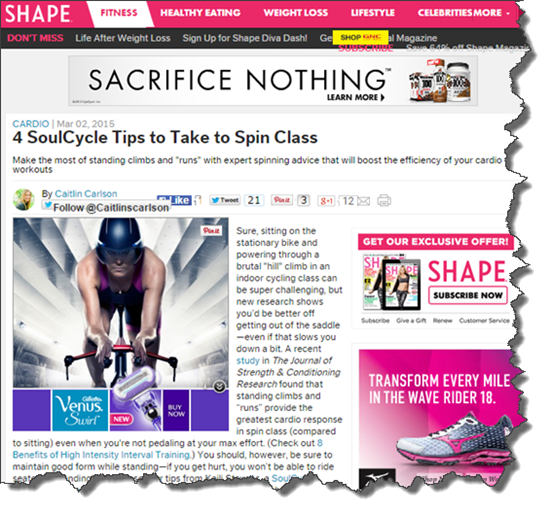
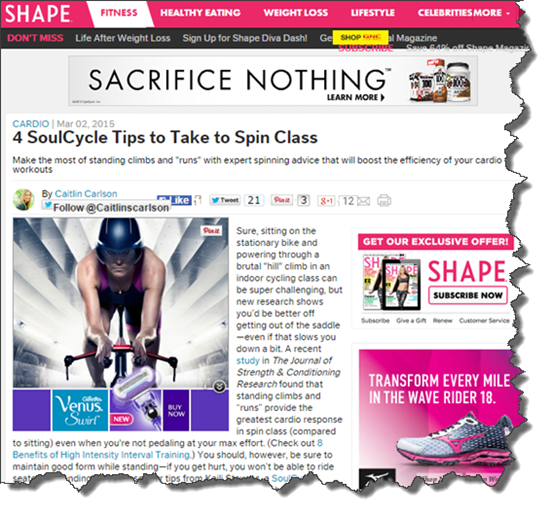
I ran across this article today in the online version of Shape Magazine. Seems like a typical bit of content designed to attract readers who have an interest in SoulCycle / Indoor Cycling.
Sure, sitting on the stationary bike and powering through a brutal “hill” climb in an indoor cycling class can be super challenging, but new research shows you’d be better off getting out of the saddle–even if that slows you down a bit. A recent study in The Journal of Strength & Conditioning Research found that standing climbs and “runs” provide the greatest cardio response in spin class (compared to sitting) even when you're not pedaling at your max effort. (Check out 8 Benefits of High Intensity Interval Training.) You should, however, be sure to maintain good form while standing–if you get hurt, you won’t be able to ride seated or standing! Take these four tips from Kaili Stevens, a SoulCycle instructor in New York City, to heart next time you hop on the bike.
This article is correct – we reported last year about a similar study conducted by Dr. Len Kravitz at the University of New Mexico that came up the same conclusions.
What caught my attention wasn't the article itself, but the image of a very fit and serious women riding a time trial bike – she's even wearing an aero helmet. The background gives the impression of power and speed. And there at the bottom of the image is an ad banner for a women's razor. That made me smile 🙂
I'm willing to bet that this post was created specifically as an advertisement for Gillette. Online magazines exist for only one reason, to make money. The bulk of their revenue comes from advertisers. Publishers like Shape have small armies of creative people who dream up ways to build promotions around advertisers. This article is a great example.
So my question for you. Is Indoor Cycling becoming mainstream a good thing?

by Joan Kent | Mar 2, 2015 | Engage Your Students, Health and Wellness, Instructor Training, KEEPING IT FUN

My college roommate used to turn down yogurt, saying, “I never eat rotten food.” Now, there may be reasons not to eat yogurt, but the fact that it’s rotten isn’t one of them.
Maybe a better term for “rotten” is fermented. Fermentation is highly beneficial for the digestive system, and we’ll get to that. Meanwhile, how do we know if we should eat rotten foods?
Problems with bloating, gas, acid reflux, constipation and/or diarrhea are a sign. Even problems that seem unrelated to digestion could indicate that gut bacteria are out of balance: skin problems (such as acne), sleep problems, headaches, urinary tract infections, weight gain, and strong sugar cravings.
About 85% of the immune system is in the gut, and gut health affects inflammation, allergies, and autoimmune responses.
Good Bacteria, Bad Bacteria
[wlm_private ‘PRO-Platinum|PRO-Monthly|PRO-Gratis|PRO-Seasonal|Platinum-trial|Monthly-trial|PRO-Military|30-Days-of-PRO|90 Day PRO|Stages-Instructor|Schwinn-Instructor|Instructor-Bonus|28 Day Challenge']
As you probably know, we have both good and bad gut bacteria. The good should outnumber the bad by 6 to 1 (or better). Various environmental factors — pollution, chlorinated water, farming pesticides — may throw off that ratio.
Dietary habits can negatively affect gut bacteria. Such habits include consumption of sugar, alcohol, or artificial sweeteners in diet beverages, diet foods and gum. Processed foods in general wreak havoc on the gut and the immune system by triggering inflammation.
Taking antacids or laxatives can disrupt gut flora and, in a self-perpetuating cycle, actually increase the need for the products.
Use of antibiotics is known to interfere with the gut environment. That applies to antibiotics in any animal products we eat, not just to prescription meds.
So How Can We Fix The Gut?
Eat rotten foods. Fermented foods are powerful detoxifiers that break down and eliminate heavy metals and other toxins. Fermentation destroys pathogenic bacteria and optimizes gut flora, balancing the ratio of good and bad bacteria.
Fermented foods produce enzymes and probiotics that help with digestion and improve vitamin and mineral absorption. Fermentation can actually produce B vitamins (which fight sugar cravings). It also “predigests” foods so they’re more easily digestible.
Fermentation can regulate stomach acid production, increasing production when it’s too low and decreasing it when it’s too high. Fermentation preserves the nutrients in foods and can even increase food storage time and prevent the loss of nutrients.
Many countries have their own fermented favorites. Below are several fermented foods common in the U.S., with many more found worldwide.
– Soy is fermented to make tempeh, miso, or natto.
– Cabbage is fermented to make sauerkraut or the spicier kimchi, a popular Korean food.
– Milk is fermented for yogurt or kefir. Stay aware that flavored versions of these products contain sugar, which would seem to cancel some of the benefits.
– Kombucha is a fermented tea that contains small amounts of alcohol. Some people dismiss the alcohol in it as inconsequential. However, do what you feel is in your best interest. I drank it a couple of times and noticed a liking for it that made me suspicious. I stopped drinking it as a result, but that’s me.
Apple Cider Vinegar
No list of favorable fermented foods is complete without apple cider vinegar. The folklore around it is vast. Old, well-worn books describe apple cider vinegar’s value as both medicinal and preventive with daily use.
Apple cider vinegar contains acetic acid, said to be antimicrobial and antibacterial. Cider vinegar has been touted as beneficial for heart health, weight loss, and even fighting cancer tumors. Some of these claims are inconclusive at best.
A documented benefit of apple cider vinegar, however, is its ability to decrease glucose levels in type 2 diabetics. It offers a similar benefit in non-diabetics. Of course, that fact alone won’t compensate for a diet loaded with sugar and/or refined carbs, but it does suggest that cider vinegar could complement a healthful diet.
Apparently, fermentation rocks. And my college roommate was off-target. Besides, she used to drink wine, and that’s fermented.
I guess the real rotten food continues to be sugar. Ya think?[/wlm_private]
by Joan Kent | Feb 9, 2015 | Health and Wellness

Sugar is big nutrition news these days, and sugar addiction is getting the attention it deserved a long time ago when only a few nuts (like yours truly) were talking about it.
I searched recently for the mainstream “wisdom” on getting rid of sugar cravings. The suggestions I found display a poor understanding by the various authors of what makes us crave sugar.
Below are some of those suggestions, and why I doubt their effectiveness. Of course, almost everything will work for some people, but as a rule, these aren’t things I’d recommend to my clients.[wlm_private ‘PRO-Platinum|PRO-Monthly|PRO-Gratis|PRO-Seasonal|Platinum-trial|Monthly-trial|PRO-Military|30-Days-of-PRO|90 Day PRO|Stages-Instructor|Schwinn-Instructor|Instructor-Bonus|28 Day Challenge']
- Turn your attention to something else. This approach is a good match for the next one on the list.
- Change the scenery & take a walk. Whoever proposed these two solutions thinks cravings are “all in your head”, so the solution must be to focus your thoughts on something else.
- Talk to a friend. If you believe that a sugar craving is an emotional phenomenon, this suggestion seems reasonable. It’s less reasonable if you look at the physiological side of cravings.
- Meditate. If you think cravings are the result of a way of thinking or feeling, or a result of stress, this may seem reasonable. And it can change brain chemistry, so it could work.
- Avoid stress. Of course, that sounds fantastic. Who wouldn’t want to avoid stress? But it’s not always realistic. Besides, what if you’re already stressed? What do you do then?
This advice also doesn’t distinguish a craving from the urge to eat. That urge to eat when stressed may actually be an inborn reaction. Even animals do it. It’s not always the same thing as a craving.
- Drink water. This is ALWAYS good advice. But a craving isn’t necessarily the result of dehydration. Thirst can be mistaken for hunger, and, apparently, the urge to eat is sometimes mistaken for a craving (see “Avoid stress” above). But they’re not really the same.
The following suggestions might be effective temporarily, but could backfire in the long run.
- Eat a little of the craved food, then divert your attention. This shows a misunderstanding of the neurochemical effects of sugar. Yes, eating sugar will take away the craving — after all, you’re eating what you craved. But it will probably come back later with a vengeance. And if you eat sugar and the craving goes away, why would you even need to turn your attention to something else?
- Eat the craved food, then something healthful. Sorry, you’ll never convince me that sugar cravings will be “cured” by eating sugar plus kale. The craving will return big-time later, and the sugar may make kale (or other healthful food) seem unappealing.
- Eat a decadent, delectable version of the craved food and savor it. How slowly and voluptuously you eat the food has nothing to do with eliminating the craving. Eating sugar will always stop a sugar craving — but that’s short-term at best.
- Eat fruit. As if fruit isn’t sugar. If you recognize that it is, this suggestion is the same as the rest of the food suggestions above.
My recommendation is to treat a craving like what it truly is: a neurochemical phenomenon. Since it’s neurochemical, it’s physiological. Would we tell someone to get rid of the flu by changing the scenery? By diverting her/his attention? Those are good things to do, but they might not be an effective answer to a physiological problem.
In a previous post, the causes of sugar cravings were described, and all were neurochemical.
Addressing neurochemistry may be a better way to fix a neurochemical problem. Use liquid B-complex, suggested in a previous post, for short-term relief. (It really works.) Change your diet for a long-term cure. (It really works.) Get a coach for ongoing support, because those two suggestions can be easier said than done.
Coaching really works.[/wlm_private]
by Joan Kent | Jan 19, 2015 | Engage Your Students, Health and Wellness, Instructor Training, Master Instructor Blog
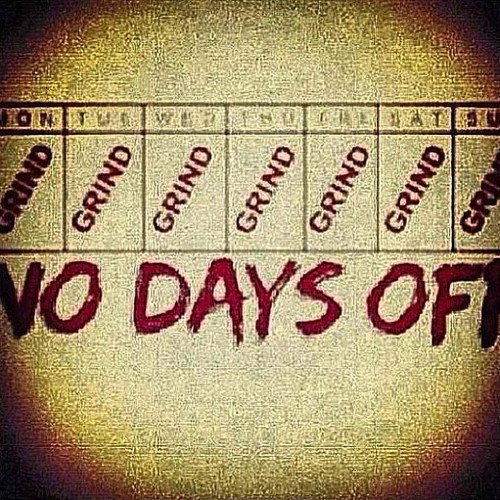
“I don’t stop when I’m tired. I only stop when I’m done.”
It surprised me to learn that the above quotation came from Marilyn Monroe. How many times have we heard those words in connection with athletics?
In the training and weight loss program I taught for 14 years, participants would sometimes wish for a day off, or even several days. They’d tell that to the strength-training coach, for example, and his reply was an annoyed, “There are no days off! This is it — the way you eat, the way you train — all the time.”
Men can get away with saying things like that more easily than women can, I think. Regardless, I appreciated him for saying it — and, of course, agreed with him.
One participant asked me if she could stop keeping her food log on the weekends. She acted as if (and maybe actually believed) she just wanted a break from logging.
It seemed obvious, though, that those days off would only encourage her sugar addiction. I imagined her stopping the log not on Saturday, but on Friday morning, eating sugar nonstop for three days, and re-starting her log sometime on Monday.
What I pictured most vividly, however, was her discovery that she wasn’t losing weight and asking for my help. But we’d have no records of her weekly binges.
I told her the truth: I couldn’t stop her from doing that but wasn’t going to approve it. How could I agree to help her fail and then tell others that our program didn’t work?
Toward the end of 2014, I read an article for entrepreneurs on finishing a great business year. The author explained that the only way to finish the year strong was absolutely to understand that there would “never be a day that (would) not require dedication, discipline, perseverance, accountability, and the need to execute relentlessly.”
Wow. That article may have been written about business but is all about fitness, athletic training, even weight loss. We know success in those areas depends on consistent and persistent action, not on temporary changes till the pounds are lost or the goal is reached.
I must be in a quotation kind of mood because Dan Millman comes to mind:
“There are no ordinary moments.”
Isn’t that what wishing for a day off is — a wish for moments that simply don’t count? Moments with no repercussions, when we can do what we know we shouldn’t and not suffer the consequences?
I’ve wanted those moments, too: when the alarm wakes me at some ridiculous hour to go train, for instance, or when I was flat-out tired of writing my dissertation.
We’ve probably all had moments when we wish for ordinary moments. But since I’m quoting everyone else’s wisdom today, here’s the proverb I like best in this context:
“When climbing a mountain, give up a thousand times; just keep your feet moving.”
That one really works. We can mentally go in any direction — discouraged, foolish, negative, fanciful, absurd — but never let it affect our behavior or change our plan of action.
At this point in January, some of our participants or clients may already be struggling with a motivation slow-down. Instead of trying to recharge everyone’s battery, which will need to be done over and over, why not encourage them just to keep their feet moving, no matter what?
And on that note, how about one final quote:
I do not believe in a fate that falls on men however they act, but I do believe in a fate that falls on them unless they act. — G.K. Chesterton
by Joan Kent | Dec 22, 2014 | Master Instructor Blog, Strength Training, Training With Power

Image credit http://cyclefit.co.uk/sportive-preparation-should-i-lose-weight-or-increase-power-part-1
As a nutritionist, I hear many clients say they want to lose weight — to look better, have more energy, improve their health. But losing weight can also help you increase your power on the bike.
Ratios intrinsically provide two ways to improve the ratio — by manipulating either variable. The results of improving both variables can be dramatic.
As covered in a previous post, efficiency — the ratio of work output to expended energy — can improve with increased work output or decreased energy expenditure (or both).
In the same way, your power-to-weight ratio on the bike (measured in watts per kg) can improve with increased power or decreased body weight, or both.
Power is itself another ratio, of work to time. If work increases or time decreases, the result is greater power. ICI/PRO is currently covering this topic in depth.
So that provides 3 variables in the power-to-weight ratio: increase your strength (work), increase your speed, or decrease your body weight (or all of them).
Why Lose Weight?
Even if you’re not overweight, weight loss may improve your power-to-weight ratio. It need not — and shouldn’t — involve a strict “diet” that leaves you hungry most of the day.
It does involve careful monitoring of your numbers — how many calories you burn (using your power meter or, preferably, a wearable calorie counter 24 hours a day), and your calorie intake.
The goal is to eat fewer calories per day than you burn, but not by much, just 150 to 300 calories. If that feels too restrictive, drop the deficit to 100 calories. The result would be a slow decrease in weight that you can stop or reverse at any time.
These days, the general recommendation for weight loss is rapid loss. (Is that to match up with HIIT and the shorter-and-harder approach to fitness, I wonder?) Rapid weight loss is said to keep the “loser’s” motivation high.
Yet gradual weight loss — while also training for power — has the advantage of maintaining fat-free mass (FFM) so you won’t lose strength, an important variable in the power ratio.
Holding On To FFM
Weight loss often decreases muscle mass, especially rapid loss. But in the long-running (13-plus years) weight-loss program for which I was both the nutritionist and a training coach, we typically saw steady or increased FFM while the participants lost weight at a slow, sustainable rate.
That helped them maintain strength and power so they could do the training, which was frequently high-intensity. The intense training, of course, was designed to increase strength and power.
Maintaining FFM also prevented participants from having to drop calorie intake more and more (and more) for continued weight loss.
Don’t Bonk
Make sure you don't restrict calories on the ride itself. Whether you’re riding outdoors or doing tough power training in the studio, under-fueling before or during the ride could cause you to bonk.
Even without bonking, you may still feel week and have difficulty working up to your capacity — the power you’re trying to improve. Fuel as usual while riding.
Keep the calorie restriction small. Cut back a little more on days that you’re not training hard, or at least save the restriction for after the ride. If your power ride is late in the day, early A.M. calorie cutbacks may work. Just keep your pre-ride meal about the same as usual, and eat or drink whatever you need on the bike.
Be strict about post-training refueling (covered in a previous post) so you can train well the next day.
Technique and Efficiency
In all of this, don’t forget that better technique on the bike will help you waste less energy by reducing the energy needed for pedaling, reducing energy lost as body heat, and retaining more energy for your next pedal stroke. Your functional strength, a power variable, will increase.
Combining good technique, all the power training tips you’re currently getting here on ICI/PRO, and gradual weight loss will help you dramatically increase your power-to-weight ratio on the bike.
Wishing you great success with this!
