I read this from ICI/PRO member Bill Jenks and clicked the donate link when I got to the end.
Hi Friends
A few weeks ago I shared a bit of my history with you. I wrote about meeting Laura, getting married and having a wonderful life together. I wrote about being each others best friends. I wrote that things changed last December. I wrote that on January 22, 2014 Laura was diagnosed with Amyotrophic Lateral Sclerosis (ALS). I shared our love for each other and our commitment to each other. I mentioned our marriage vows “to have and to hold, from this day forward, for better, for worse, for richer, for poorer, in sickness and in health, until death do us part”. Today I am writing to tell you that Laura passed away on Monday, June 16 at 7:00pm.
Today I am writing to tell you about the disease that progressed through Laura's life and how it caused her death. In December we new something was wrong. Laura began to stumble a bit when she walked and her beautiful handwriting became sloppy. In January the doctors told us Laura had Amyotrophic Lateral Sclerosis. ALS is also known as Lou Gehrig's Disease.
So what is ALS? The definition of Amyotrophic Lateral Sclerosis, or ALS, is a “progressive disease of the nerve cells in the brain and spinal cord that control voluntary muscle movement”.
But what does that mean? It means that when you want to pick up a glass of water your brain sends a signal down a nerve telling your arm, hand and fingers to move. To reach for the glass. To wrap your fingers around the glass. To pick up the glass. Someone with ALS wants to pick up a glass of water too but their nerves are failing and over time those nerves loose the ability to transmit the signal to the arm, the hand and the fingers. Someone with ALS can no longer pick up the glass of water. They progressively become paralyzed.
By mid January the nerves controlling Laura's tongue began to fail and her speech became slurred and she began to have difficulty chewing and swallowing food. The nerves controlling her legs and arms continued to deteriorate. In March she lost the ability to take even one step and the ability to even reach for the glass of water. In April she lost the ability to stand – to support her own body weight. By May she could no longer move her arms, her legs, speak or swallow anything solid. The nerves controlling her core muscles were failing too and she could no longer hold her self upright in a seated position.
Some other nerves were progressively failing too. As time passed Laura had a harder and harder time breathing. To inhale we use a muscle called the diaphragm. The nerves controlling the diaphragm progressively lost their ability to transmit the signal telling the diaphragm to move. Laura's body and brain continued to have the same need for oxygen that it had before ALS but now her failing nerves were starving her of that oxygen. For the last couple of days of her life Laura's breathing was labored and difficult. For the last 12 hours of her life she was gasping for air. She was unable to take in enough oxygen to sustain her life -she was suffocating. At 7:00pm on Monday, June 16 she died of respiratory failure caused by ALS.
ALS is a cruel disease. It takes your ability to move, to talk, to eat and even to breath. Through it all Laura kept smiling. She had ALS but it did not define her. She was always Laura with the beautiful quiet smile and big brown eyes. She made the most of her time. She spent time with friends. Time helping others finish some of her quilts. Time attending quilt classes. Time playing Canasta. She spent time with her family. Her sisters. Time with me. She will be missed.
Through it all the Evergreen Chapter of the ALS Association was there for us. When we needed information they were a phone call away. When we needed equipment it was there for us. When we had questions about how to manage some part of the disease process they had answers. They helped both Laura and I be less afraid. The Evergreen Chapter of the ALS Association provided the help and support we needed when we needed it. They were instrumental in Laura's comfort and happiness. They helped me to take the best care of Laura that I could. They provide that information, equipment, answers and support at no charge. They do it because the care. In order for the Evergreen Chapter of the ALS Association to continue to provide the support to families like Laura and I they need our help.
The Evergreen Chapter of the ALS Association holds the DoubleDay Bike Ride To Defeat ALS each July. The DoubleDay Ride is a two day non competitive bike ride on Saturday and Sunday, July 26 and 27. The ride will help raise funds to support people like Laura and I and to raise awareness of the need to find a treatment and a cure for ALS.
Laura and I rode in the Double Day Ride to Defeat ALS last year. That's us in the attached picture. We rode to honor Judy Marshall, our Team Captain Bob Vincent's sister. We rode in memory of Dr. Gene Berg (Laura's Dad) and for our friend Bob Ross. All three were taken by Lou Gehrig's Disease. This year we ride for Laura. Please join me and Team One Love to raise money to support people in our community with ALS and to spread awareness of the urgency to find a treatment and a cure.
It is easy to help the Evergreen Chapter of the ALS Association support families like Laura and I. Please follow this link to my personal page and click on “Donate To William” and follow the instructions. If you would like to join our team follow this link to the Team One Love page and click on “Join Team” and follow the instructions. In honor of Laura and to help other families like mine I will match, dollar for dollar, any donations made to Team One Love (up to $5000.00). Together we can make a difference. No donation is too small. Please follow the link to my personal page to donate today.
Together we can make a difference. Join us for the ride of someone else's life.
Bill Jenks
YMCA Group Cycle Instructor & Faculty
Spinning Star 3, Cycling Fusion & Keiser Cycling Instructor
Heart Zones Trainer Level 2
Follow me on Facebook
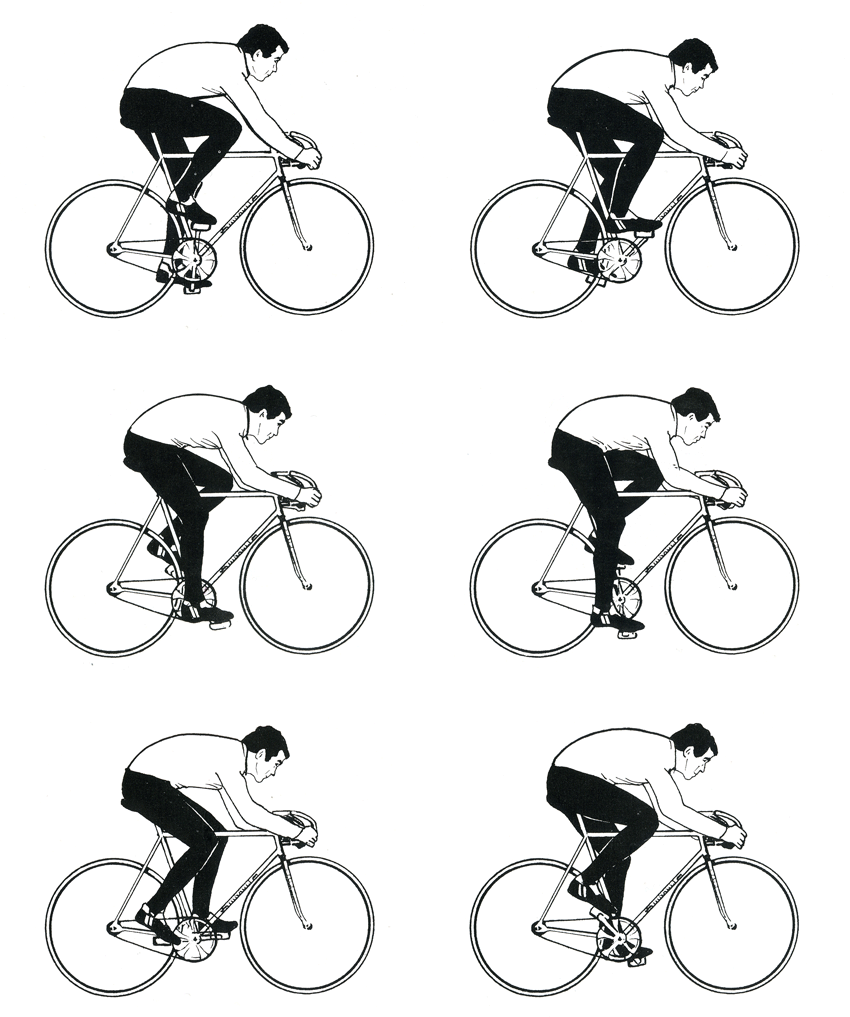
Beyond the obvious fitness benefits Indoor Cycling provides to our outdoor riders, there's an overlooked skill that will make your participants smoother and safer riders in a pace-line… riding fixed-gear Indoor Cycles teaches us to pedal constantly – i.e. not starting and stopping while riding.
It's rare that you'll ever have your class stop pedaling. We start turning the cranks and don't stop until the end 45 minutes later. Not surprisingly this steady/consistent pedal stroke is the mark of an experienced cyclist. Pedaling without stopping will also prevent you from hearing me calling out from behind you, in a somewhat irritated voice; Pedal, Pedal, Pedal!
At this speed you only get one chance.
Riding in a paceline at speed is a magical experience. Sailing along at 20 mph with your wheel 12″ or less from the person ahead. You feel their draft dragging you along, as the group members take turns sharing the work of pushing through the friction of the air. As long as everyone rides smoothly and consistently, it's all good. But “things” happen over a 40 mile ride; dropped water bottles, lost or distracted concentration, garbage on the shoulder – lots of “things” that will cause one of the riders in front of you to slow suddenly. Exactly how you react can make the difference between just another “thing” that happened on today's ride or you painfully ending up on your head 🙁
I've seen a lot of rear-end collisions and nearly always it's the rider behind who gets the worst of it.
@ 20 mph you are travelling ~ 29 feet per second. That 12″ gap between you and the rider in front represents 1/29th or 0.034482 of a second. So let's say you're JRA (Just Riding Along) and everyone in front slows very quickly. There's very little time (just a fraction of a second) to; perceive the change in speed and then react, before you hit someone. A fraction of a second may sound like a short period of time, but your brain can do a lot – especially if you've conditioned/trained it to respond correctly.
Brakes are for slowing… Pedaling is for going
Spend as much time leading and riding with cyclists in a paceline as I do and you start noticing the small differences that identify experience levels. Observing how closely a rider is willing to follow, consistently maintaining the distance to the rider ahead, is what tells me if you've done this before. When I see someone who's not comfortable following closely, it's almost always because they are attempting to control their speed by first stopping their pedals. Trouble is that bicycles coast…
MICROADJUST It's nearly impossible for everyone to put forth equal amounts of effort, especially on undulating terrain. You need to make adjustments along the way to prevent what Ignosh calls the Slinky effect, where the line alternately bunches together and becomes strung out, with big gaps. “It's better to make two small undercorrections than one big overcorrection,” he says.
“Think of it like driving: You don't slam on the brakes, then hit the gas; you moderate your speed.” To do that in a paceline, try one of these techniques:
Soft pedal: If you feel like you're getting sucked into the rider in front of you, take a light pedal stroke or two to adjust your speed accordingly.
Air brake: An easy (and safe) way to trim speed is to sit up and catch some wind. It'll slow you down a notch without disrupting the rhythm of the line.
Feather brake: Gently squeeze the brakes while continuing to pedal. You can scrub speed while shifting up or down as needed to alter your pace.
Note that none of these 5 techniques involves stopping your pedals.
New/inexperienced/poorly trained riders typically do the following in a panic situation:
Sense the change in speed > {stop pedaling} > realise that wasn't enough > grab a handful of brake > overlap the wheel ahead or hit the rider's wheel. The time spent between the {stop pedaling} was their allotted 1/29th of a second to react and prevent the collision. Having survived this mistake a few times, the rookie rider will increase the gap {adding additional time} until they learn what's causing the problem.
Experienced riders have learned to skip the {stop pedaling } and instead quickly apply (feather) the brakes lightly, while soft pedaling. In a panic, their hands are already doing what their supposed to be doing and can continue to add pressure to the levers as needed. Collision prevented 🙂
I've discussed this in my classes and have used it to break up the monotony of a long long tempo flat at Threshold. I'll ask everyone to close their eyes and visualize the scenario I described above…
You're tucked into a fast group this morning. Your hands are lightly resting on the hoods, fingers at the ready on both brake levers. Sensing the lead rider slowing you feather the brakes just enough to maintain your 12″ gap between wheels, while softening the pressure in your feet just a fraction. Keep this level of effort until the group accelerates again – your response to this surge is perfect.
With any luck you'll have taught them a valuable skill that could keep them safer in a group ride. Or at least save me from have to call out; Pedal, Pedal,Pedal!
Riding a fixed gear bicycle is a common training technique among outdoor cyclists, for the exact reason.
When you fit new riders to Indoor Cycles you tell them their numbers, right? You say; your seat is hole 6, seat slider is X, handle bar height is Y, etc… You may write these settings down on a note card and your riders depend on these setting marks/numbers being accurate, regardless of which bike they ride.
Their expectation is that they'll be able to pull out the 3×5 index card, with the position numbers listed and set themselves up properly – regardless of which bike they choose. Doesn't always work that way…
This past Thursday morning I set up my Instructor bike, jumped on and knew immediately that something was wrong. I felt like I was sitting way forward of my normal position. Jumped off and checked the slider position – It was exactly where I always have it. Jumped back on and still felt like I sitting too far forward… and I just lived with it while I taught my class.
I checked afterward to see what was causing my concern and it was as I suspected – someone must have switched out this bike and this saddle was installed in a different position, all the way to the front of the seat post = although I had adjusted the slider correctly the saddle was still to far forward.
You'll need a wrench to fix this.
Saddle Fore/Aft position of the saddle can be change in two ways:
How you're familiar, using the adjuster knob or pin and sliding position –
Or by loosening the nut that holds the two seat rails to the seat post – slider assembly. Here's where you need a 9/16 or 15mm wrench. Each saddle should have been installed in the same position – operative word here being should, they almost never are. You'll only need to make this adjustment once, preferably when you take each of the box.
Here's a video I made showing Spinner NXT's and how you can check that each saddle is installed correctly. NOTE: every Indoor Cycle and bicycle saddle adjusts on the rails the same way – how you measure the position, in relation to the slider, will be different between the various brands.
While you're at it, I suggest checking that each seat is level. Dead level is typically best for men and women. You're measuring from the high-points (not the center depression) on either side, to the nose of the saddle.
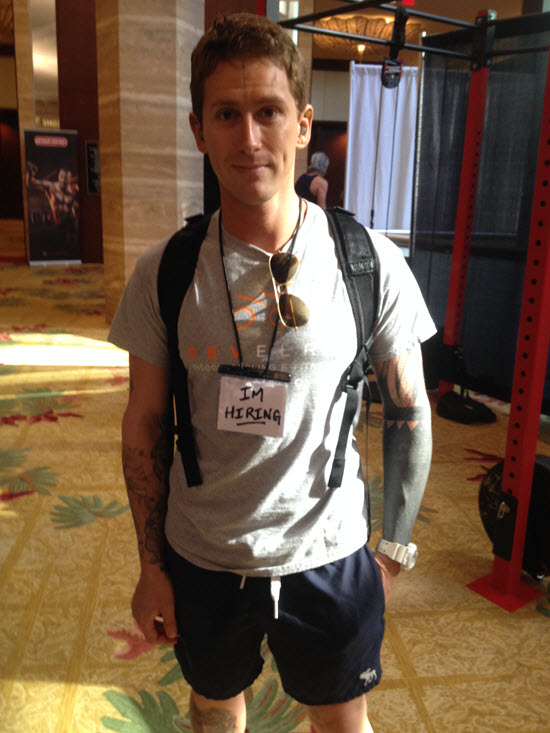
Christian Noni wants to hire you as an Instructor at Revelry Indoor Cycling and Fitness. But there's a catch to his interview process… he's looking for Instructors / coaches who've experienced inspiration from fitness, who have seen the light.. the proof.. (whether it be weight loss, winning a triathlon, or even had a wild twist and that’s how they met their wife or husband) and who lives to share and pass that torch in their classes.
I've been asked multiple times; “John can you help me with a problem I have hiring Instructors?” “I've never hired anyone before, what's the trick to bringing on only great Instructors who will fill the room?”
Great question. One that I really didn't have an answer for, before this interview with Christian Noni. Christian is the Fitness Director at Revelry Indoor Cycling and Fitness. One of his responsibilities to recruit, hire and train the Instructors who will make their studio successful. He has a wonderful way of interviewing potential Instructors… Listen to the interview to learn exactly what he's looking for from and then how they plan to train each new Instructor to bring consistency to all of their classes, regardless of who's teaching.
Christian's mentor is the excellent educator Lawrence Biscontini. If you haven't yet, I would highly suggest that you listen to both episodes of the interview we had with Lawrence:
Good stuff and these two interviews probably rank in the top ten of all the interviews we've ever recorded 🙂
Here's my interview with Christian.[wlm_private ‘PRO-Platinum|PRO-Monthly|PRO-Gratis|PRO-Seasonal|Platinum-trial|Monthly-trial|PRO-Military|30-Days-of-PRO|90 Day PRO|Stages-Instructor|Schwinn-Instructor|Instructor-Bonus|28 Day Challenge']
I'd love to hear if this helps you to select better Instructors. [/wlm_private]
It's “Equalizer” or “Equaliser” depending on what side of the pond your classes are held.
In a comparison of Deezer's and Spotify's iPhone Apps, I would always choose Spotify – their App includes adjustable crossfade playback. Once you have crossfade you won't want to go without it. Beyond that the IOS Apps are very similar.
A little bird notified me today that Deezer is going to release a new version of their music player App for both iPhone and Android soon… whatever that means? Based on the above graphic, the new Apps will allow higher quality 320kbps playback, crossfade and an Equalizer. I let you know when I hear more.
I know how to use crossfade effectively – OK, I just have it set at about 8 seconds and have left it there for at least a year.
But I'm going to be really curious to play with the Equalizer 🙂
Have you delivered your class music with your laptop and used the Equalizer that's in iTunes?