I stumbled into this article and wanted to share it with you. This group meets regularly in a garage to ride together on trainers…
It is almost quiet. No loud music, no instructor shouting motivational slogans. A pair of box fans hum, nearly drowning out whirring bicycle drivetrains. Conversations are brief, limited by the exertion.
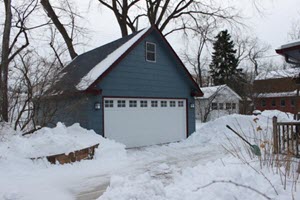
The workout leader calmly, periodically, issues instructions to the half-dozen or so cyclists laboring in a two-car garage in a west Yakima home.
This is back-to-basics wintertime indoor bicycle training – simple, personal and sweaty.
It began nine years ago, the idea of Yakima’s Donna Smith, as a way for riders to stay in shape through the winter.
“It was fun to get people together during the wintertime when you can’t ride outside very much and actually do a workout and talk about the rides you’ve done in past years – and what you’re going to do this next year,” said Smith, a national- and world-champion cyclist between 2005-07. “It helps the winter pass more quickly for us nonskiers.”
The article included this video.
I'm struck by how simple and unpretentious this all is. Just a bunch of like minded cyclists showing up and pounding out some intervals with friends. Awesome 🙂
Where in America should you go if you want to be “healthy, wealthy and wise”? TODAY's special series looks at top places in the US in each category – and you may be surprised at the winners.
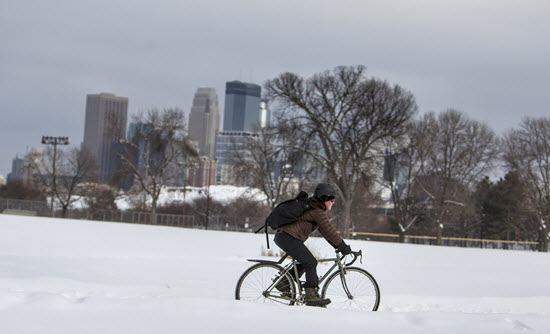
Which city is considered the healthiest, fittest in America? It's not a sunny, bikini-weather spot like Miami Beach or Malibu. It's a city famous for its frequent sub-zero temperatures, where residents need snow coats and ear muffs for months of the year: Minneapolis, St. Paul, Minn., according to the American College of Sports Medicine's most recent American Fitness Index.
Minneapolis, St. Paul has more parks per square mile than any major city in the U.S. and is second only to Portland, Ore. for the number of bicyclists per capita. The Twin Cities also get high marks for access to fresh food.
“There are twice as many farmer's markets in that area than in the top 10 percent of [U.S.] cities,” says ACSM's Walter Thompson, Ph.D.
I don't agree with their judging criteria – access to or number of Farmer's Markets? Most are only open during our 4 or 5 weeks of summer and only on Sunday's.
Residents here are fit because we don't have a choice… it's all about survival during our Godforsaken winters. We're thin due to the amount of calories we expend keeping warm. Shoveling snow was the original full-body workout. Move fast enough between passes down & back up the driveway and you add a cardio component + you get the added bonus of staying warm and not freezing to death.
In keeping with the Nonlinear Periodization training prescribed by Coach Troy, today was a combination day of strength (climbing) and building endurance @ Threshold HR/Watts.
Experienced cyclists know what a real climb feels like. While Indoor Cycling may get close, nothing can truly replicate climbing outdoors, on a road bike, over a long, steep climb. This morning's profile includes 4 long climbing efforts; 2 x 8 min., 1 x 10 min. and the final 11.5 min. to the summit. The final 2:48 features “The Wall” – an all out effort paced to my favorite Black Sabbath track Paranoid. Only available from iTunes.
Long duration efforts, at reduced pedal cadences, offer time to work on other components of efficient cycling; pedaling technique, body position and breathing control. Today we focused on what I call disruptive breathing, i.e. consciously breaking each rider's innate breathing rhythm, for the purpose of bringing focus to each breath and making each as complete as possible.[wlm_private ‘PRO-Platinum|PRO-Monthly|PRO-Gratis|PRO-Seasonal|Platinum-trial|Monthly-trial|PRO-Military|30-Days-of-PRO|90 Day PRO|Stages-Instructor|Schwinn-Instructor|Instructor-Bonus|28 Day Challenge']
There's some interesting literature about this. Here's an excerpt from one article.
WHAT CAN YOU DO?
First, practice deep breathing. With a normal breath we generally use only 10 to 15% of our lungs capacity. And during exercise, we tend to increase the rate, not the depth of our breathing. Although deep breathing is more work, and uses a bit more energy, the pay off can be that 1 – 2% edge in a competitive situation. Here are 4 changes you might consider:
Exhale more completely. After a more complete expiration, it is easier to take a deep breath. The usual rhythm is exhale to a count of 3 followed by inhaling to a count of 2.
Belly breathe. As you concentrate on deep breathing, you will push your diaphragm down and thus the abdominal contents out. If you are doing it correctly, your abs will expand more than your chest.
Widen your hand position. A 2 cm wider hand position will open up your chest and decrease the difficulty of drawing in a deep breath.
Synchronize your breathing. Try to synchronize your respiratory rhythm to that of your pedal cadence. Remember the 3:2 ratio of exhale to inhale.
I cued variations on all four of these concepts throughout class.
Quick Tip: years ago I learned first hand how widening your hand position can improve your O2 uptake / power while cycling. My first road bike (Schwinn Paramount) came with somewhat narrow handlebars. Not knowing anything different, I rode with them for about a year. Until during one group ride one of the “Old Dogs” riding next to me asked; “why do ride with such narrow bars?” Not having a good answer, I just shrugged my shoulders and said they came with the bike. Taking the hint, that week I bought new bars in the width recommended by my team's sponsor/bike store. They made an amazing difference in my ability to breath and with wider width bars, I felt better in control of the bicycle.
Warm Up — 10 minutes. 5 minutes of gradual increases in wattage. During the second 5 mins. we’re finding the wattage where everyone is first noticing a change in breathing; VT1 / Aerobic Threshold = the top of the Recover Zone. This establishes a rough understanding of a base wattage that we use throughout the rest of class.
3 x 30 sec. Hard / 30 sec. Easy – Times Like These Openers to AT/LT. I cue these by first having everyone find the amount of load @ 70 RPM that has them feeling they should (not just could) come out of the saddle. The 30 sec. Hard is then simply accelerating to 90+ RPM which results in some pretty impressive power numbers. The 30 sec. Easy is back to 70 RPM — many will stand and walk during the Easy portion.
2:35 rest – The Best Is Yet To Come ~ Tony Bennett. I encourage riders to focus on their recovery. Once they feel calm in their breathing, bring back the Base level work wattage. I'm talking/motivating everyone about how important it will be for their “Best Effort” to be a BEST EFFORT!
3 min. Hard Effort — 4:03 Race Against Time ~ U2. Here’s the “Best Effort” to establish a benchmark PTP Personal Threshold Power (top of the Perform Zone) or ride at 110% of FTP if known. Song is @ 70 RPM – which is perfect to establish PTP at a climbing cadence. Have everyone find the tempo and add gears > STAGE Button about one minute in and I coach them off the bike during this hard effort.
1:16 Rest – Quick drink before we start Climb #1
7:58 Climb – Bermuda ~ Fluke. Right back to 70 RPM and have riders quickly establish their wattage to 10%-15% below the 3 min. “Best Effort” power. > STAGE Button and then maintain this average until the end. You may want to offer slight changes in cadence & load, while keeping wattage = to the initially established watts #.
4 min. Rest – Delirious ~ Prince
8:02 Climb – Tribal Force ~ Higher cadence @ 84RPM with the same wattage. This moves more of the work to the aerobic system and is a little less stressful on everyone's legs.
4 min. Rest – White Flag ~ Dido
10:03 Climb – Final Frontier ~ Juno Reactor. Back to 70 RPM and encourage riders quickly get as close to their 3 min. “Best Effort” as possible and sustain it to the summit. Many of your athletes are strongest now – help them take advantage of their full strength here!
2 Min. Rest – Last Impression
Final 11:33 Climb – Starts with Come together ~ Joe Cocker at 83RPM. This is more of a tempo effort in the middle of the Performance Zone / between the two power thresholds. Continues with Time Will Crawl ~ Bowie as the road steepens and pedal speeds slow to 63RPM > keeping the same watts, with a bigger gear, as we approach the the final challenge of the day…
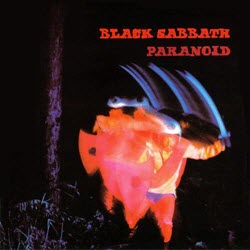
The Wall – 2:48 Paranoid ~ Black Sabbath. The beauty of riding magnetic cycles is how simply accelerating a big gear = a huge increase in work. Those big pedals accelerating from 63RPM to over 80RPM should produce the biggest #s of the ride and at less than 3 minutes this should be achievable by everyone 🙂
Base Wattage (aerobic) flat road to finish — use these time to congratulate everyone and give tell them a bit about what you have planned for them next week.
Any time I play a classic rock song from the 70's, I refer to it as “Drug Music”. Let's be honest here. If you're looking out at a sea of 50ish male faces in class, there's a good chance that more than a few “experimented” during their teenage years. A huge part of that experimentation included vinyl LPs from early 70's Rock Bands like; Led Zeppelin, Pink Floyd, Rush (Amy's person favorite), Deep Purple, David Bowie, Jethro Tull, Emerson, Lake & Palmer, Blue Oyster Cult, Aerosmith and others. You can add your favorites below.
During this less than healthful period in my youth, if I was going to be spending some time in a darkened living room, in the middle of the day, (there was a period of my life where I considered school attendance optional) Black Sabbath was my absolute favorite. I was a wanna-be Rock-and-Roll bass player. Sabbath's bassist Geezer Butler was my hero. I spent hours with my pawnshop bass & 200 watt Plush guitar amp, trying to play along to each track on Paranoid – Sabbath's second (and most popular) album and Master of Reality.
Digital sources of those early Sabbath albums were unavailable until iTunes announced this week that they had the complete Sabbath collection – awesome! I bought their greatest hits album {link} as none of these are on Spotify or Deezer.
Caution: although Spotify and Deezer do offer a bunch of live recordings, Ozzy Osbourne has a very fowl mouth – so I suggest sticking with the clean original versions.
Here are a few excellent mashups featuring Black Sabbath that I would appreciate hearing in your class 🙂
This track combines Sabbath's War Pigs and Zeppelin's Whole Lotta Love masterfully.
It's a fact of life for all of us teaching power based classes; inconsistency in the watts readings between cycles. Some brands seem to be better than others. Certain bikes seem to be always right, while others are never even close. Calibration is done more frequently by some clubs… or not at all – or the cycles you ride don't offer that option.
This isn't just about us either. Our riders want to feel confident in what they are seeing on their monitors. If they don't believe what they're seeing, they'll soon come to ignore it or worse – ignore you and your coaching.
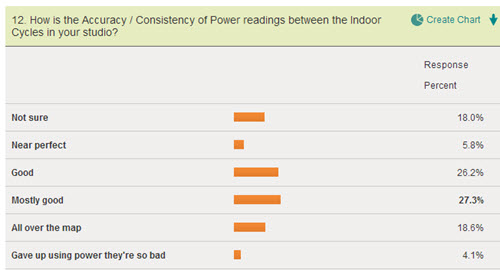
Here's a screen shot from the Indoor Cycle With Power Instructor Survey – click here to add your experiences.
As you can see, only 32% of Instructors rate their cycles as having Near Perfect or Good Accuracy/Consistency. Those of you in the other 68% have a real challenge, making effective use of the tools we're provided and teaching an awesome class!
So here's what to do about it, three simple steps:
Step # 1 – Acceptance of the problem
I actually found myself getting defensive whenever someone made a negative comment to the effect of; “the power meters on these bike aren't accurate.” I'd start making excuses, or questioning the person with; “inconsistent compared to what”? This question, it turns out, does have some value. It's often important for Step #2 to understand; are they are comparing the cycles in your studio to their road bike power meter, or is their complaint focused on inconsistencies between the individual cycles in the room?
If you don't catch yourself, excuses may slip into complaining about management's lack of over-site (not doing regular calibration) or lament that no one asked you which Indoor Cycles to purchase. It you only had XYZ brand this wouldn't be a problem 🙁
This is all out of your control – so just accept “what is”, smile and deal with it.
Step #2 – Communicate your acceptance
To your cyclist you may say; “Yes I know that the power you're seeing doesn't compare with the $2,000.00 Quraq power meter on your road bike.” “There are a multitude of reasons why you're seeing different watts readings… your fit is different, the crank arms are longer/shorter, etc…” Or you might add; “has it been a while since you were riding consistently?” “Could your fitness have changed”? In any event I feel you just need to communicate your understanding that there is a difference.
More importantly, to your class; these power meters are an awesome tool to help you improve your fitness. We are seeing some variation between cycles, making it difficult to compare wattage numbers between workouts and/or other individual bikes in the room. What's important is today's numbers. After all, yesterday's or last Tuesday's ride is in the past… let's focus on today's effort!
Step #3 – Coach the solution
In the survey we're running, I ask the question; Do you conduct any type of assessment during class, to help your students understand or identify a benchmark watts PTP (Personal Threshold Power)? If so please briefly describe what you do and how you teach it.
Yes I know it was a bit of a “leading question”. But identifying a benchmark watts/power # is the solution to inconsistencies between the Indoor Cycle's power meters in your class.
The question was open-ended and drew a number of great responses:
Because the power measurements are so different (inaccurate) among the bikes in the studio I do a 7 minute PPT at the beginning of every class to give each member a usable number for the specific bike they are using.
I need to do a “mini” threshold test at the beginning of every class to get participants “dialed in” because the power readings are so inconsistent from bike to bike.
Yes.. A 5min MAP test
I'm not aware of any “approved” protocol for a benchmark / PTP effort (I call them “Best Efforts”). Depending on your demographic you want these to be 3-7 minutes long – mine are typically four minutes long. I do feel that you and your athletes will benefit from consistency. I do these in every class. If you're a Life Time Fitness Instructor these fit very nicely into the new EDGE Cycling format.
Warm Up — 10 minutes. 5 minutes of gradual increases in wattage. During the second 5 mins. we’re finding the wattage where everyone is first noticing a change in breathing; VT1 / Aerobic Threshold = the top of the Recover Zone shown above. This establishes a rough understanding of a base wattage that we use throughout the rest of class.
3 x 30 sec. Hard / 30 sec. Easy – Openers to AT/LT. I cue these by first having everyone find the amount of load @ 70 RPM that has them feeling they should (not just could) come out of the saddle. The 30 sec. Hard is then simply accelerating to 90+ RPM which results in some pretty impressive power numbers. The 30 sec. Easy is back to 70 RPM — many will stand during the Easy portion.
2 minutes rest – I encourage riders to focus on their recovery. Once they feel calm in their breathing, bring back the Base level work wattage.
4 min Best Effort – to establish a benchmark PTP Personal Threshold Power (top of the Perform Zone) or ride at 110% of FTP if known. It’s very helpful to riders to have that understanding of their personal upper wattage number. The “Best Effort” Threshold # + the Base Threshold # we found earlier form the three Power working zones I use in class.
– 1 min. build at preferred cadence (suggested as 85-95 rpm) — press the Stage Button to reset the averages.
– 4 min. “Best Effort” This should hurt, but be do-able. I ask everyone to observe their average at the end