One of the benefits to teaching with OPM (other people’s music) is that it forces you out of the safe/comfortable/familiar box you’ve drawn around yourself. In the past, my musical “box” has limited me to selecting my class music a bit like this:
Interesting little Spotify playlist you have here…
Love it…
Going to use this exactly as you’ve constructed it…
Well except this Britney Spears track, no way I’d play that in my class…
Pitbull? Eh, no thanks… Not quite my style.
And that cheezie “Tabata” track you’ve got there near the end? What’s up with that? I don’t think so… that wouldn’t be me… I think I’ll just copy most of your tracks into a playlist of my own and add in a few more “appropriate” tracks to replace those that just don’t quite fit into my safe/comfortable/familiar box.
We see that our PRO/Playlists are viewed thousands of times in Spotify and Deezer, but a relatively small number are actually followed. What’s the difference? You can’t alter a playlist you’ve Followed. You have to use it As Is. You can’t meddle or mess with it. You can only hit play and follow where it takes you and your class.
In case you missed it, we discussed what I called; The Great Spotify Enigma back in February. It included a survey where ICI/PRO members communicated they did pretty much what I describe above; Instructors tend to pick and choose songs, rather than Follow and use the playlist as originally constructed. Which is fine, if you’re content with staying in your Box.
But I’ve found that people in my class didn’t express much appreciation for the music in my Box.
They do when I use music from Chris, Amy, Julz, Krista, Cameron and other’s who I follow on Spotify.
So if you Followed (and used) Chris Hawthorne’s latest profile High Intensity Supersets PRO/Playlist you lead your class through two Tabata rounds. Maybe I should have said; the voice in the music lead you and your class through two Tabata rounds. I used this playlist last night and got the inevitable; “that was really cool tonight, John” that reinforces my transition to using OPM 🙂
Both Spotify and Deezer offer large selections of Tabata tracks.
For your free track I found a Tabata track without any voice-over, and yet the timing of each interval/recovery is unmistakable.
Please let me know if you’re willing to give it a try.
ICI/PRO contributor Chris Hawthorne contributes our latest Audio Class PROfile –
High Intensity Supersets and Active Recovery
This profile is based on a 12 week strength training program that I have been following for the past few months. The program, which can be found on BodyBuilding.com is made up of three distinct “Phases”. Phase One is preparing and warming up the muscles for the hard work ahead in the next two phases. Phase Two is the muscle building phase, and Phase Three is the fat burning stage. This ride profile includes the three phases plus a cool down and stretch.
Thankfully it wasn’t my wedding anniversary (Amy and my 25th is Sept 23rd) but the 5th anniversary of indoorcycleinstructor.com!
Wow – what a ride this has been. Everything started back on August 2nd 2008 with this post. Well actually all this probably started 6 months before I published that first post. I had become intrigued with the thought of starting an Internet radio show, after listening (and become addicted to) sales and marketing Podcasts while driving between customer locations.
As a travelling sales guy, I spent my days “interviewing” prospective customers. A typical 30 minute meeting would consist of me asking a series of questions of my prospect and then listening to their responses – but rarely was this reversed, where the person would be asking me questions. So I thought; why not create an Internet radio show / Podcast that featured interviews with experts and personalities connected to my real passion, Fitness & Indoor Cycling?
How tough and/or expensive could this be?
Well it wasn’t as difficult as it may seem and I think I spent about $50.00 in total to get started. The whole Podcasting thing really came into its own around 2008. iTunes was firmly established as the Podcast feed reader – although there were dozens of similar services competing for this space (most are no-longer) – and at the time the iTunes store was one of the top five places on the Internet where people searched for content specific to their interest. So beyond Google and YouTube, the iTunes music store was the place to be.
Of course we needed a website. The open source, blogging software WordPress was becoming very attractive to Podcasters. It was most importantly free, easy to use and automatically created the special RSS feed that connected indoorcycleinstructor.com to The Indoor Cycle Instructor Podcast in iTunes.
So I bought a $30 headset mic, registered the domain $9.95 and signed up for some cheap hosting @ $5.95 a month. But nobody warned me about how much time I would need to invest in all of this 🙁
I’ve done some simple studies on how much actual time I invest to produce one 30 minute episode:
2-3 hours recruiting each guest for the show, spread over days, weeks or for a few – months or even year. The folks at RealRyder have the distinction of being the most elusive to date. I’m still working on a few that could eclipse them… stay tuned.
One+ hour consisting of a dozen emails and one (sometimes two) 30 minute pre-calls to sort out the topic and questions.
One hour for a late cancellation & rescheduling
60-90 minutes for the actual recording session
2 hours post production; editing to make each guest sound good (I swear I have removed at least a million “uhms”, “you knows”, lip smacks, sniffs, etc…), creating and uploading the MP3 files, creating the post and then promoting the episode.
272 episodes x apx 9 hours = around 2,400 hours!
But they’ve been totally worth every minute as long as you’ve enjoyed them!
When I started all of this I had a concern that we’d run out of things to discuss. After all this is just Indoor Cycling… what’s there to talk about?
As it turns out a lot. As I look forward I see that we’ve just scratched the surface.
There’s lots more coming during year 6 here at the Indoor Cycle Instructor Podcast
*Note to self – add calendar reminder for 9/23 so you don’t miss that anniversary… and don’t forget to find something special for Amy.
I used a new metaphor this morning that seemed to resonate with my class.
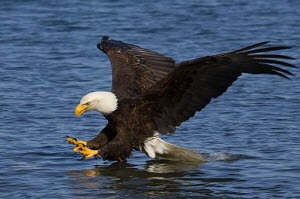
Watch this video and see if you can see the similarity between an eagle catching a fish and proper pedaling technique.
Through the magic of slow-motion photography it’s obvious that the act of plucking a large salmon out of the water is a very fluid, near circular, motion by these powerful birds.
This morning was a cycling strength day. I really enjoy teaching these classes and I describe the format to the class as; BIG PEDALS turning slowly. But slow = STOMP for many in my class.
To help everyone move beyond stomp, I’ve been introducing the concept of ankling through each pedal stroke to my class. If you missed it here are two videos that demonstrate what local bike fit Guru Chris Balser categorized as USA vs. EU pedaling techniques. To help communicate the concept I’ve been talking about how there shouldn’t be any specific action; stomp, scrape, pull up, ect.. Rather just one fluid motion of your feet rotating around the pedals, with flexible ankles. Tough to describe until I happened to see this video and then it clicked – the focus is on your toes! Or in the case of the eagle, its claws & talons.
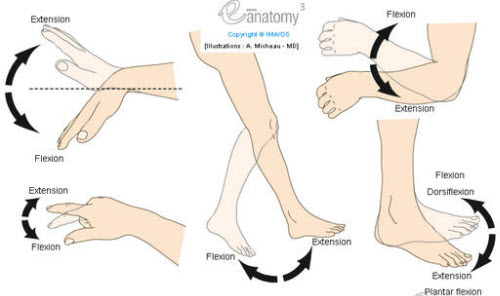
Watch the video again and see how the eagle’s talons and *ankles are at full extension as it reaches forward and down in preparation to grab the fish. The eagle’s claws then flex forward, essentially rotating around its catch, as it lifts it from the water. This is the same movement Chris was helping me learn to improve my pedaling mechanics and power output.
The difference between extension and flexion in joint movements.
How would you describe this movement to your class?
I had everyone try to visualize what it would feel like to be an eagle, swooping down on a fat, tasty salmon. Talons extended as your pedal crosses the top of the circle, then, flexing forward while you sink your talons into the flesh. Your claws rotate around the fish as you drag your catch from the water… only to drop it… so you try again.
*I’m not sure what that joint is called on a bird, but you get the point.
Improving support for our iPhone/iPad users > we’ve finally figured out how to configure the player to show and play on your iDevice 🙂
We’re upgrading all of the Podcast and Audio Class Playlists this morning to a new HTML 5 player (the kind Apple will display) so you may find a player that doesn’t work using your computer. Hope to have everything done in a few hours.