by John | May 18, 2013 | Engage Your Students, Instructor Training, Master Instructor Blog
I saw this last Tuesday and forgot to share it with you. Our club ride begins at the Minnetonka Lifetime Athletic Club. Better known as The Spa, this is a unique LTF facility. Definitely not a Big Box, this club began as a women only club before being purchased by Lifetime.

When I got there Tuesday night they were setting up for an outdoor ride. How fun is that? We rolled before they got started and I heard later that they (Manager and Instructors) did a very nice job making this outdoor class an event, rather than just a class.
The area behind the fence is a small patio. After the class participants enjoyed Hors d’oeuvres and a cash bar – this is an adults only club. They even had live entertainment from a local duet. Is that something you could do at your club or studio?
Could I keep up in a group ride?
With Amy visiting her family in Phoenix, I become the de facto sub for her Saturday AM class. Which was fine – 55 and rain this morning = no outdoor ride for John. After class a regular member asked me if I felt she could keep up in a group ride. I dislike giving answers beginning with; “well that depends” – except in this situation it really does. Riding with a group depends on a number of factors. So I asked her the following:
- Do you have a suitable road bike?
- Are you comfortable riding close to others?
- Are you OK riding on the road?
- How far (miles) can you typically ride at a consistent pace?
It surprised (and delighted) me a little when she quickly answered positively to each question and then clarified what she was asking:
How many Watts do I have to make, to keep up in a group ride?
She’s been listening and wanted to equate the power/watts she seeing in class to riding outdoors 🙂
I had to think about it for a few minutes, before I could answer her. I explained that most organised group rides have multiple “levels”:
- “A” groups are normally drop rides. If you can’t keep up you get dropped, and ride home by yourself. Based on my purely anecdotal experience, “A” groupers can sustain 1.5 or more watts per pound of body weight for the entire ride.
- “B” groups, depending on the organization and/or leaders, are partial drop rides = we may wait for you or there maybe someone who will come back to help you catch up. To hang with the “Bs” you should be comfortable producing your body weight in watts > and be able to climb at around 1.5 watts per pound.
- “C” groups are no drop rides. Everyone stays together and ride at the pace of the slowest rider.
But I don’t want to slow everyone up – so what’s the minimum watts I need to make?
I told her that there’s no way to know that number. I encouraged her to show up one night and see what happens…

by John | May 17, 2013 | Instructor Tips and Tricks, Instructor Training, Music

Who was it that decided climbing songs should be slow?
If I tried to stay with the group I ride with on a long climb, grinding along at 60 RPM, I’d be off the back (and on my own) in no time flat.
Sure a climb should make you struggle to turn the pedals – but to replicate an actual climb outdoors, might I suggest having everyone maintain their cadence in the 80s? Or at least the high 70s?
I’ve been keeping track of rider’s cadences during our group rides, especially when the grade turns positive. Anyone who appears strong is spinning smoothly at 75 RPM or more. The grinders hang on for a little while… just a little, before their leg muscles fatigue and someone ends up waiting at the top – to help them catch back on.
Bicycles have gears for a reason. My new VeloVie has 20 to choose from. How I decide which gear to be in is simple…
I select the gear that allows me to maintain my prefered cadence of ~85 to 95 RPM.
Going up, down or on a flat I’m continuously shifting to keep my pedals in this RPM range. The one exception would be on a long downhill where I will have shifted down to the point where I’m pushing a huge gear at ~ 60 RPM. The exact opposite of conventional thinking.
The typical rookie mistake on the road is to wait to shift until the road literally forces you to do something. They’re pedalling merrily along during the beginning of the climb, with their cadence slowly decaying and forward momentum slowing. That is until someone stuck behind them (that would be me) yells SHIFT. By that point the damage is done and they’ve lost touch with the wheel they were following. Riders behind (again me) are forced to pass them and fight to close the gap before we (once more me) get dropped as well.
A more experienced cyclist will respond instantly to the feel of the road pushing back against their pedals and shift gears. Same with any feeling that their legs are tiring and starting to slow. Shifting to maintain or increase cadence moves the production of work from fatigued legs, up to your (hopefully) less stressed cardiovascular system.
Todays free track is at a very powerful 85 RPM – but it’s not a flat. Try coaching this as a climb. If you’re riding a magnet cycle have everyone add load at 70 RPM until they feel the need to stand > then accelerate to the music’s 85 RPM.
Friction folks will have participants find the tempo and then add the hill while staying with the music.
In either case, cuing everyone; “if you’re feeling a burning in your legs > you’re doing it right :)” “No burning? Then you’re not keeping up, slipping off the back and you will be riding home alone!”
[soundcloud url=”http://api.soundcloud.com/tracks/1134276″ iframe=”true” /]
by John | May 16, 2013 | Music, Spotify
ICI/PRO member question:
When I click on the links nothing happens as I try to bring the playlists into Spotify. I also clicked on each person’s name/profile but Spotify says they are unknown user?
Please help, I think I’m way off. I’m still trying to learn this app. Also, in order to take advantage in my class, I have to get a Premium account to stream through my iPhone right?
Thanks!
My response:
Hi – I’ll try to help.
Yes you need a Spotify premium account to use your iPhone. You can
get a free 30 day trial to see if Spotify is right for you.
There’s a setting in Spotify that maybe preventing this.
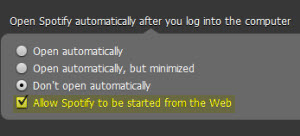
Open Spotify – Up at the top go to Edit > Preferences > and then scroll down to Open Spotify automatically and check the Allow Spotify to be started from the web box.
Let me know if that solves it 🙂
John
P.S. You’ll notice that I have the Don’t Open Automatically box ticked. That setting prevents Spotify from opening on computer startup, but doesn’t prevent Spotify from opening if you click a track or playlist link.
——————————–
Do you ever Shazam a track and then forget about it… only to be pleasantly surprised to find it later in our tagged lists?
I remembered to check this morning and here’s what I found:

by John | May 12, 2013 | Instructor Training, Latest News

Confirmation of a job well done!
Moms are awesome – I realise that although raising kids can be a thankless job at times… there are moments that make it all worthwhile 🙂
This is college graduation weekend for older daughter Abby. Amy and I are very proud of how she has grown into a self sufficient, hard working young women.
It’s not a surprise to me. Abby had a fantastic role model growing up.
While watching this very confident graduate receiving her diploma, I couldn’t help but think; I’ll bet Amy’s parents watched a near replica of this and felt exactly the same way as I do now. There’s no mistaking Abby and Amy as anything other than mother / daughter.
Abby and her housemates hosted a big after-party at their favorite tavern. The place was packed and I must of heard 50 times – YOU MUST BE AMY, ABBY’S MOM!
Amy and I will be heading out on the “Bus” (our Trek Tandem) later today after it warms up. My plan for the ride has me doing more than my share of the work – but I’m not sure Amy will be soft pedaling for very long. When there’s work to be done, Amy has the tendency to step up and hammer whenever and wherever she’s needed. And I appreciate that.

by John | May 8, 2013 | Instructor Training, Master Instructor Blog

“There must be something wrong with this bike… my wattage doesn’t match what I normally see on my road bike with a PowerTap. 🙁
A common complaint that many of us are hearing, now that our clubs are offering power meters.
The answer could be as simple as; “it’s because our Indoor Cycles have a different saddle than your road bike.”
Now I’m not saying that that’s the only reason for the discrepancy. There are multiple factors that affect how you produce power and what ultimately gets displayed by the console. A few months ago I wouldn’t have believed you, if you tried to convince me that (beyond the level of comfort you feel) a bike’s saddle design could add or subtract to the power I could create.
I believe it now.
Back in March I had a professional bike fitting on my new VeloVie with none other than the Bike Fit Guru Chris Balser. I figured that I had a few dollars left because of the incredible deal I got and, with one kid graduating for college this Friday, why the heck not?
I was a bit naive about what all was entailed in a 2 hour fitting. I thought Chris would be super focused on getting my seat height exactly right, maybe futz with the tilt of the handlebars. Stuff like that. Nope. For close to an hour we tried out different saddles, 11 in total. That’s right, Chris had me ride on a trainer, trying 11 different saddles, to find the perfect saddle that (his words) your ass can find easily. Here’s what we finally decided on… a Fizik Kurve.
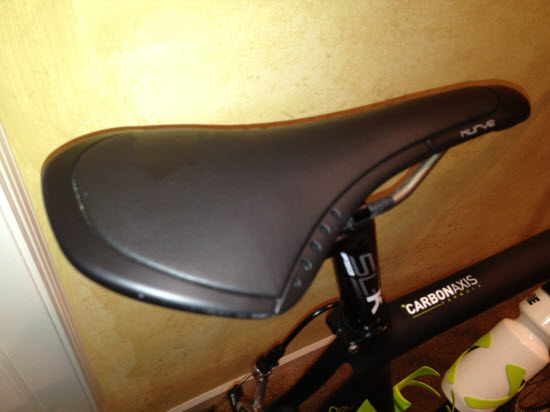
Impossible to tell just by looking at it – my butt knows where it belongs.
What we were looking for was more than a comfortable place to sit my butt. Actually comfortability was third on Chris’ list of criteria for a saddle. The first was; “can your ass find it?” and second was; “how much power do you make with it?”
Both the “find it” and “power” go hand in hand. I’ve forgotten which number (of the 11 saddles) this Fizik was, but I knew the instant I sat on it… or better said, my butt knew the second it sat down. It just felt right and I wasn’t sitting on it, I was kind of in it. That’s when I understood what Chris was talking about when he kept saying find it. There wasn’t any question where on the saddle I was supposed to sit, I just sat down and I was right where I was supposed to be. No working my way a little forward or backwards. I just sat down.
Once my butt found its home I made more power! The trainer I was riding was connected to a power meter that displayed both my left and right leg’s power, on a flat screen hanging in front of me. I was pedaling an easy gear at 90 rpm and making around 40 watts. Each saddle change I road in the same gear/cadence. Chris was watching me to see how stable I was and the balance of power between each of my legs.
The differences we saw were considerable, as much as a 20% or more variance left to right. Once I was sitting on the correct saddle for me I was able to maintain a nice even flow of power with my butt happy that it found its place.
Everything that can be changed or adjusted on my bicycle affected my power. Stem length, handle bar height, saddle tilt, height & fore/aft and cleat settings all made a difference that could be observed. Some were positive and some negative. Chris explained how our bodies adapt to the settings on our bikes. Some changes, that could be ultimately be helpful, often require time as our muscles and the nerves that control them adjust to the new settings. During this adjustment period you could/will appear less powerful.
So it stands to reason that hopping off the bicycle you’re ridden for thousands of miles and on to any of the Indoor Cycles with power, you’ll see a difference in wattage. The tendency is to blame the accuracy of the power meter – now I understand that there are mutiple other reasons.
A fitting with the Bike Fit Guru is actually split between two days, with a couple of hundred miles in between. Getting those miles has been a challenge with the miserable weather we’ve had this spring. Part two of my fitting is set for June 10th and I’ll be doing a full report on everything I’ve learned about the correlation between bike fit and power production.