I really enjoy adding a jump track in the middle of a long endurance segment, sandwiched between two, long, 90ish RPM flats. The jumps serve a couple of purposes;
They breakup a potentially monotonous part of your class.
The slower tempo encourages additional load, which should have everyone working a bit harder once we accelerate on to the second flat.
The speed needs to be just right. I like a track around 70 RPM and found this song while I was creeping on Schwinn Master Instructor Julz Arney's Spotify profile.
Macy Gray's “Nothing Else Matters” looks like this – once you move past your cluelessness.
If you've experimented with some of the 3/4 time track suggestions from this past weekend, you may have some confusion about how you count oddly timed music – like I did.
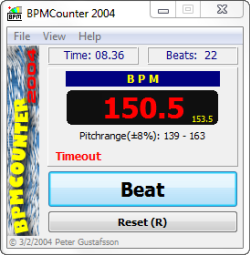
While I was writing the post, I wanted to find the RPM they communicated and share it with you. So I broke out my trusty BPM Counter*… and then quickly drove myself crazy trying to tap out the count; One-Two-Three / One-Two-Three and have it show a believable RPM. I actually quit trying to tap out the songs and instead jumped on my FreeMotion S11.0 down in the official ICI/PRO training facility (my basement) and rode to each song. Riding to the One-Two-Three / One-Two-Three comes easy to me – which is exactly why we recommend using music in 3/4 time to help your students Find The Beat – Find The Beat.Some LTF Instructors may get that private little joke.
When Amy returned, I explained that my rhythmic deficiencies were preventing me from tapping out the RPM successfully 🙁
She gave me a little smile and explained; “It's just Beat-Beat-Beat, Tap-Tap-Tap like any music in 4/4 time.” “Then you just divide it in half to find the RPM… silly.”
So I tried it again, this time forgetting the; One-Two-Three / One-Two-Three and instead just used Tap-Tap-Tap.
And she was right – as usual.
*Here's an old tap-to-the-beat program (PC only) that I've used for years. You can (right click here – save as) to your desktop. It's an .exe file that you need to run each time you want to use it. Your PC may warn you to be concerned about .exe files – you should if they don't come from somewhere not trustworthy (like a spam email) but this file is clean.
One of my goals for 2013 is to have a majority of my participants riding to the beat of my music. Not an easy task with the number of riders I teach that can't seem to hear the beat of the music – or are simply ignoring it.
Now I know that you may have been taught that it's not always the dominate beat that you should follow and match with your pedals. You're supposed to hear some subtle rhythm hiding in the music and follow it where ever it takes you.
Sorry, I don't (and never did) buy it – or at least I've never been able to hear these magical under tones and follow them. I (and most of the men in your class) need a strong beat if you expect us to follow it.
So let's give them something easy to follow. A beat that you can't ignore and has your head swinging from side to side.
That would be a Waltz… as in One-Two_Three / One-Two-Three / One-Two-Three / One-Two-Three / Right-Two-Three / Left-Two-Three / Right-Two-Three / Left-Two-Three
Amy's working on an audio version of this concept. I call her the Human Metronome and believe me, when we dance together, she leads. She has a very fun way to present this in your class that will have your (and my) participants learning to follow the intended cadence RPM that you designed into your class. Podcast #246 featuring Amy is now available.
But for now I wanted to give you some suggestions that you can add to a playlist
ICI/PRO Learn to Ride to the Beat Spotify playlist with 48 tracks that are in either 3/4 or 6/8 (Waltz) time.
This cover of Nothing Else Matters from Macy Gray would make an awesome 75 RPM climb. Listen to it with your eyes closed and count out the one-two-three / one-two-three and hear yourself cuing Left-Two-Three / Right-Two-Three to gently bring everyone in sync. Notice how each measure ends on the opposite leg – which many of the men in your class will find easy to follow.
Comment & question from a brand new ICI/PRO member.
John,
Just a quick hello from the Midwest. I teach cycle at Lifetime Indianapolis and LOVED your suggestion on using Spotify! I am so excited to have a new way to use, create and lets face it steal great song lists!
Quick question for you…do you download to your phone to make your song list available offline or do you use WiFi when using Spotify in class? It seems to take a long time to upload the tunes if I go offline. My concern if I am on WiFi is that someone will text or call me during class. Any suggestions would be great.
Excited to be a part of the ICI/PRO community….Ride on!
Party Marti
Marti asks a couple of really good questions and expresses a common confusion surrounding airplane mode, that I'll paraphrase and respond to here:
Should you download your playlists to your phone or use the club's WiFi?
I forgot or didn't leave myself enough time for everything to download to my phone, before running off to teach my class. How do I prevent a call or text from interrupting my class, if I need to use the club's WiFi?
Let's start with the confusion about using airplane mode – I had the same concern when I cut the cord and started using a Bluetooth receiver with my iPhone and worked through it again with Amy's Android.
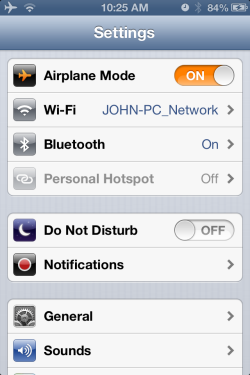
On either type of device (iPhone/Pad or Droid) turning on airplane mode switches off all connections to the outside world; no cell service, WiFi, hot spot or Bluetooth. But both devises do allow you to turn WiFi or Bluetooth back on, leaving the cellular connection off, preventing those embarrassing calls from interrupting your class.
Should you download your Spotify* playlists to your phone or use the club's WiFi? If at all possible you want your music on your phone for two major reasons…
You can't depend on a public WiFi to have the connection speed you need to reliably stream your music = possible technology failure that would wreck your class.
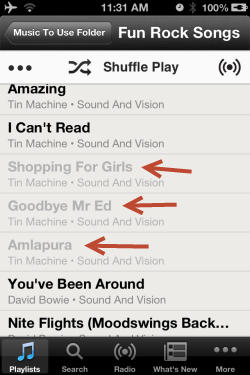
Your playlist may include Local Files – music from your computer that's not available on Spotify = tracks that are Local Files won't play over WiFi, wrecking your class.
Grey tracks are local and won't play using WiFi
But what if I'm stuck and have no choice but use the WiFi at the club?
Start by turning on airplane mode and then going into the Settings and turning WiFi back on.
Next, Spotify will download (save in offline mode) your playlist from any WiFi. So as soon as you can, connect up and turn Available OfflineON. Spotify downloads in order, starting with track one. Feel free to hit play and start your class without needing to wait for everything to download 🙂
Then pray that your playlist doesn't have any Local Files that won't play and wreck your class. But if it does, just smile and pretend you wanted it to happen.
Myth #6 You should be concerned with setting the saddle height too high.
If you've taught for any length of time you have probably observed that; left to their own devises, our participants will universally have their saddles set somewhere between just right and too low. I discussed how you should approach these low riders in an earlier post about my 10 Myths.
But should you have any concerns about raising them too high?
No.
Let's start deconstructing this Myth with a visualization exercise.
To begin I'd like you to close your and see if you can call up an image of the last participant whom you observed riding with their saddle set too high.
Can you see one? No?
Well keep trying…
OK, that's enough. You can open your eyes.
There's a good chance that you've never had a student in your class riding with their saddle set too high. I personally can't think of a time when I've seen this and felt I needed to respond / intervene between the rider and the cycle. Even when I thought I saw someone set too high (doing the classic Toe Pointed Peddling) it turned out that when I encouraged them to loosen their ankles and drop their heels, their seat was still set too low.
There's a simple reason for this > peddling with too high a saddle is painful and riders will instinctively choose a lower height where there's no pain.
I need to credit my Schwinn certification for this one. Schwinn teaches two levels of bike setup; a “Quick Fit” and a “High Performance Fit”. While “Quick Fit” is basically “get em close”, the “High Performance Fit” version relies on the comfort of the rider to determine saddle height.
From my Schwinn Indoor Cycling Instructor manual:
In the proper riding position, with hands on the handlebars, have the rider place their leg at the bottom of the pedal stroke. Kneel down beside the pedal, and make sure the rider's heel stays level with the floor.
Check that the knee extends as far as comfortably possible while the rider is pedaling Raise and lower the seat until the rider finds the highest comfortable adjustment. This should not be determined simply by observing the leg length, but rather by observing leg length AND through trial and error.
The minute I heard this during the certification, my ears perked up and I thought it made perfect sense. Riding with too high a saddle is painful… or riding with a saddle that's at the proper height, but higher than your flexibility allows, isn't comfortable to ride either.
And uncomfortable riders won't sit there in pain for an hour, and they certainly won't come back 🙁
Your focus needs to be on the comfort of the student, not some arbitrary number on a Goniometer or Spinning® Fit System tool.
I'll never forget the guy at the amusement park years ago with the stick he used to measure each rider's height, to see it they were tall enough to ride the Charlie Brown swings. He was so focused on the top of my daughter Carly's head, and if it was over the top of his measuring stick, that he completely missed how Carly was doing her best ballerina impersonation (up on her tip-toes) as she walked past his review station. He gave her an approving nod and she was in, while I watch her lose 6″ in height, in her next two steps, as she returned to her heels. Then she turned and smiled back at me about her cleverness – it was priceless.
Schwinn's system is beautiful in it's simplicity and how it's focused on feedback from the student. When you see a Low Rider in class suggest that they will be more efficient / burn more calories or develop more shapely legs if they raised the saddle. Then raise it a notch and ask them; “how does that feel?”
If they answer with anything other than; “it feels too high”, suggest they try another notch and ask again. Repeat until they respond with; “that feels too high” and drop them down one hole.