So if you're not including jumps in your classes… why aren't you?
The proper way to do this would be to ask you personally; so why don't you include jumps in your classes? But I can't [wlm_firstname], because you're there, and I'm here. So let me take a few guesses as to why you are reluctant to include these:
#1 I don't feel I can properly demonstrate jumps and don't want to look foolish.
I totally get this. If you didn't come from a Group Fitness background – or you suffer from what's called Caucasianism [To be completely and utterly rhythmically challenged. Someone who does not know what a beat is, nor how to stay on it.] you may have trouble finding and pedaling to the beat. To me, this is the number one reason many Instructors don't like Jumps – or any other form of rhythmic movements done on an Indoor Cycle, they simply can't do them… so they don't.
Trust me, you're not alone. I've experienced multiple classes where the Instructor appeared to have zero sense of rhythm. Based on what I observed at WSSC, there are a larger percentage of both male and female instructors who either can't connect their cadence to the music – or choose not to follow the beat.
To perform Jumps that are controlled, smooth and orderly, your movement must be RIGHT-ON-THE -BEAT and strictly follow the phrasing. My preference is to always Jump on a hill with a level of resistance that has you feeling you need to stand – which is why we come out of the saddle, isn't it?
Listen to these short example MP3s to get a sense of how you count jumps properly.
[wlm_private ‘PRO-Platinum|PRO-Monthly|PRO-Gratis|PRO-Seasonal|Platinum-trial|Monthly-trial|28 Day Challenge']
Let's start with Strangle Hold – a perennial favorite of mine for 74RPM Jumps following the 8 count praising.
Here's an example of some club music – slower @ 63RPM and it feels like you should count the phrasing as 4 vs 8 counts.
It isn't necessary to cue continuously > I like to get everyone started and then Jump with just the music. Depending on the track, you might have everyone stop moving and remain either up or down during a quite section. This introduces some additional challenge for both you and your riders as you focus on the phrasing, so you re-start at just the right point.
#2 If you don't do it on an outdoor bicycle… you don't do it inside… end of discussion.
Whenever I hear Instructors parrot “If you don't do it outside…” they're saying it like it's a law or something. Who exactly decided this? There isn't any “rule” – but why do some people act as if it is?
What's the purpose of deliberately removing banishing a fun and challenging activity from our Indoor Cycling classes? My guess is that it has something to do with #1 – but they don't want to admit it.
One reason maybe peer pressure. Many Instructors are competent outdoor cyclists. When they look up at their classes they see other cyclists riding in front of them. It's easy to understand why they would feel compelled to demonstrate good form and only use “cycling specific” movements. No one wants to embarrass themselves in front of their peers – right?
But is it proper to direct your class specifically toward the few cyclists in your classes?
I don't feel it is. When I'm consulting with a studio owner I ask a lot of early questions. The most important is; what is the current percentage of cyclists vs. regular folks in all of your classes? With the exception of studios that offer special Endurance /Performance training classes, the percentage of real cyclists should be 15% or less of the total number of participants for all classes. I have an interview going up this weekend with an Instructor who teaches at very popular club in Costa Mesa, CA. 50 bike classes are sold out for much of the week and they see <5% cyclists.
Wait… why don't you want a large percentage of cyclists? It's a pretty involved discussion and I'm planning to write about it in the near future. The short answer is this: If your class is directed at cyclists, it will come at the expense and/or exclusion of the people who are more inclined to ride at your studio regularly, especially during the summer months. Those people are middle aged women who make up the majority of all types of group fitness classes. They should be the majority of your customers and the primary focus of your classes.
If you don't believe me, go to the most popular class at your club or studio. A quick head count should confirm what I'm saying.
#3 My certification didn't include them – so don't.
My response to this would be to ask a bunch of questions:
How accurately or completely do you follow your initial certification?
Do you do exactly what your were first taught?
Have you, over time, added additional elements into your class that you learned here at ICI/PRO or picked up from another Instructor?
During my latest interview with Julz Arney, she explained that the current Schwinn certification they are offering includes information that's 40% new content. My point here is; there are a lot of things your certification didn't cover and what was included changes over time.
Why not decide for yourself if Jumps are something you should add to your classes?
#4 I read somewhere that they aren't safe.
Performed correctly; climbing gear and following along to a 60 – 75RPM cadence, Jumps are IMO perfectly safe. Sure there were idiots way back when, who tried to Jump randomly (popcorn style) while pedalling at 110+ with no resistance. BUT YOU WOULD NEVER DO THAT… WOULD YOU?
There's also a segment of “experts” in our industry who, in their crusade to remove anything that doesn't follow the If you don't do it outside… thinking, have used concerns about safety as a way to dissuade Instructors from offering many forms of movement from our classes.
My goal with this article is to encourage you to be open minded. Decide for yourself if you should include Jumps and other forms of movement in your classes. [/wlm_ismember]
#5 I don't want to embarrass anyone / I'm concerned some in my class won't be able to learn to jump.
If you came to a class and the Instructor stood up in front and announced; I can tell just by looking that many of you won't be able to perform the activity I had planned for today… so we'll just sit and pedal for an hour. You'd be insulted, wouldn't you? I know I would.
[/wlm_private]
Your participants want to be challenged. I'm convinced that much of the appeal of SoulCycle and their clones is that the movements in these classes are technically difficult to perform correctly. Riders leave thinking “I need to come back next week and show that Instructor (or person riding next to me) that I can do those Jumps as smoothly and rhythmically as everyone else in the room.
And that motivation is part of what could be filling your classes each week 🙂
I feel that “jumps” (the controlled/rhythmic/on-the-beat type – not the random “popcorn” or David Lee Roth varieties) have gotten a bad rap as of late. I love when they're a part of a class, enjoy teaching jumps and see them as beneficial for multiple reasons… here are five* for you to consider:
Picture yourself riding an exercise (stationary) bike for forty-five minutes (alone) in your garage while staring at a blank wall in total silence. No company. No music. Nothing (interesting) to look at. I get bored just thinking about it.
Now, relocate your bike to a bright room with lots of inspirational posters on the walls, a few flat-screen TV’s, a great view out of the numerous windows, some awesome music pumping through the place, a room full of motivated people peddling beside you and a hot-looking bloke (or chick) up the front inspiring you through a great work-out.
Some people call this scenario Spinning® (RPM, etc.). I call it cognitive dissociation.
It’s the same but different. Find a way to make it work for you.
A major part of our role as Instructors is to provide a distraction from the monotony of exercise. We do it with our music, structured profiles, our presentation of the class and video/virtual rides. All of these things can provide helpful distractions for the visual and auditory learners in the room. But what about the third type… the Kinesthetic learners in your class?
Kinesthetic Learning (also known as Tactile Learning) is a learning style in which learning takes place by the student carrying out a physical activity, rather than listening to a lecture or watching a demonstration.
Those are people who can't sit still and have got to move! I'll bet that you have participants in that category and they hate being forced to just sit there and pedal. My older daughter Abby is a super Kinesthetic Learner. It would drive her crazy to have to sit still to study. But give her something she could move/play with and problem solved.
Jumps can provide this cognitive dissociation because they force participants of all learning styles to mentally focus on the activity, not the effort. I can remember vividly how Amy used to teach classes where we would do 50, 80, 100 or more jumps in a row. I'd be so intent on staying with the music and counting down each jump, I would completely lose touch with the actual intensity – which for me made exercising fun!
Question for you: Do you have a few participants who won't sit still and occasionally do their own thing? I'd like you to consider why they are acting out. Could they be kinesthetic learners and you aren't offering them enough variety of movement?
Or asked a different way: could requiring everyone to “just sit there and pedal” be alienating a segment of the population who can't help the fact that they can't (and won't) sit still?
#2 Jumps can become Tribal Movements
Have you ever been to a sporting event where they did “the wave”? Try to remember the feelings you had when it happened:
Do you remember how you felt as you watch “the wave” slowly approach your section?
The feeling of being part of that massive, collective group?
Pretty cool, right?
Feeling like you're part of the “Tribe” goes a long way toward a feeling of connection with, or being part of, something bigger than yourself.
Did you maybe have just a touch of anxiety, worrying that you would stand up at just the right moment?
How did you feel when the “wave” started to become disorganized?
Were you a little frustrated with the others in the stadium?
Maybe you exerted your leadership skills by trying to reorganize the wave?
Tribalism is the state of being organized in, or advocating for, a tribe or tribes. Got an iPhone, iPad or Mac? Chances are one reason you choose an Apple product, over a PC, is because you wanted to join the “Apple Tribe”.
SoulCycle, if you haven't noticed, has an amazing tribe. I'm convinced that part of their appeal is directly connected to having everyone moving together as one. It truly is a thing of beauty. If you've never experienced a class like this, I highly recommend trying one.
Studio owner Paul Harmeling understands the value of building a passionate tribe, as demonstrated by his three successful Full Psycle Indoor Cycling Studios. If you didn't hear my interview with him, where he describes the importance of developing a tribe through specific movements, you can find it here.
#3 Jumps – help for the rhythmically challenged
I'm personally in the demographic that (had) a problem with rhythm. For most of my life, I had no ability to hear and then follow the beat of the music. Dancing? Let's just say that I'm really glad that pocket video recorders didn't exist back in the Disco era – my moves were not pretty and rarely connected to anything close to the beat. That all changed when I learned to jump as a participant in cycling classes.
Early on I found that, with practice, I could learn to pedal to the beat of somewhat slow music > in the 60ish RPM range. Having to rise and fall along with the Instructor (and other riders in the class) became a sort of gauge that helped me to understand if I was actually on the beat. Amy helpfully explained how coming up on the same leg, in the same point in the crank rotation, identified that I was truly “on the beat”. It took a long time for me to feel comfortable doing jumps without needing to think about each action – and it may for some of your regulars. I can't think of a better example of the “practice makes perfect” cliche – it really does take time.
So if you have men people like me in your classes, do them a big favor and teach them how to jump. I'm willing to bet that there's a significant other in many of their lives who will thank you for it 🙂
#5 Jumps are challenging
Why are extreme endurance events like the Spartan Race so popular? OK, that's a dumb question. Pretty much anyone who knows what these events are, know why people flock to them by the tens of thousands… they're crazy challenging both physically and mentally. Everyone who finishes has a sense of accomplishment that only comes from overcoming the challenges faced during the race.
Can all agree that there's little challenge in pedaling a bicycle? That's a big part of the appeal of Indoor Cycling, anyone can do it. Sure you can make the class hard – challenging physically. But why not add a few jumps, which for many people are mentally challenging as well? The end result is that once mastered, jumps can create a small, but similar, feeling of accomplishment at the end of your class.
#5 Jumps are FUN
Please don't underestimate the FUN factor of jumps. Not everything in your class has to (or should) be focused on some specific element of training. There's a lot of good arguments that playful exercise is as beneficial as structured workouts – especially with people who are burned out or bored by rote workout regimens. Recognise that many of your participants come to your class to have fun and want to enjoy their time exercising. My feeling is that adding a few jumps will go a long way to keeping them happy with you and your classes.
Stay tuned for Pt2: Jumps – 5 possible reasons why you aren't offering them…
* I'm tempted to add a #6 here: Jumps help cyclists learn to smoothy come out of the saddle. I know it has helped me, but there's a lot of conflicting opinions about if it does or not. The majority of your riders are probably not cyclists anyway, so this point really doesn't matter… does it?
If your objective is to communicate (sell) the value of either Training With Heart Rate – or – Training With Power, teaching your class using Three Zones will be the most easily understood, accepted and remembered… here's why.
The Rule of Three
It's no accident that throughout history – thousands of years in fact – three (3) is the magic number in many, memorable fairy tales, myths and marketing campaigns. They're easily remembered and shared because they follow The Rule of Three…
There were three little pigs, three blind mice, Goldilocks and the three bears, Three Musketeers, three wise men and the Three Stooges.
1st, 2nd, 3rd – who ever remembers (or cares) who came next?
This copy writing blog explains the Rule of Three very well in the context of effectively communicating ideas.
It all comes down to the way we humans process information. We have become proficient at pattern recognition by necessity, and three is the smallest number of elements required to create a pattern. This combination of pattern and brevity results in memorable content, and that’s why the Rule of Three will make you a more engaging writer.
Sticky Ideas
You see the Rule of Three used all the time across diverse areas of life. Why?
Because information presented in groups of three sticks in our heads better than other clusters of items. For example:
“Life, liberty, and the pursuit of happiness”
“Government of the people, by the people, for the people”
“Friends, Romans, Countrymen”
“Blood, sweat and tears”
“Location, location, location”
“Father, Son and Holy Spirit”
“Faith, Hope and Charity”
“Mind, body, spirit”
“Stop, Look and Listen”
“Sex, Lies and Videotape”
“I came, I saw, I conquered”
I'm confident you can add a bunch more to this list, which kind of makes my point. All of our brains are hard wired to create and retain patterns of three concepts… not four, five, six or seven – three is the magic number.
Sally Edwards understood The Rule of Three. Her three heart rate training zones concept called Zoning is designed to appeal to as many people as possible.
Please note that I didn't ask; What's the most accurate/precise/correct number of HR or Power zones? My question was; What's the best number of Heart Rate and/or Power Zones in our classes?
Cameron Chinatti with Stages Indoor Cycling says the answer is 7 Power zones. So does Joe Friel, Dr. Andrew Coggan. Chris Carmichael appears to use five. All super smart and knowledgeable people to be sure. Administered properly to a committed endurance athlete, 7 power zones is probably the most accurate/precise/correct number of HR or Power zones for them to train with.
But 7 Power training zones is too many IMO for our classes filled with Club Athletes.
The ICI/PRO Power Training Zones follow The Rule of Three.
Technology can be a great thing for our classes – as long as all of your Instructors have been trained to use it properly.
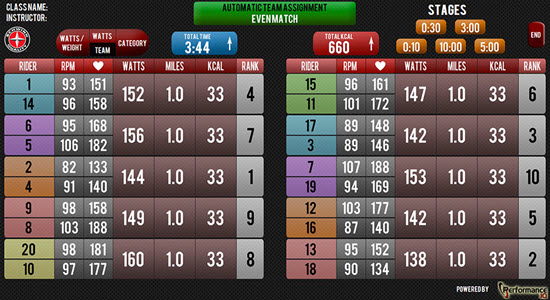
I'm seeing a bunch of clubs and studios having enormous success with performance data tracking and display systems. These systems connect to the consoles all of the new Indoor Cycle's with power and then display the information on a big screen + send out those informative emails that your participants love to receive.
Unfortunately some studios and/or Instructors aren't having the same amount of success. During many of my consultations with studio owners, I'm hearing them say that they would have appreciated (and benefited from) more in depth Instructor training, i.e. exactly how do we integrate these systems into an actual class?
So when I was at IDEA this past Summer I was encouraged to see that Schwinn Indoor Cycling has developed specific education, for the use of their Schwinn branded version of Performance IQ 🙂
To get the low down on what they are offering I invited Schwinn Indoor Cycling's Director of Education, Julz Arney, join me to discuss their education and get her thoughts on Best Practices for using Display Training.
During this interview Julz mentions that she would provide everyone with a PDF of her 10 Best Practices for using a Display Training system – here's the link to download it.
Would your club or studio benefit from additional Instructor training, regardless of the brand of cycle you're using? ICI/PRO has an experienced team that is available to provide intensive Instructor training at your location – please contact us and we can schedule a call to discuss your needs and see if we can help. We can also help you with decisions regarding Indoor Cycles, website design and performance data tracking and display systems.
How much planning did you do (or should you do), before launching your new cycling studio?
What research did you complete to understand the difference between successful studios and those that are struggling?
Fitness entrepreneur Callie Bowling has completed an exhaustive planning process in anticipation of opening a new Indoor Cycling Studio in Boise Idaho next fall. Callie interviewed over a dozen studio owners and she shares what's working… what's not and what she sees as the future of boutique Indoor Cycling studios.
This interview is an hour long, and needed to be to record much of what Callie has learned.
If you own a studio, or are considering opening one, I suggest grabbing a pen and paper, find a quiet spot (maybe with a hot tea) and listen to the podcast below in it's entirety, while taking notes – I consider this one of my top five episodes ever, it's that good 🙂
[wlm_private ‘PRO-Platinum|PRO-Monthly|PRO-Gratis|PRO-Seasonal|Platinum-trial|Monthly-trial|PRO-Military|30-Days-of-PRO|90 Day PRO|Stages-Instructor|Schwinn-Instructor|Instructor-Bonus|28 Day Challenge']
Update: This episode wasn't showing up in the podcast feed = I republished it and it appears fixed 🙂
[/wlm_private]
I was originally alerted to Callie Bowling by Amy – she had talked with her and was very impressed by how thorough she was in her business planning and the amount of research she had done via interviews with other studio owners.
So I reached out to Callie about possibly appearing on the show. This was her response 🙂
Let me give you a little background, so you can be thinking of questions on your end:
I have learned quite a bit actually, so much that just when my business plan and financials were all buttoned-up and ready to go – I was literally sitting across the table from my lender – I decided to go back to the drawing board to lay some more ground work (A MUST) and further examine my goals for my business and a smarter implementation strategy solely based on the experiences I obtained from interviewing eight indoor cycling studios across the nation. I learned a lot, the owners of these businesses were extremely generous with their time and the truly sensitive information they were divulging (the scary icky stuff like money)… lol, perhaps it's my degree in Psychology, but I've usually never had a problem getting people to open up around me… it's a double-edged sword 😉
I've learned this “dream” for us who wish to open these studios is always opened with the best intentions and out of a passion for the “sport”; we're all fitness enthusiasts who wanted to bring our passion to our communities and also make a fortune at it! I mean why not, the preliminary financials reflect success, which is a super simple function of attendance… it seems like a no-brainer right!? Get people in the door and become profitable… minimal overhead, no accounts receivables, cash based service industry, no inventory, etc. … the business model is set up for instant success! I'm sure you see I'm being simplistic and sarcastic, because nothing in life is ever that easy, and if it looks easy… take a deeper look, because you're probably missing something 🙂
With that said, there have definitely been some strong and shared commonalities amongst the failures and the successes amongst studio owners that can't be ignored… but, they're probably taboo to talk about so no one ever does, because no one likes to admit they've failed or fallen flat on their face… but, the truth is the truth, and in the same token no wants to invest their life's savings or nest egg into a business that might be doomed from the get-go, so we need to talk about it.
I will say, I don't know what came over me, but I emailed studios in XX, YY, ZZ, BB, NN, RR, and FF (on the podcast I won't disclose which states though to respect and maintain the anonymity of these studios, because in some states there is literally just one studio, so that would probably give it away, and the information they shared is certainly sensitive – we can just accurately say I reached out to studio owners across the nation) and I didn't know what to expect. I was equipped with my generic list of questions, but those soon fell to the wayside and the conversation became personal and very much a theoretical conversation about what it takes to survive as an entrepreneur in our industry and what those basic principles are.
Alas, we can go over all of this & more on the podcast, I'm loaded with info, lol, and honestly I think the things I am ready to touch on will be useful information not just for others in the “pre-startup” phase, but also for any studio owner in general that is perhaps struggling or “hemorrhaging” (as one studio owner stated) and can draw even the smallest parallels in their own business with what I have understood has also been choke holding others.
What do you think!??! 🙂
P.S. Here's the juiciest part… I think I see the future of our industry!!! lol… that may be a bit pompous for me to predict, but I've done a lot of research and there are signs and clues I'd love to cover!
Callie Kelley Bowling
Founder & CEO
CKB Fitness, Inc.