Technology can be a great thing for our classes – as long as all of your Instructors have been trained to use it properly.
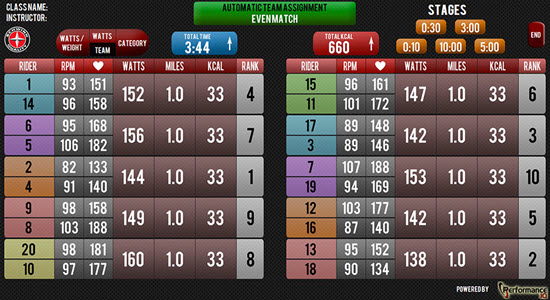
I'm seeing a bunch of clubs and studios having enormous success with performance data tracking and display systems. These systems connect to the consoles all of the new Indoor Cycle's with power and then display the information on a big screen + send out those informative emails that your participants love to receive.
Unfortunately some studios and/or Instructors aren't having the same amount of success. During many of my consultations with studio owners, I'm hearing them say that they would have appreciated (and benefited from) more in depth Instructor training, i.e. exactly how do we integrate these systems into an actual class?
So when I was at IDEA this past Summer I was encouraged to see that Schwinn Indoor Cycling has developed specific education, for the use of their Schwinn branded version of Performance IQ 🙂
To get the low down on what they are offering I invited Schwinn Indoor Cycling's Director of Education, Julz Arney, join me to discuss their education and get her thoughts on Best Practices for using Display Training.
During this interview Julz mentions that she would provide everyone with a PDF of her 10 Best Practices for using a Display Training system – here's the link to download it.
Would your club or studio benefit from additional Instructor training, regardless of the brand of cycle you're using? ICI/PRO has an experienced team that is available to provide intensive Instructor training at your location – please contact us and we can schedule a call to discuss your needs and see if we can help. We can also help you with decisions regarding Indoor Cycles, website design and performance data tracking and display systems.
How much planning did you do (or should you do), before launching your new cycling studio?
What research did you complete to understand the difference between successful studios and those that are struggling?
Fitness entrepreneur Callie Bowling has completed an exhaustive planning process in anticipation of opening a new Indoor Cycling Studio in Boise Idaho next fall. Callie interviewed over a dozen studio owners and she shares what's working… what's not and what she sees as the future of boutique Indoor Cycling studios.
This interview is an hour long, and needed to be to record much of what Callie has learned.
If you own a studio, or are considering opening one, I suggest grabbing a pen and paper, find a quiet spot (maybe with a hot tea) and listen to the podcast below in it's entirety, while taking notes – I consider this one of my top five episodes ever, it's that good 🙂
[wlm_private ‘PRO-Platinum|PRO-Monthly|PRO-Gratis|PRO-Seasonal|Platinum-trial|Monthly-trial|PRO-Military|30-Days-of-PRO|90 Day PRO|Stages-Instructor|Schwinn-Instructor|Instructor-Bonus|28 Day Challenge']
Update: This episode wasn't showing up in the podcast feed = I republished it and it appears fixed 🙂
[/wlm_private]
I was originally alerted to Callie Bowling by Amy – she had talked with her and was very impressed by how thorough she was in her business planning and the amount of research she had done via interviews with other studio owners.
So I reached out to Callie about possibly appearing on the show. This was her response 🙂
Let me give you a little background, so you can be thinking of questions on your end:
I have learned quite a bit actually, so much that just when my business plan and financials were all buttoned-up and ready to go – I was literally sitting across the table from my lender – I decided to go back to the drawing board to lay some more ground work (A MUST) and further examine my goals for my business and a smarter implementation strategy solely based on the experiences I obtained from interviewing eight indoor cycling studios across the nation. I learned a lot, the owners of these businesses were extremely generous with their time and the truly sensitive information they were divulging (the scary icky stuff like money)… lol, perhaps it's my degree in Psychology, but I've usually never had a problem getting people to open up around me… it's a double-edged sword 😉
I've learned this “dream” for us who wish to open these studios is always opened with the best intentions and out of a passion for the “sport”; we're all fitness enthusiasts who wanted to bring our passion to our communities and also make a fortune at it! I mean why not, the preliminary financials reflect success, which is a super simple function of attendance… it seems like a no-brainer right!? Get people in the door and become profitable… minimal overhead, no accounts receivables, cash based service industry, no inventory, etc. … the business model is set up for instant success! I'm sure you see I'm being simplistic and sarcastic, because nothing in life is ever that easy, and if it looks easy… take a deeper look, because you're probably missing something 🙂
With that said, there have definitely been some strong and shared commonalities amongst the failures and the successes amongst studio owners that can't be ignored… but, they're probably taboo to talk about so no one ever does, because no one likes to admit they've failed or fallen flat on their face… but, the truth is the truth, and in the same token no wants to invest their life's savings or nest egg into a business that might be doomed from the get-go, so we need to talk about it.
I will say, I don't know what came over me, but I emailed studios in XX, YY, ZZ, BB, NN, RR, and FF (on the podcast I won't disclose which states though to respect and maintain the anonymity of these studios, because in some states there is literally just one studio, so that would probably give it away, and the information they shared is certainly sensitive – we can just accurately say I reached out to studio owners across the nation) and I didn't know what to expect. I was equipped with my generic list of questions, but those soon fell to the wayside and the conversation became personal and very much a theoretical conversation about what it takes to survive as an entrepreneur in our industry and what those basic principles are.
Alas, we can go over all of this & more on the podcast, I'm loaded with info, lol, and honestly I think the things I am ready to touch on will be useful information not just for others in the “pre-startup” phase, but also for any studio owner in general that is perhaps struggling or “hemorrhaging” (as one studio owner stated) and can draw even the smallest parallels in their own business with what I have understood has also been choke holding others.
What do you think!??! 🙂
P.S. Here's the juiciest part… I think I see the future of our industry!!! lol… that may be a bit pompous for me to predict, but I've done a lot of research and there are signs and clues I'd love to cover!
Callie Kelley Bowling
Founder & CEO
CKB Fitness, Inc.
How cool would it be if your insurance company paid for indoor cycling classes?
A national policy of Prescriptive Exercise would be the holy grail* for small studio owners.
Imagine; A new client walks in with her doctor specified exercise regimen for you to “fill”, just like at a pharmacy. As an approved provider, you and your studio would provide the required exercise and then bill the clients insurance company… and not at your normal class rate – at a much higher rate in recognition of your fitness expertise.
A fantasy? Nope**, not if you're near The Wellness Institute in Winnipeg Canada. Doctors there are actually writing detailed prescriptions for exercise. How cool is that?
Doctors at a unique medical facility in Winnipeg are starting to write some unusual prescriptions.
“A lap a day keeps the doctor away” is one of the mottos at the Seven Oaks Wellness Institute (SOWI), a fitness facility attached to the Seven Oaks General Hospital on Leila Avenue, where doctors have started prescribing exercise instead of pills.
Dr. Kevin Saunders is one of the founders of the SOWI and the medical director. He said exercise is an effective treatment for all kinds of illnesses, including hypertension, Type 2 diabetes, high cholesterol and even some forms of cancer.
The facility offers clients a more holistic approach to fitness, helping people from all walks of life to understand what kinds of exercise they should be doing, and what they need to avoid if it puts their health in jeopardy.
You'll note that what Dr. Sanders is targeting with this program are Special Populations of people who would benefit from physical activity. I'm guessing you'd have a little trouble getting a prescription for a USAT Triathlon coach to get you ready for your next Ironman 🙂
What has me most excited here is the potential for prescriptive exercise for people suffering from Parkinson's Disease. It's been shown repeatedly that people of all ages with PD respond well to Indoor Cycling classes. Especially classes that are designed and taught by a Parkinson's Cycling Coach. Indoor Cycling studios already have the necessary tools to conduct this hugely beneficial classes. They're best held around 10:30 – 11:30 in the morning, which is normally a time without a scheduled class
I did some research and found an excellent article here at emedicine.medscape.com that explains in detail what Perscriptive Exercise is (different from physical rehab) and includes a number of areas where exercise is typically prescribed by a physiian.
Background
Exercise prescription commonly refers to the specific plan of fitness-related activities that are designed for a specified purpose, which is often developed by a fitness or rehabilitation specialist for the client or patient. Due to the specific and unique needs and interests of the client/patient, the goal of exercise prescription should be successful integration of exercise principles and behavioral techniques that motivates the participant to be compliant, thus achieving their goals.[1, 2, 3, 4, 5, 6, 7]
Components of exercise prescription
An exercise prescription generally includes the following specific recommendations:
Type of exercise or activity (eg, walking, swimming, cycling)
Specific workloads (eg, watts, walking speed)
Duration and frequency of the activity or exercise session
Intensity guidelines — Target heart rate (THR) range and estimated rate of perceived exertion (RPE)
Precautions regarding certain orthopedic (or other) concerns or related comments
Note that a properly structured, Power based Indoor Cycling class would easily include all of the stated components.
Consider this simple prescription:
Type of exercise or activity – Indoor Cycling class.
Specific workloads – Below, @ and Above riders observed 4 minute Best Effort PTP Watts or FTP if known
Duration and frequency of the activity or exercise session – 3 x 60 min classes weekly
Intensity guidelines — each 60 class to include: 5 x 5 min intervals @ PTP, 3 x 1 min intervals Above PTP, that remainder of class Below PTP and Above VT1 (staying aerobic) + adequate recovery after each @/Above interval.
Precautions – None
What you'd have is essentially an endurance training program, written by an MD.
Taking this further. If you were to incorporate the rider's performance data capture, from a Display Training system like Performance IQ or Spivi, your doctor could review your progress = make informed recommendations for future exercise prescriptions. Wouldn't that be awesome?
If you can offer any additional information about prescriptive exercise, I'd love to hear from you!
*Yes, I'm aware that many insurance programs offer a discount/rebate for club dues – if you attend a speciaf number of days a month. This is very different.
** I don't know the specifics of Canada's reimbursement system, but I'm looking into it. I have asked for a representative join me on the Podcast to discuss all of this.
Fitness author Pamela Light joins me to discuss her article in the latest IDEA Fitness Journal — Crystal-Clear Cuing for Indoor Cycling. In it, Pamela encourages Instructors to: Be smart about the exertion scale you use to help participants get the best ride.
Excellent Instructors use a system to describe what they expect for performance, and it's usually a combination of what they've learned in certification courses and what they've gleaned through real-world experience. Indoor Cycling teachers often rely on numbers to convey effort. While this is a good idea at face value, there are many variations on a theme.
Listen below to Pamela expand on each of the seven component parts she feels are important to Crystal Clear Cuing!
This maybe an option to adding cadence/RPM to any conventional Indoor Cycling Bike
Teaching to a room full of new Indoor Cycles with power & cadence monitors is awesome, if your club has made, or is ready and willing to make the investment. So what are the options for adding metrics to conventional cycles like the Star Trac Spinner® Pro, NXT or those made by Schwinn and others?
Let's get this part out of the way. At this time there is no, known option to add a power meter (that displays watts) to any Indoor Cycle that wasn't designed with power as an option. I get that question a lot.
How about a speed/distance meter? Nope. You can't accurately measure speed and/or distance by measuring the rotations of the flywheel.Could you install a bicycle computer and would it display something like speed/distance? Yes, but what you're seeing is nonsense. Years ago I watched my club add cheap bike computers to our NXTs in preparation for an indoor triathlon. It was comical to watch everyone spinning away like hamsters on crack, trying to reach their required distance. Please don't waste your time or money on this.
What can be added is a cadence (RPM) meter to display a riders pedaling speed. Not the same as power/watts, but it would make a big improvement to your class and simplify your cuing. I've talked to dozens of instructors who really aren't interested in teaching to power… but they almost all appreciate cuing to RPM and having everyone seeing their cadence.
Your options for installing a cadence meter to an indoor cycle are:
Wired Cadence Computer (NOT Recommended) – you'll need to run the wire down to the sensor added to one crank arm and the computer either needs to be attached to the cycle's frame (because the handlebars move) or you'll need to leave a bunch of cable slack so you can raise the bars. Looks tacky and I guarantee someone will rip off the wires no mater how carefully you route them.
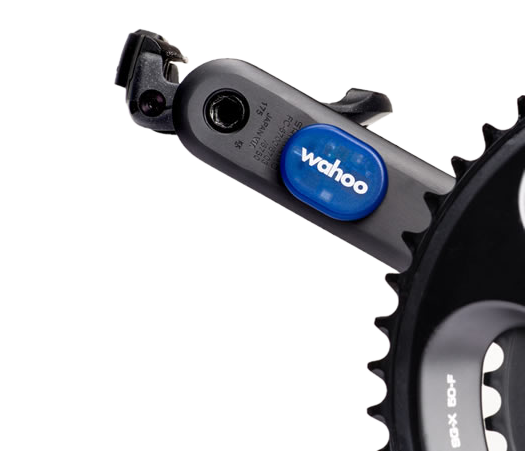
A wireless cadence sensor used with an iPhone or Android device. The picture at the top of this post shows the Wahoo Cadence Sensor which works with any of the dozens of free cycling Apps. Installation couldn't be easier > you just stick it on one crank arm and pair it to your phone. There aren't any magnets. This might not be the best option for a studio, but would be perfect for anyone training at home.
Speaking of Wahoo – I hear they are coming out with their new TICKR HR Strap – a Heart Rate strap that transmits both ANT+ and Bluetooth. Why this is important is your iPhone/Droid doesn't pickup ANT+, only Bluetooth. In the past you'd need to purchase a Wahoo ANT+ Key, a “Dongle” to plug into your device to read ANT+ signals. It's supposed to be out in a month or so and I'll let you know if you're on our newsletter list. You can join for free if you aren't.