Let's talk a little bit about resistance today. While I do not want to get into the “how much should I add” debate, there certainly is a minimum amount of resistance that every rider should
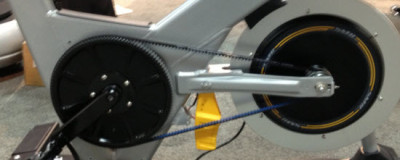
Big drive gear x small driven gear = very fast flywheel RPM
have on their bike. The true importance of resistance comes about due to the existance of a flywheel on an IC Bike.
Most indoor bikes have a weighted wheel (called a flywheel) to provide inertia and simulate the feel of riding a bicycle outdoors. It is important that riders remain in control of the flywheel at all times, particularly at higher RPMs, and not let the flywheel control them. Indoor bikes are designed with a knob, or lever, for controlling the amount of resistance placed on the flywheel which consequently affects how hard a rider will have to work in order to pedal the bike. This resistance can be either mechanical (the traditional friction pad) or it can be magnetic. The primary advantage of magnetic resistance is that it does not wear down over time, so it should provide a more consistent resistance over the life of the IC Bike. It should be noted that even with the last of friction and wear, magnetic resistance should be routinely calibrated due to operation cable stretching and general wear. This can be especially important on IC Bikes where the wattage is calculated (usually using the distance of the magnet from the wheel) rather than measured with a strain gauge.
Generally, I start my riders off at enough resistance to produce 25% to 50% of their bodyweight in pounds in watts (Watts/LB = 0.25) which generally is enough to keep them settle in the saddle and provides a good starting point. Riders should NOT pedal the bike without resistance at any time and should be encouraged to use the appropriate amount of resistance at all speeds and effort levels. Lack of appropriate resistance is the primary cause of “Hip Popping” in riders which is where the hips bounce quickly on the seat as the rpms are increased. There should be at least enough resistance on the bike to keep the hips settled and smooth in the saddle.
Please look for the next section of this series for the continued conversation and some safety specifics.
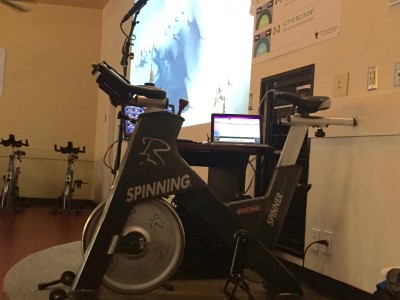
After an exhausting but exhilarating week of grand opening festivities, I’m thrilled to unveil the new Spinning® studio at Lipscomb University in Nashville, TN.
Transforming a basketball gym into an indoor cycling studio was challenging, but with the help of a passionate Student Activities Staff and talented Theater Department, the facility unfolded on schedule, came in under budget, and the final result was simply breathtaking. Students and faculty members were thrilled to return to campus to discover indoor cycling had arrived!
Kick off week included team teaching with five classes daily, self-guided scenic rides projected on a large movie screen, interviews with local newspapers, and best of all – athletic coaches began their spring training in the new Spinning® studio!
If you’d like to spice up your health club’s indoor cycling studio and create a wave of fresh excitement, try a few of these simple design elements I implemented at Lipscomb University.
The overall concern of any fitness professional should be safety. We must always make every effort to provide a safe environment for those taking our classes. Health clubs and fitness studios are responsible for providing a safe environment and equipment for their members and staff. As instructors, our responsibility is to ensure that every aspect of our indoor cycling class, from specific training concepts to the use of the bikes, is conducted using safety guidelines.
Currently, there is a vast amount of discussion in the indoor cycling industry over what truly represents safe practices. On one side of the debate is the “Keep it real” faction. Their side of the safety story is that instructors should not do anything on an inside bike that they would not do on their bicycle. They consider anything outside of their limited movements on the indoor bike as dangerous and harmful to the students. This stance always evokes some debate in itself as there are many movements and riding styles that are done on bicycles that certainly even the boldest of instructors would never attempt on an indoor bike. For example, jumping on mountain and bmx bicycles, hopping over potholes or curbs on a road bicycle and many other necessary elements of outdoor riding that should never make their way into the studio. Generally, the rides from this group of instructors focus on a training objective and the music is considered secondary. This group considers themselves the traditional or pure indoor cycling instructors.
The other side of the debate is held by the “Rhythm” indoor cycling instructors. This group seemingly has a most things go approach to indoor cycling and often their rides include the use of small hand weights, quickly cycling jumps (or tap backs) and other non-traditional movements on the indoor bike. They contend that there is no scientific, or medical, evidence that would suggest that the movements they perform on the indoor bike are actually dangerous or cause injury to the students. Generally, the rides from this group of instructors focus on the music and the dancing on the bike and the clear training objective is considered secondary.
We look at this debate from a wider perspective. As a group exercise professional, we believe that your job is to get people off of the couch and entice them to join in an active lifestyle. We like to take the middle road on teaching styles: all rides should contain sound and clear training principles, but we also realize that music is perhaps the most important aspect of the ride construction. While delivering a quality class that gives the rider’s results is important, people with not continue to train with you unless the music is something they like and most importantly fits the work being performed in BPM, emotion and intensity.
Please look for the next section of this series for the continued conversation and some safety specifics.
So if you're not including jumps in your classes… why aren't you?
The proper way to do this would be to ask you personally; so why don't you include jumps in your classes? But I can't [wlm_firstname], because you're there, and I'm here. So let me take a few guesses as to why you are reluctant to include these:
#1 I don't feel I can properly demonstrate jumps and don't want to look foolish.
I totally get this. If you didn't come from a Group Fitness background – or you suffer from what's called Caucasianism [To be completely and utterly rhythmically challenged. Someone who does not know what a beat is, nor how to stay on it.] you may have trouble finding and pedaling to the beat. To me, this is the number one reason many Instructors don't like Jumps – or any other form of rhythmic movements done on an Indoor Cycle, they simply can't do them… so they don't.
Trust me, you're not alone. I've experienced multiple classes where the Instructor appeared to have zero sense of rhythm. Based on what I observed at WSSC, there are a larger percentage of both male and female instructors who either can't connect their cadence to the music – or choose not to follow the beat.
To perform Jumps that are controlled, smooth and orderly, your movement must be RIGHT-ON-THE -BEAT and strictly follow the phrasing. My preference is to always Jump on a hill with a level of resistance that has you feeling you need to stand – which is why we come out of the saddle, isn't it?
Listen to these short example MP3s to get a sense of how you count jumps properly.
[wlm_private ‘PRO-Platinum|PRO-Monthly|PRO-Gratis|PRO-Seasonal|Platinum-trial|Monthly-trial|28 Day Challenge']
Let's start with Strangle Hold – a perennial favorite of mine for 74RPM Jumps following the 8 count praising.
Here's an example of some club music – slower @ 63RPM and it feels like you should count the phrasing as 4 vs 8 counts.
It isn't necessary to cue continuously > I like to get everyone started and then Jump with just the music. Depending on the track, you might have everyone stop moving and remain either up or down during a quite section. This introduces some additional challenge for both you and your riders as you focus on the phrasing, so you re-start at just the right point.
#2 If you don't do it on an outdoor bicycle… you don't do it inside… end of discussion.
Whenever I hear Instructors parrot “If you don't do it outside…” they're saying it like it's a law or something. Who exactly decided this? There isn't any “rule” – but why do some people act as if it is?
What's the purpose of deliberately removing banishing a fun and challenging activity from our Indoor Cycling classes? My guess is that it has something to do with #1 – but they don't want to admit it.
One reason maybe peer pressure. Many Instructors are competent outdoor cyclists. When they look up at their classes they see other cyclists riding in front of them. It's easy to understand why they would feel compelled to demonstrate good form and only use “cycling specific” movements. No one wants to embarrass themselves in front of their peers – right?
But is it proper to direct your class specifically toward the few cyclists in your classes?
I don't feel it is. When I'm consulting with a studio owner I ask a lot of early questions. The most important is; what is the current percentage of cyclists vs. regular folks in all of your classes? With the exception of studios that offer special Endurance /Performance training classes, the percentage of real cyclists should be 15% or less of the total number of participants for all classes. I have an interview going up this weekend with an Instructor who teaches at very popular club in Costa Mesa, CA. 50 bike classes are sold out for much of the week and they see <5% cyclists.
Wait… why don't you want a large percentage of cyclists? It's a pretty involved discussion and I'm planning to write about it in the near future. The short answer is this: If your class is directed at cyclists, it will come at the expense and/or exclusion of the people who are more inclined to ride at your studio regularly, especially during the summer months. Those people are middle aged women who make up the majority of all types of group fitness classes. They should be the majority of your customers and the primary focus of your classes.
If you don't believe me, go to the most popular class at your club or studio. A quick head count should confirm what I'm saying.
#3 My certification didn't include them – so don't.
My response to this would be to ask a bunch of questions:
How accurately or completely do you follow your initial certification?
Do you do exactly what your were first taught?
Have you, over time, added additional elements into your class that you learned here at ICI/PRO or picked up from another Instructor?
During my latest interview with Julz Arney, she explained that the current Schwinn certification they are offering includes information that's 40% new content. My point here is; there are a lot of things your certification didn't cover and what was included changes over time.
Why not decide for yourself if Jumps are something you should add to your classes?
#4 I read somewhere that they aren't safe.
Performed correctly; climbing gear and following along to a 60 – 75RPM cadence, Jumps are IMO perfectly safe. Sure there were idiots way back when, who tried to Jump randomly (popcorn style) while pedalling at 110+ with no resistance. BUT YOU WOULD NEVER DO THAT… WOULD YOU?
There's also a segment of “experts” in our industry who, in their crusade to remove anything that doesn't follow the If you don't do it outside… thinking, have used concerns about safety as a way to dissuade Instructors from offering many forms of movement from our classes.
My goal with this article is to encourage you to be open minded. Decide for yourself if you should include Jumps and other forms of movement in your classes. [/wlm_ismember]
#5 I don't want to embarrass anyone / I'm concerned some in my class won't be able to learn to jump.
If you came to a class and the Instructor stood up in front and announced; I can tell just by looking that many of you won't be able to perform the activity I had planned for today… so we'll just sit and pedal for an hour. You'd be insulted, wouldn't you? I know I would.
[/wlm_private]
Your participants want to be challenged. I'm convinced that much of the appeal of SoulCycle and their clones is that the movements in these classes are technically difficult to perform correctly. Riders leave thinking “I need to come back next week and show that Instructor (or person riding next to me) that I can do those Jumps as smoothly and rhythmically as everyone else in the room.
And that motivation is part of what could be filling your classes each week 🙂



 After an exhausting but exhilarating week of grand opening festivities, I’m thrilled to unveil the new Spinning® studio at Lipscomb University in Nashville, TN.
 re responsible for providing a safe environment and equipment for their members and staff. As instructors, our responsibility is to ensure that every aspect of our indoor cycling class, from specific training concepts to the use of the bikes, is conducted using safety guidelines.