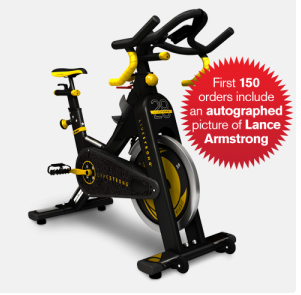
I just found this, but it may be old news to you. I'm not sure if it's club quality but it's sure nice looking. Here is what Lance says about Livestrong fitness equipment:
I'm excited to introduce a new line of LIVESTRONGâ„¢ fitness equipment where every piece sold raises money for the fight against cancer. Our team has put countless hours of development into making these products worthy of the LIVESTRONGâ„¢ name, and I am proud of this partnership. Staying fit has always been an important part of my life and leading an active lifestyle is one of the best ways to stay healthy.
You will be hearing more about “Q Factor” from Spinning® / Star Trac so I thought you may appreciate knowing what it is, in case it comes up in conversation.
Q Factor (also know as Tread) is simply the separation/distance between the two pedal cranks of a bicycle or Indoor Cycle. Here are two articles here and here that discuss this measurement and this picture illustrates how it is measured.
What prompted this post was a conversation I had last week with Josh Taylor from Spinning® about the changes to the latest version of the Spinner® NXT and the new Spinner® Blade. Josh explained to me that one of their design criteria for both cycles was to reduce the Q factor, without reducing the reliability of the Bottom BracketWikipedia article. The purpose of the change was to make the new Spinners more Bio-Mechanically efficient. You've no doubt heard about “knee over pedal” that can be adjusted by seat position and shoe cleat alignment. Alignment between Hip Joint > Knee > Feet is also important. For some people bringing your feet closer to their natural spacing will maximize the muscular forces applied to the pedals. Notice I didn't say all people. According to the company who manufactures the KneeSaver there are people (specifically those with wider hips) who benefit from a wider Q-Factor.
You can read more from Josh at his own blog jtcycle.blogspot.com and it includes his descriptions of the new Spinner® NXT and Blade.
I wanted to get a point of comparison so I pulled out my trusty vernier caliper and measured a few Indoor Cycles + two of my road bikes to see how they compared:
Amy's Trek Women Specific Road bike = 156mm
Our Trek Tandem Road bike = 165mm
Spinner® NXT = 170mm
Schwinn AC Performance = 170mm
Keiser M3 = 197mm
New Spinner NXT and Blade will be 158mm per Josh Taylor, which is very narrow.
There are a number of design factors that determine Q Factor on an Indoor Cycling bike:
Interference from the frame, guarding or other component requires the pedal crank arms be spaced further apart. This is especially obvious on the Keiser M3 and what causes their 197mm Q Factor. The carrier assemble for the Magnetic Resistance on the M3 sticks out on the RH side requiring a special pedal crank assembly.
Are the pedal cranks off the shelf, or custom made?
The width of the Bottom Bracket used.
Josh explained to me that once they set a target Q Factor for the new Spinners they realized that they would need to focus their engineering creativity on reducing the width of the Bottom Bracket. Not an easy task. The Bottom Bracket is the most highly stressed part on any pedal driven machine. Think about all the forces that need applied here; the rider's body weight + the twisting force (torque) that's applied to a machine that doesn't move. The Bottom Bracket is made up of an axle that's supported by two roller bearings, one one each end. How far the bearings are apart effects the amount force applied. The wider you space the bearings (and the frame that supports them) = better, which is OK unless you are trying to reduce the Bottom Bracket's width.
Star Trac's solution to this problem was to design a narrow Bottom Bracket with larger bearings and strengthening the frame that supports these bearings. To ensure the crank arms stay securely attached they are using a Morris Taper, instead of the typical interference fit and bolt used in the past. Based on the dimensions Josh is reporting they now have the Indoor Cycles with the narrowest Q Factor on the market.
Why should you care?
I know from experience that the narrower the Q Factor, the closer my feet are to each other, the more comfortable I feel riding a bicycle. This is especially true on a long ride and some cyclists will go to great lengths to reduce their total Q Factor by adjusting shoe cleat position, effectively moving their feet as close together as possible.
But we aren't talking about your personal bicycle here, where changes and adjustments can be made to fine tune the fit of the owner. These are Indoor Cycles. They're designed to ridden by every conceivable variation of human adult; short, tall, wide hips, narrow hips, leg length disparities, etc… Will some in your class notice or appreciate the difference? Maybe. But I personally don't see how a narrower Q-Factor will help our typical students in any measurable way.
There's a lot of pressure on clubs and studios to upgrade to the latest technology… those basic, conventional bikes just don't cut it when there's a new competitor down the street.
So what does a struggling fitness studio do to come up with the cash (two grand or more per cycle) for a room full of the latest from Schwinn, Star Trac, Keiser or FreeMotion?
How about running an online fundraising campaign to raise the money? Could that ever work?
We will know next month when Ypsi Studio closes their indiegogo campaign on September 21st. They're running what they call SchWinning at Ypsi Studio. Owner Julia Collins is hoping to raise enough money to upgrade to new Schwinn AC Performance Indoor Cycles for her Ypsilanti, Michigan studio.
With clients looking to stay on track with the most up to date exercise equipment, Ypsi Studio owner Julia Collins has launched a Indiegogo campaign to help raise the money needed to upgrade the indoor-cycling bikes the studio is currently using.
“I’m a small-business person and I’ve been in this business for 10 years. Gradually over those 10 years I’ve expanded from a tiny one room place to a place with two floors and different classes and several employees,” Collins said. “Every time I was making profits, I was putting it right back into the business.”
However, those profits are not enough to upgrade the equipment for her customers.
Collins is hoping to raise $25,000 so the studio can purchase 13 new indoor-cycling bikes. Currently the studio has several bikes they’re using that are in good condition, but they’re nearly 10 years old.
According to the campaign website the bikes the studio is looking to purchase are comparable to bikes offered in other fitness studios in the area. They will not only allow the user to exercise, but also monitor RPM, calories burned, heart rate and how long you've been riding.
Didn't the author leave out the most important part? Power!
Good luck with this Julia! I've made a note to follow up with the results of her campaign. You can learn more and pledge your support here.
Schwinn is promoting an improved version of the Schwinn AC Performance Indoor Cycle, calling it the “Plus”. The biggest changes are to the saddle and handlebar Fore & Aft adjustment mechanism. Earlier versions of the AC Performance limited both adjustments to three set position that were labeled “+” / “0” / “-“, with “0” being Neutral and the others ahead and behind. I heard a number of concerns that because people don't come in only three sizes, only offering three positions were too coarse, not allowing for the finer level of fitting we prefer to bring to our students.
The new AC Plus solves that with a new method that they say offers an “Infinite” level of adjustability. Here's a link to the new brochure you can download.
While we are on the subject of saddle adjustments, now is the time to go in review this video about ensuring all your Indoor Cycles are setup correctly. It's very important that once a student is setup correctly, that position is the same on every cycle in your studio.
At the end of our first class on the new FreeMotion Indoor Cycles last Sunday, I spent close to 30 minutes answering questions from participants about the cycles and the Power meters:
How many Watts should I be making?
Why did I have to turn it up so high before I saw any real increase in watts… didn't you say power had a lot to do with cadence?
It said I was riding at 23 mph… was I really?
Why doesn't the calorie totals match up between my Garmin Heart Rate monitor and the console?
Why could I create more power, at a lower heart rate, sitting instead of standing?
I felt like I needed to work so much harder on this bike… why is that?
I'm going to be soliciting answers from our Master Instructor PRO Team for their responses to many of these questions. But I wanted to address the specific question/comment mentioned by multiple riders; these bikes make you work a lot harder – they're more like riding outdoors… why is that?
For those of you who have ridden (or teach on) a FreeMotion S11 series, Keiser M3 or Schwinn AC Indoor Cycle you probably already know the answer: Magnetic Resistance 🙂
And no, it isn't because they are watching their watts readings.
Magnetic Resistance more closely resembles the effect Air Resistance has on an outdoor cyclist, which if you've ridden outside, or simply stuck your hand out the window of a moving car, realize is substantial. On a flat road above 20 miles per hour >95% of your energy is being used to overcome wind resistance.
I found this graph (and added some additional details) to help you understand the differences.
For the sake of simplicity I have taken some liberties with the graph, but here's what I feel you should know:
The Horsepower graph is based on: 0.2hp = Strong Cyclist, 0.4hp = Competitive Cyclist, > 0.6hp is Tour de France caliber Pro Cyclist.
The thin purple and blue lines represent the amount of Power needed to overcome wind resistance and ride at the listed speeds. Notice how sharply the line curves upwards and more than twice the Power is needed to ride at 30 mph vs. 20 mph.
The dashed blue and red lines are the effective resistance created by Magnetic and Friction based Indoor Cycles respectively.
In my Epic Wine Country Audio PROfile I offered these suggestions for cueing load/resistance dependent on the type of friction system your cycles use:
How you cue the addition of intensity is very important in an Indoor Cycling class of any format and its different dependent on the type of Indoor Cycle you’re riding.
– With any Indoor Cycle that uses friction to create the resistance I suggest adding resistance to cadence. Class is pedaling ~ 90 RPM and then add load to reach intended intensity. This has the effect of preventing “runaway pedals” when your students start with a small amount of load and then accelerate. The momentum in the spinning flywheel negates what little load there was.
– If you are riding a FreeMotion S11, Keiser M3 or Schwinn AC with magnetic resistance you can add resistance to cadence or you can do the exact opposite, adding cadence to resistance.
You've never heard that before, have you? It’s why I see magnetic resistance as being superior.
Here’s why:
My biggest struggle (besides getting people to be quiet) is how to best communicate load in class. If you have been paying attention in class you have noticed that when you slow your pedals (on a conventional friction IC – any Spinner, etc… ) they get heavier. We have all seen the person who was supposed to be accelerating out of a climb start bouncing like they have no resistance at all. This happens because as your student pedals faster, the added centrifugal force overcomes the fixed amount of friction, making it easier and easier to pedal, until it’s like they have no load at all. Not Good! Cycling is all about endurance. We want them to endure it! The solution is to establish leg speed and then adjust load to regulate the work they are doing.
Indoor cycles with magnetic resistance (S11, M3 and AC) work very differently. As the speed of the flywheel increases the Eddy Currents that create the load increase as well. So these Indoor Cycles actually get harder to pedal as cadence increases, just like a real bicycle. So with these types of cycles cue your students to set their load at a slower RPM and then simply increase cadence to add intensity.
Give this a try in you next class and let me know the results.
We are very excited to announce a new partnership with online Indoor Cycle parts distributor SPORTSMITH that will save you an additional 10% on replacement parts for your Keiser, LeMond, Livestrong, Schwinn, Star Trac and Tomahawk Indoor Cycles.
A year ago when I was looking for a company to distribute my Red Pedal Tool, I did a bunch of research into who was the best company in this space. As you would guess, there are a number of business selling replacement parts. After doing some virtual shopping to find who was offering the best pricing on common replacement parts and talking to some purchasing agents for large club chains, I decided to go with SPORTSMITH.
Everything was going great until I got an email from Troy Mosley, their Marketing Manager;
Hey John,
I've got an idea! What would you think about your own Indoor Cycling bike parts store?
I told Troy that it sounded pretty cool, but that our first priority is that any relationship needs to first bring additional value to our community of Indoor Cycling Instructors and Studio Owners.
Can we offer an additional discount? Was my response. After considerable arm-twisting Troy's answer was yes… 10%
Now I know that for some of you 10% may not sound like much, but in a very competitive online market it's huge.
Let's say your studio has 30 old Spinner NXTs that you need to nurse along for another year, until you are ready to upgrade to something with Power. They all need new brake pads and the drive lines are completely worn out = requiring new drive chains and sprockets. The normal SPORTSMITH replacement parts cost (Crank Arm Set, Flywheel Sprocket and Chain) for each cycle is $104.47. Multiply that times 30 cycles = $3134.10 … we just saved your studio $313.00 – which would go a long way toward covering the cost of the labor needed to install everything 🙂