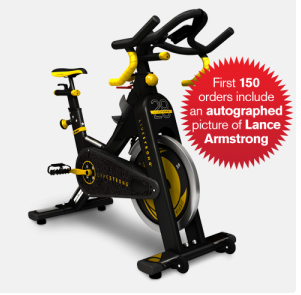
I just found this, but it may be old news to you. I'm not sure if it's club quality but it's sure nice looking. Here is what Lance says about Livestrong fitness equipment:
I'm excited to introduce a new line of LIVESTRONGâ„¢ fitness equipment where every piece sold raises money for the fight against cancer. Our team has put countless hours of development into making these products worthy of the LIVESTRONGâ„¢ name, and I am proud of this partnership. Staying fit has always been an important part of my life and leading an active lifestyle is one of the best ways to stay healthy.
You will be hearing more about “Q Factor” from Spinning® / Star Trac so I thought you may appreciate knowing what it is, in case it comes up in conversation.
Q Factor (also know as Tread) is simply the separation/distance between the two pedal cranks of a bicycle or Indoor Cycle. Here are two articles here and here that discuss this measurement and this picture illustrates how it is measured.
What prompted this post was a conversation I had last week with Josh Taylor from Spinning® about the changes to the latest version of the Spinner® NXT and the new Spinner® Blade. Josh explained to me that one of their design criteria for both cycles was to reduce the Q factor, without reducing the reliability of the Bottom BracketWikipedia article. The purpose of the change was to make the new Spinners more Bio-Mechanically efficient. You've no doubt heard about “knee over pedal” that can be adjusted by seat position and shoe cleat alignment. Alignment between Hip Joint > Knee > Feet is also important. For some people bringing your feet closer to their natural spacing will maximize the muscular forces applied to the pedals. Notice I didn't say all people. According to the company who manufactures the KneeSaver there are people (specifically those with wider hips) who benefit from a wider Q-Factor.
You can read more from Josh at his own blog jtcycle.blogspot.com and it includes his descriptions of the new Spinner® NXT and Blade.
I wanted to get a point of comparison so I pulled out my trusty vernier caliper and measured a few Indoor Cycles + two of my road bikes to see how they compared:
Amy's Trek Women Specific Road bike = 156mm
Our Trek Tandem Road bike = 165mm
Spinner® NXT = 170mm
Schwinn AC Performance = 170mm
Keiser M3 = 197mm
New Spinner NXT and Blade will be 158mm per Josh Taylor, which is very narrow.
There are a number of design factors that determine Q Factor on an Indoor Cycling bike:
Interference from the frame, guarding or other component requires the pedal crank arms be spaced further apart. This is especially obvious on the Keiser M3 and what causes their 197mm Q Factor. The carrier assemble for the Magnetic Resistance on the M3 sticks out on the RH side requiring a special pedal crank assembly.
Are the pedal cranks off the shelf, or custom made?
The width of the Bottom Bracket used.
Josh explained to me that once they set a target Q Factor for the new Spinners they realized that they would need to focus their engineering creativity on reducing the width of the Bottom Bracket. Not an easy task. The Bottom Bracket is the most highly stressed part on any pedal driven machine. Think about all the forces that need applied here; the rider's body weight + the twisting force (torque) that's applied to a machine that doesn't move. The Bottom Bracket is made up of an axle that's supported by two roller bearings, one one each end. How far the bearings are apart effects the amount force applied. The wider you space the bearings (and the frame that supports them) = better, which is OK unless you are trying to reduce the Bottom Bracket's width.
Star Trac's solution to this problem was to design a narrow Bottom Bracket with larger bearings and strengthening the frame that supports these bearings. To ensure the crank arms stay securely attached they are using a Morris Taper, instead of the typical interference fit and bolt used in the past. Based on the dimensions Josh is reporting they now have the Indoor Cycles with the narrowest Q Factor on the market.
Why should you care?
I know from experience that the narrower the Q Factor, the closer my feet are to each other, the more comfortable I feel riding a bicycle. This is especially true on a long ride and some cyclists will go to great lengths to reduce their total Q Factor by adjusting shoe cleat position, effectively moving their feet as close together as possible.
But we aren't talking about your personal bicycle here, where changes and adjustments can be made to fine tune the fit of the owner. These are Indoor Cycles. They're designed to ridden by every conceivable variation of human adult; short, tall, wide hips, narrow hips, leg length disparities, etc… Will some in your class notice or appreciate the difference? Maybe. But I personally don't see how a narrower Q-Factor will help our typical students in any measurable way.
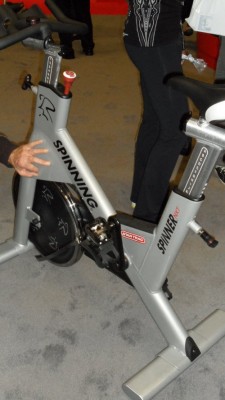
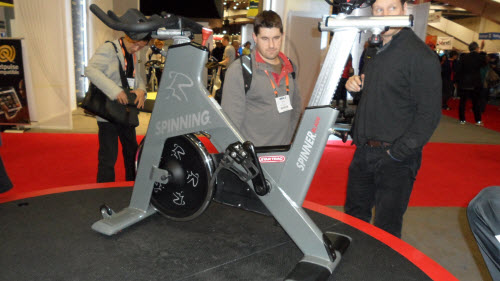
Here are pictures from IHRSA of the new Spinner NXT and the all new Spinner Blade. I'm going to guess that Spinning still sees a large market for conventional Indoor Cycles that would cause them to redesign the NXT.
4/15 update: I had a very informative discussion with Josh Taylor today about all the changes they have made to the NXT. I hope to have a separate post about it early next week.
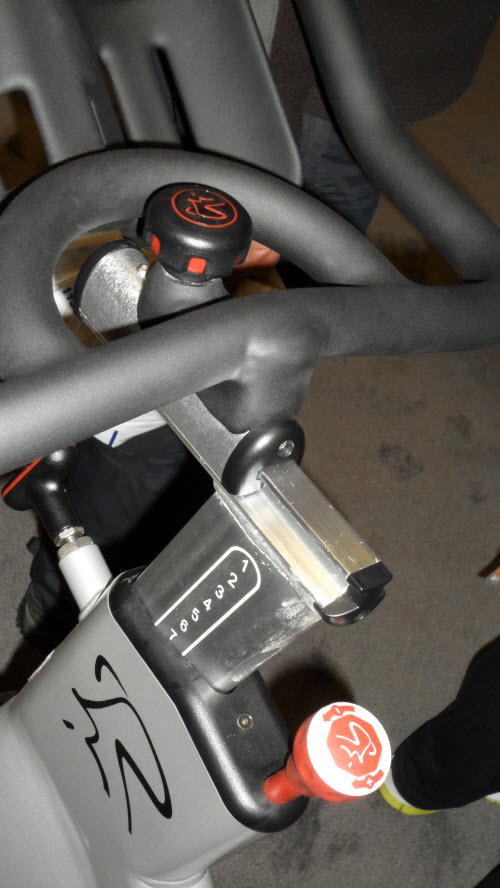
The only significant change I can see is the addition of fore/aft adjustment of the handle bars.
Adjustable Handle Bar
My understanding is that the crank arms on these new cycles us a proprietary (as in unique) pedal spindle thread size that will prevent using any other types of pedals 🙁 That would mean that Schwinn Triple Link pedals (a common upgrade for indoor cycles) will not be an option and studios will have a very limited choice of replacement pedals. What's up with that?
Spinner Blade
Although it looks very stylish, from a technological perspective the new Spinner Blade is a bit disappointing to me. This will be Spinning's cycle with power – and they're using the old friction system for the resistance? That's so 1990's, especially when Keiser, Schwinn and FreeMotion are all using vastly superior Magnetic Resistance. No clue as to how they are measuring the amount of force applied to compute a riders power output. This display cycle doesn't show any computer/console . They must not have it completed yet. Will the Spinner Blade be ready by WSSC?
John Baudhuin with Colby the office dog -photography by Michael Darter
The brand that we all know now as Spinning grew out of a partnership between endurance athlete Johnny G and cyclist / CPA John Baudhuin in the early 90's. Together they formed Mad Dogg Athletics and the rest is history!
John R. Baudhuin is the founder, President and Chief Executive Officer of Mad Dogg Athletics. Prior to founding Mad Dogg Athletics in 1994, Baudhuin worked as a certified public accountant for Los Angeles-based Duitch, Franklin & Company, where he provided a variety of consulting and strategic planning services. An active member of the Young Presidents Organization, Baudhuin received his Bachelor of Arts degree in Economics from the University of California, Santa Barbara and his MBA from Loyola Marymount University.
Listen to the interview below – or .
Are you receiving our weekly email newsletter? Click here to subscribe and receive our Top 404 Indoor Cycling Songs list
My friend Sally Edward is looking for a National Club Sales Manager. Her HEARTZONES Display Training system is becoming very popular – they're closing in on 400 schools using the Heart Zones System.
The Heart Zones products and services target a wide spectrum of end users, from competitive athletes to everyday health-seekers. Heart Zones’ offerings will help people seeking weight loss, renewed levels of energy, sports performance, and emotional fitness results. In the last two years, Heart Zones has transformed itself into a fitness technology company with wearable technologies coupled with its patented training methodology to create its first hero product, the Heart Zones System. The Heart Zones System is a group fitness technology designed to motivate users to get fit using wearable sensors, real-time data feedback, and custom reporting and assessment to tailor programs specifically to the needs of each individual.