This Podcast is was originally published on November 24, 2008, I have updated it with our new Podcast host information and I am representing it now. I hope you enjoy it, Joey
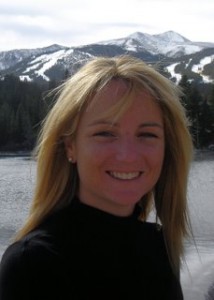
My guest for this Podcast is Dr. Haley Perlus. Haley and I discuss Indoor Cycling Instructor Burnout, what it is, where it comes from and how to conquer it!
Haley is a doctor of sport and exercise psychology. She is an expert at empowering individuals to achieve peak performance.
In addition to her expertise in exercise psychology, Haley has been an indoor cycle instructor for 11 years. She's one of us and has first-hand experience teaching full classes as well as teaching a cycle class with 2 participants in a room that holds 50 bikes.
Visit www.DrHaleyPerlus.com and register to receive Dr. Perlus’s FREE monthly Mental Toughness Training articles.
Special Webinar (tele-seminar) Announcement
Dr. Perlus has offered to to hold a live consulting & training tele-seminar, specifically for my audience, this upcoming Sunday November 23rd, 8:00 pm Eastern Time.
Its worth mentioning Haley charges participants $97 per person to attend her group Mental Toughness Training calls. However, since we have on average 1,000 people downloading my Podcasts…she’s agreed to allow as a bonus to my audience that the first 25 people who download this podcast and register now at www.DrHaleyPerlus.com/cycle will get in absolutely FREE. She’s also been generous enough to allow those people who are not the first 25, attend her live consulting call for just $9.00 That’s a huge $88.00 savings.
Listen to the Podcast below for additional details or subscribe using iTunes or Zune.
This Podcast is was originally published on October 10, 2008, I have updated it with our new Podcast host information and I am representing it now. I hope you enjoy it, Joey
What a treat to be able to interview Johnny G along with Jennifer Sage as my co-host for this special Podcast. When you listen to him speak, it’s easy to understand why Spinning has become a household word.
Johnny G and Jennifer talk about their involvement with the Challenged Athletes Foundation at the Tour de Cove in San Diego CA. Jennifer is presenting and Johnny G is speaking during the 4 ½ hour Spinning Tour to raise money for the Challenged Athletes Foundation. Here’s the link to Jennifer’s Donation Page.
Next Johnny explains how his new Johnny G Krankcycle “competes with nothing, yet compliments everything.” Listen as he describes; his initial inspiration, what makes it special, group class formats and it’s use for physically challenged athletes.
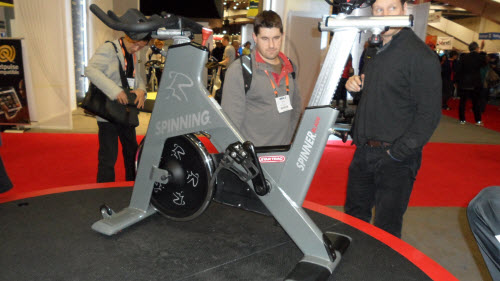
Here are pictures from IHRSA of the new Spinner NXT and the all new Spinner Blade. I'm going to guess that Spinning still sees a large market for conventional Indoor Cycles that would cause them to redesign the NXT.
4/15 update: I had a very informative discussion with Josh Taylor today about all the changes they have made to the NXT. I hope to have a separate post about it early next week.
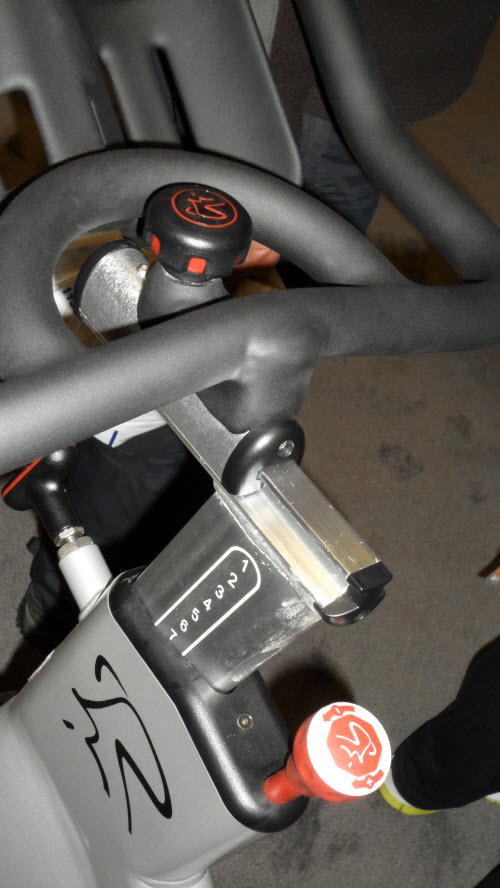
The only significant change I can see is the addition of fore/aft adjustment of the handle bars.
Adjustable Handle Bar
My understanding is that the crank arms on these new cycles us a proprietary (as in unique) pedal spindle thread size that will prevent using any other types of pedals 🙁 That would mean that Schwinn Triple Link pedals (a common upgrade for indoor cycles) will not be an option and studios will have a very limited choice of replacement pedals. What's up with that?
Spinner Blade
Although it looks very stylish, from a technological perspective the new Spinner Blade is a bit disappointing to me. This will be Spinning's cycle with power – and they're using the old friction system for the resistance? That's so 1990's, especially when Keiser, Schwinn and FreeMotion are all using vastly superior Magnetic Resistance. No clue as to how they are measuring the amount of force applied to compute a riders power output. This display cycle doesn't show any computer/console . They must not have it completed yet. Will the Spinner Blade be ready by WSSC?
John Baudhuin with Colby the office dog -photography by Michael Darter
The brand that we all know now as Spinning grew out of a partnership between endurance athlete Johnny G and cyclist / CPA John Baudhuin in the early 90's. Together they formed Mad Dogg Athletics and the rest is history!
John R. Baudhuin is the founder, President and Chief Executive Officer of Mad Dogg Athletics. Prior to founding Mad Dogg Athletics in 1994, Baudhuin worked as a certified public accountant for Los Angeles-based Duitch, Franklin & Company, where he provided a variety of consulting and strategic planning services. An active member of the Young Presidents Organization, Baudhuin received his Bachelor of Arts degree in Economics from the University of California, Santa Barbara and his MBA from Loyola Marymount University.
Listen to the interview below – or .
Are you receiving our weekly email newsletter? Click here to subscribe and receive our Top 404 Indoor Cycling Songs list
At WSSC I had the opportunity to complete a PST (Personal Spinning® Threshold) test – which is (their words) the key to Spinpower success. I couldn't agree more as knowing your maximum sustainable power or Heart Rate, and then building training zones around a known metric BPM/Watts is crucial to effective training. Here's some notes on this session and the discovery process MI Janet Toussaint lead us through to determine our Personal Spinning® Threshold.
PST is something we can change
Janet's session included a lecture period before we climbed on the Blade Ions for the PST test. During her presentation she made three very profound points that I feel are important for anyone teaching with power, to convey to their participants…
It is possible to change/raise/improve your PST. You maybe familiar with the statement; if you can test it you can improve it. In the past the Spinning program was based on Maximum Heart Rate – a number that doesn't change no matter how hard you train. Yes you can become more efficient at Fat utilization, except that's difficult to measure without a metabolic cart. Sustainable power at threshold (PST) is something you can easily see changing and that can be very motivating.
PST is based on Maximal Efficient Effort – key word being efficient, as in where efficiency drops off during the graded intensity ramp test. This isn't a test where COME HELL OR HIGH WATER I'M GOING TO PUT UP THIS HUGE WATTAGE NUMBER!!! Janet made the point a number of times that you have to be careful not to let these assessments become a competition, where people are trying to prove something.
Your PST is specific to this sport – actually Angie Sturtevant made similar statements. The wattage you see as a PST only applies to a Spinning class – not your road bike with a power meter. I would add that it also only applies to the specific brand of Indoor Cycle.
I snapped this picture showing the ramp test protocol used to asses the PST used to create the 6 power zones in the SpinPower program.
Constants and Variables
The constant during this test is cadence/RPM which doesn't change during the test. Janet suggests you not mandate a cadence, instead ask every one find “where they hang out” = natural cadence. What will vary will be the amount of resistance, and the resulting changes in HR and perceived exertion/RPE.
Start everyone warming up in zone one, finding that natural cadence for 10 or more minutes. Include a few brief accelerations – but not too intense or long.
Every two minutes you'll add resistance / ramp up. How much? Janet recommends 10-20 watts from women and 15-30 watts for men.
After you've added the new ramp, push the reset button to record your average for that ramp – remembering the previous ramp's wattage.
When you can't maintain your cadence, for the whole two minutes, you're done. Your PST is the watts from the last fully completed ramp.
How many ramps is the right amount? Janet explained that there is no “right amount”. You need to run the assessment until everyone has completed the test. There were some questions about this and it sounds like you should see at least 4 ramps until failure. Less than that probably means that the rider is adding too many watts with each ramp.
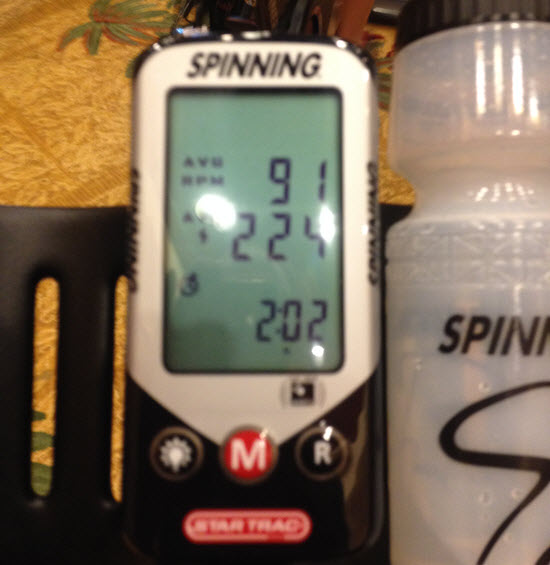
My experience during the test was as I got closer to PST, I wanted to reduce the size of each ramp's increase. I also knew very quickly when I wouldn't be able to finish a ramp. My numbers are in the image above. I couldn't complete my last ramp of 240 watts, which actually isn't that far off what I'm used to seeing as my threshold on the FreeMotion bikes I teach on at Life Time.
Thinking about conducting an assessment like this in your class? I would suggest that you practice on yourself first, so you understand what your riders will be experiencing.
If you are teaching on Spinner Blade Ions I would love to talk to you. Please contact me.


 This Podcast is was originally published on November 24, 2008, I have updated it with our new Podcast host information and I am representing it now. I hope you enjoy it, Joey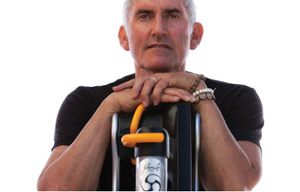
 This Podcast is was originally published on October 10, 2008, I have updated it with our new Podcast host information and I am representing it now. I hope you enjoy it, Joey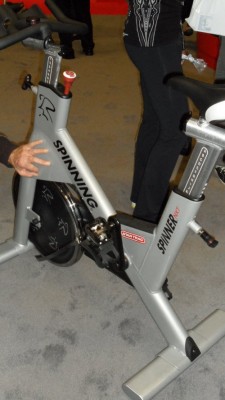



 At WSSC I had the opportunity to complete a PST (Personal Spinning® Threshold) test – which is (their words) the key to Spinpower success. I couldn't agree more as knowing your maximum sustainable power or Heart Rate, and then building training zones around a known metric BPM/Watts is crucial to effective training. Here's some notes on this session and the discovery process MI Janet Toussaint lead us through to determine our Personal Spinning® Threshold.