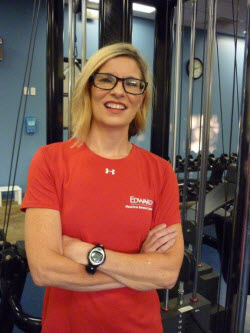
I enjoy poking around the RateYourBurn Instructor review site to get an understanding of what participants are looking for in our class. Sure some of the comments can be a bit harsh, but many of the actual reviews are well written and offer very specific “If you would do ___________________ I would enjoy your class more” advice.
So yeah, I liked a lot of things about Chris, but the ride was… improvable. Luckily for Chris, these nits are absolutely fixable.
A little head's up, please? Countdowns: We really, really need them. Without countdowns, I start to wonder if you're just making up moves on the spot; I don't know when to exert the most effort, and I start worrying whether we'll be in a second-position jog FOR ETERNITY.
Choreography was not really timed with the music. Chris could work on ending the choreography segments to time up with each song. There were three different songs where we ran out of music while continuing choreography. Again, this feels like the class is a little bit tossed together in the moment rather than planned out. According to his bio, Chris has been a dance educator for more than a decade: timing choreography to the music (and giving countdowns to help with that) is likely second nature for a dancer. Just bring it to the bike!
Timing of pushes. These felt a little awkward and were usually too short. One thing that would help would be for Chris to cue us ahead of time when we were going into a push, but the pushes always came with the command “pick up your legs now!” and ended with “slow down” – no warning, and no countdown to the end. Help me gear myself up for a 30-second push, and then let me know when I'm just a few seconds from the finish line – I'll work much harder when I'm not ambushed by a sprint!
There's an old adage about giving effective presentations that goes something like this;
Explain to everyone what you're going to say or expect them to do.
Say or do it.
Remind them what it was you said or what they just did.
In the first and third comments above, the reviewer is frustrated because Chris is skipping #1 – and not giving advanced notice to what's coming next. I can't speak for the women in your class, but many of the the men who ride with you are sequential thinkers like me. We like to start with A, move on to B, C, and then D. It drives us crazy when you skip one or more steps and completely throws us off our game.
I'm completely guilty of point #2 – not getting my choreography matched to the length of the music at times. I'll blame the combination of my slowly failing eyesight and those tiny little numbers on the Spotify App for not understanding the time remaining for a specific track. My classes are very cycling specific and feel I do a good job prepping everyone for the upcoming efforts. Where I feel I get into trouble is I take too much time leading up to the start of say a 4 minute Best Effort, using a 5:00 minute song. I can't see the time remaining and the music ends before the interval – not very professional 🙁
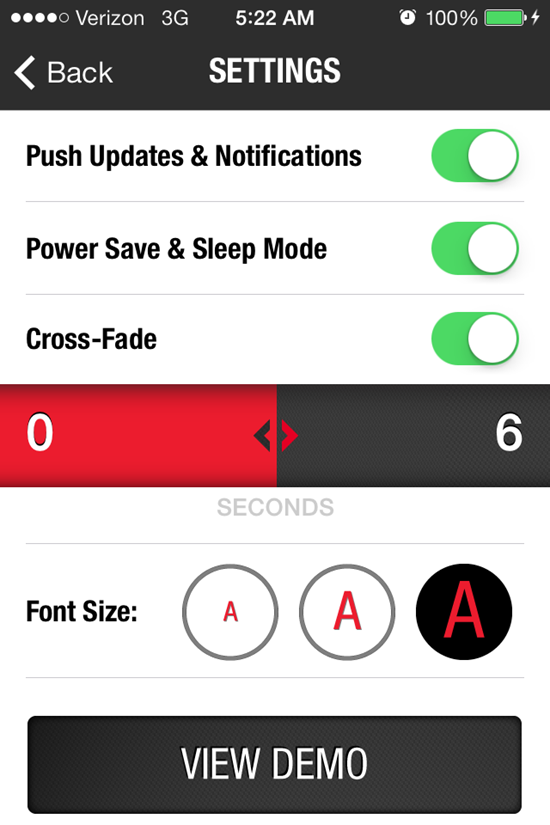
I'm very tempted to move back to iTunes music and use the new Schwinn Class Tamer App simply for the option in the settings to really embiggen the font size so I can see it.
Question for you [wlm_firstname]…
If you had access to this type of constructive criticism, would you accept and use it?
Johnny G, legendary creator of Spinning and all indoor cycling, as well as Kranking, teaches three elements of training — rhythm, timing and breathing. From him, I borrowed the idea of opening each quarter of training with these concepts, one each day.
Day 1 is about rhythm. This is not following a beat; that’s actually a matter of timing. It’s about feeling our own rhythm within, our sense of aliveness. That sense is always there but can be obscured by internal noise — thinking, unfocused attention, and so on. If you can quiet your mind enough to feel it, you’ll always train with peace and a sense of joy.
Day 2 is about timing. You can explain cadence and work on drills involving cadence changes. I added my own “spin” on it by teaching the close connection between timing and technique. Most mistakes in technique are mistakes in timing.
Technique is important for safety, efficiency (we waste less energy), and the optimal application of power. The mechanics of the pedal or Krank stroke stay essentially the same at any cadence, despite the change in timing. That’s where cadence work becomes essential. Beatmatch is a terrific tool in cadence drills.
Another timing element is more apparent in movement sequences than in continuous circles — summation of forces. Force summation requires correct timing and sequencing of body segments and muscles throughout the motion. As you may know, combining correct timing and sequencing from large muscles to smaller ones results in maximum force. Before energy is lost from the first — and largest — muscle group, force from the next largest is added to it, continuing through the sequence and creating max force.
Some of you may have analyzed the pedal stroke in such a way that you can give a perfect breakdown of each segment of the pedal stroke in terms of force summation. I’d love to hear from you on that.
Day 3 is about breathing. Sustained power depends, of course, on oxygen delivery to muscle, and hard training is made possible by efficient breathing. A basic drill is to inhale and exhale with a consistent rhythm, so that the number of breaths matches up with a specific number of pedal strokes in any given time (say, 1 minute). Focus on basic abdominal breathing. Participants have called it “yoga breathing” because inhaling and exhaling both start in the abdomen.
Then run a cadence ladder and note how the match-up of breathing and pedal stroke changes with the increase in power and heart rate.
Another “spin” on breathing comes from my martial arts background. Power is created when we exhale. In karate, the kiai is performed not to shout and make noise, but to generate a moment of great focus of power. In tennis matches, we hear the forceful sound of the players exhaling. Pedaling is continuous, so there’s no specific moment where we focus power. Instead, we can create one. It can be any part of the pedal stroke that feels like an application of power, but it should be at that same point on each exhalation.
The final breathing drill was another Johnny G technique: uneven breathing. The even rhythm the rider has established between pedal stroke and breathing now changes to make the exhale one pedal stroke shorter (and sharper) than the inhale. (Inhale for, say, 4 down-strokes. Exhale for 3.) This takes practice but is a fantastic way to focus. (I did it for 40 minutes one morning, and my very experienced core knew it had done some serious work.)
At any rate, it’s a new year. It seems that one great way to start January — even in a class that’s been running continuously since last year — could be to go back to the beginning of indoor cycling, back to the basics, back to the underlying factors behind the basics, and back to our IC roots.
Then take off from a solid foundation for a great year of training. Happy New Year.
Today was the official launch of the Life Time Fitness Performance Cycle Winter training series. These classes are hosted at many of the LTF clubs around the country and the plan is for all of us to deliver similar formats, following the same nonlinear (or is it non-linear) periodization training program.
If the concept of nonlinear periodization is new to you, join the club. I first saw the term used in some of the educational material from Coach Troy Jacobson that was provided to us. It essentially means you don't follow the rigid training periodization calendar we're all familiar with; Endurance > Strength > Speed > Anaerobic > Race.
Here's a good description of nonlinear periodization from trainingpeaks.com
Lydiard-style periodization is known as linear periodization because the various major training stimuli (aerobic, anaerobic, strength, speed, etc.) are largely segregated from each other in the training process and arranged in a line in which each gives way to the next. This approach is distinct from nonlinear periodization, in which the various major training stimuli are mixed together throughout the entire cycle and only the emphasis changes from period to period.
Most of the newer periodization systems–those introduced since 1980–are nonlinear. One example is the so-called multi-pace training method developed by David Martin and Peter Coe. In their book, Better Training for Distance Runners, Martin and Coe wrote, “One sensible method for injury-free performance progress over the course of a macrocycle involves harmonious interdevelopment of strength, speed, stamina, and endurance all during the year, never eliminating any of these from the overall training plan… We tend to disagree with coaches who prescribe large volumes of solely longer-distance running over an initial period of weeks, followed by a similarly concentrated bolus of solely higher-intensity speed sessions over succeeding weeks.”
When I hear Nonlinear Periodization I think NOT BORING! Perfect for our Indoor Cycling classes where we really don't know exactly what our Athletes in class need, so let's give them a combination of; Endurance > Strength > Speed > Anaerobic.
I discussed this with Coach Troy during an Instructor call last week. His said he felt confident that our riders will see good progress, working in multiple energy zones in the same class = no mind numbing Long & Slow classes… or at least Long & Slow combined with some Strength > Speed > Anaerobic efforts to break up the monotony of a long class.
Why haven't I heard about this before?
Good question…
As this was the official Kick Off – we started with Spinervals 27.0 Threshold FTP Test .
Here's my Spotify FTP Class Playlist which tracks well with Epic RaceDay Indoor Cycling DVD — which includes a very intense 30 minute criterium race that is the perfect motivation for a 20 minute FTP assessment classes.
Instructor Tip
You can time the criterium to end right on cue with the completion of your 20 minute effort for an awesome finish – complete with the cheering crowd and ringing cow bells! At the initial start/options screen, select 60 min SFX – (no music > just the sound effects). I run the video from the beginning, not really following it until the start of the Crit. When you have 15 minutes left in the FTP assessment use the Skip >> on the DVD player remote to move forward to the next section = the final 15 minutes of the Crit. I keep the DVD sound down until the last 5 minutes. It's bicycle racing magic when they ring the Cow Bell signalling last lap / one minute to go!
Class length 75 minutes + Cool Down
Warm Up — 10 minutes. 5 minutes of gradual increases in wattage. During the second 5 mins. we’re finding the wattage where everyone is first noticing a change in breathing; VT1 / Aerobic Threshold = the top of the Recover Zone. This establishes a rough understanding of a base wattage that we use throughout the rest of class.
3 x 30 sec. Hard / 30 sec. Easy – Openers to AT/LT. I cue these by first having everyone find the amount of load @ 70 RPM that has them feeling they should (not just could) come out of the saddle. The 30 sec. Hard is then simply accelerating to 90+ RPM which results in some pretty impressive power numbers. The 30 sec. Easy is back to 70 RPM — many will stand during the Easy portion.
1 minute rest – I encourage riders to focus on their recovery. Once they feel calm in their breathing, bring back the Base level work wattage.
3 min. Hard Effort — Here's a “Best Effort” to establish a benchmark PTP Personal Threshold Power (top of the Perform Zone) or ride at 110% of FTP if known. It’s very helpful to riders to have that understanding of their personal upper wattage number. The “Best Effort” Threshold # + the Base Threshold # we found earlier form the three Power working zones I use in class.
2 min. Rest
3 x 1 min. Hard Effort x 1 min. Rest. These should be above the 3 minute average wattage.
3 min. Rest
20 min. TT / FTP Assessment effort – Quickly establish the average wattage at or near the 3 min. Interval. > Stage Button and then maintain. You may want to offer slight changes in cadence & load, while keeping wattage = to the initially established watts #. I was off the bike at the 10 min. to go, coaching, encouraging and then just watching them with a big smile on my face. This is a great group and they looked incredible – I'm so in my element with these classes 🙂
5 min. Rest
Base Wattage (aerobic) flat road to finish – use these time to congratulate everyone and give tell them a bit about what you have planned for them next week.
Don't depend on BCC email getting through to your athletes.
“Sure John – I'll email everyone on my list about your up-coming classes.”
My buddy Randy Erwin is a “Connector”. One of those awesome people who makes the effort to plan events (like outdoor rides) and get-togethers. Randy is the team captain of our Subaru MS 150 team and his love/passion for coordinating group rides lead to him being recruited to be the area Life Time Fitness Cycle lead.
Last night I talked to Randy and he told me he was excited for the FTP assessment I had planned for this morning and that he had emailed everyone three times, so he felt that we'd have a bunch of cyclist from his list.
Except most of them didn't show this morning 🙁
A couple of them did show up for the 9:00 am class that follows mine. Confused looks at those of us there who were cooling down; “Wait, was there an earlier class… why wasn't I told?”
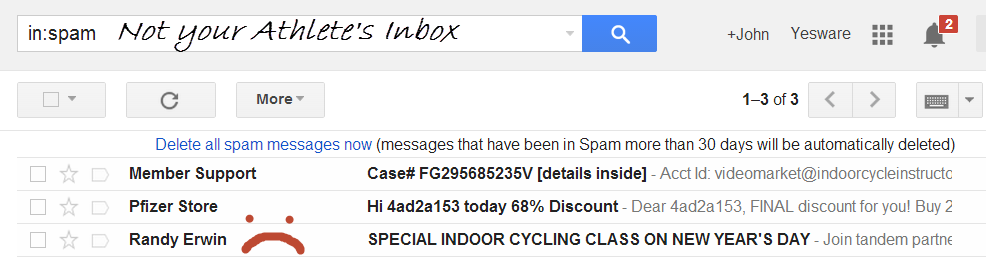
I hadn't received (and neither had many others) any emails from Randy this week. Neither did Amy – we're both on his list. So when I got home this morning I checked and found one of Randy's emails in my SPAM folder, which I rarely check on my laptop and never on my iPhone. Note to self to check there more frequently.
I called and asked; Randy…how many names are on your list? . About 200 was his response. Send a BCC email to a large of a list of email addresses must have triggered something in Gmail to think his email was SPAM = very few of us saw it.
So what to do?
It drives me crazy when I receive mass CC emails – typically I see them as sub requests. They are a total violation of email privacy and if one of the recipients have their email hacked, we all get the spam emails.
So if I want to email a list of athletes who take my class, I should use the BCC (Blind Carbon Copy) feature… right?
For a few people, sure that's OK. But once you have a large number (20+) of recipients, then No. At least not if you want to be sure your email doesn't end up in a SPAM folder and everyone will receive your latest class/event announcement.
Use a White-Listed Email Provider.
White-Listed just means trusted source… as in we don't allow any SPAM emails sent from our accounts Ms. AOL, Yahoo, Gmail, Hotmail, etc. so you can confidently deliver it to your customer. The two most popular are Constant Contact and my favorite MailChimp for a bunch of reasons. The biggest reason for you is that it's completely free until you go over 2,000 subscribers or send over 12,000 individual emails a month. So if Randy used MailChimp he could send 60 emails a month to is list of 200 subscriber each month at no charge. Fabulous deal – they don't even ask for a credit card.
Click to Subscribe
At one point you subscribed to the ICI/PRO Newsletter, by clicking a link and adding your name and email address. Using MailChimp you'll have the same ability to post a Subscribe Here link on your Facebook or Instructor blog = no manual entries!
You need their permission first
I decided that I would like to have all of Randy's contacts in a MailChimp account so I could email them > and know they are getting through. Except Randy doesn't have permission to give me the list, from the people on it, so he can't just give it to me. The solution is to:
Create a MailChimp account – here's the link.
Create a specific list
Have Randy send out my Subscribe Here link in an email. I'll suggest that he brake up the list into 20-30 address at a time and send the email with the link 2-3 times.
I already have a MailChimp account – so all I needed to was to create a new list. Here's the link to my list if you'd like to see it – http://eepurl.com/LQ_2P The Default in MailChimp is to collect First & Last Name + email address, which is normally plenty to start with. It's beyond the scope of this post, but the signup form can be easily modified to include pretty much anything. Please understand that you can ask for too much and they'll not subscribe.
Class sign-in list
I'm also collected emails at the start of each class using a hand written sign-in legal pad.
Instructor Tip: When adding emails to MailChimp from a sign in sheet, it's not uncommon to end up with a few you can't read. My tip is to do a quick search in Google using what you CAN read and search for the rest.
First and Last + the word “email” will many times display the correct email. You might need to add a state (MN, CA,FL, etc.) or city for common names. Google knows everything.
I will frequently check the domain alone – @XYZcompany.com or the domain + first/last name
Would you like additional info or help with this or other methods of marketing your class?
Many of us get near ZERO help from our club/studio > so it's up to all of us to grow our classes.
Instructor and Zoning Specialist Kay Mamo joins me to discuss her version of a Cycle & Strength class and then provides the profile and music suggestions that you can use to teach you own class of this format.
In case you missed it, I subbed a “Cycle – Sculpt” class a few weeks ago and posted about it here. I also posted it on my Facebook page where Kay quickly commented that she wanted to share her experiences teaching what she calls a “CYCLE & STRENGTH” class with you. So here it is 🙂
I feel that there are some key takeaways you can learn from Kay in her interview – the most important being how her class is very similar to the one I subbed = these are not the typical participants you see in your classes each week. There's something about these (do we call them combo classes?) that make them very appealing to non-cyclists.
Everyone can listen to Kay's profile below > Only ICI/PRO members will see links to download the profile pdf and complete Spotify playlist.
[wlm_ismember]Feel free to treat yourself to a monthly or annual subscription and be ready for 2014.[/wlm_ismember]
Several months ago, John interviewed Micah Zuhl, doctoral candidate at UNM, for an ICI/PRO Podcast. Among the questions John asked was which Zuhl considered better — high-intensity interval training (HIIT) or endurance training.
Zuhl’s answer wasn’t entirely clear to me; he sounded somewhat back-and-forth. But he did emphasize the need to give cycling students some intensity, along with some variety. He used the well-known phrase “change it up.”
Let me make it clear that I have absolutely nothing against HIIT. I use it frequently in my own training and have used it when teaching, as well.
Virtually any vigorous exercise, including indoor cycling, will trigger the release of beta-endorphin. That’s neither good nor bad, just what is. The more intense the exercise, the greater the beta-endorphin release will be. No doubt that’s one reason cycling students enjoy — or even prefer — harder workouts.
When it comes to comparing HIIT to endurance training, though, I’ve noticed something interesting, and I’m definitely not including Micah Zuhl in this statement, because he was asked the question by John and didn’t bring it up himself.
Diehard HIIT advocates always seem to measure the benefits of HIIT against the lamest cardio they can find, then proudly proclaim that HIIT provides superior results. Have you noticed?
In reality, we don’t have to choose between long, slow nothing and HIIT. If you train right, and train hard, you can go hard AND long. HIIT alone won’t necessarily provide that training adaptation.
My background has taught me that progressive, periodized training can develop a power/endurance dyad, along with a mental discipline that short-duration bursts typically don’t. Jim Karanas posted much on this website on the mental, emotional, even spiritual, benefits of endurance training. I frequently use HIIT as part of a long, structured, “authentic” training.
Having said all of that, I’d like to switch directions. I also use HIIT when my day is slammed and I need to resort to my BTN Workout. (BTN means “better than nothing.”)
One of the convenient features of HIIT is how little time it takes. At this time of year, being able to fit in a short workout is very helpful.
Here’s an 11-minute format that I devised for the Stairmaster (I’m lucky enough to have one at home), but it can be done on any piece of cardio equipment. Set the timer, if you have one, for 11 minutes. On the Stairmaster, every workout is divided into 30 vertical rows of a duration that depends on the programmed time. An 11-minute workout yields 30 rows of 22 seconds each.
I warm up for 9 rows. That takes 3 minutes, 18 seconds. Every 3 rows, I increase the intensity by 1 MET. (Each vertical dot is another MET.) Then I begin my intervals.
The remaining time allows for 7 intervals total. The work segment is 2 rows (44 seconds), followed by a recovery of 1 row (22 seconds). The first work interval is moderately hard, a transition between the warm-up and the hard work to come. The other 6 intervals are done as high as the Stairmaster can go. I drop down in the recovery period to the level-3 warm-up intensity, but no lower.
If I find myself leaning on the Stairmaster during the work segment, I back off one vertical dot (1 MET) until I get back to good, disciplined form. It’s rare that I need to back off more than one, but I’ve dropped 2 METS once or twice. The goal is not to take extra recovery, just to regain good form and make it harder.
If you’re at all like me, you prefer a serious cycling training to something like this. Still, the BTN approach can be used so easily, and on anything. It’s gotten me through insane scheduling more than once. I’ve done it on my indoor cycle, too, and it works. This approach could help students who are over-scheduled and missing classes this season.
Sure, it’s just BTN for enthusiastic indoor cycling fans, but it’s HIIT, which we know is authentic training. Better than nothing when there’s no time for more, yes?




 Hotmail, etc. so you can confidently deliver it to your customer. The two most popular are Constant Contact and my favorite MailChimp for a bunch of reasons. The biggest reason for you is that it's completely free until you go over 2,000 subscribers or send over 12,000 individual emails a month. So if Randy used MailChimp he could send