
by John | Sep 13, 2021 | Instructor Tips and Tricks
 Amy and I went to a Halloween party last weekend dressed as PeeWee Herman and Miss Yvonne. Yes my costume included a “shoe mirror” 😉 During the party someone asked me “what's the secret word for today PeeWee?” and I thought why not add a similar feature to ICI.com.
Note: yes I am aware that Groucho Marx first popularized “what's the secret word” on his TV show.
Eustress – It's not a secret word and you may have never heard it before. I first heard Author Tim Ferriss use it in the 4 hour work week. Eustress is simply defined as Good Stress. More here. Tim describes eustress as stress that has a defined end where you can recover. Any form of physical effort is eustress except for when an athlete is over trained – and you know the result of over training, don't you?
If you are familiar with the “wear sunscreen” song, which is a musical version of a commencement address, you may remember the line: “do something everyday that scares you”. Placing yourself is scary situations, then experiencing relief, is a form of eustress. Some examples would be: public speaking (teaching your first class), skydiving, asking someone out on a date, asking for a raise or competing in a race.
When I use eustress in class, I explain that the eu prefix is the same as in the word euphoria.
Originally posted 2009-10-28 08:39:36.
by Jennifer Lintz | Aug 26, 2021 | Featured Studios, Instructor Tips and Tricks, Instructor Training
 When I take off my instructor hat and walk into a class as a participant, I have two expectations beyond the obvious (getting a good workout):
1. The class will start on time.
2. The class will end on time.
I understand there are exceptions to every rule and occasionally instructors get started a little late or run a bit long, but in general, I think it is important that we make a concerted effort to stick to the official schedule.
Why? For me, it comes down to being respectful of people's time and making sure members' expectations match up with reality. If the schedule says class will run from 5:30 to 6:15 p.m., folks probably anticipate a 45-minute class that starts at 5:30 p.m. and ends at 6:15 p.m., and they should! There may be participants like the one in Krista's recent post who take extreme measures to be at class early. There may also be people who feel bad about leaving “early” in the event that class ends late. Straying from what is expected increases the likelihood that participants will leave feeling disappointed, frustrated or annoyed.
Whether you are a hyper-prepared instructor or a professional improviser, there are several things you can do to ensure you start on time and end on time. Below are my thoughts regarding time management in the cycle studio.
Arrive 15 minutes early. I don't just mean walking into the building 15 minutes before class starts; I mean walking into the studio dressed and ready to teach 15 minutes before class starts. This will give you time to get your music ready, test the microphone, adjust your bike settings, greet members, answer questions, and assist new participants with bike setup.
Read announcements before class starts. I typically turn on my microphone to make announcements 1 to 2 minutes before class begins. That way, when 5:15 a.m. or 5:30 p.m. hits, I am ready to push play and teach immediately. Every minute counts.
Have a plan. I don't like to feel unprepared and I also don't like looking at the clock, so my profiles are planned out down to the minute to avoid both of those situations. Preparing a thorough class plan allows me to focus on my participants instead of the time.
Be consistent with cool down. If you teach every Thursday from 5:30-6:30 p.m., pick a time when you will start cool down and stick with it. That way, even if you improvise in your classes, you know that when 6:25 p.m. (or whatever time you choose) rolls around, you better start slowing things down.
Stay focused. Talking too much can throw a wrench in class plans; I know, because it has happened to me. I can recall multiple occasions when I had to shorten hills or alter drills because I was long-winded with a story or something that was on my mind. Being conversational has its positives, but it is also important not to get too carried away.
What are your strategies for time management?
Originally posted 2013-04-11 12:34:24.
by John | Jun 30, 2021 | Instructor Tips and Tricks
 When a student asks what they should purchase for Indoor Cycling Shoes, what do you recommend? Do you have a place to send them? Does your club sell Indoor Cycling Shoes?
If you're only using them for Indoor Cycling classes, then a shoe with a recessed SPD cleat is the best choice. Often refered to as Mountain Bike shoes, you'll find they are easy to walk on and won't scratch the floor. Every pedal you will find and a studio these days will have a SPD on one side.
Here are links to a number of suggestions at Amazon.com which has as good a pricing as anyone and you can't beat Amazon's easy return policies.
Indoor Cycling Shoes for Women
Indoor Cycling Shoes for Men
I ride a lot outdoors and prefer a conventional “Cycling Shoe” that has an exposed cleat – I have used Look cleats on all of my road bikes. My feet are very wide and flat. After suffering with ill fitting shoes in a “regular” width for years, I finally broke down and purchased a pair of Sidi Mega Road Cycling Shoes . Yes I know they are expensive. I've had mine for at least ten years and other than looking a bit faded, they are as comfy as ever.
I should add that I wear my Sidi's with Superfeet supportive insoles that prevent my feet from rolling inward, which takes a lot of stress off my knees.
This post has more suggestions and recommendations for the best indoor cycling shoes for wide feet.

Originally posted 2010-06-19 09:51:02.
by Chuck Cali | Mar 26, 2021 | Master Instructor Blog, Promote and Build Your Class

This cute kid found something good – image from http://www.kingarthurflour.com/blog/2012/09/24/gluten-free-apple-crisp-fall-away-from-tradition/
The posts with more than a couple of comments always catch my attention. It shows a hit on a subject that interests people enough to share their thoughts. I have always considered this forum's primary objective to do just that. Light a fire so-to-speak.
That said, the post on Single Leg Pedal Drills got me thinking. They are a staple of my classes. I teach on both magnetic as well as friction resistance bikes. Like Doug (Yo Doug good to hear from you) I cue the riders to “let one leg go along for the ride.
The term ‘contraindicated' has – over the years — been associated with these drills when the rider has been instructed to ‘unclip'. And I agree though I see the risk as minimal. Even on bikes using MR we have a few ‘bouncers' — those that will just never put the kinds of resistance we instructors are trying cue — and as such are at risk for getting a pedal in the back of their leg. So I just don't do it.
Yet, what I liked most about John's post is that he has come back around to an important issue. It clearly got us talking with our fingers which means — hopefully — we gave it some thought. We don't always need to be finding something new so much as reinforcing something good. And that got me thinking.
As I have moved from beginner to journeyman to experienced to grizzled veteran, I've learned a few things.
Embrace and learn from those that take the time to compliment you/your class. Lately there have been many more of my riders — some regulars some new — that have taken the time after class to come to me with an acknowledgement of well delivered class. “Your best yet” said one just yesterday. The irony was that I'm doing nothing really new. In fact I used a playlist favorite of mine that has been collecting dust in my iPad for a while. When I think about it I've not really put anything new together in quite some time. Oh, I've got a pile of audio podcasts printed out waiting for me to take action. But I believe the truth is that the riders in my regular classes are enjoying my growth as an instructor far more than hearing Katy Perry's new tune. Or another way to climb.
People resist change. We already know we cannot please everyone in class every time. So if you are committed to bringing new everything to your class, every class, you may be setting yourself up for failure. Your regulars have an expectation of what you're going to deliver before they walk into the studio. Try your new stuff out when you sub.
You are who you are. If you have been teaching well attended, prime time classes then it is very likely that your success has more to do with you, than what you play and cue. While I don't recommend getting stale I do strongly urge you to stay true to your style.
I will use John as an example of what I mean. Recently he posted about a technology, Harmonic mixing, that blends tracks of the same musical key. His frustration was that others could put together better mixes than he. Ok, I guess. First, that is his opinion of his playlists and probably not an issue for his riders.
Next, while his integration of harmonic mixing may have a subtle effect (positive or negative) on what the riders hear, John is teaching to full room because he is John. A great smile, always happy to see his riders, has a plan for the workout and best of all, his voice over the mic during his cues are about the best I've heard. Right up there with the late Jim Karanas. Which segues nicely to.
Know your strengths and play to them. Maybe wife Amy and Chris Hawthorne put together mixes that he thinks flow better. Good for them, that is their strength, among many others, 🙂 not his. We all chose to get to the front of the room. On stage is what I call it. So face it, you like the affirmation. What gets you applauds is what your strengths are. If you are a new instructor then you may still be searching for key performance parameters. I use the word performance intentionally because that is what we do. It's not just about the workout but how you deliver it. Your performance.
One last thought on strengths. The best of the best are quite adept at getting their riders attention and holding it. I cannot stress this enough, go watch them. How? Maybe at your club there is the one instructor that ‘packs em in'. Attend conferences. IDEA here on the left coast is dedicated to instructor continuing education. SCW has monthly conferences around the country. Find one near you.
Know when to say when. If you are teaching more than an average of a class a day it will be very difficult to keep the fire burning hot. Motivating ain't easy. If you are teaching your third class of the day it will soon become obvious to your riders that you are not feeling the love. Teaching indoor cycling for living is tough and — in my opinion — not sustainable at pro levels. Unless teaching that many classes is standing between you and the street, consider what your optimum number is per day as well as per week.
Do continuing education. You can always get better. Our craft is one of caring, connecting, nurturing, prodding and sweating. But none of that is possible if you don't base it on sound fundamentals. Indoor cycling is about doing cardio vascular training on an indoor cycle. Knowing as much as you can about training both, will never hurt. Add your personality, a touch of some stuff you picked up from the pros and you've got a winning recipe.
We don't always need to be finding something new, so much as reinforcing something good.
Save
Originally posted 2017-11-20 09:00:51.
by John | Mar 20, 2021 | Best Practices, Correcting Form, Instructor Tips and Tricks, Master Instructor Blog

NOTE: I'll be publishing what I believe are the 10 Myths of Indoor Cycle Rider Setup / Bike Fit on Wednesdays each week, starting today with:
Myth #1 – It's proper, for you the instructor, to cue people to draw in their knees.
I cringe whenever I hear; “OK people, now I want everyone to bring in your knees!” because, for most of the riders in class, everyone's knees are already where they need to be. Please note that I didn't say where they should be, but where they need to be based on a number of different factors. Some are based on how the rider is fitted to the cycle and some are because…
Indoor Cycles are perfectly symmetrical – Humans, not so much…
You can find dozens of books and multiple business who focus on the art of fitting an imperfect cyclist to a perfect bicycle. Discussions of Leg Length Discrepancies, Feet Pronation, Q Factor and Cycling Shoe Cleat Wedges are beyond the scope of an Indoor Cycle Instructor helping a student with setup.
But there is one aspect of Indoor Cycle setup that has a huge influence on knee position, and yet is universally ignored*- foot alignment.
Take a minute and try his test on yourself: Stand on a smooth floor wearing your socks. Feet shoulder width apart, with a soft bend in your knees (like you should have on the bike). Now transfer the majority of your weight to the balls of your feet (like you're standing on the pedals) and rotate your heels inward. Notice where your knees go?
For most of us they move out, did they for you [wlm_firstname]?
Now let's see what happens when you arbitrarily decide; “my knees are sticking out, I need to bring them in.” Go to the same position as before; soft bend, heels in, but now bring some of your weight back to your heels which will prevent your feet from moving (similar to how the pedal cages or cleats fix the position of your feet) and try to bring your knees in. What happened?
Because everything is connected (you remember the song; foot bone's connected to the ankle bone, the ankle bone's connected to the thigh bone, the thigh bone's connected to the knee bone, etc…) the position of your knee is exactly where it needs to be, based on your position on the cycle. If you have a student with improperly adjusted shoe cleats (or too low a saddle) and you tell them in your BIG INSTRUCTOR VOICE; “I want everyone to bring in your knees during this crushing 11 minute climb!” you could potentially hurt them over time. Worse, cause them to ignore the true reason their knees are out which for many people is simply having their heels rotated inward – like my buddy Randy demonstrates below.
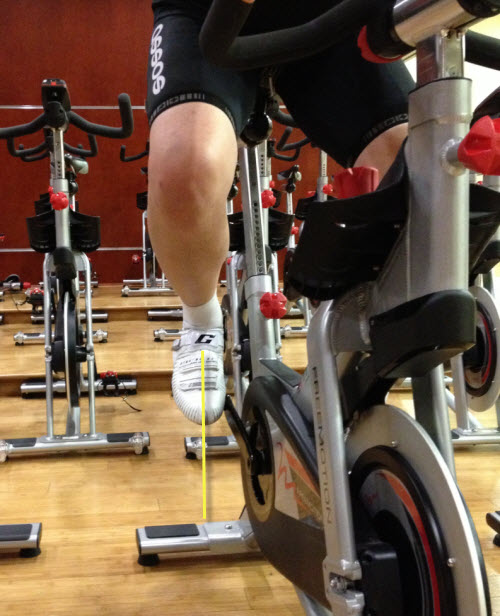
Heels rotated in forces knees out

Feet aligned forward bring knees over pedal 🙂
There's actually a Sub- Myth here; the objective of proper bike fit isn't to just “bring in your knees”. The objective is to get your knee pushing directly down on your pedal = the most efficient transfer of power with the least amount of stress on the most vulnerable joint in the system – your knees. We live in a three dimensional world, not two 🙁 So when while helping a student get set up, be sure to observe them from the front, as well as from the side.
So what to do and/or cue as the Instructor?
Jim Karanas gave us a beautiful cue during a class I took last week in San Francisco. He had us down in the drops (I realize your cycle may not have drops – Spinning Instructors can read this as comfortably in position 2) and asked that we look down and we should see our knees in the space between our arms. Nothing more. He was simply suggesting that we observe what was happening.
You haven't heard it yet, but I will be publishing an interview with Jay Blahnik in December where he makes a similar point about suggesting your students observe something and then let them act on it.
You may also pay attention to what you see in your students and identify excessive foot rotation. But be careful – some people are naturally very duck footed (or whatever the opposite of pigeon toed is where you live) so my suggestion is to ask “did you have someone set up your cleats? This may give you a clue to if they put any thought or care into attaching their cleats. You could also have them stand naturally in their socks on a smooth floor to see if there's anything weird and refer them to your local bike fit expert if necessary.
*There are 100's of YouTube videos explaining a multitude of different ways to properly fit someone to an Indoor Cycle, but not one that I'm aware of makes any comment or suggestions as to foot position and it's effect on knee position / alignment. Even the Spinning® Fit System ignores this topic beyond “… the cleats must be adjusted properly on the shoe. A good bike shop or bike fit specialist can help with this if needed.” What “adjusted properly” means remains a mystery.
Read the rest of the 10 Myths of Indoor Cycle Rider Setup / Bike Fit
Originally posted 2012-11-21 12:19:18.
by Joan Kent | Feb 26, 2021 | Big Box Instructor, Instructor Tips and Tricks
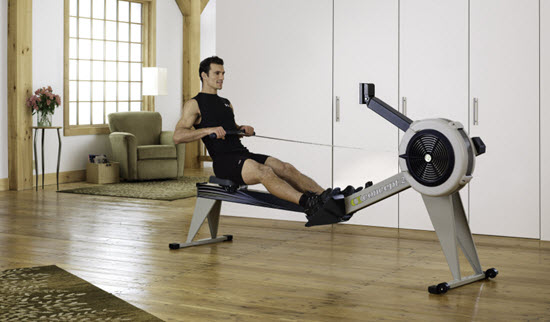
What do you do when you want to train but need a break from cycling? Indoor rowing is an excellent alternative. If you’re into power training, this is for you.
Most of my teaching of indoor cycling was done in Performance Max, a program that included both cycling and indoor rowing. I took the program as a participant for 14 years and taught it in a different location for 12. This post covers the basics of starting to row.
Truly, the only indoor rowing machine worth using is the Concept 2 Rowing Ergometer (“erg” for short). Yes, other rowing machines exist, but no one who rows takes them seriously. The Concept 2 is the gold standard. The current models are the D and the E (slightly higher off the floor). The longest-standing model is the C, which was the one-and-only for many, many years. (I have one, love it, and wouldn’t trade it for a D for anything!)
If you have access to a Concept 2 erg and are new to rowing, learn correct technique from the start. It’s easier to learn it the right way than to unlearn the mistakes that people commonly make when trying to row on their own. If you teach at a gym with an instructor who really knows rowing, that’s ideal because you’ll get good instruction and correction. Years of teaching rowing have shown me that correction is essential.
If you don’t have either an erg or personal instruction, visit the superb Concept 2 website (concept2.com). This 5-minute video teaches rowing technique step by step and repeats the steps clearly and slowly.
There’s also an “erg finder”. Enter your location, the type of facility you want (e.g., health & fitness club), and the distance you’re willing to travel. You’ll get a list of clubs with addresses and the number of available ergs there. You might want to call to verify the info. (When I looked for ergs in San Francisco, the club I taught at for years was listed as having only 1 erg; that was wrong. Farther down the list, though, the same club was listed again, accurately, with 17.)
Once you’ve learned to row, you can take advantage of Concept 2’s Workout of the Day. You can choose short (30 minutes), medium (40-45 minutes), or long (60+ minutes). It’s available on the website daily — or can even be delivered to your inbox.
A few points to keep in mind:
– Rowing is not an upper-body activity. It’s a full-body activity that centers on leg power. Sliding seats were added to rowing shells in the 1870s to optimize the superior power of the lower body. The best training I’ve heard on this came from a Performance Max instructor who rowed on the U.S. National team: “The arms are an afterthought.”
– Rowing has a definite learning curve. In the beginning, it may feel frustrating not to have sufficient power in your stroke to reach a high heart rate. That will change with practice. Believe me, rowing heart rates can go very high, typically higher than in cycling.
– Because of the learning curve, novices often use a higher damper setting than necessary. The damper opens the drum to let in more air, increasing the resistance. Skilled rowers, however, use a moderate setting and create effort by accelerating quickly at the start of the stroke (the catch).
– The most common mistake is bending the knees too soon after you finish the stroke. (This will make sense once you’ve watched the video or gotten some instruction.) It’s almost instinctive and can be difficult to correct. One effective correction is to stop rowing and hold for 2 seconds after you’ve extended the arms before letting your knees bend. Repeat with each stroke for a few minutes.
– Rowing should NOT be done with a straight back. Curving the shoulders slightly forward will engage your core and protect your back. A straight back is more likely to be injured.
Holding an even and consistent pace can be difficult to learn. Jim Karanas, who created the PMax program, always said rowing builds character: With every stroke, the computer tells you you’re a failure [i.e., your pace is off], but you have to keep going.
Working on pace feels like moving meditation. Skilled rowers doing sustained efforts even look relaxed and meditative.
So here’s to a character-building, meditative yet exciting alternative to cycling. I think you’ll like it. You might even find yourself adding it to your training on a regular basis.
Podcast: Play in new window | Download
Originally posted 2014-07-07 08:42:14.
