
by John | Jun 13, 2013 | Instructor Training, Master Instructor Blog, Music

We all rely on music as a tool. Tools are used for building things and it's common to describe our practice of creating profiles as; “I'm building my class”. Most of us put a bunch of effort into; “building our playlist”. Track selection is often by BPM or song length. We categorize and file/store our music in ways designed make the selection quicker and easier, i.e. flats, climbs, etc…
In my workshop at home I do the same thing. I have a big tool box with a bunch of drawers. Each drawer has a specific type of tool (sockets, wrenches, screwdrivers), many are arranged by size (1/4″, 1/2″, 10mm, 14mm), or purpose (Phillips Head, Straight Blade, Allen Head).
I'm a self-professed “Tool Guy” – Tim Taylor was one of my favorite TV characters of all time. Tim understood it's “all about the tools”. My Grandfather was often accused (by his wife) of “spending 5 hours to design and build a tool that would save him 2 minutes, on a job he'd only do once.” So I come by this naturally 🙂 Whenever I need to build/fix/repair or create something the first thing I do is find the tools I'll need for the job. And no, I'm not beyond spending an afternoon/day/month designing a tool to solve some problem I'm having. Case in point is my Red Pedal Tool for studios using the red Schwinn triple link pedals. That took about a year from start, to a finished product.
My class preparation probably isn't much different from yours [wlm_firstname]. I start with a basic “plan” and then I select different tracks based on their value as a tool; “I need a 6 minute song @ 150 BPM for this climb I have planned” isn't any different from; “I need a 14mm end-wrench to remove the lawnmower blade, so I can sharpen it”.
The resulting playlist is very functional, very Indoor Cycling 2.0. But I'm learning can also be a bit sterile – dare I say soulless?
This morning a long-time member said hello to me, as I was leaving the club after my 6:00 am class. Her comment stopped me in my tracks; “I so wish I had taken your class this morning John… everyone was saying how great the music was”.
That's not something I hear very often, to be truthful, almost never. What was different this morning? I didn't use a playlist of my own creation. In fact the playlist I used didn't even fit what I had planned. The BPM was all wrong, efforts started in the middle of the songs – and often continued through track changes. There was nothing right about any of it (Rick Springfield?) – the musical equivalent of using a butter knife instead of a proper screwdriver… and yet they loved it.
This morning I used Team ICG Master Trainer Missy Crosson's playlist from her ICI/PRO Podcast # 263 — Rolling to the Classics Audio PROfile.
So, Is it wrong to rely on music as a tool? I'm seeing how it could be for me.
by Joan Kent | Jun 10, 2013 | Health and Wellness, Master Instructor Blog
By Team ICG® Master Trainer Joan Kent
Have you ever felt as if your legs weren’t recovered enough for the day’s training? Do you ever look for quick ways to bring your legs back to full capacity, e.g., ice, massage, cross-training, stretching, so you can work hard again?
This post is about glutamine and its effects on recovery.
Glutamine is an amino acid, one of the most abundant amino acids in the body. It’s released when muscles contract. A long, hard training can deplete glutamine by 25% to 30% or more.
The significance of this is that glutamine is a fuel used not only by muscles, but also by immune cells. The immune system manages recovery of all types: illness, injury, surgery, and training. Glutamine is a fuel source for cells that line the GI tract, which guards against microorganisms that cause disease. In addition, glutamine facilitates glycogen synthesis, which is highly important after training.
For both optimal health and optimal recovery, glutamine needs to be replaced after training.
The obvious way to replace glutamine is through food selection. Since glutamine is an amino acid, many protein foods contain it. Examples of glutamine-containing proteins are: beef, fish, chicken, pork, eggs, egg whites, milk, yogurt, ricotta cheese, and cottage cheese.
Some vegetables also contain glutamine: Brussels sprouts, carrots, celery, kale, parsley, spinach, cabbage and others. Raw vegetables work better than cooked.
Glutamine can also be found in fruits: apples, apricots, avocado, bananas, cantaloupe, dates, figs, grapefruit, oranges, papaya, peaches, pears, persimmon, pineapple, and strawberries.
The long fruit list doesn’t contradict my previous posts that recommend minimizing sugars, including fructose, the sugar in fruit. I suggest limiting the number of fruit servings per day to one or two, and choosing your fruits from the above list to help with glutamine replacement.
Other foods that contain glutamine are: beans, soy, peanuts and other legumes; wheat, barley, beetroot, corn, nuts (small amount).
If you’ve been training hard enough to feel that you’re not recovering fully — even with these foods in your training diet — you might want to go with a glutamine supplement. I’m most familiar with glutamine powder, although it’s also sold in tablet form. If you use a supplement, try taking 1 heaping teaspoon (5 grams, the usual recommended dosage) before bed. Mix the powder into about an ounce of water and drink it, then drink a full glass of fresh water. Glutamine powder has worked well for me, but I’d like to hear from you if you give it a try.
One of the benefits of taking glutamine before bed is that it can trigger a release of human growth hormone. HGH is a complex topic, but it has been shown to have immune benefits and to aid in cell and muscle recovery.
by Jim Karanas | Jun 3, 2013 | Master Instructor Blog
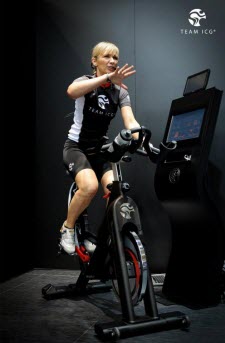
by Team ICG® Master Trainer Jim Karanas
At the beginning of every class we teach is an activity called “warming up”. Since the warm-up seems inadequate in many indoor cycling classes, I felt a review of the process would be beneficial to have on record.
During warm-up, we try to bring the expected working muscles to a state of readiness. To many, this means an easy roll of the legs while gently increasing resistance and/or cadence.
As an aging cyclist, I have made warming up a practice unto itself. Each warm-up is specific to the workout I have planned. It varies depending on what we do, and lengthens in accordance with the difficulty of the training.
Warming up properly on the bike should accomplish the following things:
- Increase blood flow (thus oxygen and fuel) to the working muscles.
- Increase aerobic metabolism in the working muscles.
- Stabilize breathing and heart rate.
- Decrease the viscosity of the working muscles.
- Increase the speed of contraction of the working muscles.
- Improve coordination among muscle groups.
- Prepare the students mentally before initiating difficult training.
Increased Blood Flow
The average person does not have enough blood in the body to support a maximal level of effort in all the muscles at the same time. The body must “shunt” blood to where it's needed to provide the oxygen and fuel necessary for increased activity.
Have you ever noticed when you press intensity early in the training that the muscles feel as if they’re anaerobic, even though your heart rate is not yet high? The body hasn't had enough time to shunt blood to that area to increase the oxygen available for the increasing rate of metabolism.
Increased Aerobic Metabolism
When the muscles are not engaged in exercise, ATP derived from glycolysis and ATP from oxidation are in a specific balance. Although anaerobic production of ATP yields waste products, it's done at a rate that allows the body to clear them from the muscles so there's no feeling of discomfort.
As the level of activity begins to rise, it's our anaerobic metabolism that initially increases to satisfy the greater demand for energy. Once the muscles begin to work with greater efficiency and more blood is providing increased oxygen, the body shifts to producing more ATP via aerobic metabolism. This is when we feel a sudden sensation of greater balance and muscular efficiency, despite a significantly higher heart rate.
Stabilization of Breathing and Heart Rate
Once the body has shifted as described above, a notable regulation of breathing and heart rate occurs. Rhythmic breathing increases the oxygen that can be delivered to the working muscles. To a certain degree, this happens naturally. It also stabilizes the heart rate as long as the intensity remains constant.
Decreased Muscle Viscosity
Viscosity refers to the degree of “stickiness” in the muscles. The body lubricates muscle fibers during warm-up, reducing viscosity and preparing them for the force we’re about to apply. Insufficient warm-up may not allow time for this lubrication of the muscles. When stimulated through exercise, inactive muscles initially perform small, irregular contractions with incomplete relaxation. Once viscosity has been reduced, the contractions become stronger and relaxation more complete.
Increased Speed of Muscular Contraction
Warming up properly increases the speed of neural impulses. That enables the muscles to contract more quickly in response to the work effort and improves efficiency and ease of movement.
Improved Coordination
Coordination basically refers to firing the right muscle fibers at the right time for a given physical task. Correct timing and sequencing from large muscles to smaller ones lead to optimal force. Cycling-specific exercises that engage muscles in the same movement patterns that they will later perform will improve technique and prepare the body for the unique demands of a particular indoor-cycling workout.
Prepare the Student Mentally
I’m often surprised when someone — instructor or student — considers warming up to be only physical. A similar approach should be taken regarding mental preparation. Instructors can guide students through specific thoughts, words, images, and feelings and prepare their minds for the upcoming workout. This mental preparation occurs in conjunction with physical preparation, so the students warm up body and mind together.
So, in five minutes or so, we have to shunt blood, ramp up aerobic metabolism, stabilize our breathing, lubricate the muscles, fire the muscles more quickly, practice technique, and prepare everyone mentally for what we are about to do for the rest of the class. Five minutes is the standard length of warm-up in the average indoor cycling class.
A five-minute warm-up is often considered the minimum necessary before activity. Note that I did not say “performance”. A proper warm-up can take as much as 20 minutes out of a class, depending on your ride profile.
My point is to consider the warm-up as important as the training. Plan it as intricately as you do the training. The right sequence of movement, music, cues and intensity can prepare students and instructors alike to train as they've never trained before.
by Chuck Cali | May 27, 2013 | Big Box Instructor, Master Instructor Blog

By Team ICG® Master Trainer Chuck Cali
Lately, lively discussion has surrounded a series of posts by Krista Leopold. She uses hypothetical letters to the instructor to highlight instructor professionalism. In her most recent “letter”, Krista discusses a subset of professionalism — bad-mouthing other instructors or the facility.
Krista has opened the door on professional behavior (ethics) in our workplace. Let’s walk in.
Webster defines professionalism as “the skill, good judgment, and polite behavior that is expected from a person who is trained to do a job well.”
Ethics are “a system of moral principles; the rules of conduct recognized in respect to a particular class of human actions.” In this case, the human action is workplace etiquette. We learn ethics as children. Our parents called it “doing the right thing.”
From that perspective, let’s examine another behavior in our workplace — self-promotion.
The forums I browse, including ICI/PRO, feature discussions on how to promote ourselves to our riders: social media, web sites, newsletters, email, business cards. It seems like a good idea, but is it ethical?
Unless you own the studio, the riders in your classes are customers of the facility that pays you, not your own. We have no ethical business contacting their customers. Yet it’s done all the time.
Instructors with regular classes build contact lists of subs, for obvious reasons.
Instructors with regular classes also build contact lists of their riders, for less obvious reasons.
Most instructors are also on sub lists. Sooner or later, an email arrives from a popular instructor, who needs a sub for a prime time class. The sub thinks, “Teaching to a full room is always fun; I’ll do it!” Seconds later, the sub gets a response from the appreciative peer, “Thank you so much. You’ll love this class. It’s always full, and they like a great workout.”
The sub spends considerable time, effort and money preparing. After all, this is prime time, and people arrive 45 minutes early to get a bike.
The sub arrives 20 minutes before the class and opens the door to…an empty room. A bit weird, but there’s still time. A couple of people walk in. The sub smiles and does the meet-n-greet. At class time, there’s a roomful of mostly empty bikes.
What happened? The instructor contacted the regulars to inform them that a sub was teaching. That’s all it took to empty the usually full room. Have you experienced this?
A serious breach of professional etiquette, this behavior has long been standard in big-box gyms and crosses the ethical line. It’s about self-promotion. Not to participate forces one onto an unleveled playing field. The playing field is Head Count, the gold standard of an instructor’s worth. Is this an instructor survival tactic? Must one be unethical to protect one’s turf?
I’m no stranger to contradictions, but isn’t discouraging attendance essentially the same as bad-mouthing another instructor? I see this as an ethics issue, rather than a survival tactic. What do you think?
When an instructor contacts riders and influences them not to attend class, many things happen. None of these is good for anyone but the instructor — who needed help in the first place.
At the big-box gyms, where most of us teach, there’s no real need for self-promotion beyond doing a good job. Why? Well, as stated, our riders are not our customers. And the gym promotes its own programs and, by extension, the instructors teaching them.
Our first priority as employees is to keep the members happy, better known as service after the sale. We do that by implementing many time-tested principles often discussed on ICI/PRO.
As always, there’s an exception. Soul Cycle. Their business model, largely based on self-promotion both on- and off-stage, pits instructor against instructor, in favor of those who sell out the studio every class. It’s all about sales. From that point of view, these unethical tactics can at least be understood.
Currently there’s buzz surrounding a lawsuit alleging that Soul Cycle exploits instructors by not compensating them for all their time. Exploitation? Maybe. I see it as creating an environment of competition in the interest of sales. Let the best at self-promotion win.
But what we do in the big boxes is about service after the sale. That changes everything when it comes to workplace etiquette.
My own subbing experience was invaluable. Unfortunately, I learned that instructors may act professional around their riders but less so with their peers. I also realized how hard this job is, especially building a loyal following of regulars.
I’m proud that, through continuing education, experience and professionalism, I play to a full room in most of the six classes I teach per week. I still don’t know the emails or phone numbers of any riders in my classes.
I have no illusion of effecting behavioral change with these words. Management at big boxes made the choice long ago to leave it to the instructors. Empty studios are of no consequence because, in such facilities, the cycle studio is not a profit center. Not so in boutique studios. Let’s hear from studio owners on this issue and how they deal with such tactics.
If we’re going to examine professional behavior in a forum for indoor cycle instructors, let’s look at all of it and ask ourselves if we’re doing the right thing.
by Chuck Cali | May 20, 2013 | Engage Your Students, Master Instructor Blog

by Team ICG® Master Trainer Chuck Cali
As I prepared to support ICG at IHRSA 2013, I considered the ICG tenet that learning is about removing resistance.
I had just gotten back from a bit of Vegas shopping. A nice saleslady asked me what I was doing in Vegas and told me about the time she and her friends first tried indoor cycling. She loved it and was hooked, but her friends ran away and never came back. She explained that their initial reluctance to try something with a reputation for being hard had unfortunately been validated.
The cycling class tradition is steeped in that reputation — it’s crazy hard and the people doing it are crazier still. The reputation makes it difficult to get new riders. There’s built-in resistance to the classes. Regrettably, many instructors deliver indiscriminately on the reputation.
Yet we know that doesn’t need to be the case. How an instructor begins a class can go a long way toward removing resistance for first-timers. So I’ve developed a list. I’m not sure if they’re “Dos and Don’ts” or “Pros and Cons”, but certainly following these tenets during every class will help improve the reputation of indoor cycling.
YOU MUST GET THERE AT LEAST 15 MINUTES EARLY!!
This seemingly simple, yet consistently underemployed, strategy will put you in a calmer place. Your riders can feel your tension. Moreover, it gives you a chance to get ready without stress and bond a bit with your riders. Especially first-timers.
BE ATTENTIVE TO FIRST-TIME RIDERS
Many first-time riders will not approach you with that information. They tend to wander in, head to the back of the room, and look for a bike that fits. If you’re in discussion with your roadie friend, picking videos, lacing up your bike shoes, emailing or texting, you could easily miss them. Be on the lookout.
PERFORM A BIKE FIT TO GET TO KNOW THEM AND LET THEM KNOW YOU
I’m often made fun of for the amount of time I take doing bike fits for my riders. Well, LOL, for first-timers, the key is the time you give them, rather than how precisely you fit them. While doing the bike fit, I ask their name, talk about the console (if applicable), show them how to change resistance, define some terms I’ll use, explain the order of tasks (fun, cadence, resistance), and most importantly, explain how to modify anything I ask. Make your first connection here.
START CLASS BY WELCOMING THE NEW PEOPLE
I may catch some flak here because some people don’t like to be called out. But rather than calling them out, I simply state that we have a first-timer and have everyone clap. Then we get to it.
MAKE EYE CONTACT AND GIVE POSITIVE REINFORCEMENT
During class, check in on your first-timer. It’s simple. Watch. Make eye contact. Smile and nod reassuringly. If they’re struggling, find an opportune moment to get off the bike, turn off the mic, and give some help. Help other riders along the way.
TALK TO THEM AFTER CLASS
As much as practical, get right to your first-timers and talk to them. How did it feel? What did you like? What didn’t you like? Did you get the workout you expected? Where to buy cycling shorts and shoes. Welcome them into the community.
FINAL WORDS ON EDUCATION
Innovation has been the cornerstone of the ICG mission. Our approach to education — learning is a process of removing resistance — is a giant leap forward for indoor cycling. As an instructor, you have the opportunity to remove resistance and educate both your regular riders and beginners. The longevity of our craft depends on bringing in, educating and motivating new riders. Removing resistance is the first step. Take it.
At IHRSA, I worked the ICG booth and was fortunate — in some bizarre way — to be cornered by two club owners after my second of three demo rides. Both used the same language.
“You’re very good at teaching to video. But, of course, that’s why your company brought you here. How can we get our instructors to do as well as you and make their classes just as compelling?”
I explained that the best programs are those where the synergy between club management and employees is high. When management works closely with the group exercise teams to educate, promote, nurture and applaud, good things happen. The corollary is that management first needs to go in search of “the best of the best (and) make them better”. (Yes, I stole that line from “Top Gun.”)
They were surprised to hear that ICG's online continuing education is free for everyone, not just those who buy our widgets. I explained our concept of educating by removing resistance. Our online modules are there for all — and you don’t have to start at the top. Nor do the instructors, who have learned a thing or two over the years, have to read all the chapters before taking the quiz at the end of each module.
As instructors, we can’t lose sight of the fact that, if we’re not working on improving our craft, then it could be better.
by John | May 18, 2013 | Engage Your Students, Instructor Training, Master Instructor Blog
I saw this last Tuesday and forgot to share it with you. Our club ride begins at the Minnetonka Lifetime Athletic Club. Better known as The Spa, this is a unique LTF facility. Definitely not a Big Box, this club began as a women only club before being purchased by Lifetime.

When I got there Tuesday night they were setting up for an outdoor ride. How fun is that? We rolled before they got started and I heard later that they (Manager and Instructors) did a very nice job making this outdoor class an event, rather than just a class.
The area behind the fence is a small patio. After the class participants enjoyed Hors d'oeuvres and a cash bar – this is an adults only club. They even had live entertainment from a local duet. Is that something you could do at your club or studio?
Could I keep up in a group ride?
With Amy visiting her family in Phoenix, I become the de facto sub for her Saturday AM class. Which was fine – 55 and rain this morning = no outdoor ride for John. After class a regular member asked me if I felt she could keep up in a group ride. I dislike giving answers beginning with; “well that depends” – except in this situation it really does. Riding with a group depends on a number of factors. So I asked her the following:
- Do you have a suitable road bike?
- Are you comfortable riding close to others?
- Are you OK riding on the road?
- How far (miles) can you typically ride at a consistent pace?
It surprised (and delighted) me a little when she quickly answered positively to each question and then clarified what she was asking:
How many Watts do I have to make, to keep up in a group ride?
She's been listening and wanted to equate the power/watts she seeing in class to riding outdoors 🙂
I had to think about it for a few minutes, before I could answer her. I explained that most organised group rides have multiple “levels”:
- “A” groups are normally drop rides. If you can't keep up you get dropped, and ride home by yourself. Based on my purely anecdotal experience, “A” groupers can sustain 1.5 or more watts per pound of body weight for the entire ride.
- “B” groups, depending on the organization and/or leaders, are partial drop rides = we may wait for you or there maybe someone who will come back to help you catch up. To hang with the “Bs” you should be comfortable producing your body weight in watts > and be able to climb at around 1.5 watts per pound.
- “C” groups are no drop rides. Everyone stays together and ride at the pace of the slowest rider.
But I don't want to slow everyone up – so what's the minimum watts I need to make?
I told her that there's no way to know that number. I encouraged her to show up one night and see what happens…
