
by John | Jan 8, 2013 | Master Instructor Blog, Music
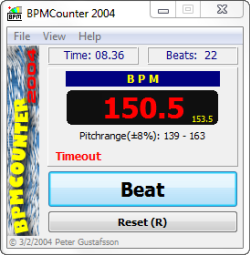
Macy Gray's “Nothing Else Matters” looks like this – once you move past your cluelessness.
If you've experimented with some of the 3/4 time track suggestions from this past weekend, you may have some confusion about how you count oddly timed music – like I did.
Amy had gotten me started with a bunch of the tracks in the ICI/PRO Learn to Ride to the Beat Spotify playlist and then ran off.
While I was writing the post, I wanted to find the RPM they communicated and share it with you. So I broke out my trusty BPM Counter*… and then quickly drove myself crazy trying to tap out the count; One-Two-Three / One-Two-Three and have it show a believable RPM. I actually quit trying to tap out the songs and instead jumped on my FreeMotion S11.0 down in the official ICI/PRO training facility (my basement) and rode to each song. Riding to the One-Two-Three / One-Two-Three comes easy to me – which is exactly why we recommend using music in 3/4 time to help your students Find The Beat – Find The Beat. Some LTF Instructors may get that private little joke.
When Amy returned, I explained that my rhythmic deficiencies were preventing me from tapping out the RPM successfully 🙁
She gave me a little smile and explained; “It's just Beat-Beat-Beat, Tap-Tap-Tap like any music in 4/4 time.” “Then you just divide it in half to find the RPM… silly.”
So I tried it again, this time forgetting the; One-Two-Three / One-Two-Three and instead just used Tap-Tap-Tap.
And she was right – as usual.
*Here's an old tap-to-the-beat program (PC only) that I've used for years. You can (right click here – save as) to your desktop. It's an .exe file that you need to run each time you want to use it. Your PC may warn you to be concerned about .exe files – you should if they don't come from somewhere not trustworthy (like a spam email) but this file is clean.
Here's an old video showing how to use the counter – I made it back in 2009 and it's helped over 10,000 viewers 🙂
This online Tap to the Beat counter works well.
There are a bunch of free iPhone Apps like this one you can use.
Android Users can download this free App.
by Chuck Cali | Dec 24, 2012 | Master Instructor Blog
Image from http://taloeffler.com
By Team ICG® Master Trainer Chuck Cali
In the movie A League of Their Own, the coach, played by Tom Hanks, confronts player Geena Davis as she quits just before the World Series because, “It just got too hard.” The coach’s reply is a memorable rant that ends with, “The hard is what makes it great.”
For me, that means: The ultimate satisfaction with a job well done is directly proportional to how much effort it took to do it.
“The hard is what makes it great.” That line has stuck with me over the years, and I’ve used it often in coaching middle-school wrestling, girls’ fast-pitch softball, my own golf game, and of course cycling, indoor and out.
It came to me again recently as I worked out with Team ICG® Master Trainers at ICG Academy in San Francisco. This team does the hard. We’ve met to train more times in the six months I’ve been an ICG Master Trainer than Brand X has in the three years I’ve worked for them.
At ICG Academy, in my favorite west coast studio, OMpower, we work hard to help each other get better, deliver the full value of ICG education, and instill our zest for MyRide®+. Team ICG does the hard.
Does the cycling or group X team at your club do the hard? This sort of club-level teamwork seems rare. Am I wrong? Do your club’s cycle instructors meet and work toward a common goal? Does your club even separate cycling from group X? If so, I’d appreciate a comment on how your club does it.
In my experience, group X departments leave it in the hands of us instructors. If the hard is what makes it great, then doing the hard work will make your classes great. So, are you doing the hard, and what is that?
Top of the list, and, I suppose, the hardest: Change your style. I know the daggers are flying. Everyone says style makes one unique. I maintain it’s not your style your riders come back for, but you.
Treat them to something new, or at least different. No matter what we name our profiles, we’re doing cardiovascular training on an indoor cycle. The key is how you present and perform those ride profiles.
Doing the Hard #1: STOP SCREAMING!
This sort of teaching was the norm years ago (and still is fun from time to time), but I suggest doing the hard. Stop screaming. Start teaching.
Screaming over the music is the screamers’ comfort zone. They coach high-intensity classes to loud, driving music and somehow believe their classes won’t have impact unless they scream. A headset mic doesn’t work for them. They scream into it, causing over-modulation. They finish totally wiped and would find it difficult to teach another class without rest.
Do the hard. Learn to use the headset microphone and the audio mixer — that panel with the knobs labeled mic, iPod, CD, treble, base. Give yourself time to set it up properly for the effect you want. You may be a bit uncomfortable the first couple of classes, but it’s powerful when done well.
Make sure you can be heard without overpowering the music. Vary your voice and tone. Be upbeat and happy during warm-up as you explain the ride. Use your best coaching voice during the intense moments, friendly banter during recovery. Soften as you cue the cool-down. Don’t compete with lyrics.
Now that you’re not screaming:
Vocabulary. On outdoor bikes, we ride on a combination of flat roads, uphill and downhill. We gear up or down, depending on terrain. Stay true to the bike; say “gear”. Use words that describe riding a real bike over real terrain. If you don’t ride outside or are unsure of correct terms, comment on this post and I’ll help you.
Define the terms you use, especially for new riders. Also, consider the class. A group doing advanced heart rate or power training needs different cues from a beginner class.
Talking. What and how much is said separates great from good. Talking too much is common. We all need to work on that, but we at ICG suggest always wearing a headset microphone.
Doing the Hard #2: Continuing Education.
When you talk, is there a message? You read ICI/PRO, a good start, but it’s not everything. There’s direction to further education on this site, so use it.
Continuing education can come from online sources, workshops at your facility, or specialty certifications. I recommend all three. But I draw the line with this: Whatever the continuing education, it must apply to indoor cycling or cardiovascular training. A kettle bell certification is cool but won’t add value to your skills as an indoor cycle instructor.
Try the other guy’s certification. How many of you have not added another certification since your original? Go to conferences; see what other instructors are doing with new bikes, video and great sound systems.
If getting out of the house is inconvenient or too expensive, create your new self by implementing some of the esoteric posts on ICI.
Joan Kent’s recent post on Focus with the Zen Triangle image was powerful for me. That message is different from what one hears in a typical cycle class. It truly helped me solidify the verbal descriptors I use to help my riders reach that state of liberating the body from the mind.
Or Jim Karanas on Flow, or Effortless Power. John Macgowan on being a celebrity. Cameron Chinatti on “true RPE”. Yours truly on connecting.
“The hard is what makes it great.” Doing any or all of these isn’t really that hard. Maybe the hard is just deciding to do something different.
by Jim Karanas | Dec 17, 2012 | Engage Your Students, Master Instructor Blog
Does hosting an Indoor Century appeal to you?
By Team ICG® Master Trainer Jim Karanas
Using power/watts conventionally in indoor cycling improves students’ fitness. But it’s the tip of the iceberg, a small projection of the immense power below the surface. Consider, instead, introducing the concept of effortless power in your classes.
Without the inner aspect, indoor cycling can limit students’ imagination, causing confusion and disappointment when progress wanes. The inner factors — center and intrinsic energy — provide controlled determination, calm, clarity, and an extraordinary source of power.
To get students to look at power abstractly takes patience. Pursuit of an ideal may not lead to measurable results, but enhances understanding and engages you for life.
Experiencing effortless power is possible, albeit challenging, in daily classes. Students won’t prepare adequately because outside preparation is necessary. An in-house event enables you to coach outside aspects of their lives. I like to use a 5-hour indoor century, during which the students must maintain a certain power output to cover 100 miles in 5 hours. If they don’t complete it in 5 hours, they keep riding until the odometer displays 100 miles.
During the event, minimize time off the bike. No breaks are scheduled; the goal is continuous effort. The event can be a fundraiser, but focus on preparing the riders to maintain a specified power output the entire time.
Some students will consider 5 hours impossible. Others will gear up and train for competition. Both perspectives miss the point. It needs to be viewed as a training session that reveals potential that’s difficult to realize in daily classes riddled with schedules, distractions and unconsciousness. Five hours allows students to detach from what they think is (im)possible.
A key to experiencing effortless power is being centered. Finding center requires Life Balance, which is coached pre-event. It has little to do with training.
Life Balance
Many of us experience life as hectic and frenzied. The experience of effortless power isn’t possible unless chaos becomes order, and motion comes from stillness. When coaching this, one-to-one conversations may be necessary, as individual circumstances vary. Balance needs to start with Lifestyle, then move to Nutrition, and finally to Training.
Your Lifestyle must be in order as you approach the event. Does your spouse support the time you need to train properly? Does your job allow for adequate recovery? Does your schedule permit adequate sleep? Do you have time to sit quietly and contemplate?
Nutrition follows Lifestyle. Do you have time to prepare healthful meals? Are you able and willing to remove alcohol, caffeine and sugar from your diet?
Last is Training. Is your training schedule regimented? Have you made time for ancillary training off the bike, including necessary recovery therapies?
Effortless power comes from balancing and coordinating intrinsic energy, not from endless training. On average, students won’t make all the necessary concessions, but a coach needs to move them toward simplicity and order. My experience has been: the greater the sacrifice to bring balance, the greater the experience of effortlessness.
Coordinating Intrinsic Energy
Daily workouts prepare the body for the rigors of the event. They’re also what the students are used to doing. Below are six effective trainings to help students achieve effortless power while riding. Introduce them sparingly and practice them yourself, so you can teach from experience. Some may resemble exercises you currently use. The shift lies in the intent behind the exercise and what you want the students to accomplish. Build in more of these concepts as you approach the event.
1. Ride position. Grace always accompanies effortless power. Whichever ride and hand positions you use, emphasize the discipline of maintaining proper position and transitioning fluidly. Coach conscious awareness of riding technique: Straight back. Soft elbows. No sitting up or standing unless coached. One hand on the handlebars when drinking water. Fluid transitions from one position to the next. Seated Flat Road at 90 rpm for 32 counts (use Beatmatch: match cadence to the music); 32 counts of Seated Climb at ~75 rpm (use Freestyle); 32 counts of Standing Climb at ~60 rpm (use Freestyle); 32 counts of Standing Jog at 90 rpm (use Beatmatch). Find a 90-rpm song that’s about 10 minutes long. M’Bali Jo by Pili Pili works well.
2. Pedaling technique. To promote awareness, start each class with 10 minutes of soft-pedaling at <50 rpm, with light resistance. Use ambient music to avoid emphasizing the downbeat, such as The Flow of Let Go by Anugama. Independent crank arms work wonders on technique but aren’t available on indoor cycles. The KRANKcycle by Matrix is an effective substitute. Through kinesthetic awareness, you’ll develop leg control by training your arms with independent crank arms. Master and perfect smooth rotations by using the Split, hands exactly 180 degrees apart. Rotations (arms or legs) must be slow (<50 rpm), with little to no resistance. Most students will become frustrated with this exercise.
3. Cadence and power ladder. 20-minute ladders (80, 90, 100, 110 rpm), 5 minutes at each cadence. Power output ladders up, as well. Identify the specific power output (or HR) for each cadence and keep it constant. Intensity is easy to moderate. Use four songs, and Beatmatch each cadence. The following playlist works well: Salt Water Sound by Zero 7 (80 rpm), Whole Lotta Love by Vitamin Dub (90 rpm), When You’re Falling by Afro Celt Sound System (100 rpm), and Reckoner by Radiohead (110 rpm). Cadences don’t need to be exact but should show a definite progression in speed.
4. Breath/cadence integration. After warm-up, perform 20 minutes of one ride movement and hand position (Seated Flat Road is best) at easy-to-moderate intensity. Don’t change position for 20 minutes. Keep power output (or HR) constant. Keep the diaphragmatic breathing pattern (number of pedal revolutions between exhalations) constant. Keep one hand on the handlebars when drinking water. Kanga by Professor Trance (80 rpm) is perfect for this exercise. Use fast, forceful exhalations, pulling the navel to the spine, and relax the abdominals while inhaling every 4 beats. You’ll breathe 20 times per minute for 20 minutes. 400 conscious breaths is a powerful meditation. Students who stay engaged could well experience effortless power during this exercise.
5. All-terrain cruise. After warm-up, vary ride and hand positions for 20 minutes. Change cadences while maintaining a consistent power output (or HR). Select easy-to-moderate wattage or HR and keep it constant, regardless of the terrain changes. Any combination of songs is appropriate for this exercise. Don’t allow students to fall into a rhythm. Use Freestyle more than Beatmatch.
6. Limited recovery with breath/cadence integration. 30 minutes in the saddle at a constant cadence (80, 90 or 100 rpm), using two distinct power outputs or HRs (upper threshold and slightly below). Alternate 5 minutes at each power output. This is a high-intensity effort. The limited recovery should enable students to repeat the high threshold effort. Specify a breathing pattern (number of revolutions per exhale) for each effort level. You’ll need six 5-minute songs at the selected cadence (Beatmatch works best). The cadence need not be exact, but keep it the same throughout. The breath integration described above is necessary, although the rhythm might be different at this higher intensity.
Special trainings help to move students toward effortless power during the 5-hour event. One example is “90 at 90”: 90 minutes at 90 rpm at one specific, moderate power output, using integrated breathing. The discipline is not to change ride or hand positions. Drink water with one hand on the handlebars. The students’ breathing pattern, coordinated with their pedaling, will get them through this exercise with minimal adjustments. Although not mandatory, it will help students to realize effortless power on the day of the event.
The Event
Divide the 5 hours into ten 30-minute segments. Have only one instructor. Each segment should have a beginning, a close, and a defined playlist. Don’t actually break between segments, but allow students to sit up and relax, without disengaging. Quickly bring them into the next 30-minute sequence.
Video
The benefit of Forward Motion Video in this event can’t be overstated. The sensation of forward movement will better enable students to channel their intrinsic energy. That, accompanied by a change of location every 30 minutes (e.g., World-Tour Challenge videos on Myride®+), will dramatically impact students’ sense of effortless power.
This 3-part article challenges conventional thought on power in indoor cycling. Its current use solely for measurable fitness results is not sustainable long-term. Power measurement can instead develop inner balance and the awareness, and coordinated extension, of intrinsic energy, resulting in effortless power.
To learn more, read Flow: The Psychology of Optimal Experience and Zendurance: A Spiritual Fitness Guide for Endurance Athletes
 – both cited in earlier posts.
by Gino | Dec 9, 2012 | Master Instructor Blog

One study down, a few hundred more to follow.
As a bit of “post-mortum” on our little EBC project, I asked all those participating in the study to share their own personal thoughts or observations with me. So as any experienced researcher will tell you, the actual collecting of the data can often reveal as much as the data itself.
There Is Joy In Repetition
No, I’m not talking about techno music, although the first time I heard that expression (about the joy in repetition) was in regards to Trance music. Getting back to our study, early on I heard feedback from some of our guinea pigs… er, I mean riders who found the Muscular Endurance work to be harder than they thought. They reported thatl making even just 2 sets of 15 minutes in Zone 3 and 75 RPM was more challenging than they thought. I also heard about how it got easier week after week. This was naturally expected from an RPE or “mental state of mind” is considered; doing something familiar will typically seem easier than doing something completely brand new. However, this later point emphasizes the real importance of having training tools.
Training Tools
In other words, if we consider that human nature tends to encourage us to work as little as possible to accomplish our objective (think efficiency, not laziness), in combination with our mental comfort with all things familiar, we run the real risk of depriving ourselves of a good training effect when these are at play in our physiological development or improvement as a rider.
If we put this in the context of our current study, if we did not heart monitors, we would not have been able to insure or insist that our heart rate remain within the range specified. If a training effect were to come into play (that is, we were to become stronger in some way from doing the M.E. drills), without a heart monitor, we might not have increased our gear (remember, keeping cadence constant was a requirement) as the training effect occurred, and thereby inadvertently reduced the amount or the longevity of that same training effect.
Not Just for Curiosity & Science
I also heard from at least two people that if they had not done the study, they would not have been as well prepared for a late season big ride they had scheduled. The combination of the type of training and the fact that it was an obligation to get through each of the study weeks was enough to motivate them to keep training.
In general I have found that most of my study participants gain a good deal of benefit from our little research projects. The worst case scenarios seem to be that they don’t improve, but they are no worse off than when they started. It’s generally a neutral to very positive both in experience and results.
Parting Thoughts
I have answered the previous comments through this graphic below. However, these answers may be wholly unsatisfying. Remember, the reasons this entire blog started and I coined the phrase Evidence Based Cycling™ is because the same studies are used by different coaches to emphasize different things or with completely different conclusions. It’s not exactly religion, it is science, but believe me there is way more subjective interpretation involved than many are willing to admit to.
I will not claim to be a professional researcher, nor the final word on any subject for that matter. But I will also not hide behind the science and say that it must and only can say this or that. It is what it is, look at it, learn about the subject, then draw your own conclusions.
At a minimum, I hope you are encouraged to dig in and do your own studies. Learn to question everything including everything written in this blog — but don’t just be a movie critic — get in there and make your own movies!
.
by Jim Karanas | Dec 3, 2012 | Master Instructor Blog, Training With Power

Image from http://en.wikipedia.org/wiki/Newton_metre
By Team ICG® Master Trainer Jim Karanas –
The Watt. Ten Newton Meters. Ten times the force necessary to raise 1 kg 1 meter vertical in 1 second.
Clean. Absolute. The cyclist’s preferred training statistic. Whether it’s power-to-heart rate ratio, sustainable watts per unit time, or maximum watt output, there’s no better measurement of improved cardiovascular fitness than a watt.
The watt has inspired recent interest in the indoor cycling community and generated millions of investment dollars by product manufacturers to bring it to the average fitness consumer. How good an idea is it?
A driving occupation of the fitness industry is to produce Results for our customers. Customers use our services and products to achieve results that justify the time and money spent working out: weight loss or weight gain, improved fitness, and improved health. They’re all measurable.
Other, unquantifiable, results are often attributed to fitness training — an improved sense of wellbeing, better life balance, greater happiness.
Results are more marketable when they can be measured. “Lose 10 ten pounds in 7 days!” Sustainable or not, the consumer is drawn to the promise of a measurable result.
What about the watt? It’s measurable, but does it tell most consumers what they want to hear? “Improve sustainable watts for your next FTP test in just 3 months!” That might attract some cyclists, but will it attract the general fitness consumer? The poor watt just isn’t as widely accepted as calories.
Some studios put up leader boards that display everyone’s power during class. They provide testimony that comparing participants’ watts to those of other riders in the room makes them try harder. But the comparison doesn’t make sense. It’s your power-to-weight ratio that determines if you get dropped on the next climb, not average watts. Why don’t they factor in body weight? The answer is obvious: It’s more difficult to manage, and people won’t likely weigh themselves before class. So the watt display means nothing. Why not let the watt do its job correctly?
The correct use of watts, particularly in conjunction with heart rate, will increase cardiovascular fitness exponentially in a short time. There’s no doubt. If you want to show a customer quick results, watts help — particularly if the customer has never done structured training before. But that person goes through the rapid-improvement phase only once. After their exponential stage (which could go on for months to years), the average fitness consumer will see a plateau, then a decline in performance measurements using watts. The watt loses favor.
Watts are brutally honest, and most people don’t like looking at them after a while. Ask anyone who has trained with power for 10 years and is no longer “getting stronger” how he/she feels about doing a 20-minute FTP test.
So why is the industry buzzing about whose bike measures watts, how accurately they’re measured, how consistently they’re measured from bike to bike, and whose education provides the best training for instructors to deliver to the members?
Can watts help us with our indoor cycling classes? Maybe. Teaching people to put out more effort is a good use of watts. “As we begin to climb, I want you to drop your cadence below 80 rpm. Remember, climbing requires more effort and a greater power output. Make sure your watts increase as you drop your rpm.”
The above cue uses watts to develop the experience, a good use of the measurement. But when someone feels that improvement of the metric is the motivation to train, there’s potential for dissatisfaction over time. People love watts when they’re going up; not so much when they’re going down. The poor watt can’t catch a break.
Soon all indoor cycles will measure watts. Still, I’m not convinced that watts alone will help indoor cycling.
Maybe you think this is hypocritical. Whether or not it makes sense, watts are here because the market demands it. Who created the demand? We did. By saying we can prove that your training is working. You’re making measurable progress. You want results; we can show them to you.
Up to now, the poor watt has been seen only as a measurement of performance and progress, which is great for the short term. Its use in indoor cycling will eventually lose impact. Cyclists will like the idea until it gets old. Manufacturers will continue to provide options, but how many club owners will accept the added cost over time?
Using watts to create a better experience will work long-term and open the door of understanding to what indoor cycling really brings.
Consider this: Instead of asking how many watts, ask how effortless they are. The first draws attention to measurement and performance. The second inspires deeper contemplation of the experience. The former takes a short-term view and eventually loses appeal. The latter can remain intriguing in every ride for the rest of your life, and will be understood more thoroughly as time goes on (see my recent post on Flow).
If we look at watts differently, they can help people and become a staple of indoor cycling. I like the watt because of the mystery of effortless power. Have you ever seen someone generate formidable watts without looking as if they’re working hard? Where does the power come from?
The watt has more to offer than most people think. I hope we give it a fair chance and don’t relegate it just to measuring performance.
by John | Nov 28, 2012 | Correcting Form, Instructor Training, Master Instructor Blog

All the confidence in the world and totally clueless.
I actually got myself in a little trouble exposing Myth #2
You (the Instructor) can set yourself up correctly.
It was at the end of an Instructor evaluation, where I was a pretend participant. The Dept Head asked us if we had any comments or suggestions for the Instructor being evaluated. Now I'm not normally comfortable critiquing others publicly, so I sat and pedaled quietly off to one side. A few of the other Instructor/participants offer a few simple suggestions and I felt pressured to say something… and being a guy, finally offered up something I thought would be safe:
“Have you ever had someone evaluate your bike setup?” “Your saddle appears to be too far back.”
Not a good choice.
I couldn't tell if her flushed look was communicating embarrassment or anger. Either way it was the wrong thing to say publicly in a room full of her peers.
“I'm right where I'm supposed to be”, she said rather indignantly as she sighted down across her knee at the left pedal.
But she clearly wasn't. Any experienced cyclist looking at her from the side could see how stretched out her position was and how she looked on the bike would benefit from a few minutes my (or anyone's) observation.
When was the last time (if ever) you've had someone look at your bike setup on the instructor bike at your club? During your initial certification doesn't count.
Instructors are proud people.
We expect others to look to us for stuff like bike fit, direction and guidance. Unfortunately this has us walled off as a sort of island, operating all by ourselves, without the benefit of any constructive criticism.
Our participants are nice = they won't typically say anything, even though they see something not quite right – or even grossly wrong.
I'll never forget a lunch meeting I had with a prospective customer a few years back. He had a spinach salad, I've forgotten what I ate that day. I remember his spinach because at some point during the meal my lunch guest suddenly had one green tooth. Completely green like it was something he paid for from one of those places at the mall where they sell jeweled “grills”. A piece of the spinach had attached itself and neatly covered one of his front teeth. I foolishly said nothing while we sat and talked. The whole time trying not to stare at his new organic dental appliance. We parted and I had forgotten all about it until checking my email later that day; I CAN”T BELIEVE YOU JUST SAT THERE LOOKING AT MY GREEN TOOTH AND NOT SAY ANYTHING! I'm pretty sure that was the last time I communicated with him.
But participants (read cyclists) will judge you based on everything they see
Believe me when I say cyclists will judge you. What do you think we are doing to keep our minds occupied during a 5 hour ride? We notice every detail. Now I'm sure that the Instructor being evaluated really did believe she was properly positioned. She found a bike setting and repeat it every time she taught. Her body got comfortable until it became “right”… even if it wasn't. Alone at home in your basement this isn't a problem. Sitting in front of 10s or 100s of cyclists every week is.
What to do?
I'm guessing you already know the answer to this; ask for help! And it doesn't need to come from another Instructor.
Would you like to make someone's day? In your next class pick out one of the experienced cyclists. Ask them to review your setup on your bike. I know I would have been flattered if someone in authority (you) asked for my help. You could even make a big deal about it during your warm-up. Simply explain how you recognized that you needed a second pair of eyes to really check your bike setup, so you asked Linda to help because you saw her as an experienced cyclist. Then you could continue with how Linda was able to suggest a few small changes and how much better you feel now.
This simple act of humility may have a profound effect on your class. Once other's realize that the Great and Powerful Instructor needs help, they to maybe inclined to ask for help as well.
Give it a try and let me know your experience.
