I found an easy to use iPhone App that will identify the key of a song for you. This $1.99 App is called Key+ (info here) and it will determine the key of any unprotected song on your iPhone/iPad – or – it will listen to a song played from another source, like Spotify!
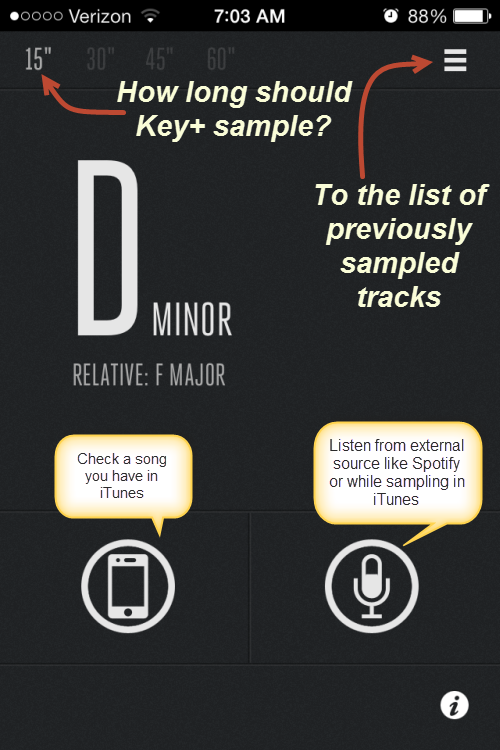
I found this super easy to use. Opening the Key+ App shows you a minimum number of options:
At the top you can choose how long you want Key+ to sample; 15, 30, 45 or 60 seconds. I couldn't see any difference in results, although I'm learning that some songs change Key at some point in the song.
The three horizontal bars takes you to previously sampled tracks from your iTunes music App. NOTE: this list is only shows previous samples from iTunes music – not from when you use the mic to listen with Spotify or Deezer.
The little iPhone icon takes you to your iTunes music App. NOTE: Key+ can't sample any tracks that are protected AAC files.
Click the microphone icon to begin listening to an external source, like a song from Spotify playing on your computer.
Unfortunately you can't have the two Apps (Key+ & Spotify/Deezer) open at once – so you need a second source to sample anything other than from iTunes.
The awesome folks at Mixed in Key sent us demo downloads of their software to play with. I'm learning the PC version and Chris Hawthorne has a copy of the Mac version – more when we've had a chance to dig into it.
Does your eating ever go off-track? Do you sometimes eat more than you “should” or foods that you “shouldn’t”?
This post poses 3 questions on eating behaviors.
Who (Whom!) Do You Blame When Your Eating Goes Off the Mark?
I always blamed my mother. She pushed food on me relentlessly, whether I wanted it or not. When I didn’t want it, she told everyone I was a picky eater.
But I wasn’t a picky eater. I was just constantly pushed — even forced — to eat food I didn’t want. It never gave me a chance to be hungry.
So eating food I didn’t need originated with my mother.
BUT!
My mom tried to sway me in other ridiculous ways — like making me afraid of dogs — and those didn’t work. Why did I let this food thing in?
Taking 100% responsibility means not blaming my mother for any mindless or unnecessary eating. I made the behavior mine, for better or worse.
Let’s explore 2 other eating behavior questions.
WHAT Do You Blame?
When it’s difficult to resist desserts or other junk you know isn’t good for you, WHAT do you blame?
I always blamed my sugar addiction.
Over 25 years ago, I was writing, reading (in varied science journals), and teaching my clients about sugar addiction.
That was way before everyone started comparing sugar to cocaine or heroin, or saying sugar was the most addictive of all.
And my sugar addiction was obvious (to me) many years before that – before anyone even acknowledged that sugar is addictive. Many people smirked when I mentioned it.
Sugar addiction was my go-to scapegoat — the reason for any struggle I had with food.
But taking 100% responsibility means I can’t do that anymore. As the world’s foremost(!) Recovered Sugar Addict, I know my recovery is the point.
It eliminates my old excuse completely.
So when my eating goes off the mark – for me that’s usually more about quantity when I’m stressed, not junk I shouldn’t have – I don’t have my sugar addiction to blame anymore.
It’s all about me.
I have to deal with stress in other ways.
What have you been blaming for any bad – or odd – food habits you may have?
Finally, WHEN Do You Blame?
Once you’ve identified WHO and WHAT you blame for your eating “excursions,” the next step is to identify WHEN you resort to blaming those people and things.
This can go a bit further than simply recognizing your triggers for out-of-control eating.
It’s helpful to know that you binge eat – or eat the wrong foods – under stress, for example. But does stress instantly trigger blame, a finger-pointing response?
In this example, stress may not always push you to get into blame, even if it does push you (maybe consistently) into out-of-control eating.
I’ve noticed that I get into blaming when I feel somehow victimized – say, when one thing after another is going wrong, and it feels as if that will never end.
And that’s when my other blame patterns come up – blaming my mother for pushing food on me, or blaming my sugar addiction for making me so sensitive to certain foods that it’s necessary for me to be overly rigorous about controlling what I eat. Yeah, poor me.
You know your Who and your What. Can you identify your When?
How will you take responsibility for your eating behaviors? More importantly, how may I help you?
If you’d like help with any aspect of your eating, including exploring or ending food habits that have been standing in the way of your good health and good moods, perfect. That’s what I do. Just visit www.FoodAddictionSolutions.com/Coaching and grab your free Eating Empowerment intro. Find out how easy and painless it can be to get foods working for you, not against you. Small changes can yield big results!
In my last article I focused on the implications of making adjustments to the drivetrain (seat height, fore-aft, tilt, etc.) to compensate for issues and limitations surrounding the upper-body and cockpit.
Drivetrain … Cockpit….. are these “technical” terms in the cycling industry? No, not really. They are however terms that have been used for years when we want to refer to an area on the bike and not a specific part or movement. For example, I could say that we are going to discuss the impact of handlebar height, handlebar fore-aft position and posture to address comfort and performance, but it is much easier to lump the whole thing together as the “cockpit”.
SIDE NOTE: Keep in mind that indoor bikes are often limited in their adjustments. On a real bike, in addition to handlebar height and fore-aft position, the following would be considered: handlebar width, angle, position of brake levers, reach, drop and type of bend.
4 Considerations for Handlebar Position
As always, there can be multiple factors which contribute to each consideration, but here are some basic principles to give you a starting point in helping riders make the best decision and adjustment.
Comfort: Many riders (both indoors and outdoors) find handlebars that are set low to be uncomfortable. This can be due to weak core muscles, poor posture, back and spine issues, and simply because it is not something they are accustomed to. Raising the handlebars can relieve pressure, relax tight muscles and provide a more upright and comfortable position.
Performance and Power: Relatively speaking, handlebars that are lower can help riders gain more power and better performance. Besides aerodynamic considerations, deeper torso flexion can provide better gluteal and hip flexor activation often resulting in a more efficient pedal stroke and more powerful down-stroke.
Flexed Spine: When the fore-aft position of the handlebars is too close to the rider (cockpit too short), riders may have the tendency to hunch (curve or flex their spine). This can put their back and spine at risk particularly when they are using large amounts of resistance. Adjusting the fore-aft position to lengthen the cockpit can help neutralize and relax the spine and surrounding muscles.
Over-Extended: When the fore-aft position of the handlebars is too far away from the rider (cockpit too long), riders can find themselves reaching, hyper-extending the spine and in deep flexion at the hips. This over-extended position can cause lower back pain, shoulder pain, strain on the neck and leave riders with fatigued arms. Adjusting the fore-aft position to shorten the cockpit will relax some of the aggressive angles and allow the arms and core muscles to support the upper body.
In many cases you will find yourself both adjusting the handlebar height the fore-aft simultaneously to get the desired position. Also, don’t assume that more aggressive settings (in either direction) are necessarily wrong. I’ve seen road cyclists and triathletes that are comfortable and safe using a very low handlebar position, as well as, a rider recovering from back surgery with their handlebars appropriately in the highest, closest position.
Determining The Optimal Cockpit
Our first concern is always safety which is why the first question we should ask any rider before we suggest or make an adjustment to their bike is “Do you have any injures that may be aggravated by riding?” Knowing this information upfront can save you from putting a rider in a risky position plus allow you to help them make better decisions as to what may be best at this time.
Handlebar Height
Assuming we have no physical concerns, it is simply a matter of comfort vs. power. When I setup a rider for the first time, I prefer to place their handlebars level with their seat (often referred to as “neutral”). This can sometimes be a challenge with shorter riders because the handlebars on some indoor bikes cannot be adjusted that low. Do what you can. If a rider feels uncomfortable, raise the handlebars in small increments. If a rider feels they are too high or wants more power, lower their handlebars in small increments. I’ve talked to instructors who feel that the handlebars should never be lower than the seat. I’m not sure where they received that information, but it is incorrect. It is not uncommon for outdoor riders (particularly road cyclists and triathletes) to have their handlebars more than 4 inches below the level of their seat. Consider the safety and needs of the individual rider and avoid making up rules.
Handlebar Fore-aft Position
Many of the bikes we use indoors may still not have the ability to adjust the fore-aft position of the handlebars. Even though, you still may be able to make suggestions for where a rider should grip the handlebars based on what you observe. As I mentioned in my previous article, this is the reason we should avoid numbered hand positions.
To determine the optimal starting point for handlebar fore-aft position, have the rider (seated) bring their foot and pedal to 12 o’clock keeping their ankle relaxed. Have them place their elbow to their kneecap with the end of their arm (hand and wrist) on top of the handlebars. The other hand should be gripping the handlebars and providing support.
Simply observe the alignment of the wrist and the crossbar of handlebars. If the crossbar is more than a fingers-width in either direction, you can suggest making an adjustment (keeping the above considerations in mind). You may find yourself incorporating a combination of hand position and handlebar position depending on what range of adjustment is available.
My Strong Opinion
I’m certain no one is surprised as I’m also certain I’m preaching to the choir on this one: “there are no short cuts when dealing with the variables and complexity of the human body in motion”. Certifications and individuals that advocate specific settings and positions will often find themselves wrong, and worse, lead others astray or toward injury. However, I’m comforted knowing that all of us at ICI/Pro default to knowledge. Doing something right requires understanding, where following rules…not so much.
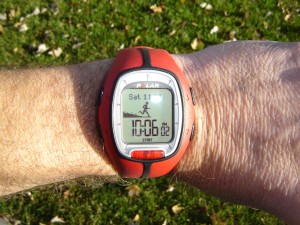
I got tired of replacing the chest-strap-battery in my old Nike monitor so I though it was time to upgrade. Based on the recommendation from a Personal Trainer at my club, I bought this Polar RS200. It is the lowest priced Polar monitor he was aware of that you can enter your own HR Zones. I tested it out this morning at my Indoor Cycling class. What impressed me the most is the new chest strap design, very comfortable! No more hard plastic strap cutting into my chest.
John Baudhuin with Colby the office dog -photography by Michael Darter
The brand that we all know now as Spinning grew out of a partnership between endurance athlete Johnny G and cyclist / CPA John Baudhuin in the early 90's. Together they formed Mad Dogg Athletics and the rest is history!
John R. Baudhuin is the founder, President and Chief Executive Officer of Mad Dogg Athletics. Prior to founding Mad Dogg Athletics in 1994, Baudhuin worked as a certified public accountant for Los Angeles-based Duitch, Franklin & Company, where he provided a variety of consulting and strategic planning services. An active member of the Young Presidents Organization, Baudhuin received his Bachelor of Arts degree in Economics from the University of California, Santa Barbara and his MBA from Loyola Marymount University.
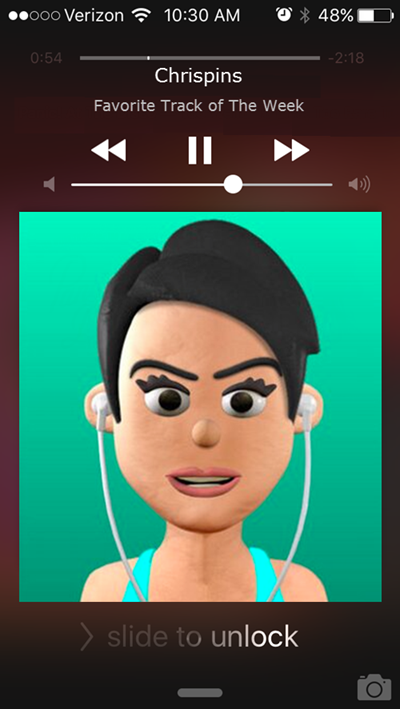
These two just released tunes will give your riders the opportunity to climb to new heights with a fresh new sound. Check out some brand new One Republic and Imagine Dragons for flat roads and X Ambassadors for a hill.