Spotify's Your Daily Mix Playlists can be found on your iPhone App, under the Your Library tab.
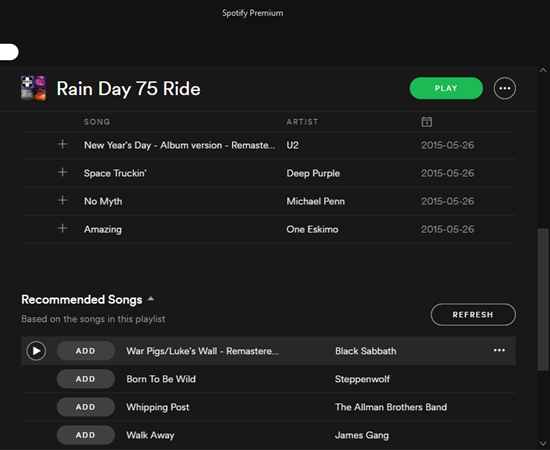
Chris Hawthorne, AKA Chrispins, joins me to discuss a few new music discovery tools she's using in Spotify. As these Podcasts are only audio, I've included screenshots of where you'll find the Discovery Weekly, Daily Mix and Recommended Songs for a specific playlist.
NOTE: The song recommendations will only display for playlist that you've created – not for a playlist of someone else's you're subscribed.
Listen below and then stay tuned for Chrispins' latest 60 min Audio Profile publishing later this weekend.
You'll find Chrispins at her music blog, on Twitter @chrispins1 and on Spotify where you can add yourself to her awesome subscriber count!
Scroll down one of your playlists to see additional suggestions & click Refresh for more.
If you're searching for a new song for sprints, look no further than this week's favorite track. Big Wild released it's single Invincible in September, and the remixes just dropped today. I especially like the Manilla Killa remix for sprints. Here's how we'll be riding to this one: :00-:50 seated climb; :50-1:20 sprint; 1:20-3:00 seated climb; 3:00-3:30 sprint; 3:30-3:49 recover.
Check out these video about IMAXSHIFT Indoor Cycling studios. They've raised the bar on using video an order of magnitude above anything else I've ever seen.
This Spin Class Makes You Feel Like You’re Soaring Through Space
IMAX Shift CEO Bryan Marcovici said the images help shift cyclers’ attention away from the exercise’s intensity.
“The science of distraction is really interesting,” he told The Huffington Post. “We’re taking the focal point outside of the riders’ head and giving them something in front of them to actually anchor to.”
Jesse Alexander, a master spin instructor at IMAX Shift, said “people work harder when they’re visually distracted and visually immersed.”
“When they see something, that makes them want to pedal faster,” he continued. “When they see something, that makes them want to turn the resistance up. It becomes a far more effective workout.”
One of my favorite songs to cycle to is Welcome to the Black Parade by My Chemical Romance. Well, it's been 10 years since the iconic song was released and now Gerard Way, frontman for My Chemical Romance has teamed up with Steve Aoki for a special 10th anniversary remix of the song. It was released today and it does not disappoint. Here are both songs and how I rode to them:
I've got a hunch that you know someone (friend or class participant) who suffer from plantar fasciitis. This new, noninvasive procedure sounds promising.
HAMDEN >> Alex Horjatschun was in excruciating pain from tendinitis, caused by a bone spur on his heel. On a scale of 1 to 10, it was a definite 10.
“I would get up off the couch and I would be limping,” he said, and it was difficult to do his workouts or stand for any length of time.
Normally, tendinitis and plantar fasciitis, which is closely related to tendinitis, are treated with surgery or with high-powered shock waves, both of which require anesthesia.
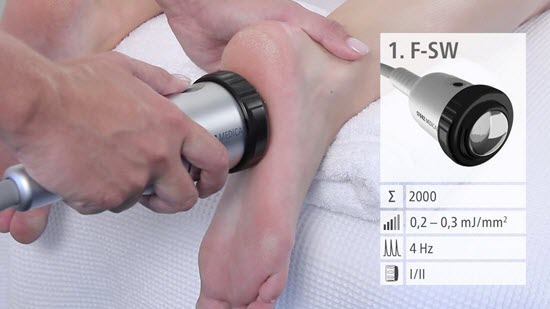
But Horjatschun is one of the first patients to be treated with a new machine that uses lower-level sound waves – the Storz Duolith SD1. “This machine has the benefits of having the patient direct you to the areas that hurt because it’s a midrange energy level that’s tolerable,” said Horjatschun’s podiatrist, Dr. David Caminear of Connecticut Orthopaedic Specialists.
Caminear was one of the authors of a double-blind study to test the Duolith, which recently received approval from the Food and Drug Administration. The study was published in the Journal of Bone and Joint Surgery, “arguably the most prestigious orthopedic journal in the world,” Caminear said.
“I was a little skeptical of how it was going to work … but after the first treatment (the pain) seemed to really subside and after the third treatment it was like night and day,” said Horjatschun, who lives in the Valley. (He asked that his hometown not be identified for personal reasons.)
“The pain now is maybe a 1, if that,” Horjatschun said. The treatments “decreased the inflammation and now it’s gone away.”
Tendinitis is inflammation of a tendon that connects a muscle to a bone. Plantar fasciitis affects the bands that connect to the heel and help stabilize the foot. Both conditions can be tremendously painful.
Caminear and his colleague, Dr. Jeffrey DeLott, were among the podiatrists at six sites across the country that participated in the study. “It’s Level 1 evidence, which in the medical world is the highest level you can get,” Caminear said. In the study, neither doctor nor patient knew whether the Duolith or a “placebo” machine was being used.
To be considered a successful therapy, patients had to report greater than 60 percent pain relief, Caminear said, and 65 percent of patients did, which is considered a success. In other words, six in 10 patients who were subjected to the Duolith machine experienced at least a two-thirds reduction in pain.
Nutrition coaching can be a gratifying business when clients get results. But it can be rather frustrating when clients fail to follow instructions — particularly for reasons that seem illogical, arbitrary, or even a little self-destructive.
Looking at weight-loss timing, for example. Much damage can occur from the time we first go off-course with our eating to the day we decide — somewhat arbitrarily — it’s the “right” day to begin anew.
Take the “Diets Start on Monday” Thing
Who was the first person to decide that Monday is the right day for healthful eating to begin? A heck of a lot of off-track eating can happen between the decision that you need to change your diet and that new-leaf Monday.
Or maybe the time span is only the weekend. Plenty of junk-outs can still crop up in anticipation of the deprivation that will come with Monday.
And if you catch yourself falling off your new food plan on Tuesday or Wednesday, what will the rest of the week look like if you wait till the following Monday? Imagine how many extra desserts or drinks you might squeeze in, how many extra pounds you might gain.
Don’t Wait Till New Year’s Day
For that matter, who decided that January 1 is the day to re-set after holiday chaos? The holiday season lasts at least 5 weeks. Why go through the same behaviors, and then set the same goals every year?
Two clients — married to each other — used to drink their way heavily through the year and “dry out” (their words) in January. I discovered their January dry-out didn’t last the full month of January. It barely covered the first 3 weeks of the year.
We needed to make changes
A few other clients of mine have difficulties with sugar, alcohol, and weight gain. They’ve told me (separately) that they intend to keep eating and drinking through the holidays and start following a healthful plan in January.
Again, changes seem to be in order.
Food, Alcohol, and Highway Lane Dividers
What if we delayed fixing things in other areas of our lives? Like driving, for example.
No doubt you’ve momentarily driven over the raised lane dividers on the road — the ones that make the tires bump when you move into the next lane. What did you do?
It’s not a trick question. You probably course-corrected immediately and centered yourself back in your lane. It’s the only safe and sane thing to do.
The crazy, self-destructive decision would be to let the car keep moving into the wrong lane until it crashed.
Course Correction Is Everywhere
In other examples, we notice when we’re off course and adjust our steering instantly, literally or figuratively.
All travel involves course correction — spacecraft, airplanes, sail boats — without delay. Entrepreneurs risk failure if they don’t plot a new direction when a business drifts off-course.
Hopefully, healthful eating is a plan you’ll follow for the rest of your life. Forget starting on a Monday, or New Year’s Day, or first thing in the morning. We’re in the middle of the holiday season now. Sugar and alcohol are virtually everywhere.
My only recommendation is to view your health as a lifetime project. Whatever harm you may have done thus far this season, simply stop and course correct. Anytime, and sooner is better. Imagine the wreckage you can prevent if you course correct right now, instead of waiting another month or so.
All-or-nothing thinking is a rigid perspective that can get us in trouble if we let it. True flexibility can encompass a few indulgences — as well as getting back on target right away, at the very next meal.
Just do what you’d do if you crossed over a lane divider. Steer back and re-center immediately. It may be just that important for your health.
Looking for help with your holiday or post-holiday food plan? Perfect, because I make it easy. Just visit www.LastResortNutrition.com and request your free Eating Empowerment consult. Find out how small tweaks can make a big difference and help you feel great.