“Because that's where the money is…” was famous American bank robber Willie Sutton's reported answer to the question; “Willie why do you rob banks?”
I can imagine a similar conversation with an upscale restaurant owner; “so why do you cater to business people?” “Because they regularly entertain important clients and pay with expense accounts!”
Now that business people (and their prospective clients) are moving away from the two-martini lunch and adopting a more healthful lifestyle, expense accounts are paying for fitness classes.
Wall Street’s salesmen and dealmakers, whose expense accounts help fill downtown chophouses and box seats at ballparks, are now treating clients to a different kind of entertainment: high-end workouts.
Pre-dawn and afternoon classes at Manhattan fitness studios SoulCycle, Barry’s Bootcamp and Flywheel Sports are growing popular with bankers who want to bond without loading up on liquor and fatty foods, according to traders and salesmen. John Abularrage, head of Tullett Prebon Plc’s Americas unit, takes clients to 5 a.m. sessions at Barry’s Bootcamp in Tribeca, where they run on treadmills and lift weights to thumping dance music.
…
Bankers who sell stocks or bonds have long plied mutual-fund traders and hedge-fund managers with tickets, meals and drinks in the hopes that friendship — or at least familiarity – – will lead to more trades. Health-conscious clients increasingly view steak dinners as “three-hour ordeals,” said Chelsea Kocis, a 26-year-old former equity saleswoman.
“‘Let’s meet at 5 for a workout,’” she said, describing the way she’d invite out traders. “‘You can be home before your kids go to bed.’ That’s an enticing thing for a lot of people.”
New Yorkers have been wooing clients and forging business relationships in yoga classes and locker rooms for more than a minute, but after the New York Times introduced the term “sweatworking” to the public at the end of last year, the concept entered the serious spotlight.
And at the center of it all was Sarah Siciliano, an advertising production executive who has turned sweat-working into a branded business. Siciliano now has a website and a group of clients who work out with her two or more times a week. They spin, stretch, and make business deals.
CREATING BUSINESS CONNECTIONS OUTSIDE OF THE OFFICE HAVE BECOME TOO MUCH ABOUT EATING AND DRINKING, OFTEN TO EXCESS. THE CONCEPT OF SWEAT-WORKING IS THAT EVEN BETTER, MORE MEANINGFUL CONNECTIONS CAN BE FORGED WHEN A GROUP OF LIKE-MINDED PEOPLE WORK TOGETHER TO IMPROVE THEIR MINDS AND BODIES. IMAGINE IF ALL THE TIME WE INVESTED IN NOISY, CALORIE-LADEN, ALCOHOL-SOAKED NETWORKING EVENTS WERE PUT TOWARDS INVIGORATING, CLARIFYING, ENERGIZING ATHLETIC CLASSES AND EXCURSIONS.
Now you don't have to wait for someone like Sarah to organize a group of like minded people and have them meet regularly at your club. You could do it yourself by using a free service like www.meetup.com.
I encourage you to visit meetup.com, search by your studio's Zip Code and scroll through all of the results. I did a quick check for groups located within 5 miles of ICI/PRO member Joe Ducosin's CycleQuest studio and found these groups…
Would any of these groups be interested in holding a meeting at your studio? I have no idea, but the group leaders are easy to contact.
Another option would be for you to form your own networking group that meets after your class for coffee. What types of business are prominent nearby? Who's already in your class that would benefit from meeting more people?
Joe has a huge (6,000 employees) new health care provider moving in just up the road. I'll bet there will be a steady stream of sales people visiting who may appreciate a sweat-working opportunity at his studio – and will pay for the privilege with an expense account 🙂
John, you absolutely need to interview this new customer of our's in Boston… she's only 25 years old and it sounds like her Indoor Cycling Studio is really doing well!
I was talking with Gina Perrault from MINDBODY Online last month, at their conference in LA. I had asked her if she knew of a studio owner with an interesting story to tell.
A few days later Gina connected me with Jessica Bashelor (now 26 – she had a birthday last week) and her Handle Bar Cycling Studio in South Boston.
Jess is The Handle Bar's owner and manager. She grew up a competitive swimmer and developed a love for fitness at an early age. Attending college at Northeastern University, Jess discovered her love for group exercise, specifically indoor cycling classes. Now, 7 years later, Boston is Jess' home and cycling is her passion. An avid music lover and listener, Jess is motivated by rhythm, calmed by acoustics, and touched by the lyrics of songwriters old and new. She opened The Handle Bar to offer classes with the intensity she craves, set to playlists composed with care. Jess rides to house music, hip hop, and heavy rock… Her classes are crafted to challenge riders physically, and inspire them to achieve greatness both on and off the bike.
If you're running or contemplating opening a new studio, Jessica shares some excellent ideas about understanding your customer demographic and connecting with them. Her studio's blog regularly features participants > a great way to make people feel valued and appreciated – not to mention they share these with all of their friends 🙂
You can listen below or find this episode + over 100 more on your portable device by
I’ll switch gears from my recent posts on using public speaking techniques to enhance our teaching to talk about what we say. In The Art of Cueing, I discussed the use of cues to bring depth to the class and make it more than just a workout. Cues concerning the science, the music, the video, your personal experience, even philosophy can make your class more interesting and more impactful.
Philosophical cues are the most difficult to incorporate. Instructors don’t typically cover philosophy when they teach because they don’t think people want to hear it, or they don’t feel comfortable talking about it. Someone who doesn’t teach might say the first is true. But maybe that person hasn’t yet heard a well-delivered philosophical message and is just uninformed.
I understand not feeling comfortable talking about it and will address that later.
Adding philosophy to a class so it doesn’t sound like preaching is what I call “messaging.” A class without messaging is just a workout. It might even be a good one. But the instructor’s power will weaken over time, just like playing the same workout video over and over. It diminishes with no message. All the public speaking techniques in the world can’t compensate for a class that lacks substance.
Unforgettable lyrics are unforgettable because they send a message. A public address goes viral on YouTube when it sends a message. Messaging will touch a person’s life beyond the great workout you just delivered and compel him/her to come back to your class again and again.
What’s a message? Any life concept that you bring to the class and that can be experienced in the class as result of the training you’re providing. A couple of examples:
Focus
Coaches often tell you to “stay focused” but rarely tell you how. Focus is not simply directing your attention to what you’re doing. That leads to thinking. Thinking will weaken focus. Focus is complete engagement in what you’re doing. A focused mind pays no attention to distractions. Fast descending takes focus. If you’re not 100% engaged and non-reactive to distractions, you might crash. How do you train yourself to be this way — not just during a dangerous descent, but right now, so you get the most from your workout? That’s the essence of our class today.
Motivation
Something that happens outside of you that you consider “motivating” is not a strong incentive. You might see someone overcome great adversity or hear a story that strikes a personal chord with you and feel filled with motivating energy. These external motivations work temporarily, but have far less impact than motivation you generate by yourself. I want you to look at motivation as something personal. Then you have the ability to train and get better at it. You can train yourself to be motivated the way you train anything else.
When you understand how to do this, motivation is endless, limitless. The only time you won’t feel motivated is when it’s a personal choice, and you’ll recognize it as such. You’ll no longer look to me or to anyone else to motivate you to train. You’ll rise to the occasion again and again because you’ve trained yourself to do so. I’ll show you how to do this in today’s workout.
As an instructor, all you have to do now is deliver a physical practice (the day’s ride) that delivers the results you just promised to deliver in your message. If I’ve enticed you, and you want to learn how to focus or be consistently motivated, the solution is simple: Come to my class. That’s the power of good messaging.
The messages you can deliver are many: how to engage fully, how to sense meaning, how to expand your concept of what you can do, how to sense your life energy, how to direct it, how not to react to adversity, how to develop discipline, how to go beyond hope and fear, and on and on.
How do you, as an instructor, learn to deliver these messages, both verbally and physically? First, you must want to. Second, you must become a student of philosophy. You study and you ride, and you bring the lessons that you learn from your study to the bike, and then to class.
I have a small library of what I call my “Life Books”. These are about 10 books that I have found extremely helpful. I’ve read each of them dozens of times. A good philosophical book is one you immediately realize you need to reread. My first Life Book was Way of the Peaceful Warrior: A Book That Changes Lives. It was the first book to encourage me to approach my training from a conscious perspective. I have several copies with dog-eared pages and many handwritten notes throughout.
Physical movement has been part of spiritual training for thousands of years. It was not meant to provide exercise. Daily activity was supposed to do that. Keep a conscious attitude, go beyond the workout, and deliver a message every time you teach.
We got great responses to our two surveys asking for feedback from both Instructors and Studio owners about the Indoor Cycles they're riding and the impact power is having on their classes. Now the challenge becomes; “how do we publish all of this information in a way that's valuable?” I had originally wanted to just share all of the info, except I'm not finding an easy way to remove all of the personal information – so I'm not comfortable sharing access to the full results.
Instead I'd like to help you understand what I feel are the important bits 🙂
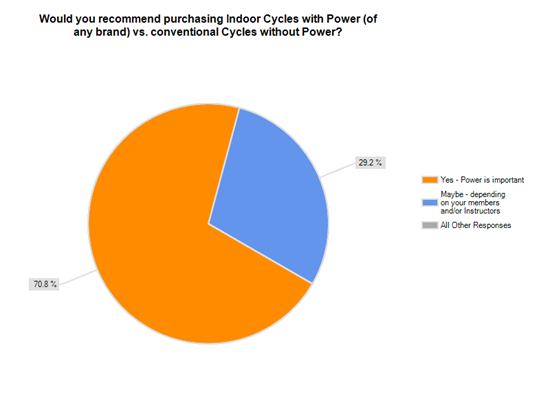
Let's start with answering what I see as the most important questions; Is Power worth the added expense, and does it improve the quality of Indoor Cycling classes?
70.8% of respondents responded in the affirmative, yes, power is important = worth the added investment vs. conventional ICs without power. The other 29% offered a reserved Maybe – with it dependent on the makeup of a club's members and Instructors. There weren't any negative responses.
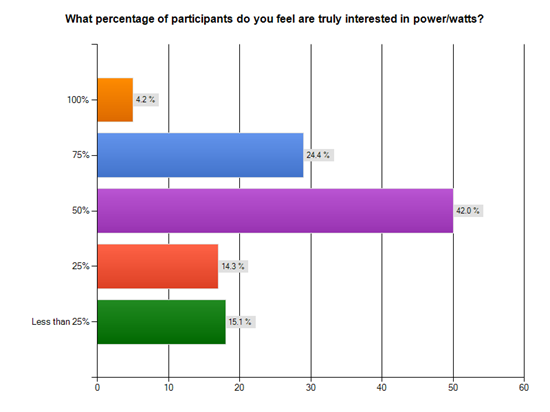
Over 70% say their riders are interested in power – does that square with your experience? I really wish I had included more questions asking what do your riders like about power/watts?
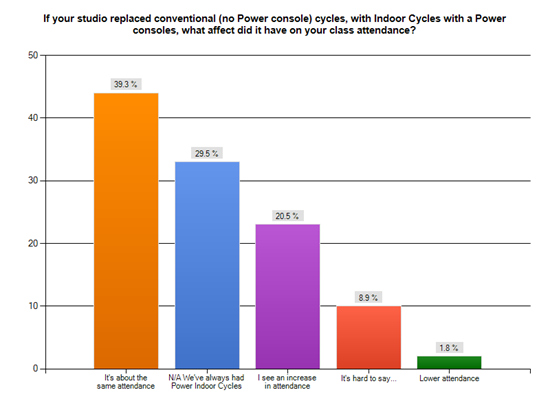
Did the switch to power increase attendance? This is a good sign with 20.5% saying YES they're seeing improved attendance in class and less than 2% say it's reduced class size.
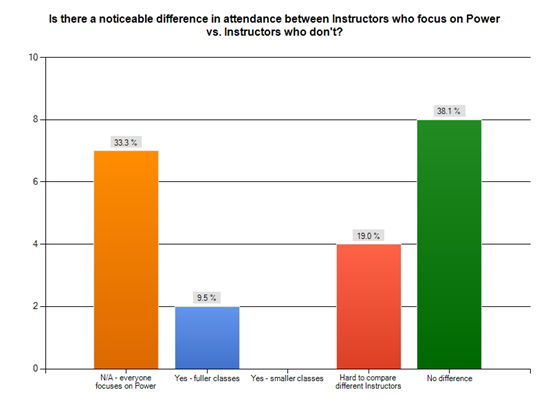
I asked this question specifically to studio owners; Is there a noticeable difference in attendance between Instructors who focus on Power vs. Instructors who don't? In retrospect I now see that this would have been a difficult question to answer and It doesn't appear that there's much difference between them.
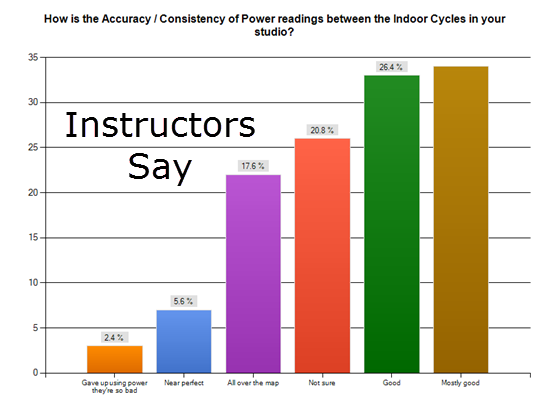
Now there does seem to be a disconnect between Instructors and owners & managers about the quality of the wattage these Indoor Cycles are displaying.
Which is typical. We're in the thick of it, while owners and managers have learned to tune out complaints 🙁
I'm working on the comparisons between brands and will have it up ASAP.
With the season of giving upon us, I have a question for all of the Indoor Cycling instructors out there.
What one “gift” could your facility add to your Indoor Cycling studio that would help you improve the experience you try to create for your class participants?
I teach indoor cycling at multiple facilities in the Denver area but I spend most of my work week at Greenwood Athletic and Tennis Club. Greenwood is my “home club”. This is where I'm a personal trainer, teach indoor cycling, HIIT (High Intensity Interval Training) classes, CVI (Cardio Vascular Interval Training) classes, I've been a Master Swim Team coach, a Triathlon Team coach, I'm one of the Race Directors for the annual Tri-Our-Village Kids Triathlon and the Roadless Century Coach and Lead for the annual Roadless Ride fundraiser to benefit Brent's Place.
Greenwood is considered one of the best athletic clubs in the country. They do a lot of things VERY well. The facility is kept immaculately clean, they have the latest and greatest equipment and vast and diverse group exercise program with some of the best instructors in the Denver area. I could go on and on about what they do well, but there are plenty of facilities that are clean, big and have plenty of offerings, let's talk about something they do differently.
Greenwood is the only facility that I have every worked in that has, PAID, semi annual ALL STAFF meetings. There are some things that cannot be expressed in an e-mail or newsletter. There is something powerful and unifying about the ENTIRE staff gathering TOGETHER hearing the EXACT SAME message coming directly from the facility owner and general manger.
Our first All Staff meeting of 2016 took place last Thursday. The most exciting announcement, for me, was replacement of our Spinner Blade Ion indoor cycling bikes with the new Stages SC3 bike. This will take our, already stellar, indoor cycling program to a whole new level!!!!!!! I felt the most memorable segment of this meeting was when the video I've posted below was played. Watch, listen and know that your actions are powerful.



 John, you absolutely need to interview this new customer of our's in Boston… she's only 25 years old and it sounds like her Indoor Cycling Studio is really doing well!
 It was the first book to encourage me to approach my training from a conscious perspective. I have several copies with dog-eared pages and many handwritten notes throughout.