
by John | Jun 28, 2014 | Correcting Form, Instructor Training, Leading Group Rides, Master Instructor Blog
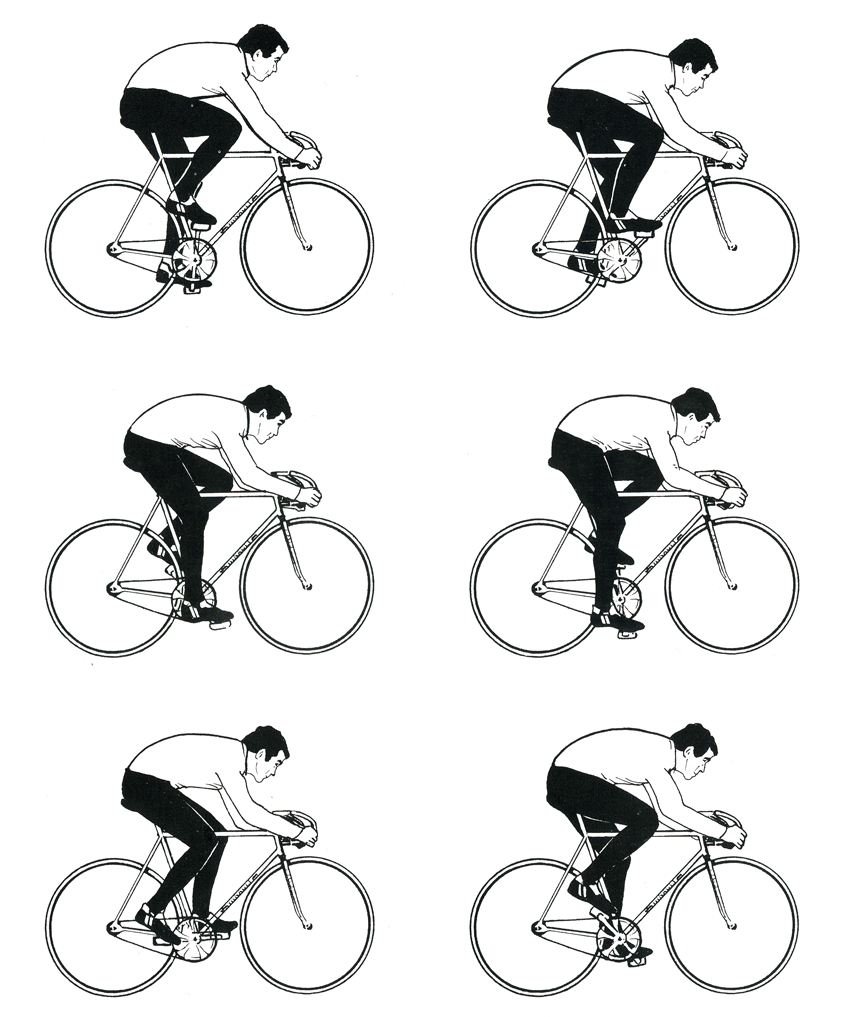
Beyond the obvious fitness benefits Indoor Cycling provides to our outdoor riders, there's an overlooked skill that will make your participants smoother and safer riders in a pace-line… riding fixed-gear Indoor Cycles teaches us to pedal constantly – i.e. not starting and stopping while riding.
It's rare that you'll ever have your class stop pedaling. We start turning the cranks and don't stop until the end 45 minutes later. Not surprisingly this steady/consistent pedal stroke is the mark of an experienced cyclist. Pedaling without stopping will also prevent you from hearing me calling out from behind you, in a somewhat irritated voice; Pedal, Pedal, Pedal!
At this speed you only get one chance.
Riding in a paceline at speed is a magical experience. Sailing along at 20 mph with your wheel 12″ or less from the person ahead. You feel their draft dragging you along, as the group members take turns sharing the work of pushing through the friction of the air. As long as everyone rides smoothly and consistently, it's all good. But “things” happen over a 40 mile ride; dropped water bottles, lost or distracted concentration, garbage on the shoulder – lots of “things” that will cause one of the riders in front of you to slow suddenly. Exactly how you react can make the difference between just another “thing” that happened on today's ride or you painfully ending up on your head 🙁
I've seen a lot of rear-end collisions and nearly always it's the rider behind who gets the worst of it.
@ 20 mph you are travelling ~ 29 feet per second. That 12″ gap between you and the rider in front represents 1/29th or 0.034482 of a second. So let's say you're JRA (Just Riding Along) and everyone in front slows very quickly. There's very little time (just a fraction of a second) to; perceive the change in speed and then react, before you hit someone. A fraction of a second may sound like a short period of time, but your brain can do a lot – especially if you've conditioned/trained it to respond correctly.
Brakes are for slowing… Pedaling is for going
Spend as much time leading and riding with cyclists in a paceline as I do and you start noticing the small differences that identify experience levels. Observing how closely a rider is willing to follow, consistently maintaining the distance to the rider ahead, is what tells me if you've done this before. When I see someone who's not comfortable following closely, it's almost always because they are attempting to control their speed by first stopping their pedals. Trouble is that bicycles coast…
Bicycling.com has an article that describes what they call the 9 rules of riding in a paceline.
MICROADJUST It's nearly impossible for everyone to put forth equal amounts of effort, especially on undulating terrain. You need to make adjustments along the way to prevent what Ignosh calls the Slinky effect, where the line alternately bunches together and becomes strung out, with big gaps. “It's better to make two small undercorrections than one big overcorrection,” he says.
“Think of it like driving: You don't slam on the brakes, then hit the gas; you moderate your speed.” To do that in a paceline, try one of these techniques:
Soft pedal: If you feel like you're getting sucked into the rider in front of you, take a light pedal stroke or two to adjust your speed accordingly.
Air brake: An easy (and safe) way to trim speed is to sit up and catch some wind. It'll slow you down a notch without disrupting the rhythm of the line.
Feather brake: Gently squeeze the brakes while continuing to pedal. You can scrub speed while shifting up or down as needed to alter your pace.
Note that none of these 5 techniques involves stopping your pedals.
New/inexperienced/poorly trained riders typically do the following in a panic situation:
Sense the change in speed > {stop pedaling} > realise that wasn't enough > grab a handful of brake > overlap the wheel ahead or hit the rider's wheel. The time spent between the {stop pedaling} was their allotted 1/29th of a second to react and prevent the collision. Having survived this mistake a few times, the rookie rider will increase the gap {adding additional time} until they learn what's causing the problem.
Experienced riders have learned to skip the {stop pedaling } and instead quickly apply (feather) the brakes lightly, while soft pedaling. In a panic, their hands are already doing what their supposed to be doing and can continue to add pressure to the levers as needed. Collision prevented 🙂
I've discussed this in my classes and have used it to break up the monotony of a long long tempo flat at Threshold. I'll ask everyone to close their eyes and visualize the scenario I described above…
You're tucked into a fast group this morning. Your hands are lightly resting on the hoods, fingers at the ready on both brake levers. Sensing the lead rider slowing you feather the brakes just enough to maintain your 12″ gap between wheels, while softening the pressure in your feet just a fraction. Keep this level of effort until the group accelerates again – your response to this surge is perfect.
With any luck you'll have taught them a valuable skill that could keep them safer in a group ride. Or at least save me from have to call out; Pedal, Pedal,Pedal!
Riding a fixed gear bicycle is a common training technique among outdoor cyclists, for the exact reason.
by John | May 14, 2014 | Engage Your Students, Instructor Training, Leading Group Rides

Can't say I'd blame anyone for wanting to ride outdoors.
Are you faced with this dilemma, now that Summer is here?
Hello John,
Thanks for your speedy response.
Here is my question with a little ‘back brief' first; I live in Bend, Oregon and teach indoor cycling classes (and other types of GX as well) at the premier health club facility in my region. I have taught here for many years and can confidently say that we experience a seasonal trend in class attendance that is affected by the onset of beautiful weather! Much more so than I have seen while teaching in my other home, Southern California.
Management typically responds to this trend by cutting classes until the Fall to save on payroll. As an instructor I have learned to accept this and indulge myself in other, more self focused, activities; but in all honesty it is disheartening. Other instructors concur. I wonder if this topic is familiar to you? Have you had similar conversations with other instructors? Any insight you, or others might offer?
Really appreciate your time and expertise, and I want to say that I am a huge fan of ICI/PRO! So glad I discovered you while podcasting 🙂
In Health,
Tina
In a bit of serendipity… I received this email from my Dept Head only a few hours after Tina's.
John,
I am reaching out to get your thoughts on if you think it is worth/ideal to offer both the 6am and 5:30pm indoor cycle classes for June-August? The last think I want to do is disappoint any of our members, but I also want to be realistic with the horrific winter we have all experienced. I am not 100% sure what the participation has been like for both classes lately?? I do feel/think that many would rather be outdoors once the sun and heat really arrive.
I look forward to hearing your thoughts.
Thank you.
Tamara
I can understand how you could feel disheartened Tina. I've experienced a cutback in classes during the Summer for as long as I have been an Instructor, so this email to me was expected. You almost have to start from scratch again, building your class in the Fall. I find myself needing to re-learn many names after the Summer and it typically takes me weeks to get back the level of rapport I enjoyed the previous season.
My response was to agree to drop the evening class at the end of May, leaving me with just one class a week. This could be a problem as Life Time has a two class per week minimum to retain your status as an employee. Thankfully in my case it isn't. I lead two scheduled outdoor rides each week (Saturday and Sunday – join me if you can) and those rides are counted as classes.
If they won't come to you inside > could you go to them outside?
If getting outdoors, after a (I'll use Tamara's words) horrific winter is what your members really want, then why not apply a little bit of “out of the box” thinking here Tina? And by “out of the box” I mean it literally – is there a possibility you could create a class that's held outdoors and not in the studio?
Your participants still want to be active, so how about…
- Holding your Indoor Cycling class – outside?
- You're a Group Fitness Instructor – could you offer a park class?
- Maybe a Summer boot camp with all the activities help outdoors?
- If you ride outside, why not start a group ride? Or find a group you could join?
- Or maybe form a walking / running club?
What other ideas do you have?
by John | Apr 22, 2014 | Instructor Training, Leading Group Rides, Learn Leadership Skills, Master Instructor Blog
Happy Earth Day!
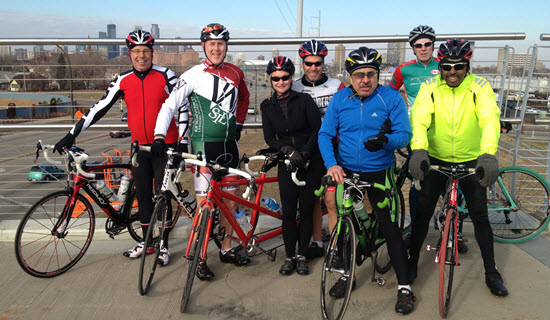
Spring in Minnesota is finally here and that means we can ride outside! I'm so excited to test my fitness against the hills, wind and other cyclists I ride with again!
This week begins our organized rides with the Life Time Fitness Cycle groups. I'm leading two rides this summer, both leaving from the Minnetonka Life Time Athletic Club. These rides are open to non-members, so please feel free to join us here or at any Life Time location near you.
Saturday 7:30 am is a strong “B” level, 40 mile ride. NOTE: we're still working out the parking problem and this location may change.
Sunday 8:00 am is our 30 mile coffee ride into Minneapolis. Amy and I lead this on The Bus (our tandem) and we control the pace, so it's a safe ride to learn group skills.
That group on Saturday has a lot of “A” type people with strong personalities. They really need a strong Leader or chaos and broken bikes/bodies can result. I've been leading group rides for close to 20 years and I feel I learned from the very best. You can read about being the “Big Dog” outdoors ICI/PRO members only – where I discussed the need for a true leader in an outdoor group ride and how to be the Big Dog.
Man or women, it doesn't matter – only that you act as the Leader. If you have the opportunity to lead a group this summer, and you want everyone to have a safe and enjoyable experience, you may find that post helpful.
With Saturday only 4 days away, I've been polishing up my “Big Dog” talk I give at the beginning of the season. The purpose is to convey the behaviors and attitudes I expect from the riders in my group so we all get home safely. I decided to give it a catchy title:
The 10 Commandments* of Outdoor Group Cycling
Commandment #1 – Thou shall honor thy Leader.
A safe, enjoyable group ride needs one Leader. It maybe me, or someone else who's been assigned to lead that day. As group Leader we are responsible for everyone on the ride and intend to bring them all safely home.
Now I understand that you may have come from a place (your work or business) where you're the Leader, but you aren't there now – you're here, riding with us today.
We enjoy having you on this ride with us. Please be OK with the fact that there's a Leader on this ride… and it isn't you.
Commandment #2 – Thou shall not ride as an individual.
Please leave your ego and sense of self-importance in your car… this is a group ride, not a bunch of individuals who happen to be riding together. We work collectively as a well organised group* to ensure the safety and success of everyone.
What are examples of riding as an individual? Great question! Finding yourself alone/away/separated from the group is a good indication you're riding as an individual.
Here are a few more that come to mind; hammering off the front, chasing a rider who hammered off the front, not staying in your place in the paceline, riding off to the side, charging up from the back, sprinting to make a yellow traffic light, hammering away from a stop sign, not willing to work at the front**, not willing to help pull others back on and of course riding like an idiot. If you do any of these expect to receive a gentle warning reminder of the importance of riding as a group – keeping in mind commandment #1.
*There are multiple places (climbs and town sign sprints) during this ride where you can demonstrate your fitness to the rest of us – wait for them please.
** We completely understand if you need to sit-in and ride in the back today.
Commandment #3 -Thou shall be ready to ride on time.
The ride leaves on time. Please be ready. Don't expect the twenty other people, who were ready on time, to circle the parking lot while we all wait for you to pump up your tires. You may have gotten there 15 minutes early, which is great, but it doesn't count because you chatting with your friends, only to realize your tires were flat as we all started to leave.
Commandment #4 – Thou shall come prepared.
Did you bring everything you'll need for this ride? Do you have; spare tubes* (or sealant if you ride tubeless), tools, CO2, proper clothing, food, water, money? Did you eat before the ride? Pee?
*Many of us are happy to help you change your flat tire… just don't expect my tube 🙂
Commandment #5 – Thou shall not talk excessively – but shall communicate.
Talking excessively leads to heads turning and looking at the person, which leads to not watching where you're going, which leads to crashing. I've seen it happen multiple times and it always ends badly. There is a slight exception to this during two-up riding during a relaxed coffee ride – just resist the temptation to make eye contact with the rider you're riding next to and watch where you are going.
Please communicate with others: point out holes/sticks/dead animals in our path or when your time at the front has ended. Call out; danger, changes in speed & direction, slowing/stopping/turning/on-your-left, flat, etc…
Commandment #6 – Thou shall not join a group beyond your level of fitness, comfort or skill level.
This is a no drop ride… which means if you are suffering to keep up, all of us have to slow down – or at the very least, one of us will be forced to drop back and ride slowly home with you. We really don't want to have to do that.
We ride in a paceline = wheel to wheel with a very small distance in between. If you aren't comfortable riding closely with others you won't experience the benefit of the draft = you'll suffer and we'll have to slow down for you.
If you find yourself in this situation, or are unsure what group level you belong, please ask. I'm happy to help.
Commandment #7 – Thou shall be willing to be the leader – small “L”.
There will be times you will find yourself riding in front of everyone else – it's very important to the order of the group that you stay relaxed and calmly assume your role up front.
A typical situation were we see riders unwilling to be the leader: You are moving up as riders rotate off the front of our paceline. With just a few riders left ahead you panic and pull left to fall back. This creates a gap in our paceline, splitting it in two. The (very surprised) riders behind you are then forced to fight to close the gap – we don't like to have to do that. When you are given the lead position, take it – even if it's only for a short time.
Commandment #8 – Thou shall not pass the leader.
The leader (again small “L”) in this instance is whomever is ahead of you. It doesn't matter if the rider you are following is first, 10th or 21st, only on rare occasions is it proper to pass them. This is a huge safety issue. We all need the freedom to maneuver quickly to the right or left. Passing begins with over-lapping wheels. If you decide to pass me, at the same time I have to veer left – someone is getting hurt. And trust me when I say, I will do everything I can to prevent that “someone” from being me.
Commandment #9 – Thou shall not focus on your technology.
Riding with your head down, watching your power meter, may work in an indoor class – but it can be deadly on a group ride. Beyond an occasional, quick check of your speed, a group ride is not the place to monitor your heart rate, current/average wattage or check the temperature on your Garmin. You need to keep your head up and continuously watch that wheel ahead of yours + what's happening around you. And no, you can't talk/text on your iPhone during the ride.
Commandment #10 – Thou shall not ride junk.
You may own an expensive road bicycle. But if it has an issue during the ride, that's related to a lack of maintenance or inappropriate equipment, it's junk and we'll be really unhappy with you. Example: sew-ups/tubulars make great racing tires, but you can't fix a flat on the side of the road, so they don't belong on our ride.
Your fancy Triathlon bike is welcome – just don't let me see you riding down in the aerobars… not even when you're up front… not ever during our ride.
Mountain bikes don't belong in a paceline with road bikes – period. I don't care if you can keep up, they're disruptive to the order of our group and remembering commandment #2, you will leave yours at home.
* To be clear, this isn't my 10 suggestions of outdoor group riding. As the ride leader I'm ultimately responsible for the safety of everyone on the ride. I try to give everyone warnings/reminders during the first few rides. After that I'm not at all afraid to ask someone to leave if I feel they are jeopardizing the safety of others – or recommend they find a different ride if they don't appear to have the necessary fitness/skill level.
by Joan Kent | Mar 24, 2014 | Health and Wellness, Leading Group Rides, Master Instructor Blog

Image from http://www.sustainablemontreal.ca/2010/07/13/7-milespotato-the-beauty-of-the-bicycle/
By Joan Kent, Ph.D.
“Sugar is bad stuff, but what should I eat on a long ride?” Over the years, many cyclists have asked me that question. In reply, I came up with the idea for Dr. Joan’s Potato Goo. (No, that’s not a brand name, just my private joke.)
I’ve used Potato Goo successfully on many long rides, including indoor centuries. The late, very great Jim Karanas made it the staple of his diet on long rides (he also ate other foods on ultra rides). I’ve often made extra for group rides, and it has developed quite a following. It even brought a skilled rider back from a complete bonk after he’d been eating bars and gels all ride long.
Never one for complicated recipes, I make this the easy way. You’ll need:
– raw potatoes of any kind (red potatoes have a really terrific, smooth texture, and I use organic)
– salt (sea salt is nice for the minerals, but not essential)
– a little water (I used distilled)
– snack-size zipper bags
– a food processor.
Select about 3 or 4 potatoes and cook them, with skins, any way you like. I microwave because I’m the laziest cook in the known universe, but choose your favorite method. They should be soft when done.
Let the potatoes cool. Slice them and place them in a food processor with some sea salt. How much salt depends on the number and size of the potatoes, but you’ll need to taste the mixture once you’ve started mixing. IMPORTANT — It should taste salty, but not overly salty.
Add water, a little at a time, to make a paste. You’ll be squeezing the Goo out of the corner of the zipper bag, so adjust the consistency. Too thick will obviously not squeeze out easily; too watery will make a runny mess.
Once everything’s in the food processor, just start it and let it run until the Goo has a uniform texture. Taste for the salt, add more if necessary, add water if necessary, and done!
Spoon the Goo into snack-size zipper bags, filling each bag with only the amount you’d want to consume at a rest stop. I actually carry a few zipper bags of Goo in my back jersey pocket, inside a light-weight plastic bag from the grocery store, and keep the empty zipper bags in the plastic bag until I find a place to dispose of them.
So what do you get with Potato Goo that you don’t get with bars, gels, shots, or other sugars? You get the recommended electrolytes — potassium from the potatoes, sodium from the salt — along with the fastest carbs going. Much faster than sugar. Glycemic index (GI) is hardly the be-all/end-all, but here’s one instance in which it’s quite helpful. The GI of potatoes is far higher (faster) than that of sugar, so the potatoes start working almost immediately. You can really feel them. There’s no sugar crash. And potatoes don’t cause the gastro-intestinal upsets commonly associated with fructose — a common ingredient in many bars and sports drinks.
For anyone who’s sensitive to sugar, this is a better way to fuel because you won’t find yourself dealing with sugar cravings, withdrawal, malaise, or other after-effects of sugar consumption.
Caution: No nutrition surprises on Performance Day! If you have a major ride coming up, try this on a training ride first. Know how your body responds before you invest 100% in Potato Goo. Please always eat a solid pre-training meal before your ride.
Dr. Joan’s Potato Goo has worked for indoor and outdoor cyclists, runners, and indoor rowers. If you try it, please let me know how it works for you.
by John | Feb 25, 2014 | Instructor Tips and Tricks, Leading Group Rides
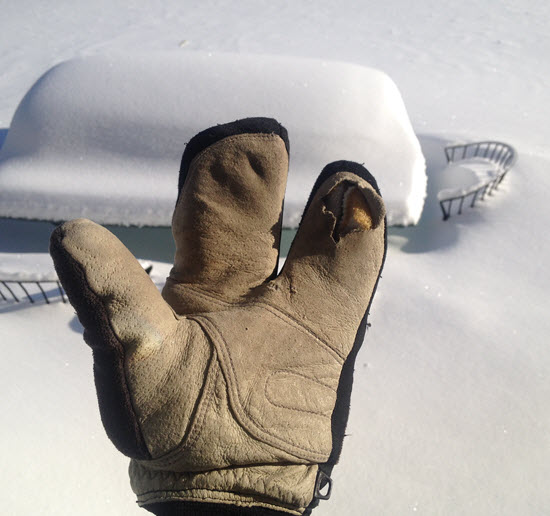
10+ years of shifting has left its mark on my gloves.
My buddy Randy is convinced that we'll be riding outdoors by March 15th. As it was -9° F this morning, I'm thinking he's a bit optimistic. But can you blame him for wishing winter will be over soon?
We've had cold/winter here since Halloween. That followed a summer that didn't really begin until mid June. Day two of our annual MS150 ride on June 9th blessed us with a light, consistent rain and hypothermia inducing temps in the early 40's. Amy and I were shivering so convulsively at the half way point, that we could barely ride our tandem. Then we did the unthinkable; we abandoned the ride at the lunch stop 🙁
So when March 15th rolls around, and if the roads are dry, me, Randy and a few others will attempt a short ride… for no reason other than breaking the depression many of us are feeling. That's not the only reason. You see Randy is the regional Life Time Cycle Lead = he manages all of the outdoor group rides and he's picked me as the ride leader for our home club in Eden Prairie.
The realist in me says I had better be prepared to stay warm.
I enjoyed winter riding on my MTB for years, mostly alone – I never didn't have much luck finding anyone to ride with. As long as my hands and feet stayed warm, I would ride for hours. I have some very ugly shoe covers that do a great job keeping my toes from going numb. The Pearl iZumi Lobster Glove pictured above must be 15 years old and did a great job (when they were a bit newer) keeping all ten fingers functioning. I burned out completely on winter a few years ago – more recently they're only used for shoveling snow.
Thinking I'm going to try these as the lobsters don't work as well with the SRAM shifters on my VeloVie road bike.
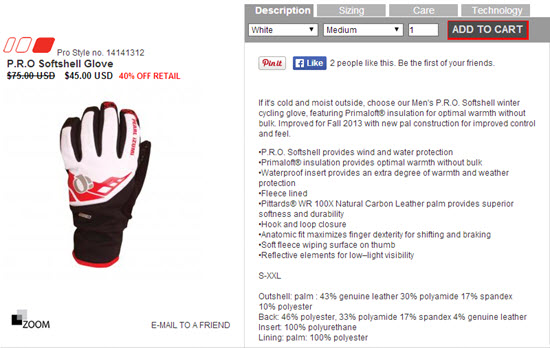
Annual ICI/PRO Platinum members get access to this 40% discount PRO purchase program. Everything Pearl makes and sells for women & men is available. Learn program details here at shop.pearlizumi.com/icipro/
If you'd like to join you can .
by John | Apr 6, 2013 | Instructor Training, Leading Group Rides
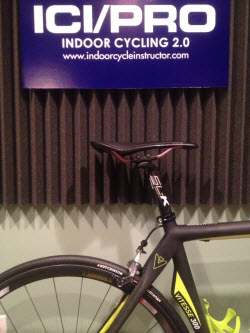
Tried 11 different saddles during my fitting before settling on a Fizik Kurve.
What happened to the promises of global warming? Younger daughter Carly turned 19 on April's Fools day. The day we brought her home from the hospital (some days you can never forget) was a beautiful Spring day… bright, sunny and in the 70s.
Today is April 6th and as I was pouring a cup of coffee I was seeing 20° F. The high for the day is predicted to only get to 50°F with 70% chance of rain. Today could be one of the warmest days we've had since October. Thank goodness for Indoor Cycling 🙂
Yesterday I had the privilege to interview sponsored elite level Triathlete Shawna Folts from Tempe AZ. You'll be interested to learn how she does much of her training indoors – at the Tempe Life Time Fitness, when she's not out on her VeloVie Veloce 100 Carbon Triathlon bike. I hope to have Shawna's Podcast up by the end of the week.
So as I sit and gaze longingly at my virgin VeloVie Vitesse 300 this morning, while editing our latest Audio Profile, I've resigned myself to the fact that it will be another week or so before my maiden bike ride… unless by some fluke that Sunday warms up.
