
by John | Mar 14, 2013 | Leading Group Rides

My new Carbon Fiber VeloVie 300 Vitesse was delivered yesterday! Now if the weather would improve and melt all of this dang snow, I could actually get out and ride it.
I purchased my new Instructor Bike (I give everything a nick-name… our Trek Tandem is called The Bus) through our new ICI/PRO Purchase Program – members get access to heavily discounted pricing from VeloVie – kind of like what they offer to their sponsored Pro Cycling Teams.
My bathroom scale says my new Instructor Bike weighs 14.6 lbs. I'm not sharing what the bathroom scale displayed for the weight of the Instructor…
I took a bunch of pictures while I un-boxed it, to share so you see how it's shipped and how easy it was to assemble using a multi-tool. My next stop will be March 24th @ 4:00 for a 2 hour fitting with Chris Balser – the Bicycle Fit Guru.

Here at last!

Everything was well packaged.

Reynolds Attack Carbon Wheels – they feel like they weigh about half what my old Mavic Carbone wheels did.

First look

FSA Carbon Seat Post / set-back per Chris Balser's instructions. Excited to try this selle italia saddle.

This bag has a few little bits

What's inside

Part of the padding was this t-shirt

All the packing removed

Be sure to save all the packing – You have 12 days to return this for a full refund.

Attach the rear derailleur to the hanger.

Handel bars are next

Then the seat post

Front wheel – the skewer lock goes on the RH side so you can squeeze the front brake lever with your right hand to center the wheel and tighten the skewer with your left hand. Those pretty blue brake pads are specifically for carbon rims 🙂

I installed the rear wheel and found I hadn't attached the rear derailleur correctly. That floating cam holds the derailleur in the proper position.

Add some LOOK pedals and my Instructor Bike is ready for the road… well once I've been fitted properly she'll be ready. If it gets over 35 degrees Saturday, I might just get things adjusted close and go for a short ride around the neighborhood.

14.6 lbs – I'm not sure how accurate my bathroom scale is but it sure feels light.
See the details of the ICI/PRO VeloVie Bicycle Purchase Program.
by Jim Karanas | Mar 11, 2013 | Instructor Training, Leading Group Rides, Master Instructor Blog
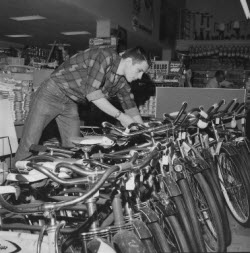
Our parents had an easier time deciding on a bicycle.
By Team ICG® Master Trainer Jim Karanas
If you teach an authentic style of Indoor Cycling and pattern your classes after riding a real bicycle, invariably students who have not ridden a bike for many years will ask you the above question. Unless you are an avid rider or coach people outdoors, as well as indoors, you may not have an educated response. If you read John’s recent post “Sticker Shock”, you may realize that our students really need our advice on how much of an investment to make.
Hundreds of articles online can answer the question. What I want to share with you is some of what I’ve personally learned through the years.
How Much Should I Spend?
Rule #1: The more you spend, the better the bike feels. This is one of the most direct, linear relationships on the planet — from the frame, to the wheels, to the components, to the tires. The more you spend, the more the bike rides like a dream.
Rule #2: The more you ride, the more you’ll appreciate Rule #1. A Ferrari is wasted on me, but I can feel the difference between Ultegra and Dura Ace. The more you ride, the more you can appreciate the subtleties of a bicycle.
Rule #3: Never bring your credit card until the 3rd shopping trip. Absolutely never. Obviously, this is to prevent impulse buying. On the other side, few things are more fun than buying a bike. You’ll feel like a kid again. Except now you’re responsible for your bills.
Which Type Of Bicycle Should I Get?
Rule #1: Speed hurts. A road bike hurts your back and your crotch the most and is the easiest to crash, but you get to go really fast, wear lots of cool gear, and shave your legs.
Rule #2: Think DIRT if you don’t take yourself too seriously. If you want to ride ego-free and experience down-to-earth cool, then get a Mountain Bike and hit the trail with loosened inhibitions and a spirit of adventure.
Rule #3: What’s the best bike in the world? The one you’re on. There’s nothing wrong with a hybrid.
Should I Buy New or Used?
Rule #1: A bike is like a pet. A bicycle works its way into your heart. Everyone who has sold a bike on Craigslist has sold a piece of his or her soul. You pray that you can find a good owner who will keep riding your bike.
Rule #2: Every bike needs a wrench. A Wrench is the affectionate name given to a bike mechanic. One of the main reasons to buy a bike from a shop is that you build a relationship with that shop and with the mechanics who tweak your bike so it feels fantastic to ride.
Rule #3: Pay homage to the beater. On the other hand, don’t overlook getting a broken-down wreck that has been neglected for decades and bringing it back to life. It will probably be your favorite bike ever.
Which Bike Shop Should I Go To?
Rule #1: Sandals with socks. The small, local shop will always have the best personalities, gentle souls who have dedicated themselves to helping others ride bicycles. The small shop will typically have great mechanics who have been there for years. They’ll know your name and be happy to see you.
Rule #2: Bright lights. The Big-Box Shops always have bright lights for some reason, and everybody’s shirt is tucked in. They’re corporately owned and very professional. Some people like that.
Rule #3: Buy something every time. Whichever type of shop you choose, be a good customer. A shop will take care of you if you support their business. Never drop into a shop, ask for a derailleur adjustment, and then just say “thanks”.
Okay, so this wasn’t the article you expected. You may have hoped I would talk about researching bikes online, or setting a price limit. You can Google that stuff.
When your students ask you about buying a bicycle, remember that bikes differ. They’re built for different situations and different terrain. Remember that riders differ in their dreams, goals and desire to ride a bike. Instead of being overly analytical, I suggest that being completely subjective — based on your student’s needs — about how much to spend, which bike to buy, where to buy it, and how to service it will be the best way for you to help the student decide.
by John | Mar 9, 2013 | Instructor Training, Latest News, Leading Group Rides
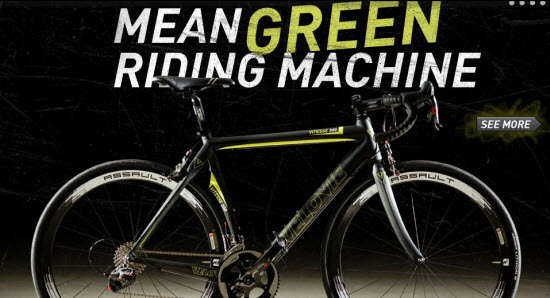
My new “Instructor Bike”
Here's a picture of my new Instructor bike – a VeloVie Vitesse 300 road bike.
Ain't she a beauty?
Showing this stock photo because I don't actually have it home yet. I've ordered it under our new PRO/Purchase Program we've negotiated with the awesome people who own & run VeloVie.com. Mine's coming with Reynolds Attack wheels, not the Assault wheels shown. I am so excited. Can't wait for the snow to melt so I can ride it!
I'm not using the word awesome here lightly – these guys understand how influential you are as an Instructor… a respected leader of people. You're just the type of person VeloVie wants riding their bicycles this summer.
Our partnership with VeloVie is the culmination of nearly 3 years of effort. I've pitched every bicycle manufacture you can think of on the concept that YOU are as valuable a spokesperson as any “sponsored athlete”. You have no idea how good this feels to finally find a company who recognise that many Indoor Cycling Instructors ride outdoors, and we carry our influence with us as we step outside.
VeloVie also understands that many of us aren't wealthy people. I'm very aware of that as well. This PRO/Purchase program extends every penny of available discount to participating ICI/PRO members. There's nothing in this for me beyond the promotional value this program adds to the value of an ICI/PRO subscription.
But it doesn't end with a discount just for you. Participating Instructors (you've purchased a new bike through the program) can offer your students/participants/friends an incredible deal – not quite as good as yours, but still unbeatable anywhere – and you'll be rewarded for your efforts 🙂
Click over to the PRO Purchase Program description page to learn more.
Feel free to contact us with questions.
by John | Mar 7, 2013 | Leading Group Rides
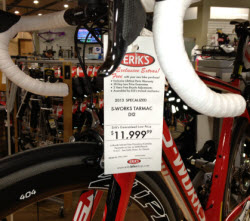
So they leave off the penny – like that makes it look more affordable 🙁
$12,000.00 for a bicycle?
Could you afford a bike that costs anything approaching 5 figures?
With the partial blessings of the SGFI (Senior Group Fitness Instructor) I've decided that it was time for John to have a new road bike. But this Specialized S-Works bicycle falls into the same unobtainium category as the red Ferrari I saw at the club last week.
With the days getting longer and the sun bringing the mid-day temps above freezing, the young-at-heart start dreaming of riding outdoors. I had some time yesterday and visited a few of our local bike shops to see what's the latest and greatest.
And quickly broke into a cold sweat.
You see… I have a bit of a problem. Other cyclists tend to judge you by the bicycle you ride. If you're a relative unknown, showing up for a scheduled ride, most people wouldn't receive a second look at their mount of choice. But (at least in these parts) I'm far from unknown. After teaching Indoor Cycling for 13 + years, leading or participating in an untold number of group/event road rides, doing a small bit of competitive racing and the simple fact that I'VE LIVED IN THIS ICE BOX FOR OVER 50 YEARS has me somewhat recognizable by other cyclists.
Despite our successes here at ICI/PRO, the meager scraps I/we get from teaching, some consulting projects and Amy's hard work, we aren't wealthy people. Please don't get me wrong. With a beautiful wife and two awesome & healthy kids – life is good. But feeling the need to be riding something that reflects my status as a leader has me a bit concerned petrified at how I will be able to afford a worthy ride and remain happily married 🙁
I took a few snapshots of what I found appealing during my short visits.
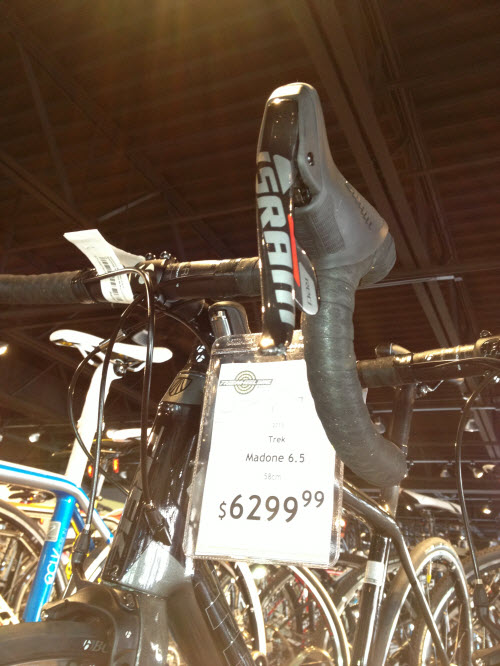
My buddy Randy (he's a bike freak – and can afford to be) told me when I asked his advice; “If you can't afford Shimano's Di2 electronic shifters, you want the SRAM Red Groupo.” Thanks for that Randy, but at $6,300.00 I'll pass.
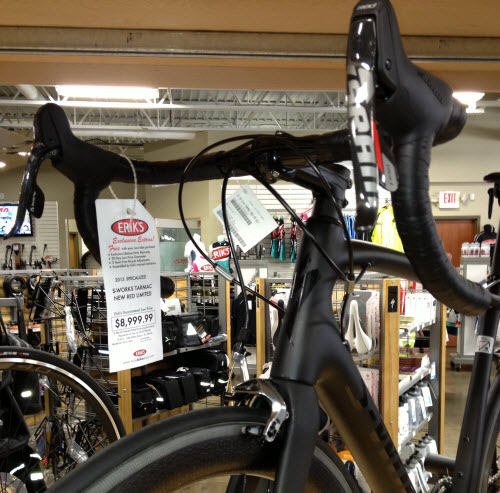
This blacked out Specialized caught my eye – until seeing the price tag and the resulting gag reflex it created. I've always wanted a tough looking bicycle. Then of course there's the need for the legs to propel it…
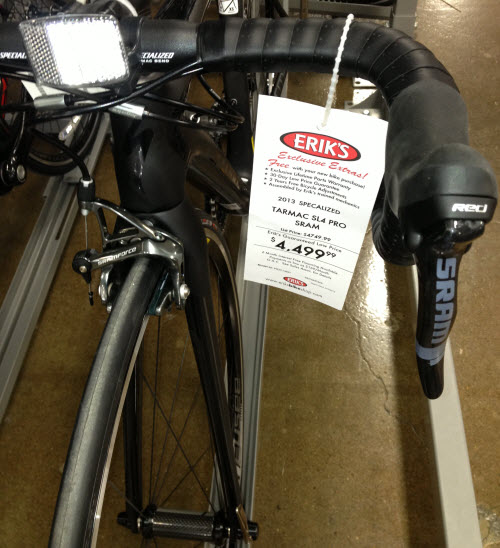
Now we're getting closer to something I could potentially convince Amy I just have to ride this year – except the “Randy's on the road may not be very impressed. Is there a place to recycle those dumb reflectors? They're off and in the trash as soon as you get home.
This wasn't going very well. Next stop – check out what's available online.
Stay tuned.
by John | May 19, 2012 | Leading Group Rides

Neighbor Eddy Macholda, Flanders teammate and me (wearing my Breathe Right) at the start of the Chequamegon Mountain Bike race
They call him “The Shepherd.” His real name is Scott Flanders and he is a Really Big Dog. Scott and his brother Jim run Flanders Cycle, a high end bike shop in Minneapolis. The Flanders cycling team has a well-known reputation for arrogance*, discipline and racing success. It's where I learned to ride safely in a fast, competitive group of cyclists.
There are actually a lot of big dogs on the Flanders team. Scott is the biggest. He had to be to keep order and maintain discipline over 30 or 40 very strong, very aggressive personalities… the safety of everyone depended on it.
I was invited to my first Flander's Saturday coffee ride by my neighbor Eddy Macholda. This isn't a group you can just jump in with – they don't allow it – I'm willing to bet that being a closed group is common with any serious cycling team.
I actually remember the day quite well. I had recently purchased my first road bike (white and purple Schwinn Paramount, complete with down-tube shifters) after completing 1000 road miles on an old cross bike. I had promised Amy that I wouldn't buy a new bike until I had shown that I was going to stick with cycling long-term.
Eddie had been a constant inspiration to me as I began riding outdoors. I found myself riding with him that morning, out to join the group. I still remember the exact place where I got dropped 🙁 In case you're wondering, yes it was quite embarrassing and to his credit, Eddy did come back to get me once he realized I was no longer there. I stuck with it. Before long I had the fitness to not only complete the 40 mile coffee ride, and could also hang with them on the longer evening and a few Sunday century rides.
Along the way I learned the dynamics and mechanics of leading a well organized pace line.
Notice I said leading, not riding, in a pace line. The skills necessary to ride in a group are not something I can teach you here. You can only learn by doing, so find yourself a well organized group and start practicing. My objective here is to communicate some of the subtleties (and not-so-subtle traits) of being a big dog.
- Establish your role as a leader. Jim Karanas suggests centering your class and I feel it is imperative to center your group before heading out on the road. Begin every ride with the short pre-ride meeting. Flander's group rides always started at the exact same place and at the exact same time. While we were waiting for everyone to show up, it was interesting to watch all the participants looking around to learn who would be in charge. There was never any “I'm going to be in charge” declaration. The natural team leaders were well-known and it quickly became obvious who would be leading the ride that day. Your pre-ride meeting should begin with you speaking and acting like you are the leader. Or as an alternative, if you don't feel you have skills necessary, you should introduce and actively support the person you feel would make the best leader.
- The Leader always begins the ride in front. I can't begin to tell you how many rides I've gone on that started with chaos right out of the gate and only got worse as time went on. It takes a lot of courage to firmly say “I'll be leading us out at the beginning.” And then do it. I typically don't see women trying to jump up front and assert themselves, but testosterone driven men seem to do it naturally. Resist the temptation to allow everyone to just do what they want, in the hope that at some point they'll all settle down. This is especially important if you have new riders in your group. The lack of order and chaotic jockeying for position can be downright frightening to someone not used to riding with others. The goal here is to quickly establish order. If you don't do it now it is very difficult to do later.
- Crush any challenges to your leadership. I know that may sound harsh, but the safety of your group depends on everyone respecting your authority. The Flander's guys were ruthless in putting down anyone acting out of line. One of my pet peeves is when someone breaks out of line and hammers up toward the front. It may be because they're frustrated at the pace the group is riding, or they simply are trying to show off. Either way you need to firmly correct them, explaining; “we ride as a group or you can ride alone… your choice.” Don't be surprised if you get some push-back. Stand your ground. I've also found it helpful to say it out loud so others can hear it, bringing some social pressure from the group. Now, if you're not following me in this example, let me explain my concern: Riders in a pace line need the freedom to quickly move right or left to avoid some obstacle or prevent running into a rider slowing in front of them. Most of us don't have rearview mirrors, so a rider passing you from the rear is unseen and presents an enormous potential hazard.
- Be as fair and even-handed as possible. This relates to #3 where your leadership is challenged and you don't do anything about. Nothing breeds resentment like selectively ignoring bad behavior.
- Assign roles. If you've done your job asserting your leadership properly, you'll be able to delegate some responsibilities to others. For example you may have a weaker riders who can't keep up with the rest. Pick out another skilled or strong rider and ask if they would fall back and shepherd the slower group.
- Exclude others. More harsh words but it can be critical to maintaining the safety of your group. Riding with Flanders was pretty much by invitation only – although they were so intimidating it was rarely a problem. People were too frightened to try to jump in. Big events like the MS 150 includes thousands of riders of all different abilities and levels of experience. Our team likes to ride fast, typically with Amy and myself upfront on our tandem. With the flat roads it's not uncommon for us to average 22-23 miles an hour. We make a very tantalizing group for other cyclists to want to join. In the past we were flattered by looking behind us and seeing 30-50 cyclists tucked into our draft. But not anymore. Not after the accident which was complete with broken bikes, broken bones and two people leaving in an ambulance. A number of riders (who were unknown to us) had joined our group, disrupting the flow that had developed over hours of riding together. It typically starts with one small mistake, a momentary loss of concentration that's followed by a number of bad decisions / poor reactions and ends with people getting hurt. There's a saying “no good deed goes unpunished”. There are times when being inclusive, isn't always in the best interest of group. Please don't confuse this with an open invitation to new riders to join you at the beginning of the ride.
- Insist on everyone wearing a team kit (jersey). I could talk for hours about the importance of having everyone dressed the same. I realize that this isn't always possible, but having something that identifies your group creates a sense of team work, i.e. we're all working together as a cohesive unit and we have a leader – YOU 🙂 Uniforms also send a powerful messages; if you're not wearing our jersey you don't belong riding with us = you will have fewer people trying to jump into your group.
As an Indoor Cycling Instructor, you already have many of the skills necessary for being the leader, the Big Dog, on a group ride. No, it's is not an easy thing to accomplish or maintained for that matter. If you're doing it for the wrong reasons it may be impossible. But if your interest is in providing a safe and enjoyable experience for everyone, I feel you will find strength necessary to carry out. And if you continuously demonstrate your interest is beyond yourself, I'm going to guess that the other members of your group will quickly respect you and your authority.
So be careful out there!
* Although I don't ride with Flanders anymore, I'll still wear my team kit or jacket on occasion. When I do, passing cyclists don't waive back at me. Is really a kind of running joke for Amy and me, when we're out on The Bus – our Trek Tandem. We always offer a friendly wave to cyclists traveling the opposite direction. They almost always waved back. Except when I'm wearing my Flander's gear. Like I said, they have a reputation of arrogance 🙁
by John | May 17, 2012 | Instructor Training, Leading Group Rides, Learn Leadership Skills

I suppose you could add many governments
That would be your Indoor Cycling Class and Outdoor Group Rides.
The concept of a democracy; social groups where everyone works together, contributes equally and respects the needs of others sounds good… but rarely works out well in the real world. I can't think of better places to demonstrate this than in your class or on an outdoor group ride. Both these collections of people require a leader… or chaos ensues. I suppose we could actually include any type of class with students. Many of us have memories of grade school or high school substitute teachers that couldn't keep control and the resulting mayhem when one, six or all the students decided that they were in charge.
Democracies don't work in either of these situations. Well functioning groups, be it your class or out on the road, require a leader. If there's no one obviously in charge, one or more of the participants will typically try to fill the vacuum.
You may have experienced this at some point in your teaching career. Maybe it was some participant in the back row holding court with those sitting around him. The effect is disrupting to your class and it may have irritated, if not angered you. I view a large part of this as simple disrespect, but sometimes it's not. It may be helpful to look at it a different way; the disruptive student may be trying to assert themselves as leader of your class. The next time you experience this situation, consider whether or not you asserted your leadership at the very beginning. Master trainer from ICG, Jim Karanas frequently talks about centering your class as part of the warm up. Beyond getting their attention and explaining what's coming next, centering is also asserting your position as the leader of the class.
I have a confession to make, I'm a big dog 🙂
For those of you who don't know me personally, your only experiences of me are listening to the podcast or reading things I've written here, you may have the impression that I'm this easy going, can't we all get along? kind of fellow. Please don't get this wrong, I really am easy to get along with. But put me in a group setting and I'm looking for the leader. If I don't see (or sense one), my personality is to assume leadership. I feel people who do know me will tell you that; “yes, John naturally becomes the leader.” “But it isn't because he has to be the leader and control everything.” “Its because he recognizes that the enjoyment of everyone in his Indoor Cycling class, and the safety of those riding outdoors with him depend on it.”
Many of us are moving outdoors.
I can't think about better marker of success, for you as an indoor cycling instructor, than seeing your students begin riding outdoors. The natural transition for a new rider is to begin solo and then ride as part of a group. A big part of cycling can be the same social interaction found indoors. Then there's the appeal of participating in a large event fundraiser event like the MS150, a local century or some other fun ride. Groups riding outdoors, require leaders to be successful and safe.
Jim Karanas and I recorded a new Podcast episode that will be published this weekend. In it Jim describes the horror of what happens when things go wrong, while riding outdoors. And I share my experience where I needed to be the big dog, during day one of a brand-new cycling club connected to a local bike shop. The purpose isn't to create a bunch of drama, rather our interest is in helping you understand the responsibilities you may have leading your own group rides. I'm also working on a number of suggestions that I feel will help you be successful, as the leader (dare I say The Big Dog) of an outdoor ride.
