The debate over cardio vs. high-intensity interval training (HIIT) usually assumes that the issue is an either/or choice. In that debate, HIIT is usually compared to absurdly low levels of cardio exercise — not to the kinds of classes ICI-PRO instructors probably teach.
This post explores the evolutionary value of combining cardio and HIIT.
In his book Born To Run, Christopher McDougall reveals the blend of morphology, paleontology, anthropology, physics, and math that led to understanding how humans became the greatest distance runners in the animal kingdom.
There’s no way this short article could do justice to McDougall’s fascinating and detailed description of the emergence of homo sapiens over Neanderthals (they were parallel species), and the evolution of humans as supreme hunters — hundreds of thousands of years before the creation of the tools we associate with hunting (spearheads, bows and arrows).
A few of the evolutionary changes include:
– upright posture to allow deeper breathing and limit retention of sun heat
– the ability to release body heat through sweat, rather than panting like other mammals until they must rest or die of hyperthermia
– the ability to accelerate when the pursued animal has been run to exhaustion.
So human “persistence hunting” combined endurance running primarily, with some sprints. Humans evolved to run in conditions that no other animals can match, and it’s easier for us.
Good At Endurance, and For a Long Time
Endurance athletes can typically continue into what would be considered old age in other sports. In many cases, such as distance running, they can still out-perform teenagers or 20-year-olds until their mid-60s.
At his first double-marathon, the most notable thing my then-35-year-old coach, Jim Karanas, saw was the age of most of the runners, who were 45 to 55. He said it told him immediately that the ultra-run was more of a mental than a physical challenge.
When workouts are always high-intensity, over-training is likely. So are failure to recover fully and a high incidence of injury.
It’s also likely that someone will burn out after constant high-intensity work, making it feel like drudgery, instead of something to look forward to each day. Why not work out in a way that you’d enjoy making part of your schedule long-term? Why not create classes like that to bring your participants back over and over again?
Matt Fitzgerald, noted marathon runner and author, suggests endurance training primarily with 2 to 3 high-intensity trainings per week.
McDougall quotes researcher Dr. Dennis Bramble, who said, “If you don’t think you were born to run, you’re not only denying history. You’re denying who you are.”
But let’s not limit this to running. Endurance athletes of other types display similar results. Countless stories describe master’s cyclists in their 50s and up outperforming younger cyclists.
In his 50s, my coach raced against the cyclists in the 30-year-old category — because he found he could perform better against them than against the experienced racers his own age! Those guys kicked his butt when he was first starting to race.
He was also one of the few (and the oldest that weekend) to ride the notorious Furnace Creek 508 fast enough to qualify for RAAM.
So the choice isn’t really between short, intense intervals and long, slow cardio with a magazine. The right kind of training is not either/or, but both.
(The cardio, of course, should be hard enough to cause a training effect, not help you catch up on your reading.)
This perfect combination is effective, enjoyable, sustainable over the long haul, and entirely in sync with our evolutionary nature.
Do Indoor Cycling Classes really need to be 45-60 minutes – to provide the health and fitness benefits expected by our participants?
Asked another way: If your studio offered classes that were shorter (say 30 minutes), while still just as effective as 3/4 or a full hour, could an “express class” attract people who feel time strapped?
Of course anytime you use the words “just as effective” smart Instructors are going to ask; “show me the research”!
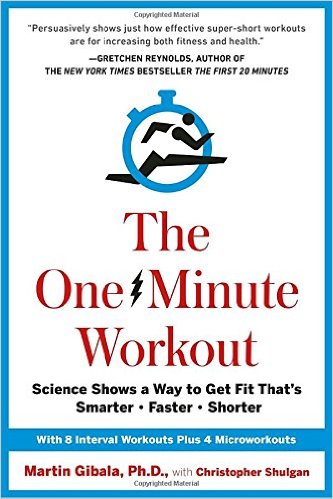
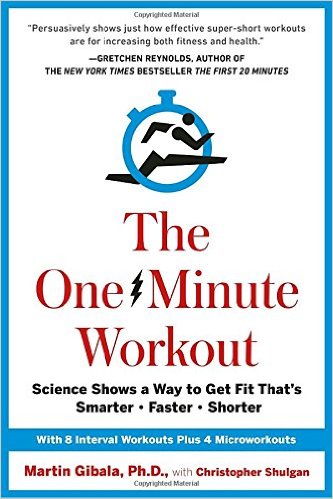
Martin Gibala, Ph.D. is my guest, for this episode of the Podcast. Dr. Gibala has done the research (and I'm quoting from the back cover of his new book – The One Minute Workout) “As the world's foremost expert in high-intensity interval training, Martin Gibala has pioneered the study of new and remarkably time-efficient type of workout, making available the benefits of exercise in a fraction of the time.
Listen to our conversation in the Podcast below to learn more about the science of HIIT and how you could use this information to improve your classes and attract more participants.
Here's a short video featuring Martin Gibala, Ph. D.
In a previous post that I co-wrote with Jim Karanas, we described specific physiological adaptations of aerobic — aka cardio or endurance — training.
As you may recall, they include increases in blood volume, tidal volume, and stroke volume. The capillary network increases, as well, as do the size and number of mitochondria. Other changes also occur, but these are the ones that move oxygen to the working muscle.
Recent research has shown that endurance/cardio exercise — not strength work or interval training — can make rodent brains bigger.
Okay, forget how much that last part sounds like the plot of a 1950 sci-fi film. Let’s look at other research.
A long-term study followed 1,583 middle-aged men and women with no personal history of either dementia or heart disease over 2 decades. Before-and-after tests done 20 years apart showed that the ones who had kept in shape tended to have larger brains, while the poorly conditioned participants had lost gray matter.
Holding on to gray matter prevents cognitive decline and decreases the risk for dementia. No specific type of exercise was explored in that study, however.
And that leads us to the long-raging debate over Cardio and High-Intensity Interval Training (HIIT).
HIIT Advocates Always Stack the Deck
Let me be clear: I have absolutely nothing against high-intensity intervals. I use them often in my own workouts and when teaching.
But something interesting occurs when staunch advocates of HIIT compare the relative benefits of HIIT with those of standard cardio.
They tend to cheat.
In the hands of the die-hard HIIT fan, the word “cardio” has become code for lame-o exercise at the lowest levels of intensity. It should come as no surprise that the benefits — if any — of such lame workouts would fall far short of the benefits of HIIT.
And no one challenges the criteria. So let’s challenge them.
You Can Go Hard AND Long
It’s simply not true that intense training must involve short intervals of, say, 20 to 60 seconds. If you train well aerobically — and train seriously enough to achieve the aerobic benefits above — you can maintain a high level of work for a pretty long time.
HIIT advocates seem to ignore the fact that elite marathon runners, for example, run faster than 5-minute-mile pace for 26.2 miles. Most people would find it difficult, if not impossible, to run a single 5-minute mile. It’s a fast pace. Elite marathoners go faster than that for a couple of hours.
As Matt Fitzgerald — well-known marathoner, trainer, and author of several books and many articles — states, “well-trained endurance athletes really don’t have to slow down much as they increase the duration of their efforts. We are not the folks reading magazines on elliptical trainers.”
I’m the furthest thing from an elite athlete you can find, but even I have done a couple of cycling time-trials on Mt. Diablo. The first one took me 44 minutes at a consistent heart rate of 173 — quite high for me, making the climb a combination of hard and long. (Okay, I told you I’m no elite athlete.)
The training combination that appeals to me most is to fit a set of about 8 intense intervals into a long training of moderate or moderately high intensity.
It’s not just my personal preference, though. Evolutionary evidence suggests that this way of training is precisely what we were always meant to do.
(Part 2 will explore the evolutionary reasons that this is what we’re meant to do.)
There are times when exercise can be painful*, especially when you're coaching or participating in, a HIIT or Tabata® training class. You know that. You might also be aware that the more you expose yourself to high intensity training, the feelings of pain / discomfort you experience diminish over time. Said another way; over time, you may develop a tolerance for the pain that accompanies HIIT or Tabata® type training. You knew that too… and now there's actual research that suggests regular exercise can reduce a person's sensitivity to most any type of physical pain.
I learned at IDEA that Tabata® is an actual brand name. Out of respect for them I've included the ®. I hope to have more about the new Tabata® Cycling certification they'll be offering in the near future.
Regular exercise may alter how a person experiences pain, according to a new study. The longer we continue to work out, the new findings suggest, the greater our tolerance for discomfort can grow.
For some time, scientists have known that strenuous exercise briefly and acutely dulls pain. As muscles begin to ache during a prolonged workout, scientists have found, the body typically releases natural opiates, such as endorphins, and other substances that can slightly dampen the discomfort. This effect, which scientists refer to as exercise-induced hypoalgesia, usually begins during the workout and lingers for perhaps 20 or 30 minutes afterward.
But whether exercise alters the body’s response to pain over the long term and, more pressing for most of us, whether such changes will develop if people engage in moderate, less draining workouts, have been unclear.
So for the new study, which was published this month in Medicine & Science in Sports & Exercise, researchers at the University of New South Wales and Neuroscience Research Australia, both in Sydney, recruited 12 young and healthy but inactive adults who expressed interest in exercising, and another 12 who were similar in age and activity levels but preferred not to exercise. They then brought all of them into the lab to determine how they reacted to pain.
Click the link if you'd like to read the entire article – here's the important conclusion…
The study’s implications are considerable, Mr. Jones says. Most obviously, he said, the results remind us that the longer we stick with an exercise program, the less physically discomfiting it will feel, even if we increase our efforts, as did the cyclists here. The brain begins to accept that we are tougher than it had thought, and it allows us to continue longer although the pain itself has not lessened.
So how can this help you as an Instructor or coach?
While at the IDEA fitness conference this week, I took the Tabata® Cycle workshop presented by Team ICG Master Trainer Mike Michels. During Mike's lecture he really emphasized how difficult it is to perform the series of 8, 20 second all-out intervals properly. So difficult in fact that Mike said none of us would be successful initially. But if we performed them regularly, over time we will improve. Beyond an increase in fitness we'll experience, some of that improvement will come from an increase in tolerance for the pain that's a part of HIIT.
I left the class thinking… I should start communicating – your incentive for working hard today, will come in the form of a less painful workout tomorrow. Then, when your tomorrow comes, take advantage of it 🙂
*Of course I'm talking about the pain felt when pushing yourself to your maximal effort, not localized pain that's indicative of poor form, improper bike set up or joint strain/injury 🙁