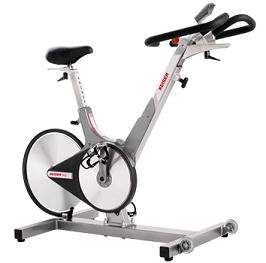
As promised, I'll be posting the results from our Indoor Cycles with Power survey. I'll start with the Kesier M3 which represented about half of the total responses. Which makes sense as Keiser has been selling the M3 consistently for much longer than any of the other brands.
Please note that we didn't separate out the older M3 from the new M3 Plus which includes the new handlebar design and updated (more accurate) power meter.
Focusing on the important bits, I will be presenting a series of graphs that I feel will best represent the findings for each of the Indoor Cycles included in the survey – click here for the list all of them.
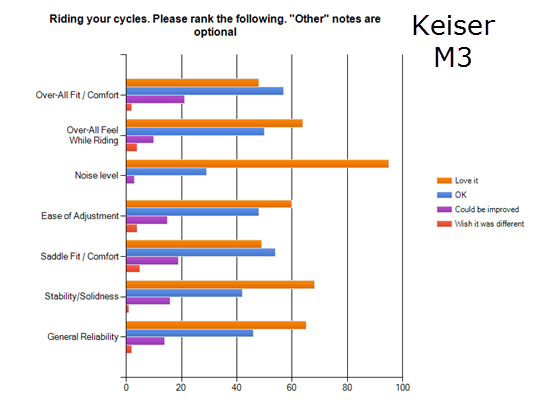
Satisfaction while riding your cycles.
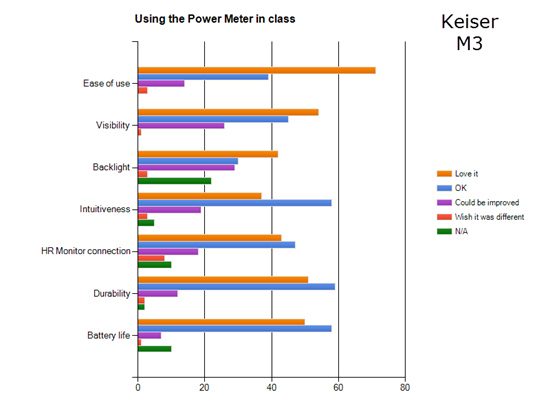
Using the Power Meter in class.
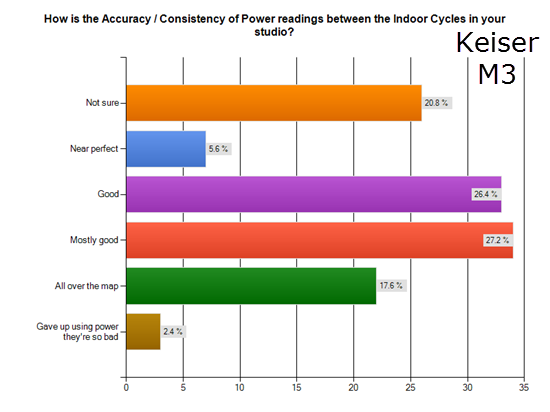
Accuracy / consistency in power displayed.
Would you recommend this Indoor Cycle to others?
Anyone familiar with Net Promoter Scores (NPS) understands the critically important “would you recommend us to your friends? question. It alone is the most accurate measure of someone's true satisfaction in a product or service.
First up, how do instructors like riding the Keiser M3?
Next, using the power meter in class.
How accurate / consistent are the power readings?
And then the percentage of Instructors who would recommend the Keiser M3. You can find more information and pricing for the new M3 plus here.
In a previous post we talked specifically about the reasons why “non-outdoor riders” would want to train with power. There needs to be incentive for all populations, and thus our focus on those that don’t ride outside was appropriate as a starting point. However, we can’t forget about how powerful (pun intended) this training is for those of us who do ride outside.
Whether it is mountain biking, road cycling, or even touring, power can be the gateway to a new experience on two wheels. You’ll be able to “hang with the faster group”, climb the hills you used to walk, or climb with speed where you used to get dropped, or just feel fresh throughout a touring ride while your companions are “suffering”.
Let’s define power just a little more precisely. It is not simply the amount of “work” you are doing. That is a different measurement. Sure many people say “I worked hard today in class”. You are also admonished by instructors to “Work it!”. In fact, the entire industry uses the term “work out” to refer to exercise. However, when it comes to Power, in terms of work, it is the RATE of performing that work; how fast you do it.
The easiest example is walking up a set of steps. If you walk up the steps, or run up the steps, it’s the same amount of work. However, running will require a different amount of power. To perform the same work faster, requires more Power. Hence, to make a bike go faster, you need more power. The same concept applies to climbing. The same hill will require the same “work” for a given individual, but if they climb it faster, it will require more power.
No, MSP doesn’t stand for “My Secret Pal”, nor does it stand for “Mom’s Special Potion”, and I’ll stop right there before this gets really silly. MSP stands for Maximum Sustainable Power. It is the level of power once can sustain for a specific time interval. When you are referencing an hour interval (measured and estimated with 20 minute tests), most elite cyclists who train with power refer to this as FTP or Functional Threshold Power.
I prefer to reserve the term “Threshold” for that unique metabolic event that takes place with respect to the production of energy; the “cross-over” process between the aerobic and non-aerobic energy production systems. In my opinion, this term should be reserved for cardiovascular training (it has been used and researched with this term as the agreed upon nomenclature for years before power meters even existed). Therefore, to avoid confusing heart rate and power training terms, I do not refer to threshold with respect to power, but instead reserve its use solely to reference ones heart rate when this metabolic event occurs.
Hey – I just got an email explaining that Spivi has added a FTP (Functional Threshold Power) Test to their display training system. I can't begin to tell you how beneficial these short threshold/best efforts are for engaging participants in your power based classes. That's why I describe these as a Best Practice for anyone teaching with power.
Like PIQ, Spivi offers the option for riders to manually add their FTP / PTP wattage into a user profile. Another option is to enable the Fitness Test option where you can select an 8 or 20 minute FTP test that will record each riders average watts for the period and then add either 90% (8 minute) or 95% (20 minute) of it to their user profile.
To start the FTP tests wizard, press the left analog stick once, just like if it was a button. Now select the requested test from the menu and press the “Start” button to start.
Don't forget to Instruct the group how to ride and what to do during the test. The FTP test lasts as long as the progress bar on the bottom right side of the screens appears.
Meet Emmy Ragali, the owner of Go Cycle Studio in Chicago IL. Emmy is the first Beta instillation site for the Top Power Display System from Performance IQ.
I wanted to learn first hand what Emmy's experiences were using the Top Power display to show the wattage and RPM of each Keiser M3 her participants are riding.
You may have concerns about bringing competition into your class and so do I. During the interview I asked Emmy some specific questions about how her class accepted the competitive atmosphere that develops by having everyone's data displayed on a big screen.
While I was reviewing the Go Cycle website I noticed this link to an evaluation form where participants can give feed back on the quality of the Instructor and their class – I see this as an excellent idea and Emmy explained to me that it has been very helpful to her and her Instructors.
Listen to the Podcast below to hear all about Top Power.




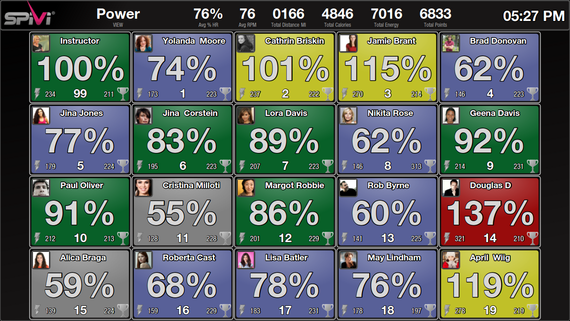

 To start the FTP tests wizard, press the left analog stick once, just like if it was a button. Now select the requested test from the menu and press the “Start” button to start.