
by John | Feb 20, 2021 | Best Practices, Engage Your Students, Instructor Training, KEEPING IT FUN, Learn Leadership Skills

4/1/16 update – not an April Fools joke, rather I'm re-publishing this today to help a friend with this issue.
I heard a very disturbing story this morning, from a regular in my 6:00am class.
What follows is a sad example of what happens when an Instructor isn't the leader in the class and tolerates disruptive behavior by one or more members.
Member: Did you hear what happened yesterday? I'm really curious what will happen tomorrow.
Me: No… what happened, tell me.
Member: It was total anarchy. The guy behind me completely lost it. I guess he couldn't take her non-stop talking anymore and yelled, SHUT THE F*** UP at the women who was riding two places to his right, while she was talking loudly on her phone.
Me: Wait, she was on her phone… in the middle of class?
Member: Yeah, she had on hand covering her ear and was talking really loudly in a conversation that seemed to go on forever. A number of us gave the instructor pleading looks to ask her to do something. She just shrugged her shoulders with a “I can't do anything” look.
Me: That's crazy.
Member: That was only the beginning. What happened next was complete chaos. People started yelling at each other. It's was almost like the people who come to focus and really work hard were empowered by that guy expressing his frustrations with the talkers. They'd also had had enough and many joined in to support him. I couldn't believe all this was happening…
I can believe it. Our riders pay a lot of money to be members. They're also polite people who tend to sit quietly, even though internally they're seething inside, being forced to endure frequent (in some classes constant) disruptions, when all they want is to listen to the music and work hard. I've been told by members, on multiple occasions, that they appreciate how I try to keep disruptions to a minimum.
I can also understand how, for some Instructors, it is difficult to be the leader and impose order on his/her class. Indoor Cycling classes are supposed to be a fun experience – not a contentious time when we need to act more like a strict parent, than a personable, fitness Instructor.
Thinking back, I don't remember “Leadership Skills” being included in any of the certification programs I've taken. Which I feel is a mistake. It's my belief that learning to be the leader in your class is the most important role you have in your studio – especially for new Instructors and a critical skill for anyone teaching in a Big Box studio with a large & diverse membership.
Understanding that many Instructors aren't natural “leaders” I have written a bunch of articles that I hope will explain; WHY your class needs you to be the leader, signs that some in class don't accept and/or respect your leadership, and what you can do to assert your proper role – even if you haven't in the past.

Stop the Talkers — Step One… Identify The Real Issue
There’s a recurring issue that keeps popping up on Facebook and Pedal-On forum:
Does anyone have a suggestion about to do about the consistent talkers in my classes? They’re really disruptive, but I don’t what to offend anyone. What should I do?

Stop the Talkers — Step Two… It’s an issue of disrespect, but why?
So if in one instance people are disrespecting you and the other’s in your class by talking, but in a different situation they wouldn’t, the obvious question to ask is WHY? Why do people act disrespectfully?
The whole concept of why people do what they do is fascinating to me. Back in 2011 I introduced you to the concept of Start with WHY and that it’s important to understand WHY you are doing what you do… and WHY some of your participants do what they do.
 Stop the Talkers — Step Three… Let’s Fix This Today!
Your class participants and manager/owner are expecting you to be the leader of your class.
So let’s end these Talker problems today!
You'll find additional suggestions on developing as the leader of your class (or outdoors as a ride leader) here.
Originally posted 2016-04-01 01:33:59.
by Callie Bowling | Jun 15, 2020 | Best Practices, Boutique Instructor, Instructor Training, Your Fitness Business
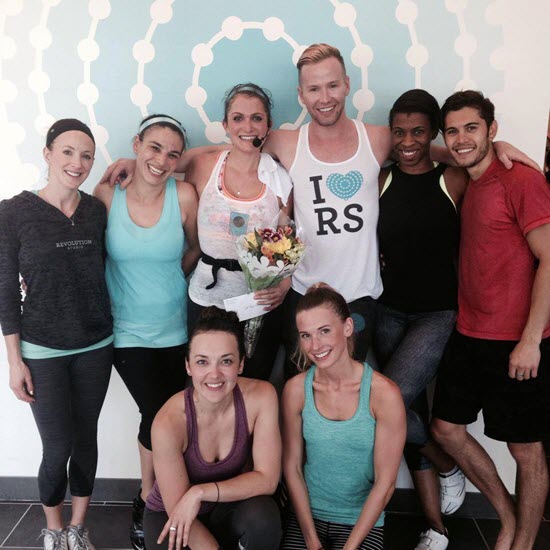
Studio co-owner Kim Syma, on left, with Revolution Studio instructors & members.
Part 1: Why Leadership, Team-Building, & Creating a Company Culture Will Save Your Ass.
Since this is the first of several articles in this series, you and I will be spending some time together over the next few months uncovering what it takes to open, own, and operate a thriving and rewarding indoor cycling studio, so before we set out on this learning journey together I would like to take a second to give you a quick overview on how and why I arrived in this space in the first place!
As a prospective studio owner working on plans to open in the rather finicky and frugal market of Boise, Idaho — which I was brand new to moving from the booming and generous economy of Houston, Texas… yes, quite the culture shock — I set out on a mission to uncover as much about the niche-fitness studio industry as I could. I felt this would solidify a successful launch of what I considered to be the largest personal investment of time and resources I would make in my lifetime; so, I did not want to enter into it lightly. And, if life has taught me anything it is when intuition speaks you’ve got to listen to it, which my intuition was telling me to pump the breaks, go back, and lay some more groundwork.
False Assumption #1: No matter how passionate you are, no amount of passion is going to override ignorance. Bottom line: When you know the road ahead, you have the ultimate advantage. And when you don’t know the road ahead you are going to get lost, sidetracked, off-course, and eventually find yourself at a dead end.
________________________________________
I called and interviewed almost two-dozen indoor cycling studios across the country representing various kids of markets, demographics, styles, and levels of success. What I found was fascinating and alarming. More than 75% of studios were just breaking even; 15% were in the red having to inject their own personal resources into the business just to keep it afloat, and only a mere 10% were actually thriving and profitable. I don’t know how that comes across to you, but to me it demonstrates that we are still a newborn industry, in the infancy stage, that has quite a bit to learning and developing to do before becoming a strong and resilient mainstay in American culture.
What we don’t want is to be a shooting star — we don’t want to come in hot, full of unbridled optimism and passion, and go out cold. What we do want is to be resilient, through recessions, and an industry constantly evolving, expanding, and growing by meeting the demands of its market, and in turn, continuously producing revenue! Once we get to that level collectively, we will have secured a place in every American home much in the same way big-box gyms like Gold’s, 24HourFitness, LA Fitness, Lifetime Fitness, and Equinox broke out onto the scene and gained mass popularization by the 1990s. That’s an industry not at risk of losing its ass anytime soon; and we, as niche-fitness studio owners, need to continue to stay hungry and get creative with ways to get our individual studios into that kind of an influential space. Currently, one has been occupying that space… Soul Cycle. But, I am here to say one cannot do it alone. There is room and a demand for more to share that space. And, if there’s room for it, my question to you is: Why not you? Why not your studio? … are you following me? If the confidence and groundwork is not there it’s not going to happen.
Action Item: Get confident, lay the appropriate groundwork, have a crystal clear vision for what space you see your studio occupying in your market, and strategically create a roadmap that will get you there, so you’re not taking detours, going off on side roads you don’t need to be on, and running head-on into dead ends.
________________________________________
Lastly, after gathering all of this information, success and failure certainly left clues and presented strong commonalities that were glaringly obvious. The purpose of this article series is to share those commonalities with you, so that you’re better prepared to anticipate the road ahead; and, to provide you with practical solutions to major problems ultimately setting you up for your greatest success. The topics covered in these articles should empower you to design a crystal clear roadmap to the end goal – having a thriving and influential studio that will continue to bring you joy, inspiration, and financial freedom into your old age.
Simple Truth #1: Being a business owner should not mean that the business has to own you.
________________________________________
Let us press onward to the first topic of this series:
Why building a company culture and establishing leadership, not management, in your studio is going to be your saving grace.
I knew I had to interview Kim Syma, co-owner with her husband, of Revolution Studio for this article, because I think they have hit the nail on the head when it comes to leadership versus management and really developing a strong group of team members they call “Warriors”. Not only that, but their studio is a proven-concept. They are now expanding their success into a third location in Houston, which will be bringing on another modality of fitness: Yoga! Their success trajectory is something most of us wish to mimic, so it would be prudent to learn from that.
Before leaving Houston, I had the immense pleasure of visiting Revolution Studio. I was immediately impressed with them for several reasons:
- The space was clean, aesthetically pleasing, and had a very uniform design
- The instructors & front desk staff were the same: aesthetically pleasing, fit, young, effervescent people in their Revolution apparel
- All of the classes were uniform and consistent in their flow, design, and delivery — allowing for the instructors’ individual personalities to shine through within the delivery that is unique to Revolution.
I believe those key qualities created an impression on me, as a customer, that this was a Brand and a Culture I was coming into. There was no dissonance or disjointed presentation — everything flowed and created a synergy. Now, before I get off on a tangent and talk about why all of those qualities are success-qualities, that is not the topic of this article; we will have to broach that conversation another time. For the purpose of this article, we’re going to talk about the how… how those qualities came to be that way — the behind the scene’s workings — under the pretense that they are, in fact, success-qualities.
Problem:
Via my conversations with various studios I quickly realized a common problem was a lack of unity amongst instructors and modalities of instruction being offered in the classes. Unfortunately, some owner’s justified the situation stating it was a good thing each of their instructors has their own style and does their own thing, because it offers the members a variety of styles to choose from. If they don’t like this instructor, they can go to another instructor’s class… if all the instructors and classes were the same people would get bored. Don’t, for a second, fall for that argument or think that concept is going to take you to the top and make you or your studio successful. I know where that argument emanates from — it emanates from a place of laziness and not wanting to spend more time rolling up the sleeves up and training people. Providing that kind of disjointed product to your customers makes you no different or better than the FREE cycling classes your customers can get at the local big-box gym for $19 a month! There, they can enjoy all the non-uniformity on the schedule until there heart’s content. I love all the different instruction styles and modes of teaching I experience at [insert gym chain here]… it is especially rewarding when all the instructors cue differently and coach differently and play all sorts of crazy kinds of music. All of that really helps me to connect to my workout on a whole new level’, said no one ever!
In reality, the #1 complaint of group fitness goers is that they can’t stand how there are some instructors they like and others they don’t, so they have to curtail their workout schedule around attending their favorite instructor’s classes and avoiding the instructor’s classes they don’t like. So, your philosophy should be to differentiate yourself as much as possible from the big-box gym experience and to solve as many of the hang-ups those gym members experience in order to pull their business away from them.
Needless to say the studios that maintained that notion were not the ones achieving great success, so I’m not going to elaborate any further, that is all the proof I need.

Solution:
Revolution Studio doesn’t hire cycling instructors. They aren’t hiring for skill, they are hiring for intrinsic qualities. You can’t give someone innate qualities, but what you can do is give them the skills they need to perform the duties you need fulfilled. That’s how that works. The majority of studio owner’s are backwards in their approach — when they hire they ask for cycling instructors, so that is what they get. They may think they are hiring for personality or characteristics, but what they are actually doing is making those a secondary priority or an adjunct to the main criteria, which is that these people be cycling instructors. That’s a problem for a couple of reasons:
- A cycling instructor who has been teaching their own way for God knows how long, is going to be set in their ways. So, you’re shooting yourself in the foot by hiring people pre-programmed with software that’s not congruent with your studio’s concept. If your goal is to unify a team and create a company culture you are going to have to step outside your comfort zone and get creative. You do this with in-house training before even handing them a class. Now, if the idea of developing and implementing a rigorous in-house training is daunting to you and seems time-consuming my advice to you is: find the time. You make time for things that are a priority, and building your team, your company culture and brand has got to be your #1 priority, because that is what will take you from average numbers to off the chart numbers. I will tell you this much, there isn’t one thriving studio I came across that is not in some way shape or form doing their own in-house training program for their instructors.
So, as Kim states, “Hire people for qualities you cannot give to them.” Don’t hire people for their skills; skills can be quickly acquired through training and on the job experience. Qualities are what pack a room. A packed room equates to dollars and raving fan customers. Raving fan customers equates to an influential brand that continuously brings in revenue no matter the season or economic climate. The majority of the instructors at not only Soul Cycle, but also at Revolution Studio were not previously cycling instructors. They are now truly products of the studio and not the other way around.
Question: Do you want your instructors to be a product of your studio, or do you want your studio to be a product of your instructors? Who works for whom?
What are some of those qualities?
As Kim states….
- Intangibles & having the X-Factor: charm, larger than life, engaging
- Open to hearing feedback and constructive criticism – This loops back around to constantly refining your craft. In order to do that, you have to be able to watch your instructor present a class, give them constructive critique, and know they are going to receive that message well and implement those changes without taking it personally. They would only do that if they trust your vision as the brand ambassador and leader and have a desire to be a part of the vision you’ve already established for the studio and are willing to fulfill that vision, not their own.
If you’re uncomfortable right now with being totally and completely honest with any of your instructors, you are either 1) in too close of a relationship with them or 2) you are not in a leadership position with them… either way mitigate it. It will not serve you.
- Young, fit, and athletic – Let’s be honest here too… people are drawn to attractive people. This is why Soul Cycle scouts actors and actresses. They know what packs a room. You have to really sit down and have a heart to heart with yourself about what your brand is going to represent. The average Jo, or something more inspired. Your instructors are walking Billboards for your studio. I can’t tell you how many personal trainers I have seen working at big-box gyms that need to loose 30 pounds, get more sleep, eat healthier, and ironically exercise more. Now, no one should crucify them for that, but at the same time no one is going to rally behind it either, which means you are inadvertently decreasing your ability to get a raving fan customer base. We all agree social media is a great marketing tool… there is nothing more incentivizing for your customers to want to take pictures with your instructors and post them online than if the instructor is the vision of health and vitality. Don’t plug someone up there that isn’t going to attract the kind of attendance your business is yearning for. It’s your business! You need to be picky!
Kim definitely had sage advice throughout the interview, but more importantly she was relatable. She admitted in the beginning it was hard – when they just had their first stand-alone studio – it was a little more challenging to find quality instructors. However, as time went on and they found a few quality people, talent attracted more talent. Her advice was to find key people really invested in you and the studio and then turn around and invest in them enforcing and nurturing their position on your team.
She advised to “Hire slow, fire fast,” and “if they’re not a hell yeah [when you’re interviewing them] they’re a hell no.” The reason being it can be very easy to talk yourself into hiring someone that fits the requirements on paper, but you’re indifferent about. So, that is when you follow your gut, which is why Kim has learned:
If They’re Not a Hell Yeah! They’re a Hell No!
In order to maintain that sense of community and unity amongst her team she holds instructor meetings every six weeks to get everyone on the same page, entire team meetings quarterly, and an annual team-building party. As Kim says, …it is critical to establish a team that likes and supports each other, because your customers feel that kind of energy when they walk in the doors and want to be a part of that kind of camaraderie. Kim also makes it a point to do lunch/coffee dates with each of her instructors to build rapport and her husband, Mitch, does the same with the management positions. These habits certainly foster the sense of team we’re talking about here.
Ultimately, what you’re doing by being a leader and having a crystal-clear vision for your studio and then implementing that vision throughout every level of your operation is you are building a pipeline, so that you don’t have to be the one hauling buckets every day. You should be able to go on vacation for a month and know your entire team is willing and able to handle everything, because you have already laid the groundwork by establishing unity, clarity, and have imparted your crystal clear vision of each person’s specific role within the dynamics of the larger picture. Because, it is that “larger picture” (the culture) that your customers are going to identify with the most and that is when you build a cult following as Revolution has done in Houston with two thriving studios and a third one on the way!
Kim and Mitch like to also work passionately with their team on self-development and have recently gotten their team involved in a book club! Her staff approached her with the idea, and Kim willingly agreed to fund it knowing 1) the value of personal development on a personal level, but also 2) the powerful tool this idea would be in giving her team one more thing they can bond and center around — learning, developing, and growing together around! I personally thought it was a brilliant idea.
To conclude, the difference between a manager and a leader is slight but impactful: a manager plans, organizes, and coordinates, whereas a leader inspires and motivates. You have got wear both hats, but you have got to always be a leader in your studio in order to build the most solid and highly motivated team you can, because if you don’t you’re dead. A team will build a brand for you, without that team — good luck. Managing will only get you so far too, what will take you over the edge and beyond will be your leadership skills. I highly recommend the book The Leadership Playbook by Nathan Jamail if you are in need of a refresher on how to effectively implement and hone those skills, because they are skills that will serve you and pay dividends in your studio and in life.
A special thanks to Kim Syma for lending me her time and incredible counsel!
Presuming you'll want to print this, ICI/PRO members can download a PDF [wlm_private ‘PRO-Platinum|PRO-Monthly|PRO-Gratis|PRO-Seasonal|Platinum-trial|Monthly-trial|PRO-Military|30-Days-of-PRO|90 Day PRO|Stages-Instructor|Schwinn-Instructor|Instructor-Bonus|28 Day Challenge']here. [/wlm_private]Right Click > Save As.
Have additional questions about opening your own studio?
We're all ears > contact us and we'll do our best to help you get the information and direction you need to be successful.
Originally posted 2015-03-21 09:07:36.

by John | Feb 13, 2020 | Best Practices, Big Box Instructor, Engage Your Students, Instructor Training, KEEPING IT FUN, Learn Leadership Skills, Master Instructor Blog

There's a recurring issue that keeps popping up on Facebook and Pedal-On forum:
Does anyone have a suggestion about to do about the consistent talkers in my classes? They're really disruptive, but I don't what to offend anyone. What should I do?
What follows are a series of well meaning suggestions from other Instructors; turn down the music, make a light joke – you don't want me to have to split you two up, do you?, stand between them, etc.
Others state something like; it's their ride, they're the paying customer, so I let them talk.
I don't feel any of these simple solutions are directed at the real problem or identify the real cause. In many cases there are no “simple” solutions. There will be a number of you won't be comfortable with the solutions I do plan to share. But before I go any further, I'd like your responses to what you see as the fundamental difference between these two scenarios:
Scenario #1
Breathless Betty and Chatty Cathy are long time fixtures at your club. They are inseparable and always ride the same two bikes (second row from the front, just off center) they have for years. They're talking as they come in and continue, non-stop, through your's (and everyone else's) class. Betty spends much of the class sitting up, soft pedaling, while looking and listening to Cathy. Cathy from a distance appears to be following the class, but never shuts up.
You've tried everything you can think of and have even asked them both privately to please stop talking in class. They don't. To make matters worse they've complained to the GM how they feel you've embarrassed them.
Despite your best efforts to ignore them, the negative affect these two have on you is wearing. Rather than being excited about teaching, you feel anxious, powerless and your class presentation suffers – resulting in fewer participants.
Scenario #1
You are super excited! You've staked out two great bikes (second row from the front, just off center) for Josh Taylor's Fighter Pilot ride at WSSC. Joining you for the ride is your dear friend Susan, who you only see once a year when you're together in Miami. You both laugh about how expensive this ride is, but agree that it will be so worth every penny. Josh mounts his custom Blade Ion. The lights come down. And with the start of the music, Josh launches into the ride.
Ten minutes in Susan looks over at you and asks; “so… how are your kids?” You're shocked in disbelief; doesn't she realize where we are? Without even thinking you turn to Susan and place your index finger across your closed lips > the universal sign for “Be Quiet”. Susan gets the hint immediately and you sense her embarrassment. The two of you ride in silence for the remaining time of the ride.
So what's the difference?
Why do Breathless Betty and Chatty Cathy not behave the same way that you and Susan did at WSSC?
In part two we'll explore what I feel is the answer to this and why, exactly, this happens.
Originally posted 2015-01-19 11:02:41.
by John | Jan 29, 2020 | Engage Your Students, Instructor Training, Learn Leadership Skills

“Thank you for saying something to those two girls. I can't tell you how frustrating it is for me to have to sit and listen to their mindless chatter while I'm trying to focus on my workout.”
It was yesterday and I had just finished subbing a class at one of the high-end clubs where I have a regular endurance class during the winter.
I started to say “You're wel…” when she interrupted me with; “Not all the Instructors will say something. I don't have a lot of flexibility in my schedule and this is one of the few classes that works for me… so thank you.”
I wanted to ask her why, when she is in that situation, she didn't say anything to the people who were disrupting her time in class? But before I could, I answered my own question.
She respected my social rank or status in the class and was waiting for me to demonstrate the leadership she believed came with my position as the Instructor. I have some knowledge of this member. She is a very successful local attorney and when you see her in street clothes you know she means business. I'm going to guess that her Social Status hasn't come from a meek or non-confrontational personality.
But when she's in class, with her Lycra shorts and a bright yellow jersey, she has the same exact status of everyone in the room, except one – the Instructor, who yesterday was me.
It's actually kind of funny when I think about it. I've often described my students as people who you will regularly read about in the business section of the newspaper or see interviewed on TV. And here's little old me, the leader of a group of high power Lawyers, CEO's and business owners… hard to believe. But for one hour every Monday morning I am the Big Dog 🙂
And more importantly, they all expect me to be the leader.
Put yourself in your student's position. Whatever social status they have outside of class vanishes when they strip down in the locker room and squeeze into their bike shorts. Some go from a position of absolute authority to near social impotence in the three minutes it takes them to change. Imagine the frustration they must feel riding in your class, trying to focus on their workout, but forced to listen to a detailed recap of yesterday's Housewives of the O C or some other nonsense.
There's a good thread running about this over at Pedal-On Students who won't shut up that has a bunch of suggestions about how you can address this problem. My personal favorite is setting clear expectations at the beginning of your class. Master Instructor Kenji Freedman is phenomenal at setting these expectations in his class opening. You can hear it at the beginning of Podcast #143.
Do you understand your role as the leader in your class?
Originally posted 2011-07-09 09:15:52.