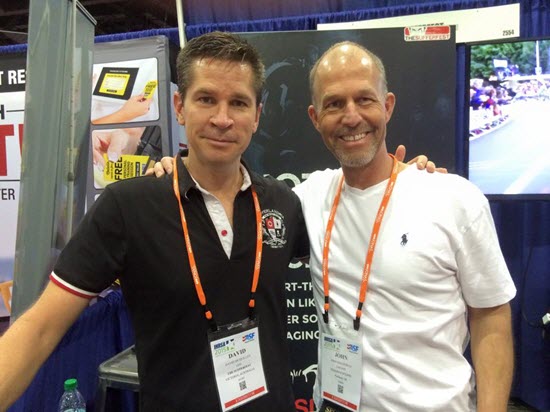
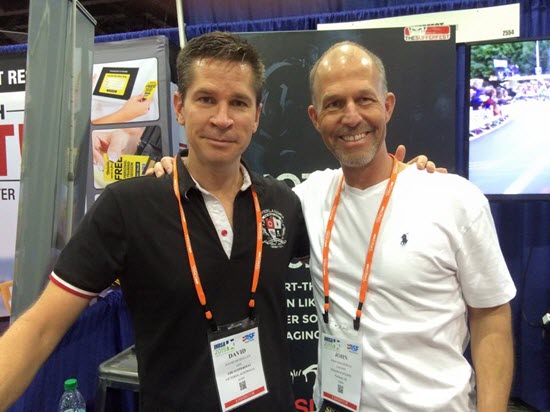
Tommy Taylor with professional cyclist George Hincapie
Finding a sub for your typical Indoor Cycling class can be a real challenge at times… finding someone qualified to coach a room full of experienced cyclists and endurance athletes expecting a Performance Cycle class can be nearly impossible. Impossible that is unless you happen to be friends with a popular, local cycling coach like my friend Tommy Taylor 🙂 Tom agreed to coach this week's Performance Cycling class for me, while I'm in Phoenix for a family wedding!
This week's class profile is a repeat of week one – which was very well received by my athletes – Coach Troy’s Spinervals Competition 22.0 — Time Trialapalooza. This week will be different with many now having a true understanding of FTP after our assessment last week! Tom is a believer of the “Best Effort” I include in every class to give everyone a baseline wattage to work off of = no one is sitting there wondering; “what the heck is my threshold you're telling me to work below, @ or above?
Class length 75 minutes + Cool Down
Warm Up — 10 minutes. 5 minutes of gradual increases in wattage. During the second 5 mins. we’re finding the wattage where everyone is first noticing a change in breathing; VT1 / Aerobic Threshold = the top of the Recover Zone shown above. This establishes a rough understanding of a base wattage that we use throughout the rest of class.
3 x 30 sec. Hard / 30 sec. Easy – Openers to AT/LT. I cue these by first having everyone find the amount of load @ 70 RPM that has them feeling they should (not just could) come out of the saddle. The 30 sec. Hard is then simply accelerating to 90+ RPM which results in some pretty impressive power numbers. The 30 sec. Easy is back to 70 RPM — many will stand during the Easy portion.
2 minutes rest – I encourage riders to focus on their recovery. Once they feel calm in their breathing, bring back the Base level work wattage.
20 min. Tempo — Here I included a 4 min. “Best Effort” to establish a benchmark PTP Personal Threshold Power (top of the Perform Zone) or ride at 110% of FTP if known. It’s very helpful to riders to have that understanding of their personal upper wattage number. The “Best Effort” Threshold # + the Base Threshold # we found earlier form the three Power working zones I use in class.
– 1 min. build at preferred cadence (suggested as 85-95 rpm) — press the Stage Button to reset the averages.
– 4 min. “Best Effort” This should hurt, but be do-able. I ask everyone to observe their average at the end and then…
– 15 min. reduce effort slightly (15% — 20%) and maintain wattage in between the two Thresholds.
I have everyone note the combined average, over the full 20 minutes, at the end of this effort. I’ll use this wattage in the Tempo Intervals to follow.
5 min. Rest — Once breathing calms we bring back ~ Base Wattage and ride out of the saddle for a break.
15 min. Tempo — Quickly establish the average wattage from the 20 min. Interval. > Stage Button and then maintain. You may want to offer slight changes in cadence & load, while keeping wattage = to the initially established #.
5 min. Rest –
10 min Tempo — Time is shorter… so we should be able to work a little harder. Again quickly establish the average wattage from the 20 min. Interval + (if possible) add 10-20 watts > Stage Button and maintain
5 min. Rest
5 min. Tempo — What have you got left? I’ve got a really competitive group and although I heard some grumbling, they all appeared to push this 5 minutes at (some above) their PTP / FTP
Cool Down
Here’s my Playlist from week one's class in Spotify and Deezer – all are 10 minute+ songs. As this is a timed class, I don’t worry about trying to match the efforts to the music.
Better late than never they say. It certainly applies to this season's Performance Cycle classes – now we're in full swing after some initial confusion that came from a sudden change on GFDH's.
We kicked off this past Sunday with an assessment to find the wattage numbers we will be using going forward. I like to use very simple terminology that minimises any mathematical computations.
… Instead I base my Life Time Performance Cycle classes on two numbers; PTP (Personal Threshold Power) and JRAP (Just Riding Along Power — AKA > Base Watts > VT1 / First Ventilatory Threshold Power). From these two rider identified threshold wattages, we can construct three meaningful power Zones;
Recover zone — watts below JRAP
Perform zone — watts between JRAP and PTP
Improve zone — watts above PTP
Today we added one more wattage number – their 20 minute FTP watts. As you can guess, riders should have a lower 20 min average than a 3-4 minute PTP / Best Effort and be above JRAP / Base Watts.
Wait John, you just said you only use the two thresholds in class.
What's the point of adding a third number?
Adding the third point of reference helps you draw a straighter line. At least that's what my high school drafting teacher taught me. It's much easier to draw between two distant points, if you add one in the middle = it helps you understand if you're on the right path between the two known points!
[wlm_private ‘PRO-Platinum|PRO-Monthly|PRO-Gratis|PRO-Seasonal|Platinum-trial|Monthly-trial|PRO-Military|30-Days-of-PRO|90 Day PRO|Stages-Instructor|Schwinn-Instructor|Instructor-Bonus']
The process of sustaining a 20 minute effort is helpful to many riders – it validates and reinforces the two threshold numbers and confirms that people are understanding my cuing.
Before/during and after these twenty minute efforts I tell everyone; this effort should fall between the two thresholds. Which you would think I shouldn't even have to mention… until you hear the confusion I heard after the effort was completed:
I really surprised myself – my 20 min watts was the same as my 3 minute level!
There must be something wrong with me – I couldn't sustain my base watts for the whole ride 🙁
Teachable moments here
In the first example; my 20 min watts was the same as my 3 minute level! I was able to ask him; “what does that say about your 3 minute effort?” He understood before I completed my sentence; “I'm not working hard enough!”
The women who told me I couldn't sustain my base watts for the whole ride also had a revelation and asked me; “Do you think I'm working too hard at my base level?” I didn't even need to answer her.
Do you now see the value of adding that third number?
A continuous state of observation
I asked my class on Sunday; how many of you are on a specific training plan? None. Not a single hand went up. This is very typical for my very diverse group of middle age men and women. Yes most ride outside – but their objectives aren't structured beyond not rolling over and hitting the snooze button. They come to my Performance Cycle class to get a nice combination of intensity and endurance work, in a fun group.
My object in this class is that everyone learn from observing their performance, make adjustments and observe again. Over time they learn exactly where they need be. When it's time to work hard – they WORK HARD and when they should work easy – it really is easy.
Make sense?
Here's my playlist –
I'll get the rest of the profile up later in the week if you want to try this in your class.
I hate math, especially when I'm forced to do quick calculations in my head.
Figuring (forgive the pun) that many other people dislike math, I won't ask anyone to do any calculations in my classes. For example, I would never cue something to the effect of;now I need everyone at 85% of AT for one minute… and then we'll push up to 95% for the final 30 seconds! Against a background of loud, pounding music, at that point I've got my head up and I'm mouthing to you:
Wait… what are you asking me to do?
Won't do it. Instead I base my Life Time Performance Cycle classes on two numbers; PTP (Personal Threshold Power) and JRAP (Just Riding Along Power – AKA > Base Watts > VT1 / First Ventilatory Threshold Power). From these two rider identified threshold wattages, we can construct three meaningful power Zones;[wlm_private ‘PRO-Platinum|PRO-Monthly|PRO-Gratis|PRO-Seasonal|Platinum-trial|Monthly-trial|PRO-Military|30-Days-of-PRO|90 Day PRO|Stages-Instructor|Schwinn-Instructor|Instructor-Bonus|28 Day Challenge']
Recover zone – watts below JRAP
Perform zone – watts between JRAP and PTP
Improve zone – watts above PTP
That's all I need to coach and cue an easily understandable class, to a variety of riders. Regulars include committed endurance athletes, Cat 2 cyclists (A group riders), weekend warriors (B group) and lots of; “I'm not training for anything John… I just like your class” regular folks.
Using these three simple zones makes the cuing each task much easier to communicate and, without a lot of numbers and percentages flying around the room, much more actionable by my riders.
Now I need everyone in the upper part of their Performance Zone for one minute… and then we'll push up to the Edge of your threshold the final 30 seconds!
This is an expanded version of Dennis Mellon's Below/@/Above threshold cues he uses and similar to the well documented heart rate based concepts that makeup the Zoning Program.
Using this system to cue wattage intensity, I've successfully taught this class for past two years – this is our third on the FreeMotion S11.9 Indoor Cycles. We do not have a Display Training system like Performance IQ or Spivi to project rider metrics on a screen and/or do the “math” for you to display percentage based power zones. The numbers on the console are what we have to work with.
Over this times I have had numerous (dozens maybe) participants thank me for NOT using percentages of “something” to communicate intensity levels of heart rate or wattages. That makes me happy and it really simplifies my job as the Instructor/Coach > Coach is a much better description of my role in these classes training sessions as I will typically ride side by side with them, rather than up front in the normal Instructor position.
NOTE: I still have control of my music when I'm riding with the group. See this post about using an inexpensive bluetooth receiver so your iPhone is wirelessly connected to the sound system.
Today's 75 minute session > Pinning Down Two Numbers
I you look at the song lengths of my playlist you'll quickly understand the class format >
A long (9-13 minute) song where we play around finding JRAP / Base Watts
Followed by a short (3-4 minute) track where we explore PTP
Rinse and repeat
The first track is of course a warm up that includes 3-4 x 30 second accelerations / openers near the end to get everyone ready to work.
Track #2 – the first PTP track is important. We'll use this average wattage for each of the four PTP efforts to follow. Everyone seemed to enjoy Billy Idol — Rebel Yell – 1999 – Remaster – maybe suffered a bit as well. At 4:47 there's plenty of time to explore PTP. We use the Stage button to reset the averages at the beginning of what I describe as; Your Best Sustainable Effort. It's normal for riders to miss-judge where they should be, so I'll often have everyone make needed adjustments and hit the Stage button again to reset the averages.
Track #3 is for finding JRAP / Base Watts. The very recognisable Peter Frampton — Do You Feel Like We Do – Live is perfect for this. We used the first few minutes of the long track to recover and then begins of dialing in the wattage that has everyone at JRAP/Base Watts. It's fast @ 108 RPM – I don't demand they follow it exactly, encouraging cadences above 90RPM. With one hand on the resistance knob, we add / subtract load in small increments… and then wait for our breathing response. I cue the feeling where you're just above “chatty” = you are first noticing you'd prefer breathing through your mouth.
My own unscientific research has be seeing JRAP / Base Watts ~ 65-70% of PTP. Sorry, there are those damn percentages I hate > I offer that just for your perspective.
If using VT1 / First Ventilatory Threshold Power or heart rate is new for you this series of posts have a bunch more detail. This video from ACE does a great job demonstrating VT1 / First Ventilatory Threshold.
I get questions; John, they're talking about heart rates here, not power, so how does this apply?
Heart Rate BPM's are just an indication of effort (how hard you're working). Watts are the same. You work “X Watts” hard, it feels like “Y RPE” and your HR is “Z BPM”. Does that make sense? It doesn't need to be any more complicated than that. Remember, I hate math 🙂
Rinse & Repeat
Self direction is a key component of how I coach my Performance classes. After all, I'm not going to be there with them on the road. So once everyone understands the drills and what what they're supposed to accomplish, I pretty much turn them loose.
Please let me know if you use this > or your questions.
Week #2 of my Performance Cycle class and I introduced the concept of using your stage average watts as a “riding buddy” today + had a nice email when I got home.
Hi John-
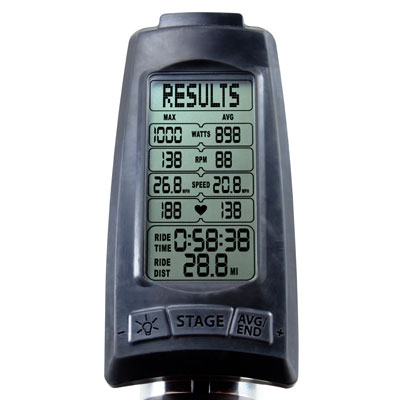
Thank you so much for the great class this morning. I took a picture of my results when I was finished. My avg watts was 148, not 212. I have no clue where I got that number. 😉
I also took your advice and upgraded my membership, so if it's ok with you, I would like to take advantage of the class next Sunday as well. Do I need to come early to be tested or will this take place during your class?
My goal is to get strong and gain endurance. I have an Ironman in 2014 that I would love to CRUSH! 😉
Thanks again for the great morning!!
Tina (Smiley, Orange Shoes girl)
This gal is an animal – the 212 watts she refers to was her average for both of the 10 climbs we did, with only a minute of recovery in between them. Here's the picture she took.
Those are awesome #s for anyone.
Now to the Riding Buddy
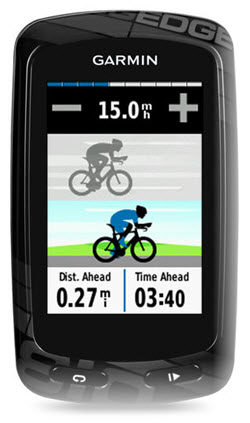
Pictured on the right is a Garmin 810 cycling computer. Beyond measuring and displaying all the typical stuff; RPM, MPH, Distance, Time elapse, etc… these computers allow you to race against a Virtual Partner, which is yourself previously riding over a known course. Racing against yourself is afascinating concept which allows you to compare today vs last week or last year. Are you getting stronger/faster/fitter? Yes? No?
http://youtu.be/o8YhrAAvh7w
After all, it's just you, who you're really racing against.
I use the stage average timer in class as a sort of Riding Buddy, comparing a specific intervals against earlier efforts. Asking; are you keeping up? Yes? No?
Warm Up — 10 minutes. 5 minutes of gradual increases in wattage. During the second 5 mins. we’re finding the wattage where everyone is first noticing a change in breathing; VT1 / Aerobic Threshold = the top of the Recover Zone shown above. This establishes a rough understanding of a base wattage that we use throughout the rest of class.
3 x 30 sec. Hard / 30 sec. Easy – Openers to AT/LT. I cue these by first having everyone find the amount of load @ 70 RPM that has them feeling they should (not just could) come out of the saddle. The 30 sec. Hard is then simply accelerating to 90+ RPM which results in some pretty impressive power numbers. The 30 sec. Easy is back to 70 RPM — many will stand during the Easy portion.
3 minutes rest – I encourage riders to focus on their recovery. Once they feel calm in their breathing, bring back the Base level work wattage.
5 min. Short Hill — Here's were we do our 5 min. “Best Effort” to establish a benchmark PTP Personal Threshold Power (top of the Perform Zone) or ride at 110% of FTP if known. It’s very helpful to riders to have that understanding of their personal upper wattage number. The “Best Effort” Threshold # + the Base Threshold # we found earlier form the three Power working zones I use in class.
– 1 min. build at preferred cadence (suggested as 85-95 rpm) — press the Stage Button to reset the averages.
– 5 min. “Best Effort” This should hurt, but be do-able. I ask everyone to observe their average at the end and then…
2 minutes rest
3 x 5 min. Medium Hill @ 1 min Rest – Now that everyone knows how hard they can go for 5 minutes, we worked at ~90% of PTP on each of the three, five minute climbs. The recoveries and transitions back to climbing are simplified by leaving resistance where it is and do what I call Walking. Have everyone stand and pedal slowly “walk” for a minute. Load should be too high for seated soft-pedaling. Then accelerating up to preferred cadence brings everyone back to ~90% of PTP.
3 minutes rest
2 x 10 min. Long Hill @ 2.5 min. Rest – the songs I used were a little short so I had everyone up to RPM/Watts before starting the songs and hitting the Stage button to establish averages. I prefaced the first climb with; “As Endurance Athletes, you recognize that you get stronger as the class goes on.” Here's where I got a few smiles and hoots… “so my expectation is that you can all climb this at your PTP (5 min. Best Effort wattage)” and we did 🙂 The Spinervals profile calls for near constant changes in gears and cadence, which is easy to do on a bicycle… not so easy on an Indoor Cycle. So instead we made 3-4 changes in load/RPM + alternated in & out of the saddle.
Here's where I was cuing everyone to focus on their Riding Buddy. No matter the change, it is imperative that you keep your instantaneous watts at or above the average, so you keep up with your Riding Buddy.
5 minutes at Base wattage @ 90RPM – which becomes a recovery > step down in intensity while we stay aerobic.
Cool Down
I'm very excited to be able to teach these Performance Cycle classes – they fit me and my personality perfectly and we have an excellent group of athletes to ride with.
Next Sunday 1/5 is the official kickoff of the winter training program > FTP assessment day. Feel free to contact me if you'd like to ride with us.
Is it possible to create Performance Cycling Classes that are entertaining and compelling, for both endurance athletes and non-cyclists? David McQuillen, with The Sufferfest video series, says you can with entertaining video content – note the emphasis on entertaining 🙂
I've been aware of David's videos for years. Perfect for pounding away in the garage or your basement, but I didn't consider them suitable for group cycling classes. Turns out I may need to adjust my thinking about this… With more than 45 licensed facilities worldwide (they're called Sufferfest Embassies) it sounds like there is a group application for these extremely well produced HD videos.
Listen below as David and I discuss his ideas on expanding your studio's appeal to cyclists through the use of his Sufferfest training videos.
Studio/Club Owners and Managers interested in becoming a licensed Sufferest facility can request a free information package by emailing Kate Patterson Kate@TheSufferfest.com – you'll want to include your studio's name and location.
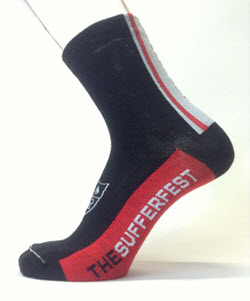
Please tell Kate you heard this interview on ICI/PRO and she'll send you a pair of these cool Sufferfest Socks, just for saying hello! Limited to responses through June 30th.