Ask Amy about her biggest teaching challenge while on a working fitness vacation at a Caribbean resort and she will tell you it's accommodating all the different languages of the guests. Jamaica is very popular among Europeans and Asians, so in one class she may have students that speak German, Spanish, Russian and Japanese. Many know some English, but Amy has learned that sign language works the best because everyone understands it. She gets their attention, demonstrates what she wants and then leads them with nothing more than her smile and hand gestures.
I'm not saying we should adopt a form of sign language to communicate Heart Rate Training Zones. I'm not sure that would work… But the signage in your club or studio should simply and accurately show visually, exactly what you are speaking in your class.
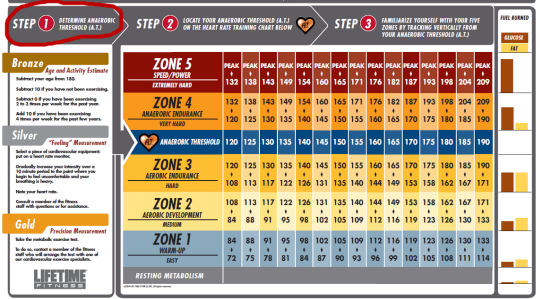
No health club is perfect, but I have to hand it to Life Time Fitness. They have done an exceptional job and educating all of their instructors on the concept of Threshold and the ever present Heart Rate Charts (in every studio) serve as visual reinforcement of the language we all use in class. You can download a pdf of the chart here.
Notice step one
I say exceptional job because it's very rare to find a student in my class that doesn't understand the concept of Threshold Heart Rate and in an average class 60% – 80% of the participants are wearing and using monitors. To put that in perspective, LTF has 90 clubs and in excess of 300,000 members that are being educated about the proper uses of Heart Rate Training .
Am I suggesting we adopt Life Time's chart? Not necessarily. We need a “generic” or “open source” version so everyone will be able to use it without cost or limitation.
How does your club compare?
Do your signage and fellow Instructors all speak the same language?
Are you resistant to establishing a standard? If so, then why?
ICI/PRO Member Karen Bernardo is the owner of Carpe Diem Fitness and Wellness in Mississauga, Ontario Canada. Karen taught a Threshold Field Test with great success in her Indoor Cycling class. When she sent us an email describing the full classes she had and how helpful it was to her students, our first thought was; “we need to have her on the Podcast”
As is customary, I’ve opened my big mouth and am faced with the proverbial “put up or shut up”. Don’t get me wrong, I’m not one to trash talk and overstate my abilities. However, I am one that is always challenging others to accomplish things they think are bigger than themselves; to push past their own perceived limits and discover things about themselves they never knew. Sounds all good so far, but I have a basic life philosophy that tends to get me in trouble. To wit, I believe that whatever you teach, you should experience first. Consequently, all my challenges to others end up first putting me to the test.
Way back in January when our annual Winter Training Program kicked off, each participant was required to have a goal to train for. Goals ranged from doing a 50 mile charity ride to having 2 separate peaks during the race season. For me however, having just finished filming the Pittsburgh Dirty Dozen as a charity project for Livestrong, and watching some of the strongest riders I know struggle just to finish, that event seemed to be the logical choice. So I said it, I would train to complete – NOT COMPETE – in the Pittsburgh Dirty Dozen Race.
Starting this weekend, September 4th, I will have exactly 12 weeks to prepare for The Pittsburgh Dirty Dozen. I’m going to post my training plan (both Heart Zones® as well as Power Training), and pre-ride schedule on this blog for others in the Pittsburgh area who would like to train along with me. The training plan will provide some structure to follow even though we will train in different areas. Every 2 weeks I will take on at least 2 (or more) of the 13 climbs as part of the overall training plan as well. Exact times and dates will also be posted here so riders who want to share the pain can join me if they like.
Point of fact is: this IS a race. Point of reality is: only about 10 to 15 of the 180 riders that rode last year were strong enough to garner any points at all. The format of this “race” is that the entire field is together at the bottom of every hill, and then the organizer, Danny Chew blows the whistle (by the way, someone needs to buy him a new whistle this year, it was sketchy at best last year), and the first 5 riders to the top get points.
While a few supermen and wonder women surge to the top like they have hidden motors in their bikes, the rest of the field climb at varying speeds, with an inevitable group on every hill pushing their way if they can’t maintain at least 4 to 5 mph. In surveying the group last year, it was clear that a lot of the field were experienced amateur racers, and that this was not bringing out the average casual rider. So when I say people were pushing, and there are always people pushing, it does not mean they were weak or inexperienced riders.
The graphic above is from the training DVD we created (Global Ride Productions) from last year’s race. It is slated to be released in 2 to 3 weeks, just in time to mix up some great indoor cycling with the outdoor application. Stay tuned, as I will endeavor to keep this updated once per week as we head towards this epic event.
“Help! One of my Indoor Cycling students told me that he is taking meds for his blood pressure, and he’s asking questions about what this means for his training. I have no idea! What should I know about this?”
– K.P., Phoenix, AZ
Melissa Marotta writes:
Since ICI launched its medical research column, we have received dozens of questions from instructors all struggling with the same issue: “How do blood pressure-lowering (“antihypertensive”) medications affect the “bread and butter” of what we do?” Yours is an extremely common predicament, and we congratulate you for empowering yourself to seek out the information you need to best serve your clients.
While many group exercise instructors and personal trainers are certified through programs designed to prepare them to train folks without major medical problems (with perhaps cursory mention of some common medication names on a single page in a manual), it doesn’t take long before they get thrown a curveball. And while we may be very responsible in a) providing information limited to the scope of our expertise and b) securing that a client has received physician approval before engaging in exercise, this doesn’t do much to alleviate the anxiety we feel in that moment where we haven’t a clue how to even begin to answer the question at hand.
This article is not meant to take the place of advanced certification in working with special populations; however, I hope it will be a helpful reference to acquaint you with how to approach a rider who asks you how to make sense of how antihypertensive medications may impact training.
I call this my Grand Canyon ride. I use the metaphor of standing at the edge, with great discomfort ahead of us and much relief behind us, to help my students understand the feeling of Threshold.
Here's your Spotify PRO/Playlist! We have made every attempt to replicate the original playlist. In some instances the tracks specified were unavailable in Spotify. When necessary we have substituted individual songs of similar length and tried to maintain the Instructor's intent. Here's the playlist in Deezer