For the past two year's or so I have been lobbying for a universal “Standard” for the description of Heart Rate Training Zones. The purpose is to get all of us talking with a common language, so we aren't confusing our students and help them reach their weight loss goals by training more effectively.
I love what we have been calling 2T/3Z or Two Thresholds / Three Heart Rate Zones and feel it is perfect for the “Club Athletes” who make up the majority of our classes.
Now there is a multi-week Heart Rate training program, designed around 2T/3Z & the Blink Heart Rate monitor, that you can offer to the clients at your club or studio. Zoning was developed by Ms. Zone Based Heart Rate Training herself; Sally Edwards, along with her partner (and ICI/PRO member) Chuck Cali.
Zoning is literally a Turn-Key fitness program in a can. I mean it will actually arrive at your studio in a can 🙂 The Zoning can contains everything you need:
Handouts and training video to educate your instructors
Promotional materials to help you sell your 6 week Zoning program to your clients
Class plans for leading each of the 6 weekly small group classes
Having seen the complete program I'm confident you will want to offer Zoning
Zoning is due to be released on November 15th and they are currently interviewing potential Beta sites. If you own or manage a fitness studio and would like to be considered as an early test facility (or you would like to be contacted when the program is released) follow this link to submit your contact information.
Before we talk about how to get a beginner class started, the first question you need to answer is why? Not, why does my club need a beginner class, but why do YOU want to lead one (if this is your plan)? As an instructor starting a beginner class you need 3 main criteria: (1) The absolute desire to work with new riders, (2) the ability to teach appropriate classes for beginners and (3) excellent foundational knowledge of bike setup and form and technique.
Working with beginners is very gratifying but it does take a special individual to have the patience to work with those who may not have the conditioning or who arrive needing all kinds of help and have tons of (basic) questions. Many people never enter indoor cycling classes because they are intimidated by what they’ve witness through the class door of the studio (instructor yelling, riders sweating profusely and everyone limping out of the room). You will need to help beginners feel comfortable and confident that they will not only survive the class, but actually enjoy it. These classes REALLY need to be designed for beginners. This does not mean we do the same drills as our regular classes, just at a lower intensity. Some riders may have trouble (or are not confident) standing, while others may find pedaling above 60 RPM a challenge. Many beginner riders I’ve witness struggle to remain comfortable on the bike regardless of how hard they are working.
One of my biggest pet peeves is bike setup, particularly when working with beginners. This is often their first experience on the bike and it should be positive and pain-free. A few months ago a new rider entered my class (not a beginner class). I asked if she needed help with her setup because I saw her sitting in a very odd position. She told me she was experiencing some knee pain after a few classes. Once I corrected her position and gave her some pointers on proper posture, she confessed that she had taken 2 other classes earlier in the week and those instructors setup her bike in a much different position. She was also given some incorrect instruction on form, including straddling the stem of the handlebars when standing (she used a blunt sexual reference inappropriate for most audiences). So whether you are a fitness director recruiting an instructor for a beginner class or THE instructor, please make sure you are grounded in the fundamentals so we start our aspiring riders the right way and the safe way.
So now that we’ve got that off the table, what is the best way to start a beginner class at your club? I’m going to present a few tips to put you on the road to success, but also look forward to our indoor cycling community (YOU) to share experiences.
(1) What I the best time of day?
I’ve seen late morning indoor classes (9 — 10am) receive good attendance. However those who attend at this timeslot are often stay-at-home parents that do not have a desire to join the primetime classes. The best conversion rate (beginners who become indoor cycling enthusiasts) has been seen from classes that are offered just before the primetime class. For example, a 6:00am beginner class before the regular 6:30am class or a 5:30pm beginner class just before the 6:00pm evening class. The back-to-back beginner to regular class combo has proven successful for a number of reasons: (1) most do not require a separate instructor since the instructor for the regular class is often able to arrive early (for some extra $$ as well), (2) beginners who become confident and conditioned can stay and try to take the regular class and (3) “advanced” riders can take the beginner class as a warm-up and for more saddle time. NOTE: please advice advanced riders (especially those who dress in full pro-team clothing) to sit in the back so they don’t intimidate the newbies.
(2) Advertise with the Right Words
When you promote these beginner classes, it is important not to insult nor frighten people. Make sure you don’t advertise the class as “for those people that can handle a regular class”. Instead focus on what they will learn and/or experience. Also, don’t send them running in fear because the flyer posted at the club lists “Threshold Management” and “Anaerobic Capacity” as some of the benefits they will get from this neuromuscular, cardiovascular class. What da….?? Yeah, those training terms may arouse us, but a beginner will assume that if they don’t understand the description of the class, they will certainly not understand what is going on once they get their. Use general fitness and cycling terms. Keep it simple.
(3) Dress Down. Make sure the photos and advertising you use to promote the beginner class is not littered with pro cyclists or riders digging into “the suitcase of pain”. It doesn’t need to include pictures of people in lawn chairs on the deck of a cruise ship either, but just take time to consider the apprehension people can have to the perceived intensity of a class and lean towards a “fun workout”. On a side note, the instructor teaching the class should also dress down. I do recommended cycling shorts, but maybe a non-cycling top (but still athletic) to put new riders at ease.
(4) At Cycling Fusion, we have found that 30 minutes is the perfect amount of time for a beginner class. 30 minutes is long enough for those without the conditioning to feel like they’ve received a good workout while keeping them from fatiguing (physically or mentally) in a position they are not yet used to.
So, go and start that beginner class. Give them a good workout, start them off the right way and have fun!
I used Epic Planet's video Epic Acadia this morning in a class I subbed. Because these early AM people are very committed and they all understand the value of Threshold based training, I knew I could lead them on a ride that included a 20 minute climb at (or very near) Threshold. The first 30 minutes are a perfect warm up with a number of short climbs I used to bring them to Threshold before we got to the climb. The graphical representation of where you are during the class is the best of any of the DVD creators that I have experienced, although I'm not completely sure what TZ 4-5 means. I assume TZ stands for Training Zone and if we only had a universal standard for what TZ stood for …
Paul Camerer, AKA Pink House, is walking proof that (220 – your age, shoe size, mailing address, phone number … or anything else) will not give you an accurate Maximum Heart Rate number to base your training zones. Paul is 91 (92 this December) and regularly rides at 30 or more beats above his “Age Predicted Maximum Heart Rate”. The guy is precious and I had the privilege to interviewed Paul back on Podcast #18 when he was only 90.
Here is an update about Paul from Sally Edwards' blog.
Pinkhouse (aka Paul Camerer) almost 10 years ago, started the first “garage gym” named after the color of his east Sacramento home. Today, he is nearing his 92nd birthday and he wanted to continue to demonstrate that maximum and threshold heart rate do not decline with age as many believe. Pinkhouse is but one example that the age-adjusted formula 220-age=maximum heart rate is useless. Don’t use this formula.
The picture to the right is taken of the final average heart rate from today’s ride using the “Gymbotron”, a device that displays heart rate on a screen or wall. Pinkhouse rode 20 beats above what the max heart rate formula would calculate (220-91=129 bpm). He averaged 149 bpm for 52 minutes. That is he rode 20 bpm above his calculated maximum heart rate. The point Pinkhouse is demonstrating is that his maximum and threshold heart rates have not dropped a beat over the last 30 years that we, the Heart Zones Training certified trainers, have measured it.
Heart Zones Master Instructor Laura Sachs contributes our latest Audio PROfile.
Laura recently published an article about heart rate training in the June IDEA Fitness Journal. Here's an excerpt and you read the whole article here.
Heart Rate Monitor Benefits
If an athlete wants to train rather than just to work out, using a heart rate monitor to zone in on the right intensity can help track the workout in an intelligent way. Quantifying an activity makes it possible to plan a course of action based on the outcome measurements and the monitoring of that activity. Clients can use a heart rate monitor to gain an accurate picture of workout intensity, putting absolute numbers such as 160 beats per minute (bpm) into relative numbers or percentages of maximum or threshold.
For example, if the number for a client’s low threshold (the first metabolic shift from increased intensity) is 140 bpm and the maximum heart rate (HRmax) from a field test measurement is 160 bpm, then the relative number (or percentage) is about 88% of HRmax (also referred to as Zone 3: Aerobic Zone). “Low threshold,” or “first threshold,” is referred to as T1 (Foster & Procari 2010).
Edwards has identified five heart rate zones, providing a simple way to set training zones based on participants’ specific response to exercise intensity.
For decades, fitness enthusiasts have used the 220-minus-age formula (age-adjusted maximum heart rate formula) to mathematically calculate HRmax and thereby derive cardiovascular training zones. According to Carl Foster, PhD, FACSM, professor of exercise and sports science at the University of Wisconsin, La Crosse, and past president of the American College of Sports Medicine, “The formula’s 220-minus-age is useless. There is no scientific validation for it.” To replace this generalized formula, Edwards has developed a half-dozen user-friendly field tests to determine both maximum and threshold heart rates that result in personalized zones for each individual. “The only way to safely and accurately estimate maximum heart rate,” she says, “is to take a submax field test. We can no longer rely on equations that were fabricated and invalid.”
After reading it I asked Laura to record this some of this as an Audio PROfile.
Here's your Spotify PRO/Playlist! Deezer. We have made every attempt to replicate the original playlist. In some instances the tracks specified were unavailable in Spotify. When necessary we have substituted individual songs of similar length and tried to maintain the Instructor's intent.





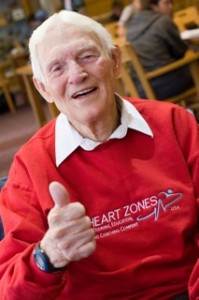 Paul Camerer, AKA Pink House, is walking proof that (220 – your age, shoe size, mailing address, phone number … or anything else) will not give you an accurate Maximum Heart Rate number to base your training zones. Paul is 91 (92 this December) and regularly rides at 30 or more beats above his “Age Predicted Maximum Heart Rate”. The guy is precious and I had the privilege to interviewed Paul back on

