Many (if not most of us) were taught some variation of; “scrape gum off the bottom of your shoe” and “try to push over the top” as the “proper” way to describe how to pedal like a “real” cyclist. But is that correct? If we really want our participants to pedal like a cyclist, is this the best way to cue proper/efficient pedaling technique?
My recently completed professional bicycle-fitting with Chris Balser the Bike Fit Guru says not necessarily.
I spent about two hours actually riding my VeloVie bicycle on a computrainer during my fitting. Not continuously and never at anything beyond a JRA level of effort. Early in the process Chris asked me; “where did you learn how to pedal?” Thinking that with way over 15,000 miles pedaling a bicycle, I've gotten to be a pretty good pedaler. So like most proud people I got defensive at his suggestion. Chris must of noticed it on my face because he quickly added; you're very smooth… but your ankle is all locked up. You are missing out on a bunch of power that's available if you'd #1) unlock your ankles and #2) focus on moving your knees through the greatest range of movement possible.
USA vs. EU pedaling techniques
To demonstrate what he was talking about he had me watch myself pedaling in a mirror from the side. My years of concentration on pushing over the top and scraping across the bottom showed Chris' observation was correct – I am smooth but my ankles were nearly locked solid with my foot at a right angle to my lower leg. That, he explained, was how people in the USA pedal.
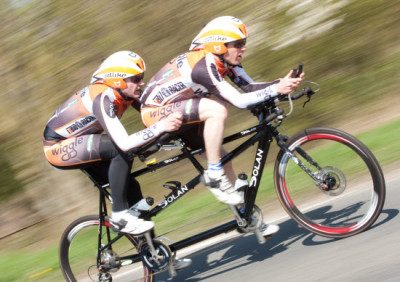
Then he showed me a number of pictures of professional cyclists like this one of a very fast tandem team from the UK:
From http://magazine.bikeradar.com
Notice how high this captain's heel is as it crosses over the top? The idea here is that by allowing the ankle to flex and the heel to rise, you create a longer lever. Longer levers create more leverage and the force can begin earlier in the down stroke = more power. When you watch a cyclist using this technique, you'll see what Chris called “big knees” – the riders knees move in a very large plane up and down. It isn't just that their legs are long or that they're riding with long cranks. The exaggerated movement of their knees comes from the additional rage of motion allowed by the flexion of their ankles.
In this video, Joe Friel demonstrates the USA focus on “push over the top and scrap across the bottom.”
Former UK professional cyclist Rebecca Ramsay runs EasyCycling.com and her video below is an excellent example of what Chris describes as the EU pedaling technique. A closeup view of this technique in slow motion begins at the 2:00 mark. Notice how much flexion she has in her ankle as it crosses the bottom. Yes she cues the “scrape across the bottom” but no push across the top. With your heel elevated there's really no way to “push” forward… just down in a strong, fluid motion that I'm learning can create some much needed, additional power from my 52 year old legs 🙂
So who's right? Good question… but I'm not sure it's the right question.
A better question would be; which way of cuing, USA or EU, will be easier to understand by our students? Or would a combination / hybrid be helpful?
I've got two assignments for you to compete and report back:
#1 – Next time you're on a bike give this a try. Concentrate on what Rebecca cues as “a flick of the ankle” at the bottom. You may feel your calf contract slightly which you'll see in the video.
#2 – Watch a stage of the Tour De France. Pay attention to the vertical movement of the rider's knees and then let us know what you find.
John, I'm still confused by this power stuff… where should I be riding? How many watts should I be seeing on my monitor, because I'm no where close to my body weight?
I get questions similar to this frequently from members. My answers has evolved over time:
I used to give into the pressure; “please tell me a number” and would throw out a vague target – “your first goal could be seeing watts equal to your your body weight”.
Later I revised it down a little; “what would be your desired, lean body weight?” “Let's try to reach that as an early power goal.”
But now I'm learning that throwing out watts = body weight (lean or actual) isn't as helpful as I intended. Sure for some it works. Those who are reasonably fit looking (read not overweight) and with a good fitness base. For others I've found I was asking them to work too hard, using a kind of formula that wasn't personalized for each individual. Which sounds is a lot like using the 220 – age for MAX HR 🙁
Now my preference is to conduct a short “Best Effort”, about a quarter of the way through class, to give everyone an understanding of a number they can work from. Not a true FTP or PTP, but it's been reasonably well accepted… but not by everyone.
Case in point: last Thursday after class I had the “how many watts should I be making?” discussion with a female member. She's a fit 50 year old and I would guess (I never ask) she weighs about 130lbs.
So I asked her what she normally sees during the “Best Effort” interval. “I average about 80 watts.” Which confused me… a lot actually. I would have guessed she could easily make more than 80 watts. I was stuck for an answer. Rather than guess at the reason, I started asking questions:
Do you ride outdoors? No, not regularly.
Are you a runner? YES!! Big smile.
How would you compare running vs. cycling? Cycling is much easier. I'm getting to something here…
Do you run in competitive events like a 5k, 10k, Marathon, etc…? Another YES !!! I love to compete!!!
Do you run faster & harder in a 5k vs. a Marathon? Yes, of course I do – why?
When you're riding in here with me, does your “Best Effort” feel more like a 5k or a Marathon? She stopped to think about it and then said; like a Marathon.
Bingo!
I didn't need to say anything more. The look on her face told me she understood exactly where her confusion was coming from. Her perception of working hard was at her Marathon level of intensity = 80 watts was exactly right, figuring an aerobic level of effort. I had been making the assumption that when I asked for hard, everyone would work at the level I perceive as “hard” – which for her was different.
She ended the conversation with; so when you ask us for our “Best Effort”, I should be working at my 5k level of effort?
Exactly, or maybe a 5k where you're chasing one of your faster friends 🙂
Instructor Kathy Palkaninec contributes The Vicious Cycle, her Audio PROfile which was one of the winners of our Ultimate Instructor Class Profile contest.
Kathy teaches at MindBody Trendzin Cooper City, FL and she begins her profile like this:
Objectives and Interests:
This ride was created after researching metabolic conditioning sequence and how to burn stubborn body fat. I found the Ultimate Cardio Sequence by Shaun Hadsall. His explanation and sequence based on science inspired my “vicious cycle”. The name of the game is Intensity first. The protocol of this ride is based on the following: Once the heart rate is elevated in the warm up, the training goes into the “fight or flight” mode with short intense bursts over and over.
The Catecholamines are the hormones released by the adrenal glands in response to stress. Being part of the sympathetic nervous system they force the release of free fatty acids into the blood stream. These short bursts will create the famous” after burn” that can potentially increase metabolic rate up to 48 hours after exercise. Science has proven that free fatty acids do pour into the bloodstream after such high intensity training. However, research shows that these fatty acids, if not removed from the blood stream, will move to another place in the body and again re-store as fat.
Click image to join our Facebook Group - everyone encouraged to join!
This Podcast is was last published on Feb 23, 2010, I have updated it with our new Podcast host information and I am representing it now. I hope you enjoy it, Joey
As promised last week, here's my interview with Bill Pryor about his experiences starting his own Spinning Indoor Cycling Studio.
2014 UPDATE: This interview has launched multiple dozens of new Indoor Cycling Studios - is yours next?
The online payment and business management service we discuss is MindBody Online combined with a LiveEdit Integrated Website.
“The most important Indoor Cycling class you'll ever take… will be the next one!”
I've forgotten which Instructor I overheard saying this to a new participant, but it's completely true. We want new students returning to our classes every week. It's good for us (fuller classes) and obviously good for them 🙂
So what should we be doing in our classes to encourage a Revolutionist, who finds him-or-her self in your class, to feel comfortable and (hopefully) return?