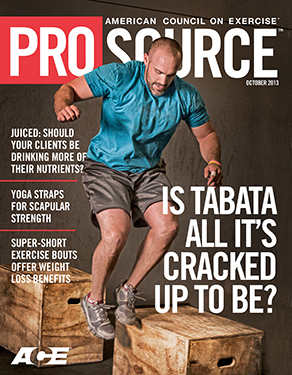
Image from http://www.acefitness.org/prosource/71/
I just read a press release and accompanying article from the ACE – The American Console on Exercise PRO SOURCE magazine about their study to gauge the effectiveness of High Intensity Training (HIT).
“It seems like everything high-intensity is now called Tabata Training,” says John Porcari, Ph.D., head of the Clinical Exercise Physiology Program at the University of Wisconsin, La Crosse. “The original Tabata study was done on a bicycle, but people are now doing that 20-second/10-second format with resistance training, plyometrics, calisthenics…with almost anything.”
Because of all of this recent interest in Tabata-style workouts, the American Council on Exercise enlisted Porcari and his research team to gauge just how effective a Tabata-style workout really is.
THE BOTTOM LINE
“The great thing about Tabata is it’s a short workout–only 20 minutes–and it incorporates your total body, so it’s working every muscle group that you possibly can,” says Embert, referring specifically to the Tabata-style workout she designed.
But what to do during the remainder of your 60 minute class?
There was a trainer at Life Time who told me years ago something I've never forgotten; First give them (your class) what they WANT… and then give them what they NEED.
The WANT he was referring to are very intense/anaerobic intervals. There's no secret sauce IMO at SoulCycle > they're just teaching very intense classes because they know that's what people WANT.
The NEED is for solid aerobic training. Not necessarily base building, but solid work below threshold HR / FTP.
Instructor Kathy Palkaninec was a past winner of our profile contest and her profile follows a similar WANT & NEED format.
You may want to announce your intentions to crush them (WANT) during a 20 minute Tabata round that will start fifteen minutes into class. Don't worry about telling them what follows. Keep everyone focused on doing their best effort during the Tabatas.
Give everyone a full 5 minutes or more of complete recovery. It's during this time that I talk about the “Golden Hour” and how most of us have 90 minutes where we can really perform well, before fatigue really limits our performance. The Golden Hour doesn't begin for most of us until ~30 minutes in. At the end of the recovery we're only @ the 40 minute mark of a 60 minute class and I explain how we're only 10 minutes into our Golden Hour – just now ready to perform. It's here where you can coach them through a 10 or more minute sub-threshold effort (NEED) to conclude the class. Here's where you can put that stage button to work if you have one – encourage everyone to ramp up to a big number, Stage Button, now maintain it by keeping your instantaneous wattage at or above the average 🙂
Here's part two of It Isn't Staying Green from Master Instructor Cameron Chinatti with STAGES Indoor Cycling.
In case you missed Pt1 you can find it and the music playlist here and you can also find the video in the iTunes feed.
It's hands down the most convenient service on earth for discovering, sampling and sharing music. I use Spotify every day and enthusiasticly promote it to anyone who will listen.
If you're privileged to live in an area where it's available, you can try their Premium version free for 30 days.
With the Premium version you can download and use the Spotify App for both iPhones and Droids. Try using it in your class and you may never use iTunes again 🙂
IMPORTANT NOTE FOR NEW PREMIUM USERS!
Spotify only works via a wireless connection between your computer and device. Yes it shows an option for connecting and transferring music using the USB cord on your iPhone – DON'T USE IT!
Please review these help articles for more tips and tricks.
I have a friend, a very accomplished cyclist, who fancies himself a Ferrari. To look at Eddy you'd have to agree; he's long, lean and very sharp looking. But to ride with him may have you thinking more Peterbilt, than Ferrari. You see my friend is very strong and rides with a slow, powerful cadence. Many who ride with him remark; “the guy never shifts… he did the whole ride in one big gear.”
I'm finally continuing with this series, comparing the athletes in your class with the engine in their cars.
Let's explore the difference between small displacement > High RPM engines found in High Performance Sports cars and the large displacement > low RPM engines found in a Semi Tractor- Trailer or Lorie you see running down the highway. Then see if we can draw a a few correlations between them that would be interesting to the Gear Heads in your class… after all, if your class is anything like mine, you're beginning to see more men, now that it's getting cold outside.[wlm_private ‘PRO-Platinum|PRO-Monthly|PRO-Gratis|PRO-Seasonal|Platinum-trial|Monthly-trial|PRO-Military|30-Days-of-PRO|90 Day PRO|Stages-Instructor|Schwinn-Instructor|Instructor-Bonus|28 Day Challenge']
The F430 Ferrari is an incredible car. It will go zero to 60 in 4 seconds, a top speed of 200MPH and you can get one of your own for only $200,000 US. What moves this 3,200lb rocket, when you push on the “fly by wire” accelerator pedal, is a 4.3 liter gasoline engine that develops 483 horse power – once it is spinning at the maximum of 8,500 RPM.
A conservative choice for an engine in your new Peterbilt truck is a Cummins ISX15 diesel engine. This engine makes 485 horse power while turning a leisurely 2,200 RPM
So the F430 and the Peterbilt both have essentially the same horsepower (483 vs. 485) available to the driver.
What's the difference? Isn't Power… Power?
TORQUE
The Cummins engine creates 1,850 Ft Lbs of Torque, over 5 times that of the F430's puny 343 Ft Lbs, while only turning 1/4 the RPM. The Peterbilt needs all this Torque to move the combined tractor and trailer weight of a 50,000lbs up over a 6% grade. To create that Torque the Cummin's engine is massive (weighing over 3,000lbs – about the same as the whole F430) with huge pistons that are (you guessed it) about 4 times as large in diameter!
Torque in an engine is created by the force of combustion acting on the surface area of the piston. While there's a lot of other physics that go into the creation of Power, I'm reminded of an old racer's adage that goes something like; There's no replacement for displacement.
What's true in engines is true in humans… with all other things equal; bigger muscles can create bigger forces = more Torque. But Torque doesn't get you up the mountain – that's Power. So of two women of equal weight, the one with the biggest legs doesn't get to the top first.
The winner to the summit will be the one who can continuously make the most Power, for the duration of the climb.
My buddy Eddy, like most endurance athletes, is a student of himself. Over 10's of thousands of miles, he's learned exactly where his body makes the most Power, the most efficiently. In his case, he understands that his very strong legs work best while powering through at what many would say is too slow a cadence.
Fans of the Tour de France may remember the climbing battles between Lance Armstrong and Jan Ullrich – where the contrast between Lance's 90+ RPM and Jan's 60ish RPM had them climbing at the same speed = they (I'm assuming they have similar body weight) made the same amount of Power. The same Power that is, until Lance turned, looked, then accelerated to 100 RPM and dropped Jan due to his superior Volumetric Efficiency – ability of an engine to process Oxygen, by efficiently moving air through itself.
After all Lance Armstrong is truly a Ferrari – but that's a subject for another post.
A fun class you can offer (if you teach with Power/Watts) is to create a profile that includes a series of laddered efforts of increasing cadences – while maintaining a set percentage of FTP or some baseline wattage. The purpose of the class is to help each student find the RPM range where they are the most efficient, i.e are they a Ferrari or a Peterbilt?
Amy and I experience this every time we ride our Tandem. In His, Hers and Ours Audio PROfile we explore how different cadences can be used to create the same amount of Power, or ground speed, which is essentially the same thing.
You may choose to use only RPE or you could tie each step to a HR. Maybe you cue wattage as a multiple of body weight; Now everyone find their One Watt Per Lb wattage at 70 RPM. Now let's add 10 RPM and reduce resistance to stay at that wattage… after 3 minutes ask, what's the result? Do you feel like you are working harder? HR higher or lower?
This might be a fun exercise to use a few weeks ahead of an FTP assessment – where we first teach everyone their Natural Cadence (best efficiency) and then have them ride at that RPM during their assessment.
Sounds like a question for Cameron Chinatti – stay tuned…[/wlm_private]
Most interviews begin with an intro call where a potential guest and I discuss the process and I answer any questions they might have. Most of these calls are uneventful – but Gloria is not what you'd describe as leading an “uneventful” life. When I called her at the scheduled time she was breathless, having just rescued a stray dog from a busy highway. As she describe to me (in real time) how she was helping this poor, frighten dog into her car – I knew right away that I had found another Awesome Instructor!
Gloria was nominated by ICI/PRO member David Santiago. If that name sounds familiar it's because David was a past winner of our Ultimate Instructor Class Profile contest. You can hear his Racing With Pros Audio Profile here.
Please feel free to contact us to nominate an Awesome Instructor.
Here's David's nomination email:
Hi John,
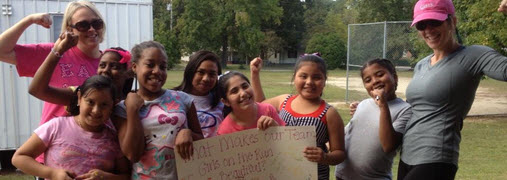
I want to nominate Gloria Stover Lewis as an Awesome Indoor Cycling Instructor at the Y and for her endless volunteer work, especially with the “Girls on the Run” program held locally in NC.
Gloria started out as a regular student coming to IDC. All of the other teachers enjoyed having her in class. She is enthusiastic with boundless energy and has an outgoing winning personality. She is also a very strong cyclist and competed in several elite outdoor mountain bike races.
It did not take us teachers long to suggest she should become certified as an IDC instructor. We are always looking for talent. She eagerly agreed and become certified. She was a natural at it and now has huge followings at two YMCA locations. Her ability to combine challenging and fun profiles with fantastic music is among the best in the area.
Gloria is now certified to teach several classes:
– Indoor Cycling (of course)
– Jump pump and spin
– Boot Camp
– ABS
– INSANITY (I took this class once and it is now off my bucket list. Toughest workout I ever had.)
I am nominating her not only as an awesome indoor cycling teacher, but also for her volunteer and charity work with kids:
– Youth triathlon volunteer
– Ecvelo club at Cotton century ride and bike post trails race (volunteers with the youth part of mountain bike race)
– “Girls on the Run” program as both a dedicated Coach and Fundraiser requesting donations for kids who could not afford them (athletic cloths and shoes).
David Santiago
Girls on the Run is an incredible program supporting young girls from 3rd to 8th grades. It provides a safe and interactive way to learn about healthy living which includes an introduction and education on important topics such as goal setting, cooperation, healthy decision making, and self respect, while training for a 5k event. The innovative curriculum teaches girls to listen and open up while also encouraging them to commit to a healthy lifestyle and harness the inner strength that they possess. Their important mission is accomplished by giving girls the tools to make positive choices for a healthy body and mind, while reducing the many risks they face today.
Attached is a fairly long and informative video explaining the Girls on the Run Program from the Chicago area. If you have any questions about starting a program in your area, please email them at StartingGOTR@girlsontherun.org.
Listen to my interview with Gloria below.
Long time friend Suzelle Snowden from Fit Bodies, Inc sponsors our Awesome Instructor Award. Suzelle is providing a $500.00 certificate that Gloria and a guest can use toward an All-Inclusive Teaching Vacation at any one of 60 beautiful resorts in the Caribbean You can learn more about participating in these trips here.




 You can learn more about participating in these trips