Dr. Carl Foster joins me to discuss his upcoming sessions at this year's ICI/PRO conference in Boston 9/30 – 10/2. As our conversation progressed we steered into; some of the history of zone based heart rate training, where “220-your age” came from (it's actually valid, in some respects) and we talked about my favorite subject – creating a standard method of describing heart rate training zones. I apologize for the length of this episode, I find it all very fascinating 🙂
These free Podcasts are provided through a sponsorship from Cycling Fusion
If you're teaching with power, there's a good chance you'll have a participant ask you this simple question; how many watts should I be making when I'm working at my threshold? Same goes for any new studio or one that is upgrading to indoor Cycles with power/watts. You will be asked for a number from many of your riders. The reason is pretty simple, many people naturally want to know how they compare.
There are two schools of thought on if, or how, you should answer this question:
There's the “Don't give them a number – ever” school that believes whatever you tell them could be wrong and potentially upsetting. You don't want to demoralize riders, or hurt their feelings, especially with a new rider with no/limited fitness, by suggesting anything. The recommendation is to respond with a question; how many watts did you see today? Then respond positively to any response.
Then the “give them something to work with” approach. My preference is to start with the suggestion of one watt per pound or a little bit over 2 watts per Kg.
They're adults = tell them the truth… they can handle it.
Have you ever had someone lie to or mislead you, under the pretense that they didn't want to hurt your feelings? Did it make you feel valued and respected? If you have experienced a situation where you weren't told the truth, did you feel you would have acted differently, if you had been given accurate information?
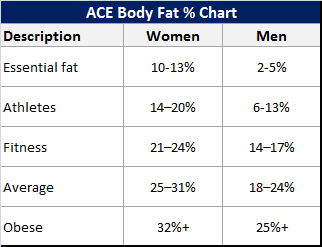
Imagine for a moment you're a personal trainer and your client asks you this question; what percentage of body fat should I have? A common question I'm sure. Is the correct response; “what is your body fat percentage now?” And then to positively affirm what ever answer they give? I don't think so… do you? There are established ranges for body fat %, published by credible fitness authorities like ACE. Here's their chart.
Let's see where you fall on this chart…
If your female client told you their body fat is 34% – would you smile and say; “that's great!” ? Of course not. You would probably suggest a diet and exercise program directed toward reducing their fat percentage down, with a goal to get into the average range. The person standing in front of you may not like hearing that they're obese, but don't they need to learn the truth so they can decide to do the work needed to change their body composition?
What about running a 5k? Or bowling for that matter? They both have metrics that define a reasonably achievable level of proficiency for an able-bodied person. Would it be wrong to suggest a goal time of 36 minutes (12 minute mile) for a 5K or 120 pin score in a bowling game?
Teaching with power for two years has me in the “give them something to work” with camp. And that something is a goal of one watt per pound of body weight*. I've asked multiple dozens of riders; “are you close to your body weight in watts?” Are they all there? No, but it's been very few. I'll bet if you were to privately poll your regulars, at the end of a 3-4 minute sustainable threshold effort, you would hear wattage #s around body weight.
At the end of the PST (Personal Spinning Threshold) assessment I did at WSSC, MI Janet Toussaint allowed me to ask the class this exact question. The majority agreed that their PST was at or above their body weight. Now a room full of fit Instructors may not be a representative sample, but it reaffirmed my experiences.
If you'd like to learn more about this concept – listen to this podcast where I first learned about it.
*I've heard other Instructors suggest using lean / goal body weight, which would reduce the number slightly. This calculator provided by ACE might be helpful.
Better late than never they say. It certainly applies to this season's Performance Cycle classes – now we're in full swing after some initial confusion that came from a sudden change on GFDH's.
We kicked off this past Sunday with an assessment to find the wattage numbers we will be using going forward. I like to use very simple terminology that minimises any mathematical computations.
… Instead I base my Life Time Performance Cycle classes on two numbers; PTP (Personal Threshold Power) and JRAP (Just Riding Along Power — AKA > Base Watts > VT1 / First Ventilatory Threshold Power). From these two rider identified threshold wattages, we can construct three meaningful power Zones;
Recover zone — watts below JRAP
Perform zone — watts between JRAP and PTP
Improve zone — watts above PTP
Today we added one more wattage number – their 20 minute FTP watts. As you can guess, riders should have a lower 20 min average than a 3-4 minute PTP / Best Effort and be above JRAP / Base Watts.
Wait John, you just said you only use the two thresholds in class.
What's the point of adding a third number?
Adding the third point of reference helps you draw a straighter line. At least that's what my high school drafting teacher taught me. It's much easier to draw between two distant points, if you add one in the middle = it helps you understand if you're on the right path between the two known points!
[wlm_private ‘PRO-Platinum|PRO-Monthly|PRO-Gratis|PRO-Seasonal|Platinum-trial|Monthly-trial|PRO-Military|30-Days-of-PRO|90 Day PRO|Stages-Instructor|Schwinn-Instructor|Instructor-Bonus']
The process of sustaining a 20 minute effort is helpful to many riders – it validates and reinforces the two threshold numbers and confirms that people are understanding my cuing.
Before/during and after these twenty minute efforts I tell everyone; this effort should fall between the two thresholds. Which you would think I shouldn't even have to mention… until you hear the confusion I heard after the effort was completed:
I really surprised myself – my 20 min watts was the same as my 3 minute level!
There must be something wrong with me – I couldn't sustain my base watts for the whole ride 🙁
Teachable moments here
In the first example; my 20 min watts was the same as my 3 minute level! I was able to ask him; “what does that say about your 3 minute effort?” He understood before I completed my sentence; “I'm not working hard enough!”
The women who told me I couldn't sustain my base watts for the whole ride also had a revelation and asked me; “Do you think I'm working too hard at my base level?” I didn't even need to answer her.
Do you now see the value of adding that third number?
A continuous state of observation
I asked my class on Sunday; how many of you are on a specific training plan? None. Not a single hand went up. This is very typical for my very diverse group of middle age men and women. Yes most ride outside – but their objectives aren't structured beyond not rolling over and hitting the snooze button. They come to my Performance Cycle class to get a nice combination of intensity and endurance work, in a fun group.
My object in this class is that everyone learn from observing their performance, make adjustments and observe again. Over time they learn exactly where they need be. When it's time to work hard – they WORK HARD and when they should work easy – it really is easy.
Make sense?
Here's my playlist –
I'll get the rest of the profile up later in the week if you want to try this in your class.
I was sitting in the Airport and started thinking about how useful Twitter could be to communicate with my Indoor Cycling Class regulars. Many people set up Twitter to send updates to their phone. I could…
Encourage attendance
Let them know what’s coming next. Give advanced notice of each class profile. Offer words of encouragement. Ask “where has so-and-so been? Anyone seen him?
What are your ideas?
Are you using Twitter to communicate with your class? If so post your ideas for others in the comment section below.
I sleep better knowing that for 17 cents a night, everything I have saved on my computer is fully backed up. All my Indoor Cycling class music, profiles, playlists, files, pictures…everything. When I see the backup status report below, I know that my three year old Dell laptop can fail tomorrow and I will lose NOTHING!
Makes me happy 🙂 They let you try it for free here.