Have you ever had someone say something so revolutionary, that it smacks you hard in the face and knocks you completely off balance?
It happened to me today and I'm still reeling with the potential of this exciting new method of creating great class playlists. Let me explain…
While preparing to record our latest Audio Class PROfile, Instructor Dennis Mellon introduced me to the fascinating concept of Harmonic Mixing, which is used by the top DJs to build a magical playlist.
This isn't mixing songs by BPM with MixMeister, but rather by combining tracks in the same or a complimentary musical key.
The net effect I'm discovering, is a flow/transition between songs that just sounds right. You may not be able to identify why exactly, it just works. If you're a bit tone-deaf like me, it may explain why some of your playlists don't elicit the same positive response, as say your wife's 🙁
This has been a continuous source of frustration for me; Amy, Chris Hawthorne and a bunch of other Instructors I follow on Spotify all have very good ears for music. And yet the playlists I create (using their songs) never sound as good as the original playlist I swipe them from.
Harmonic Mixing is an advanced technique used by top DJs all over the world. By mixing tracks that are in the same or related keys, harmonic mixing enables long blends and mash-ups. The goal is to eliminate key clashes.
The Basics
Harmonic mixing consists of two elements: knowing the key of every song that you play and knowing which keys are compatible.
To get started, find the keys of your songs. You can detect keys with a piano, a good ear, and a background in music theory. To save time, you can use professional DJ software such as Mixed In Key. Mixed In Key scans your MP3 and WAV files, and shows you the key of every song.
The First Mix
To help DJs learn harmonic mixing, Mark Davis created the Camelot wheel, a visual representation of which keys are compatible with each other:
Help for all of us Tone-Deaf Instructors!
The Professional DJ Approach
Many professional DJs move around the Camelot wheel with every mix.
To select a compatible song, choose a keycode within one “hour” of your current keycode. If you are in 8A, you can play 7A, 8A or 9A next. If you are in 12A, you can play 11A, 12A or 1A. This mix will be smooth every time.
You can also mix between inner and outer wheels if you stay in the same “hour.” For example, try mixing from 8A to 8B, and notice the change in melody as you go from Minor to Major.
Harmonic mixing is a simple technique, but it opens up a world of creativity. You will play creative DJ sets and discover interesting song combinations. It's easy to get started with any music genre.
This Camelot wheel is brilliant – just like there are color wheels to help people like me select complimentary paint colors for say the house and trim, the Camelot wheel shows you which musical keys work together and which will clash.
You can listen to Dennis explain how he uses Harmonic Mixing to create playlists that his classes really enjoy and how it could be the answer (dare I say; The Holy Grail) that many of us have been searching for?
Subscribe to the podcast and then join ICI/PRO so you don't miss hearing Dennis Mellon's Harmonically Mixed playlist when we publish it tomorrow.
If you are interested in improving your class numbers or making your studio more profitable, I feel Chef Ramsay could help a lot… let me explain.
On the remote chance you have never seen his TV show (he must have over a dozen to date) Chef Gordon Ramsay is a very successful and very foul mouthed Celebrity Chef who makes his on-screen living criticizing other Cooks, Chefs and Restaurant owners. He's also very successful restaurant owner in real life. I'm certain that the producers of any show he appears need to hire an extra hand, who's sole job is to hit the “Bleep” button until their index finger is bloodied and bruised.
And yet his shows are very popular and have been for years. I have to say I find Ramsay's Kitchen Nightmares (either the BBC or US versions) very entertaining once you understand his objective for each episode of the show; saving a troubled or near bankrupted restaurant from failure through brutal honesty. NOTE: The BBC versions are a little lot more foul than those produce for the US markets. Language Warning on the video below
Each episode of Nightmares follows the similar ebb and flow of most any dramatic TV show or movie for that matter:
Intro: Chef Ramsay is called in save some floundering restaurant and his first action is to sit and be served as a normal customer. Inevitably he finds his meal un-editable which sets the stage for…
Initial Confrontation: Ramasy confronts the Owner, the Chef, wait staff and anyone else he can find over the poor quality of the food + (take your pick) the service, decor, prices, etc… His next step is…
Observation: “Let's see this F*&#&^% place in action” has Ramsey observing the operation of the kitchen and dining room service to get an understanding of where the problems lie. This tends to be one of my favorite parts of the show, especially when he finds rotting food in some dark, walk in freezer.
Candid summation of the problem: Like many reality shows, Ramsey appears outside the restaurant and speaks directly to the camera, offering what is clearly visible to all of us watching… “The place is all F$%#@& up” delivered with a very sullen expression and a less than an optimistic appraisal of his chances for turning the business around.
After watching a half dozen or so shows, it's obvious that the problems the restaurant is experiencing fall into one these general catagories:
Owner/Chef Un-Professional Arrogance – “I serve my customers what I want to serve them.”
Owner denial – “problem? I don't have any problems…” as he or she stands in an empty dining room at half past 12:00.
Lack of business / managerial experience – being a good Chef doesn't make you a good business person.
Not truly understanding and then delivering what customers want – typically based on what can only be described as willful ignorance
Proposed Solution: Here Ramsey lays out his proposed solution. It maybe a new menu or cooking method that he feels will address the problems that he sees. In most episodes everyone seems to agree, which sets up the…
Second Confrontation: Whether by design, or simply human nature, someone refuses to go along with the suggested changes. This is by far my favorite part, but it typically includes a lot of Bleeping. Here Ramsay gets to the real reason for most, if not all, of the what's causing the trouble in this business. Time and time again, what Ramsey has to shout, swear and yell his way past is the defensiveness of the person who needs to give up the excuses, swallow their pride and accept responsibility for the current state of the restaurant.
Acceptance of the Solution: After Ramsey has successfully broken down the walls of; arrogance, insecurity, stubbornness, etc… that are ruining the business, everyone is finally on-board with his new changes.
With the new menu and other changes in place, Ramsey stages an event to “Re-Brand” the restaurant to the community. This is crucial to a profitable future, as the success of any local business is word of mouth! There's a very good reason no one is eating there and bold action is needed to inform past customers that there have been substantial changes. “Please try us again!”
Rebirth of optimism: It worked! The atmosphere in the restaurant is buoyed by a now full dining room of happy customers and a till full of money. Better days are ahead as Ramsey makes one final statement to the camera before walking off to save another restaurant.
Happy (sometimes) Ending: Much like a recovering alcoholic who's fallen off the wagon, the strong personality of an entrepreneur is difficult to change and then maintain, without slipping back into old habits. This sets up a whole other series of shows where Ramsey returns to steer the business back on course yet again.
It took me a while to understand why I (and obviously quite a few others) like Chef Ramsay. Despite his foul mouth, abrasive personality and endless arrogance he demonstrates a refreshing belief in the capability of the people he's trying to help. Every expletive laced criticism, accusation or heated confrontation he delivers is based on his honest belief that the recipient can do better.
By now, I'm guessing that you have figured out where I see a potential similarly between a struggling restaurant on Kitchen Nightmares and a class or studio with consistently low attendance. Winter is coming for many of us and your chance to Re-Brand your class if necessary is right now! If you are frequently looking out over a room with empty cycles, can I suggest that you watch a few episodes? Chef Ramsay doesn't just show up by accident, someone sent out a request for his help. Pay attention to the disconnect between the reality of the situation and the early behavior of the business owner. And then decide if any of this could apply to your situation.
I'm going to follow this up with a few ideas on how you could find your own version of a “Chef Ramsay” next week.
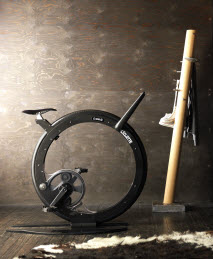
The Ciclotte is a design concept Indoor Cycle that has a lot of appeal to me. Can't you see a whole room of these in some edgy uptown Manhattan club? Where they have a bouncer in full kit standing at the door checking to see if you are the “right kind of people” before giving you the privilege of attending the class. I wonder what you could charge…
Based on their description the Ciclotte uses a magnetic resistance system just like the Keiser M3 and Schwinn A.C. Performance
It's dark at 5:30 am and I'm one not to have many lights on in the morning. Yesterday I wished I had as I knocked my Dell laptop off the kitchen counter and it hit the hardwood floor with a loud CRASH. I stood there in the dark and began to hear a Click – Click – Click from my computer; a sound it never made before 🙁
I picked it up, opened the lid and was greeted with a notice “Hard Drive not detected.”
Thankfully my warranty from Dell covered the hard drive and I'm supposed to get a replacement.
Once I replace it I will log in to Carbonite and begin recovering every one of my files. Because it backed up then night before, and I hadn't changed anything, I will have lost nothing.
I just got an email from an ICI/PRO member who was scheduled to take part in the beta test of a new LIVE online training program that I will be offering in December. It was a very short message, sent from her phone; My computer crashed, the whole thing now has nothing on it! No files, no nothing…. so I won't be joining you tonight.
I feel very bad for her and I really hope she has everything backed up. I too have also suffered from hard drive failures that lead to the lost of hundreds of files, pictures and songs. After the first time I vowed never to be unprotected ever again so, at the recomendation of my little brother the computer guy in our family, I subscribed to Carbonite. Now every night Carbonite does it's thing and in the morning every single is backed up. I didn't have to remember to do anything.