
by John | Jul 23, 2026 | Instructor Training
We got great responses to our two surveys asking for feedback from both Instructors and Studio owners about the Indoor Cycles they're riding and the impact power is having on their classes. Now the challenge becomes; “how do we publish all of this information in a way that's valuable?” I had originally wanted to just share all of the info, except I'm not finding an easy way to remove all of the personal information – so I'm not comfortable sharing access to the full results.
Instead I'd like to help you understand what I feel are the important bits 🙂
Let's start with answering what I see as the most important questions; Is Power worth the added expense, and does it improve the quality of Indoor Cycling classes?
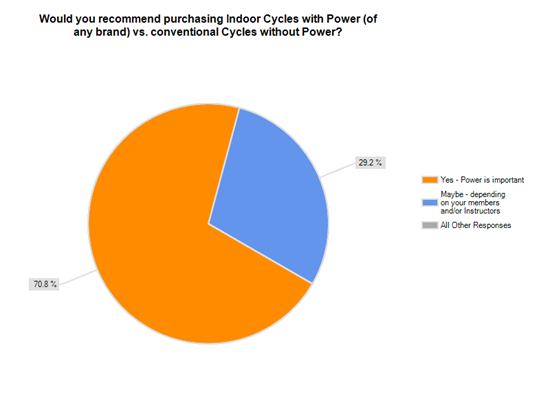
70.8% of respondents responded in the affirmative, yes, power is important = worth the added investment vs. conventional ICs without power. The other 29% offered a reserved Maybe – with it dependent on the makeup of a club's members and Instructors. There weren't any negative responses.
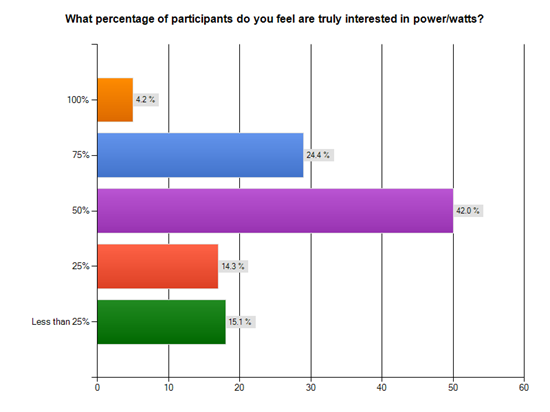
Over 70% say their riders are interested in power – does that square with your experience? I really wish I had included more questions asking what do your riders like about power/watts?
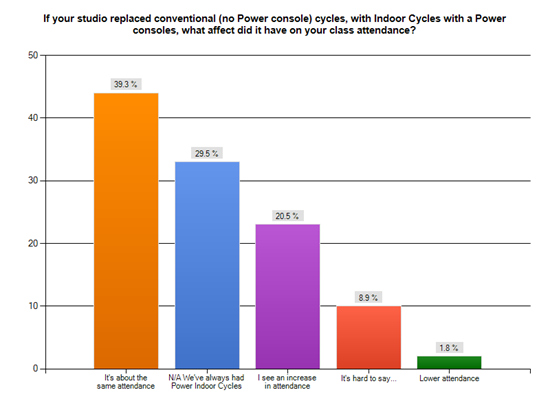
Did the switch to power increase attendance? This is a good sign with 20.5% saying YES they're seeing improved attendance in class and less than 2% say it's reduced class size.
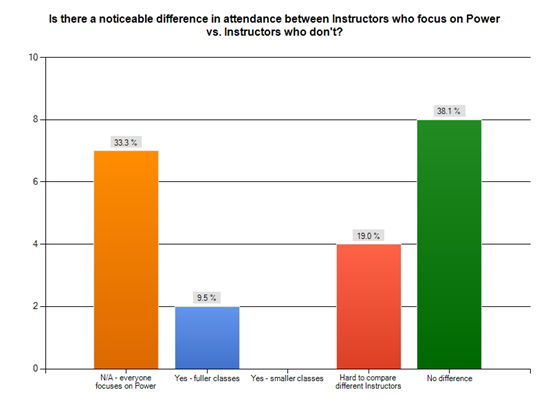
I asked this question specifically to studio owners; Is there a noticeable difference in attendance between Instructors who focus on Power vs. Instructors who don't? In retrospect I now see that this would have been a difficult question to answer and It doesn't appear that there's much difference between them.
Now there does seem to be a disconnect between Instructors and owners & managers about the quality of the wattage these Indoor Cycles are displaying.
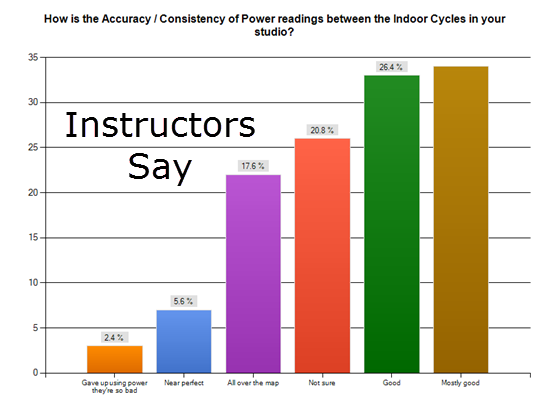

Which is typical. We're in the thick of it, while owners and managers have learned to tune out complaints 🙁
I'm working on the comparisons between brands and will have it up ASAP.
Originally posted 2014-02-18 16:23:39.
by John | Jul 20, 2026 | Engage Your Students, Your Fitness Business
The Yellow Jersey Bicycle Insurance company is promoting their service with this very cool infographic about the Yellow Jersey, worn by the leaders of the Tour de France. As they are a UK company, it's fitting that they are highlighting past British riders who have worn the Yellow Jersey. If you follow professional cycling you're aware of how utterly dominate Team Sky / British Cycling has been over the past two years. More excitement will follow for sure 🙂
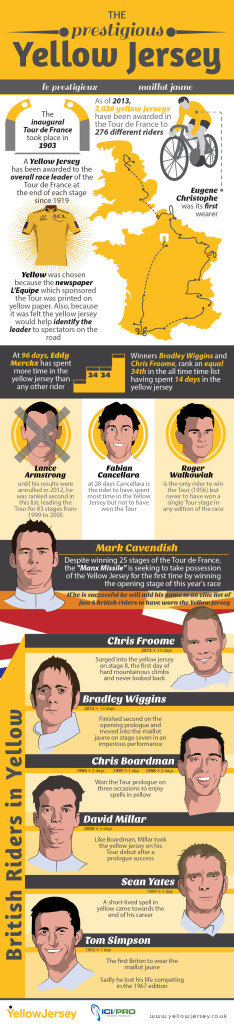
Click to Embiggen
You can download your copy here or use the share buttons below to get your friends and customers excited about the Tour! The race begins this Saturday, July 5th. Here's more info on the individual stages.
Originally posted 2014-06-30 10:01:22.

by John | Jul 6, 2026 | Instructor Training, iTunes, KEEPING IT FUN, Spotify

I've been a Cars fan forever – they were the soundtrack of my senior year in highschool. Yes I know that dates me, but these we cassettes – not 8 tracks 🙁
Turns out I have a bunch of Cars fans in my Thursday class (we're all of similar vintage) so I thought it would be fun to include a few tracks in my class next week.
Digging around I found that there are some very nice Mashups and remixes. Would any of these fit into your next profile?
https://soundcloud.com/thebenz/the-cars-just-what-i-needed
Download Right Click
Download
https://soundcloud.com/charlie-brown-superstar/the-cars-moving-in-stereo-cbs-poolside-with-linda-edit
Here's a nice playlist of original Cars favorites you can sample from.
Podcast: Play in new window | Download
Originally posted 2015-07-17 08:32:17.
by John | Jul 3, 2026 | Best Practices, Engage Your Students, Zone based Heart Rate Training

If you've followed indoorcycleinstructor.com for any length of time you know that I'm a huge fan of the 2T/3Z method of Heart Rate training which is the basis for Zoning. That simple Blue/Yellow/Red response from my Blink Heart Rate monitor is (to me) the perfect way to introduce zone based heart rate training into your class.
Here's some proof of it's success – OK it's a bit rough, but Diana presents a powerful truth that Zoning has worked for her in this video. Your students are in your class to lose body fat and Diana losing 100 pounds and finishing the Danskin Triathlon is a testament to the effectiveness of 2T/3Z Heart Rate training.
Save
Originally posted 2017-10-13 09:00:12.
by John | Jun 30, 2026 | Class DVDS & Videos, Instructor Training

Amy and I taught our Thanksgiving day class to Epic Redwing, the latest Indoor Cycling DVD from Epic Planet! – which was kind of weird actually… teaching a class of 50 while riding to a video of ourselves… at least we knew the profile 🙂
But the class loved it and you will too, especially at a 50% discount if you purchase it today.
You can use coupon code DEAL at checkout today and receive a 50% off the DVD, digital download or both.
But this isn't just for Black Friday – we are planning to feature a special PRO/Deal of the Week every Friday! Much like Groupon for Indoor Cycling Instructor's, our PRO/Deal of the Week will feature a different product or service, at a substantial discount, every Friday!
Look for more later this weekend…
Epic Red Wing
The Twin Cities area of Minneapolis and Saint Paul, Minnesota, and the neighboring Wisconsin countryside is nationally known for its cycling-friendliness. Now, you can take a virtual tandem training ride in this beautiful area with John and Amy Macgowan and friends, of the internationally renowned Indoor Cycle Instructor Podcast and Indoor Cycle Instructor Pro Website.
Take a 50-mile ride along the scenic banks of the Mississippi River and Lake Pepin, separating Minnesota and Wisconsin, on a warm July morning. What better remedy for those cold-weather blues!
This ride has it all–two climbing segments, one endurance segment and one rolling country segment–and offers a balanced workout for indoor cycling classes and home trainers.
Includes our new “Just the Ride” menu option which gives indoor trainers, coaches and instructors a choice of 60 minute and 45 minute versions of the ride to fit their training or class requirements.
Details: Can not be combined with other coupons, discounts or offers. Hurry, there's only 50 copies available at this price.
Originally posted 2011-11-25 04:36:05.


