by Joey Stabile | Aug 31, 2017 | Best Practices, Creativity Indoor Classes, Instructor Training, Music
Welcome to the The Weekly Ride by Cycling Fusion:
No more hunting for new music or counting out cues. Here is your ready to ride document, that can be displayed from your phone, or printed out onto cue cards. This ride is timed out, down to the second, to make your life as easy as possible!
(more…)

by Joey Stabile | Aug 30, 2017 | Best Practices, Correcting Form, Health and Wellness
Paul Swift from BikeFit sent out an infographic showing proper wrist alignment – their example is for a mountain bike, but the concept is identical no matter what you're riding. If you've been to WSSC, BikeFit is the company who provides the very popular bicycle shoe cleat alignment / adjustment service.
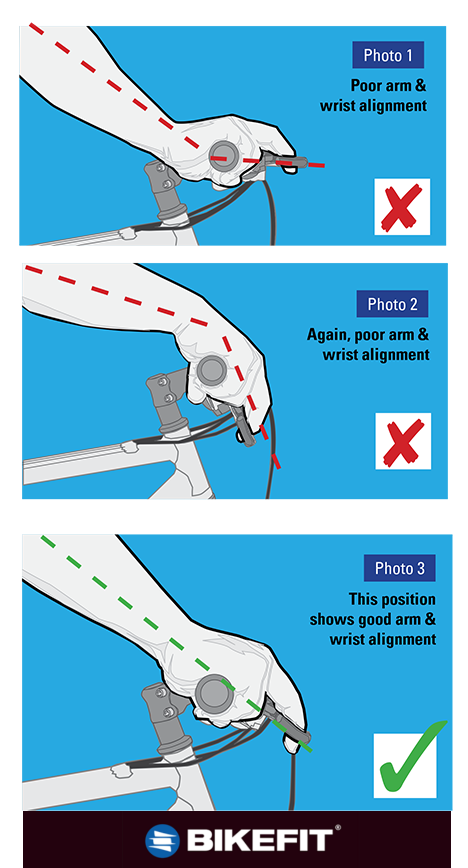
Complaints about hand numbness are typically the result of riding with hyper-extended wrists. We've explored the need for proper hand position in detail here at ICI/PRO in these posts:
Correcting Student’s Form — Proper Hand Position
More on preventing carpal tunnel / hand numbness in your students
5 Tips that will help you (and your hands) feel more comfortable on your bike
Save
Save
Save
by Joey Stabile | Aug 29, 2017 | Best Practices, Instructor Training, Music
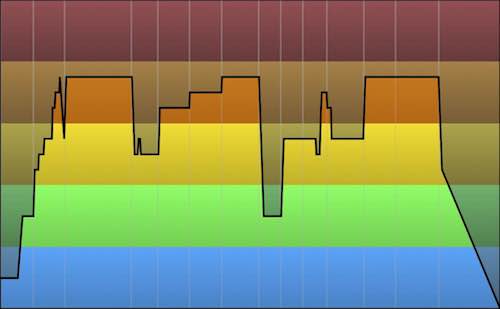
Welcome to week two of Music to Mention. This week's music to mention is my new favorite finish. It incoporates cadence work, speed and we go both in the saddle and out of the saddle. The key to making this work is to have your riders add enough resistence to keep it challanging. I usually give them a few ranges in terms of watts: 80%-100% (of their body weight in watts), 100%-130% or 150%-175%, and then let them choose how hard they want to work today. If you bikes do not have power, you can always go with moderate, hard and very hard. I do not take my classes to breathless often, but this is one song where I will. Please, caution the riders to work at their own level.
The timing for this song is:

Get the PDF Here: BassExperiment
Bass eXperiment by XS Project:

Apple Music
Spotify
Have fun with this song and enjoy the ride.
Ride Hard, Ride Well and Ride Often……Joey
Save
Save
Save
Save
Save
Save
Save
Save
Save
Save
Save
Save

by Joey Stabile | Aug 24, 2017 | Best Practices, Creativity Indoor Classes, Instructor Training, Music
Welcome to the The Weekly Ride by Cycling Fusion:
No more hunting for new music or counting out cues. Here is your ready to ride document, that can be displayed from your phone, or printed out onto cue cards. This ride is timed out, down to the second, to make your life as easy as possible!
(more…)
by Joey Stabile | Aug 22, 2017 | Best Practices, Instructor Training, Music
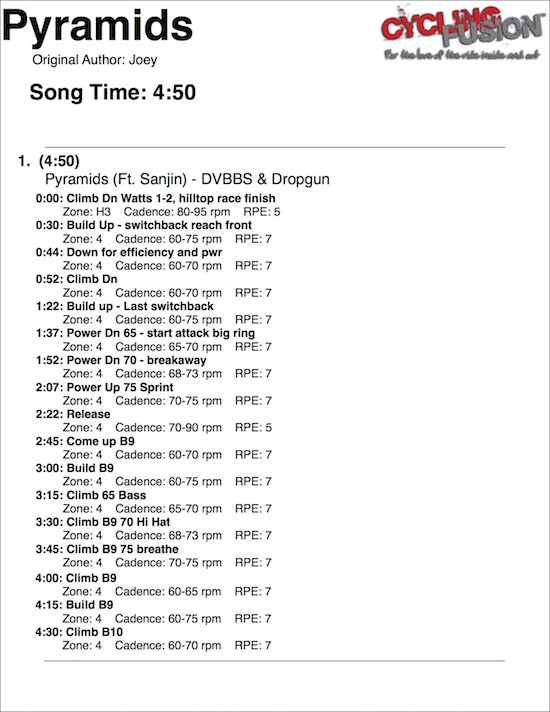
This week's music to mention is one of my favorite tracks. I often use it as a finisher and I love that it has two passes at the same “type” of drill that I love to run differently. I like to run the first half as a hilltop race finish, then take advantage of the brief rest. The second half I like to cover up the monitors and run this by rhythm with the accelerations happening by feel rather than by the numbers.
The timing for this song is:

Get the PDF File here: Pyramids
Pyramids by DVBBS and Dropgun
Have fun with this song and enjoy the ride. It is a great closer and will allow your class to leave with an amazing sense of accomplishment even though the tank is empty.
Ride Hard, Ride Well and Ride Often……Joey
Save
Save

by John | Aug 10, 2017 | Best Practices, Engage Your Students, Instructor Training

As Instructors, our riders will often asked us questions about: insert topic here.
Where we can get into trouble is by launching into a short/long/epic dissertation on the subject, often without fully understanding the whole question.
My first sales job out of school was selling motorcycles. For someone like me, who at 22 couldn't be around them enough, it was the perfect job. Being the new guy, I asked a bunch of questions to the other salespeople (there wasn't any real training) and I was told to study up on all the different models. That year Honda had 52 different bikes – we had decks of playing cards with a different model on each card. I was very familiar with many of the models – I had put myself through school working as a motorcycle mechanic, so I felt like I could answer just about any question anyone would ask. I was ready to hit the sales floor and show everyone I was a born salesman.
Does this bike have a really powerful engine?
I've forgotten many of the details, but I'll never forget the gentleman's question or my response. He was looking over a new model Honda and after our introductions he asked; Does this bike have a really powerful engine? I couldn't believe my luck. I knew every conceivable specification and had nearly memorized the latest magazine test results.
Sir, you're looking at the most powerful motorcycle in its category. I told him proudly. Then (I'm sure I was trying to impress him with all my product knowledge) I launched into what had to be a 10 minute explanation of the 0-100 mph times, rev limits, performance tires, how it will smoke any other bike on a race track, etc… The man stood and listened politely until I came up for air. He then thanked me and walked out the door.
I saw the man later in the week. He was taking delivery of his new motorcycle – a much less powerful model than I had shown him. After he drove out I grabbed the other salesman and asked what had happened. I showed him a new Interceptor, what's he doing with that low powered bike? You idiot, you completely missed his question! Was his response. We're lucky he came back here at all… he bought that bike for his 17 year old son. He didn't want anything with too much power. Lesson learned.
Have you ever been in a situation like that? You're considering making a major purchase (or need personal advise) and were at first a bit nervous, anxious or guarded? So the question you asked was an abbreviated version, one that didn't exactly communicate your specific question?
What would you want to hear next?
Let me see if I understand your question…
Each of the The Seven Habits of Highly Effective People can be applied to our fitness profession. Habit 5: Seek First to Understand, Then to be Understood rings the loudest for me.
Use empathic listening to be genuinely influenced by a person, which compels them to reciprocate the listening and take an open mind to being influenced by you. This creates an atmosphere of caring, and positive problem solving.
It doesn't matter if you're selling motorcycles, toasters or advising members about fitness, people want to feel like they've been heard & understood before communicating openly. The simple act of reflecting a question back conveys empathy and will go a long way to build trust.
Imagine if I had reflected back the question in the opening example; Are you looking for a very powerful motorcycle? My potential customer would have instantly responded; NO! This is for my 17 year old son. Then we would have been communicating and I could have made the sale.
Who knows. Maybe some day you'll be asked a question where you resist the temptation to educating and instead reflect back to them in the form of a question. Can you see how you might gain their trust and gather a better understanding of what's being asked? Wouldn't you be surprised to hear the unguarded response; I'm really hoping this class will build up my skinny chicken legs 🙂
Let me know if this helps.
