
by John | Nov 16, 2014 | Best Practices, Master Instructor Blog, Training With Power
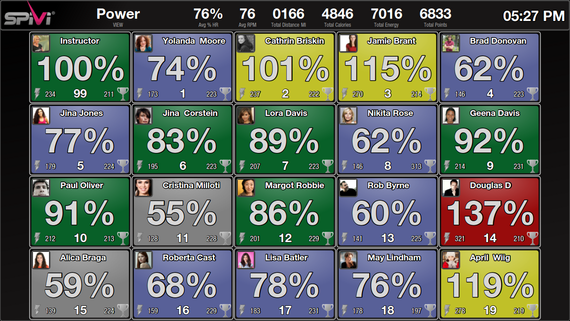
Hey – I just got an email explaining that Spivi has added a FTP (Functional Threshold Power) Test to their display training system. I can't begin to tell you how beneficial these short threshold/best efforts are for engaging participants in your power based classes. That's why I describe these as a Best Practice for anyone teaching with power.
Like PIQ, Spivi offers the option for riders to manually add their FTP / PTP wattage into a user profile. Another option is to enable the Fitness Test option where you can select an 8 or 20 minute FTP test that will record each riders average watts for the period and then add either 90% (8 minute) or 95% (20 minute) of it to their user profile.

 To start the FTP tests wizard, press the left analog stick once, just like if it was a button. Now select the requested test from the menu and press the “Start” button to start.
Don't forget to Instruct the group how to ride and what to do during the test. The FTP test lasts as long as the progress bar on the bottom right side of the screens appears.
by John | Nov 8, 2014 | Best Practices, Engage Your Students, Free Podcasts, Instructor Training, KEEPING IT FUN
This podcast is no longer available.
by John | Oct 14, 2014 | Best Practices, Engage Your Students, Instructor Training, KEEPING IT FUN, Master Instructor Blog
Amy and I are in Santa Monica, CA this week for the MINDBODY Bold convention. I knew I would have a bunch of downtime and did a search for classes near our hotel. Imagine my delight at discovering a SoulCycle just a few blocks away 🙂
We attended a sold out class there Sunday morning at 9:00. The Instructor's name was Heather P and it was very easy to see why people (primarily women 20-40 years old) are in love with these classes.
I also attended a second class (about 85% full) on Tuesday 10/14 with a different Instructor. Please keep in mind that what follows is my first hand experiences, based on taking two classes at the Santa Monica location.
It's all about the details.
The whole experience (registration, welcome, pre-class, the class, post class) had me understanding why they are so successful. SoulCycle is a well-oiled machine designed and scripted to deliver their product very efficiently. Their attention to detail is remarkable and IMO a large reason for their success is based on how well they appear to have refined (and execute) even very small details.
I've got a lot to tell you – I may end up breaking this into a few posts – so lets get started.
Registration
First time participants get a discount ($20 vs $34) and free ($3) shoe rental – but you can't sign up online if you want the deal – you need to call the studio directly. A very pleasant young lady answered the phone, asking me my questions (mine was; “who's class should I take?), took my information and smoothly asked for my credit card info to confirm my appointment.
So why do you force me to call? I'm on your website. You could easily provide a “first timers click here” button, but SoulCycle wants me to call them. WHY? I've been thinking about this question since last week. Probably overthinking it. They say the simplest explanation is typically the right one: SoulCycle wants to make a personal connection with their customers right from the beginning – before they ever set foot in their studio.
A nice touch – would that make sense for your studio?
After getting the recommendation to take Heather P's class, I was asked where I wanted to ride. I asked for two bikes near the front – they reserve the front row for regulars I think. This is important as these experienced riders tend to lead the class as Heather was off the bike for at least half the class.
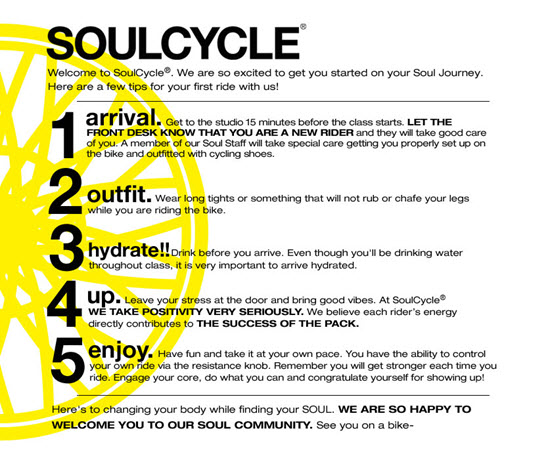
After the call I received a series of emails; a CC receipt and a Welcome to SoulCycle email that included the image above.
Welcome to SoulCycle
Amy and I had a short walk from our hotel and I have to admit I was a little apprehensive about the experience I was about have. There were three, friendly, young people behind the counter. We introduced ourselves and one of the attendants found our names on a printed class attendance list. Next to each of our names was a purple check mark, indicating we were first time riders. Another nice touch – this list was given to the Instructor so she would know who's new and she made a point of greeting us before class started.
What else can we provide for you two? I had purposely left my bike shoes at home, preferring to try out their rental shoes. I gave her my shoe size and she quickly handed me a pair of generic road shoes with LOOK cleats. LOOK cleats? Not SPD's? That didn't make sense to me and I wasn't able to get any information about why LOOK instead of SPD. Amy's idea was that LOOK cleats maybe easier to get in & out of?
Key Studio Room Details

Arrow pointing out Instructor monitor speaker
By all appearances, the studio is exactly the right size for the 60 cycles they have. There isn't room for anything else! Each bike is set very close to the others in the row. The rearward end of the seat slider in front of me sits right below the end of my bike's handlebars. The back 4 rows are raised theater style.
Some people might not like how cramped this studio is. My initial reaction was just that; too many people squeezed into a small space. But by this time I was seeing how SoulCycle doesn't appear to do anything without a purpose. As I watched the others ride, it became obvious that the closeness (we're all part of the same tribe) was another part of the charm that is this brand + with each bike potentially bringing in $2,000 a week, I'd pack them in as well plus have a few hanging from the ceiling if I could find a way for a person to ride it!
- Rubber flooring – what a relief to have something other than slippery polished stone or bamboo flooring to walk on wearing cycling shoes 🙂
- Instructor monitor speaker – even though this is a small space, having a monitor speaker (so the Instructor hears & can adjust her mic/music ratio) is crucial for keeping your vocal cues intelligible along with loud music.
- Those candles are electric – which was a bit disappointing. Here I kept hearing about the candles – maybe they are real at some of the other studios.
- Two exits – a small thing but I've been frustrated in other studios trying to get in or out.
- Ventilation – minimal and yet it never felt stuffy… nor did the mirrors fog up like I certain LifeTime club I'm aware of.
The SoulCycle Indoor Cycle
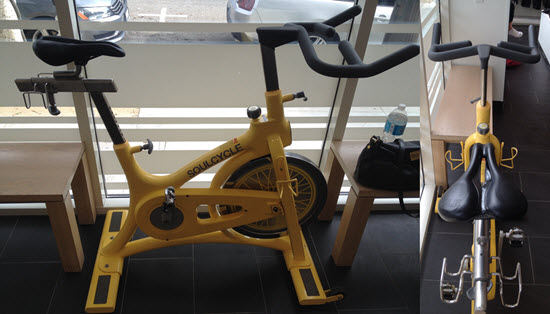
Amy wasn't crazy about the saddle and I didn't notice either way. About 70% of this class was standing so it really didn't matter.
I don't think you can buy enough for a full studio, but you can purchase the Indoor Cycles used at SoulCycle studios for use at home. These cycles are of their very own design and my understanding is that they're manufactured in the same factories that make other brands.
Conventional weighted flywheel with friction resistance. These things are very heavy bikes = solid and stable. The ride is very smooth and I found the resistance very progressive. There's no computer/console of any type and the only thing out of the ordinary are the cages that hold your weights. Every bike uses reversible LOOK/SPD pedals. There is no shoe basket option for using fitness shoes – an important detail as I'll explain in a moment.
I quickly found a setting that had me comfortable in and out of the saddle. Amy said she got close, but didn't feel completely right and she wasn't a fan of that sculpted saddle. I should note that we didn't identify ourselves as Instructors, but I was wearing Pearl bibs which obviously identifies me as someone with some level of bicycle experience. Although we were told at check-in that someone would be there to help set us up, no one did. There were three assistants in the room, so my assumption is that if we had looked clueless (or asked) someone would have been there to help.
Key Bike Details
- As you can guess, you move around on the bike a lot in these classes vs. more cycling specific formats. The rock solid stability of the SoulCycle bike instills a lot of confidence in the rider that it isn't going anywhere. After the class I tried lifting one end and those things must be made out of cast iron they're so heavy. Every bike was spotless and appear to be very well maintained despite 60+ classes offered there each week.
- If you're going to move around safely, it's important that your feet stay connected to the pedals. The LOOK cleats on my bike and SPD's on Amy's bike were adjusted quite tightly, requiring more rotational force than typical to release. You don't want your release settings too high on a road bike, but to me, tight = safe indoors.
Before taking this class, I had looked at shoe rentals as a convenience you offer to riders. Now I recognise that having a policy where everyone is securely clipped in would be a real safety enhancement. Shoe baskets (AKA Toe clips) may be more accommodating for new people, but they're truly a pain and could actually have potential safety issues when compared to cleated shoes:
- Cleated shoes offer a very secure, positive engagement vs. shoe baskets that may or may not be fastened securely – or stay fastened if the strap isn't routed correctly through the capture mechanism.
- Cleated shoes have better foot alignment – how your foot is positioned on the pedals can have a big effect on your knees. Don't believe me? Next time on the bike rotate your heals in and watch where your knees end up. Knee over pedal needs to be in two planes; fore/aft and side to side.
- Cleated shoes control the position of the ball of your foot over the pedal spindle – this can vary wildly with different size feet in shoe baskets.
- Cleated shoes have solid bottoms = much more comfortable when standing regardless of how much out of the saddle riding you do.
If your studio offers unconventional classes similar to SoulCycle, I see a policy of only allowing cleated shoes as a Best Practice to ensure your riders safety + at $3.00 a rental (your first class rental is free) it could be a nice source of additional revenue.
Details about the classes are here in part 2
by John | Oct 5, 2014 | Best Practices, Engage Your Students, Instructor Training
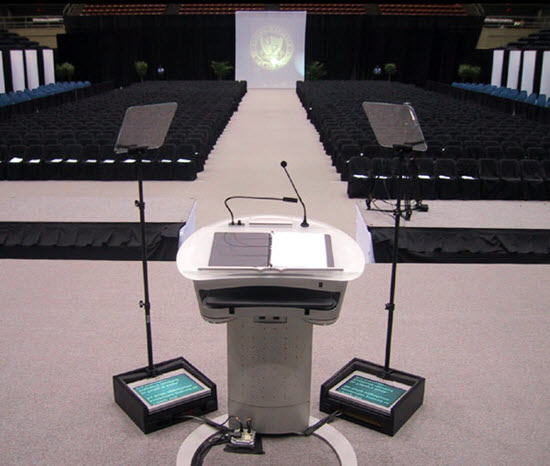
Wouldn't it be cool to have a teleprompter to work off of?
I've found myself getting a little lazy with my class introduction – that opening statement that answers the question many of your participants have before the class begins; “I wonder what we're doing today… and how hard we're doing it?” A consistent and informative opening statement is a major part of any successful class, one that I see as a Best Practice.
In retrospect, I should have committed to delivering a more informative class intro for challenge #1 of the 28 day challenge. If you aren't taking the challenge #1 was:
#1 – We all have areas where we know we could improve. Today's challenge is to publicly commit to one tangible improvement at least for the next 27 days of the challenge (e.g.: start your class on time, spend more time helping new students, not be in a hurry to leave, build in more warmup into your profile, etc..)
So better late than never, we've create a specific challenge to encourage Instructors (and Me) to create a Scripted Start for their next class:
#15 — Create a scripted class opening: “Great actors don’t show up on set and improvise as soon as the camera starts rolling. They practice putting their own personality into the words scripted for them…. Practice delivering your opening and closing scripts and you’ll be as polished as a professional actor.”
You will find a podcast transcript (includes a link) of an interview with Lawrence Biscontini in the group Files folder that will give you a lot of direction. Post your completed script.
So John… what do you have planned for us today?
In what I feel was one of, if not the best, interviews I've ever published, MI Lawrence Biscontini describes the elements of what he calls a “Scripted Start”. Lawrence explains that there are nine points you should include in your initial opening statement:
- Welcome
- Intensity
- New Students
- Gratitude
- Sound and Equipment
- Teaser
- Theme
- Issues
- Purpose
I know that sounds like a lot to squeeze in, but in reality you should be able to smoothly touch on all nine points in a reasonably short paragraph. And your introduction doesn't have to these in order, you can mix them up anyway that makes sense to your personality – just be sure to include everything.
Here is the link to Lawrence's interview – we've included a transcript for those of you who prefer to read, rather than listen.
ICI Podcast 236 Scripted Starts and Flawless Finales Part 1
Here's a pdf of Lawrence's original article, published in the IDEA Fitness Journal.
I'm working on my Scripted Start and will be posting it in the ICI/PRO 28 Day Challenge group later this week.
Now If you find yourself thinking; John and Lena have creating a “Scripted Start” as a challenge for this week… I wonder if one of next week's challenges is going to be about drafting a “Flawless Finally”? You're right 🙂
by John | Sep 28, 2014 | Best Practices, Engage Your Students, Instructor Training, KEEPING IT FUN, Master Instructor Blog
Have ever asked your class; what do you want from me?
It's a very different question than; do you like my class? or; do you like my music? or; what could I do better/different?
Challenge #6, of the ICI/PRO 28 Day Instructor Challenge, was pretty simple:
#6 Ask some of your participants to fill out the feedback form after your class.
The PDF download we provided asked just one question:
 Getting honest feedback from people can be maddeningly difficult. Mostly it's because people will often lie to you when they are concerned the truth could hurt your feelings. So we designed this question to get a response that indicates a preference vs. a response that would be a critique. Consider how you would respond to these two questions, asked from your mother when you still lived at home:
#1 – What would you like for dinner?
Vs.
#2 – Would you like my meatloaf for dinner?
Question #1 asks for your preference and you wouldn't feel a bit concerned by responding honestly with; I'd like your lasagna tonight Mom.
But question #2 is very different and most of us (if Mom's meatloaf is better used as a doorstop) might have a difficult time answering honestly 🙁
So if Mom's intent is to cook a meal that pleases you, she'll take your suggestion and do what she can to make you lasagna for dinner tonight. Then you'll be happy (you feel valued as a son or daughter) because Mom delivered based on your preference. And, because pleasing you makes her feel like she's a good Mother, Mom's happy as well!
But consider what happens when Mom asks question #2 (or doesn't ask either question) and just decides what you want/need for dinner… you show up for dinner and your first thought is; doesn't she know how much I dislike her meatloaf? Followed with; I love her lasagna, why doesn't she just ask me what I would like for dinner and I would tell her.
Now I realise that this is a pretty simplistic illustration, but does that sound anything like your role as an Instructor?
So what happened? What were the responses our challenge participants received from their classes? Here's a few:
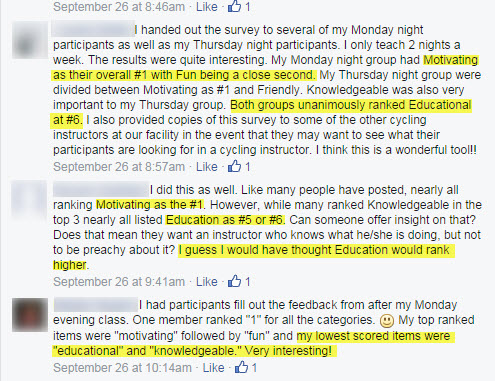
Would your class respond differently? Or similarly? Click to download the survey PDF.
So, how would your class respond?
Click here to download the survey PDF. Print a bunch to get your class responses and then report back here with your findings.
by John | Sep 22, 2014 | Best Practices, Instructor Training

Found this great graphic at http://cooperandkid.com
We published the first 7 challenges yesterday and thought it would be fun to share my thoughts about each as daily posts.
By the way, you can still join the ICI/PRO 28 day Challenge – click here to request admission to our Facebook Group.
Challenge #1
We all have areas where we know we could improve. Today's challenge is to publicly commit to one tangible improvement at least for the next 27 days of the challenge (e.g.: start your class on time, spend more time helping new students, not be in a hurry to leave, build in more warm-up into your profile, etc..)
I'll often begin my class with this statement:
I walked in here believing all of you are capable of successfully completing everything I throw at you… it will be up to each of you, to prove me wrong.
This challenge is based on the same perception in your capabilities as an Instructor – actually all of the the challenges start from our belief that you can successfully complete all of the challenges. That's not to say that they're easy. Many will be truly challenging, but Lena and I feel you're up to all 28 of them.
We all have areas where we know we could improve. You don't need anyone to tell you; you need to get to class on time, or be better prepared. You already know your own flaws and weaknesses. But for some reason we don't choose to correct them; we're perpetually late, wing the class because we forgot to prepare, etc…
It becomes our little secret; I know. I know. I'm late to my class again.
Maybe no one will notice – they will and they do 🙁
I'll try to do better next week – but you don't…
Keeping your secret is easy, you just don't tell anyone. But something very important happens when you disclose your behavioral flaw to others – you might feel the need to correct it, because there's a chance the person you told may ask you again.
That's the purpose of the public statement. When said aloud; “I will not be late to class this month” you are giving the person/people you say it to permission to hold you accountable. Most of your class doesn't have trouble getting there on time – and they, in turn, believe you are just as capable as they are… now it's up to you to prove them wrong.
