I enjoy poking around the RateYourBurn Instructor review site to get an understanding of what participants are looking for in our class. Sure some of the comments can be a bit harsh, but many of the actual reviews are well written and offer very specific “If you would do ___________________ I would enjoy your class more” advice.
So yeah, I liked a lot of things about Chris, but the ride was… improvable. Luckily for Chris, these nits are absolutely fixable.
A little head's up, please? Countdowns: We really, really need them. Without countdowns, I start to wonder if you're just making up moves on the spot; I don't know when to exert the most effort, and I start worrying whether we'll be in a second-position jog FOR ETERNITY.
Choreography was not really timed with the music. Chris could work on ending the choreography segments to time up with each song. There were three different songs where we ran out of music while continuing choreography. Again, this feels like the class is a little bit tossed together in the moment rather than planned out. According to his bio, Chris has been a dance educator for more than a decade: timing choreography to the music (and giving countdowns to help with that) is likely second nature for a dancer. Just bring it to the bike!
Timing of pushes. These felt a little awkward and were usually too short. One thing that would help would be for Chris to cue us ahead of time when we were going into a push, but the pushes always came with the command “pick up your legs now!” and ended with “slow down” – no warning, and no countdown to the end. Help me gear myself up for a 30-second push, and then let me know when I'm just a few seconds from the finish line – I'll work much harder when I'm not ambushed by a sprint!
There's an old adage about giving effective presentations that goes something like this;
Explain to everyone what you're going to say or expect them to do.
Say or do it.
Remind them what it was you said or what they just did.
In the first and third comments above, the reviewer is frustrated because Chris is skipping #1 – and not giving advanced notice to what's coming next. I can't speak for the women in your class, but many of the the men who ride with you are sequential thinkers like me. We like to start with A, move on to B, C, and then D. It drives us crazy when you skip one or more steps and completely throws us off our game.
I'm completely guilty of point #2 – not getting my choreography matched to the length of the music at times. I'll blame the combination of my slowly failing eyesight and those tiny little numbers on the Spotify App for not understanding the time remaining for a specific track. My classes are very cycling specific and feel I do a good job prepping everyone for the upcoming efforts. Where I feel I get into trouble is I take too much time leading up to the start of say a 4 minute Best Effort, using a 5:00 minute song. I can't see the time remaining and the music ends before the interval – not very professional 🙁
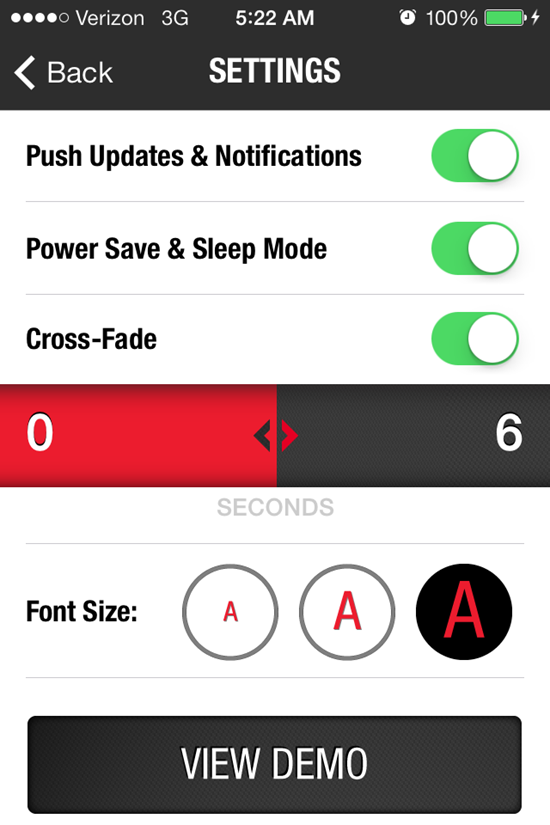
I'm very tempted to move back to iTunes music and use the new Schwinn Class Tamer App simply for the option in the settings to really embiggen the font size so I can see it.
Question for you [wlm_firstname]…
If you had access to this type of constructive criticism, would you accept and use it?
A compendium (plural: compendia) is a concise, yet comprehensive compilation of a body of knowledge. A compendium may summarize a larger work.
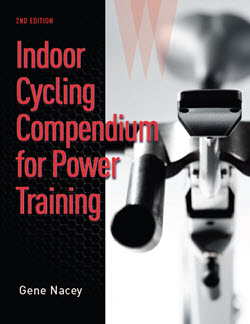
Gene Nacey with Cycling Fusion knows Training with Power – indoors and out. The Indoor Cycling Compendium for Power Training is a newebook resource that Instructors can purchase to be well informed and comfortable communicating the finer points of Power Training into your classes.
Here's an excerpt from Sally Edwards' Forward to Indoor Cycling Compendium for Power Training
‘Power Training’ is the first book to accomplish that goal. Everything else you read is focused on the outdoor rider, but Gene knows that it is the combination of the two that builds fit cyclists. His unique approach targets the IC rider specifically, as he shows you how the principles he uses inside also work outside. Training with power meters was once reserved for only the elite cyclist, but Gene has demystified it, creating a tool and a program that the average recreational rider can easily understand. He accomplishes this feat using an agnostic approach, inviting you to apply the information in this book to every manufacturer’s power meter on every power meter—equipped indoor bike. As long as you have the data from the power meter, you can follow his comprehensive system. You’ll love the charts and the workout tools in the book – each provides a way to translate the numbers on an IC power-meter bike into something tangible and easy to use for both the IC instructor or you, the rider.
Listen to our discussion below and then leave your thoughts about bringing this level of detailed knowledge into your classes.
Here's the link to pre-order either an iBook or eBook version and save $10.00
The difference between something good and something great is attention to detail. — Charles Swindoll
Do you do any writing in your work — blogs, website copy, ads, emails, posts, salesletters? Do you have lots to say, but no confidence in your ability to write it?
Writing intimidates many people. As a result, they avoid it or feel a sense of dread whenever they’re stuck writing something. The result could be missed deadlines, or a stilted, awkward article, post, letter, whatever the occasion requires. It doesn’t have to be that way.
Investing in a good developmental editor and/or copywriter is as important for your business as any other expense you see fit to justify as essential.
Writing style, grammar, sentence structure, parallel structure. The very words sound quaint as I write them. Some people couldn’t even define that last phrase. But their absence simply reeks of slovenliness.
As we know, professionalism is a matter of details. Just think of how many details go into the teaching of a single indoor cycling class: room management, music selection and recording, video selection and use, your workout plan, your training concept, any exercise science you plan to teach, any philosophy of training that matches the day’s workout, personal anecdotes that illustrate the point behind the day’s class, creating the right atmosphere, motivational messages, and more.
If you took a class taught by an instructor who neglected these important details, what would you conclude? ‘Professionalism’ wouldn’t be in your description.
So why would written work be any less important? The written word lasts. If only for that reason, the details of written messaging should be given the time and attention they require. William Feather said, “Beware of the person who can’t be bothered by details.”
There are many reasons to pay attention to our writing. Making sure our meaning is clear comes first. That’s made possible by using the appropriate tone, whether it’s formal, academic, or casual and conversational. The first two are not the only ones that matter.
The power of any message also hinges on both clarity and brevity. Avoid rambling. Unless you’re writing your own blog and hunting daily for material, don’t waste time in your posts describing the clouds in the sky as you sip your coffee while thinking about the topic you’re about to cover for Cyclotronic Cecil’s Cyclo-sation website. Get to the content and make it clear.
Another important element is grammar. Sure, I’m dating myself, but I insist that good grammar matters. Don’t kid yourself. Your readers — and not just the old ones like me — are, in fact, cringing as they read those embarrassing mistakes.
My tip on this is to avoid language trends. They always go in the direction of worsening illiteracy. Just because everyone around you says, “I could care less,” doesn’t make it right. If you don’t care, it’s correct to say you “couldn’t care less.” Think about it for a moment.
But I digress.
The point of this post is that a good editor/copywriter is a wise investment. He or she can polish stale prose, make you sound even smarter than you feel(!) when putting your ideas in writing, and leave you with the confidence that you’ve done the job well.
The attention to detail will show in your growing reputation for professionalism. You deserve that. You spend that kind of time on your teaching. Don’t neglect your writing when help is easy to find.
Give attention to the details and excellence will come. — Perry Paxton
It's a fact of life for all of us teaching power based classes; inconsistency in the watts readings between cycles. Some brands seem to be better than others. Certain bikes seem to be always right, while others are never even close. Calibration is done more frequently by some clubs… or not at all – or the cycles you ride don't offer that option.
This isn't just about us either. Our riders want to feel confident in what they are seeing on their monitors. If they don't believe what they're seeing, they'll soon come to ignore it or worse – ignore you and your coaching.
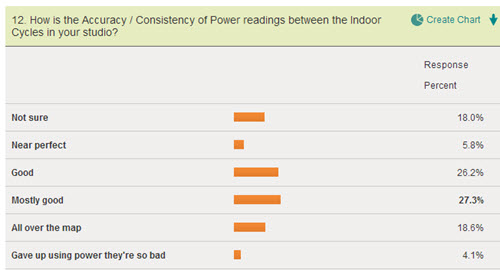
Here's a screen shot from the Indoor Cycle With Power Instructor Survey – click here to add your experiences.
As you can see, only 32% of Instructors rate their cycles as having Near Perfect or Good Accuracy/Consistency. Those of you in the other 68% have a real challenge, making effective use of the tools we're provided and teaching an awesome class!
So here's what to do about it, three simple steps:
Step # 1 – Acceptance of the problem
I actually found myself getting defensive whenever someone made a negative comment to the effect of; “the power meters on these bike aren't accurate.” I'd start making excuses, or questioning the person with; “inconsistent compared to what”? This question, it turns out, does have some value. It's often important for Step #2 to understand; are they are comparing the cycles in your studio to their road bike power meter, or is their complaint focused on inconsistencies between the individual cycles in the room?
If you don't catch yourself, excuses may slip into complaining about management's lack of over-site (not doing regular calibration) or lament that no one asked you which Indoor Cycles to purchase. It you only had XYZ brand this wouldn't be a problem 🙁
This is all out of your control – so just accept “what is”, smile and deal with it.
Step #2 – Communicate your acceptance
To your cyclist you may say; “Yes I know that the power you're seeing doesn't compare with the $2,000.00 Quraq power meter on your road bike.” “There are a multitude of reasons why you're seeing different watts readings… your fit is different, the crank arms are longer/shorter, etc…” Or you might add; “has it been a while since you were riding consistently?” “Could your fitness have changed”? In any event I feel you just need to communicate your understanding that there is a difference.
More importantly, to your class; these power meters are an awesome tool to help you improve your fitness. We are seeing some variation between cycles, making it difficult to compare wattage numbers between workouts and/or other individual bikes in the room. What's important is today's numbers. After all, yesterday's or last Tuesday's ride is in the past… let's focus on today's effort!
Step #3 – Coach the solution
In the survey we're running, I ask the question; Do you conduct any type of assessment during class, to help your students understand or identify a benchmark watts PTP (Personal Threshold Power)? If so please briefly describe what you do and how you teach it.
Yes I know it was a bit of a “leading question”. But identifying a benchmark watts/power # is the solution to inconsistencies between the Indoor Cycle's power meters in your class.
The question was open-ended and drew a number of great responses:
Because the power measurements are so different (inaccurate) among the bikes in the studio I do a 7 minute PPT at the beginning of every class to give each member a usable number for the specific bike they are using.
I need to do a “mini” threshold test at the beginning of every class to get participants “dialed in” because the power readings are so inconsistent from bike to bike.
Yes.. A 5min MAP test
I'm not aware of any “approved” protocol for a benchmark / PTP effort (I call them “Best Efforts”). Depending on your demographic you want these to be 3-7 minutes long – mine are typically four minutes long. I do feel that you and your athletes will benefit from consistency. I do these in every class. If you're a Life Time Fitness Instructor these fit very nicely into the new EDGE Cycling format.
Warm Up — 10 minutes. 5 minutes of gradual increases in wattage. During the second 5 mins. we’re finding the wattage where everyone is first noticing a change in breathing; VT1 / Aerobic Threshold = the top of the Recover Zone shown above. This establishes a rough understanding of a base wattage that we use throughout the rest of class.
3 x 30 sec. Hard / 30 sec. Easy – Openers to AT/LT. I cue these by first having everyone find the amount of load @ 70 RPM that has them feeling they should (not just could) come out of the saddle. The 30 sec. Hard is then simply accelerating to 90+ RPM which results in some pretty impressive power numbers. The 30 sec. Easy is back to 70 RPM — many will stand during the Easy portion.
2 minutes rest – I encourage riders to focus on their recovery. Once they feel calm in their breathing, bring back the Base level work wattage.
4 min Best Effort – to establish a benchmark PTP Personal Threshold Power (top of the Perform Zone) or ride at 110% of FTP if known. It’s very helpful to riders to have that understanding of their personal upper wattage number. The “Best Effort” Threshold # + the Base Threshold # we found earlier form the three Power working zones I use in class.
– 1 min. build at preferred cadence (suggested as 85-95 rpm) — press the Stage Button to reset the averages.
– 4 min. “Best Effort” This should hurt, but be do-able. I ask everyone to observe their average at the end
Don't depend on BCC email getting through to your athletes.
“Sure John – I'll email everyone on my list about your up-coming classes.”
My buddy Randy Erwin is a “Connector”. One of those awesome people who makes the effort to plan events (like outdoor rides) and get-togethers. Randy is the team captain of our Subaru MS 150 team and his love/passion for coordinating group rides lead to him being recruited to be the area Life Time Fitness Cycle lead.
Last night I talked to Randy and he told me he was excited for the FTP assessment I had planned for this morning and that he had emailed everyone three times, so he felt that we'd have a bunch of cyclist from his list.
Except most of them didn't show this morning 🙁
A couple of them did show up for the 9:00 am class that follows mine. Confused looks at those of us there who were cooling down; “Wait, was there an earlier class… why wasn't I told?”
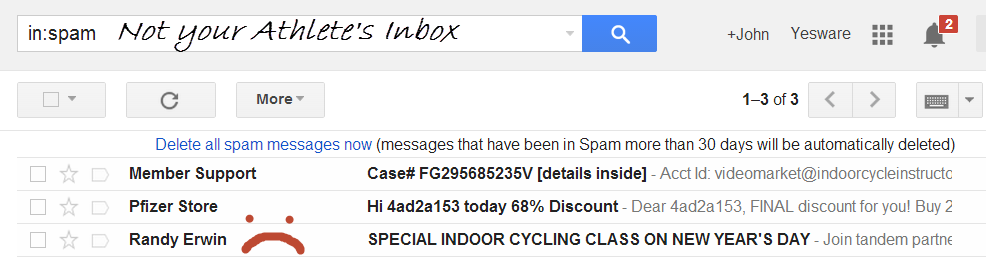
I hadn't received (and neither had many others) any emails from Randy this week. Neither did Amy – we're both on his list. So when I got home this morning I checked and found one of Randy's emails in my SPAM folder, which I rarely check on my laptop and never on my iPhone. Note to self to check there more frequently.
I called and asked; Randy…how many names are on your list? . About 200 was his response. Send a BCC email to a large of a list of email addresses must have triggered something in Gmail to think his email was SPAM = very few of us saw it.
So what to do?
It drives me crazy when I receive mass CC emails – typically I see them as sub requests. They are a total violation of email privacy and if one of the recipients have their email hacked, we all get the spam emails.
So if I want to email a list of athletes who take my class, I should use the BCC (Blind Carbon Copy) feature… right?
For a few people, sure that's OK. But once you have a large number (20+) of recipients, then No. At least not if you want to be sure your email doesn't end up in a SPAM folder and everyone will receive your latest class/event announcement.
Use a White-Listed Email Provider.
White-Listed just means trusted source… as in we don't allow any SPAM emails sent from our accounts Ms. AOL, Yahoo, Gmail, Hotmail, etc. so you can confidently deliver it to your customer. The two most popular are Constant Contact and my favorite MailChimp for a bunch of reasons. The biggest reason for you is that it's completely free until you go over 2,000 subscribers or send over 12,000 individual emails a month. So if Randy used MailChimp he could send 60 emails a month to is list of 200 subscriber each month at no charge. Fabulous deal – they don't even ask for a credit card.
Click to Subscribe
At one point you subscribed to the ICI/PRO Newsletter, by clicking a link and adding your name and email address. Using MailChimp you'll have the same ability to post a Subscribe Here link on your Facebook or Instructor blog = no manual entries!
You need their permission first
I decided that I would like to have all of Randy's contacts in a MailChimp account so I could email them > and know they are getting through. Except Randy doesn't have permission to give me the list, from the people on it, so he can't just give it to me. The solution is to:
Create a MailChimp account – here's the link.
Create a specific list
Have Randy send out my Subscribe Here link in an email. I'll suggest that he brake up the list into 20-30 address at a time and send the email with the link 2-3 times.
I already have a MailChimp account – so all I needed to was to create a new list. Here's the link to my list if you'd like to see it – http://eepurl.com/LQ_2P The Default in MailChimp is to collect First & Last Name + email address, which is normally plenty to start with. It's beyond the scope of this post, but the signup form can be easily modified to include pretty much anything. Please understand that you can ask for too much and they'll not subscribe.
Class sign-in list
I'm also collected emails at the start of each class using a hand written sign-in legal pad.
Instructor Tip: When adding emails to MailChimp from a sign in sheet, it's not uncommon to end up with a few you can't read. My tip is to do a quick search in Google using what you CAN read and search for the rest.
First and Last + the word “email” will many times display the correct email. You might need to add a state (MN, CA,FL, etc.) or city for common names. Google knows everything.
I will frequently check the domain alone – @XYZcompany.com or the domain + first/last name
Would you like additional info or help with this or other methods of marketing your class?
Many of us get near ZERO help from our club/studio > so it's up to all of us to grow our classes.
My Colonoscopy is scheduled for February 27th > if you're over 50, have you had yours?
After some not-so-gentle prodding from the Senior Group Fitness Instructor in our family, I agreed to have a physical before we left for Jamaica. I'm in excellent health by the way. A note from the doctor expressed; “Your lipid panel shows a fabulous HDL!” I'll attribute that to all of the oatmeal I eat, nearly every day.
One of my “directives” was to schedule a (to use the euphemism) “procedure” – which I did. My “procedure” is scheduled for Thursday 2/27 @ 8:00 AM and I couldn't be more excited 🙂
Ok, I'm lying to you. I'm secretly dreading this. Not the actual “procedure” as much as the preparation that leads up to the “procedure”, which I've come to learn is a rather unpleasant experience. Kind of like making a major change to your website.
And no, I won't be recording a Podcast, Tweeting, or live blogging while experiencing my “procedure”.
That would be silly. Besides they told me that I get some of those “Happy Drugs”. There would be no telling what I would say or type.
Which ends my PSA for Men's health… speaking of which I also had one of those (very low #) so carry on unless you've been putting this off. In that case it's time to make the call.




 Hotmail, etc. so you can confidently deliver it to your customer. The two most popular are Constant Contact and my favorite MailChimp for a bunch of reasons. The biggest reason for you is that it's completely free until you go over 2,000 subscribers or send over 12,000 individual emails a month. So if Randy used MailChimp he could send