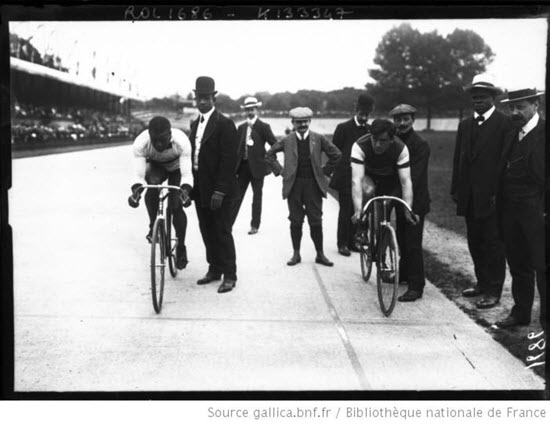
1/19/2015 In celebration of Martin Luther King Day – I thought it appropriate to re-run this podcast about Major Taylor!
Minnesota author and cycling historian Terry Kerber joins me on this episode of the Podcast to discuss his book; Major Taylor: The Inspiring Story of a Black Cyclist and the Men Who Helped Him Achieve Worldwide Fame.
About Major Taylor
In 1907, amid a time of unspeakable racial cruelty, the world’s most popular athlete was not pitcher Cy Young or center fielder Ty Cobb. During the height of the Jim Crow era, the world’s most popular athlete wasn’t even white. He was an oft-persecuted black bicycle racer who was denied meals, kicked out of hotels, forced to sleep in horse stables, trained by a washed-up former racer, and managed by a pugnacious Irish sports promoter and Broadway producer.
This is the Inspiring story of Major Taylor and the men who helped him achieve worldwide fame…
There are so many lessons in the pages of this epic story, but perhaps none are nobler than Taylor’s transcendent ability to forgive those who tormented him on and off bike tracks. That is why I was honored to speak at the unveiling of the Major Taylor statue at the Worcester Public Library, to stand in the very city that sheltered him from the racial storms a century before. I am equally honored to write the Foreword to this engrossing book, written by two gifted writers and passionate cycling fans that just happen to live near my suburban twin cities home. As the sport of bike racing and our nation attempt to transition to a new and refreshing era of transparency, we would all be well-served to seek wisdom and guidance from the lessons left behind by this remarkable sportsman.
After listening to my interview with Terry you may feel as I do, that this could be an awesome movie. If you know anyone in the business please pass this along to them.
It’s New Year’s resolution time again. For some of your participants, that may mean weight loss goals. Don’t worry; there’s no list of weight-loss tips below to pass along to your classes.
But I have been thinking about eating behaviors.
Grazing is one eating behavior that can impact weight significantly. I’m convinced that grazing is a type of binge eating, and that sugar may prompt it.
Grazing is characterized by “repetitive eating of small or modest amounts of food in an unplanned manner.” Because the behavior has yet to be fully defined, clarified and classified, there are some vague aspects to it.
Most of the research on grazing has been done on obese individuals, but my doctoral research and clinical experience indicate that non-obese people also graze.
Is Grazing a Form Of Binge Eating?
Binge eating doesn’t always fall into distinct binge episodes. In my study on women with binge eating disorder, participants were asked to log their food intake for 8 weeks and circle any binge eating episodes.
In the logs of several participants, and on more than one occasion, an entire day’s food intake had been circled — one big circle around the whole page.
Binge eating typically involves eating more food in a specific time period than most people would under similar circumstances. It also involves a lack of control — being unable to stop eating or control how much or which foods.
DSM-5 Criteria
The DSM-5 cites a 2-hour time period for a binge — but only as an example, not a strict criterion. If we expand the binge period to 24 hours, grazing could definitely fit the criterion.
Grazers may also experience a lack of control, along with other behaviors typically linked with binge eating — eating lots of food when not hungry; eating alone due to embarrassment over the eating; feeling disgusted, depressed or guilty afterwards.
Comments by the women who circled entire pages showed they felt their eating was out of control on those days. The amount they ate during each “grazing” might have been small or modest as defined above, but the overall amount of food eaten over the day was large.
So What Does All of This Have To Do With Sugar?
We’ve just made it through what might have been (for some of your participants) a high-sugar holiday season. The effects of sugar on our eating, though, don’t always disappear on January 1.
My dissertation suggested that standard criteria for addiction could be seen as “explaining” binge eating disorder, with sugar as the addictive substance.
I would modify this explanation for grazing: it isn’t limited to sugar addicts. As covered in a previous post — endorphins (beta-endorphin) triggered by sugar could, and would, inhibit the feeling of satiety in the main satiety center of the brain (the VMH). So sugar can make us want to eat more — not just at the moment but even days later.
As also covered previously, endorphins change food preferences toward sugars and fats, which may not only contribute to weight gain, but also increase the endorphin in a self-perpetuating cycle.
What Should Participants Do?
If any of your participants are struggling with grazing while trying to lose weight, they might need to change some things in their diets. Let’s keep this ridiculously simple for now.
One step is to stop eating sugar. The other is to eat protein throughout the day. Both could help them stop grazing and stick with their weight loss resolutions.
Sometimes, research language can be revealing and amusing. In animals (don’t run away yet!), sugar triggers beta-endorphin — linked with “continuance of ingestion and sustained consumption once begun.”
Is it just the geek in me, or does that sound to anyone else like grazing and the inability to stop eating?
Some riders are present to train and give 100% every class. Many, however, are present simply to be…present.
Through The Customer’s Eyes
When was the last time you really looked at the Indoor Cycling experience you offer through the eyes of your customer?
The riders who consistently attend your classes relate to you. But … have you taken the time to consider how a first time rider relates to you and your teaching style. Have you taken the time to
walk in a first time riders’ shoes or ride in their saddle. If you have had new riders in your class who chose to not come back, have you asked yourself…
Am I current and relevant to today’s customer?
Keeping up with our customers’ evolving WHY means accepting the radically different concept that an increasing number of riders don’t care about the workout. It means embracing riders who are more concerned with recovery from daily stress than recovery from working effort. It means delivering a fun, safe, and effective class to riders who train for LIFE alongside riders who TRAIN for the road or for a specific event. It means making them feel safe the moment they walk through the door.
Have you ever considered that the rider on the end in the 3rd row may be…
Overwhelmed by numbers, spreadsheets, and thinking in general
Or … Suffering from an eating disorder and low self esteem
Have you ever considered that the rider in the back row, 2nd bike in may be…
Training for the Special Olympics…grateful for a 2nd chance at life
A parent whose child recently tried to commit suicide
A rider whose spouse committed suicide
An ex college athlete whose body feels older than his years…
who rides for the non impact cardio, weight loss, and because he can escape
A verbally abused housewife who quietly arrives late and leaves early every class…
not wanting to be recognized and grateful to be alone for almost an hour
A recovering addict who rides to get high…and to stay sober
A military wife who misses her deployed husband
A depressed teenager who doesn’t seem to “fit in” anywhere.
A mother battling post partum depression
A parent of a Marine that never came home
A 50 year old father with 100lbs to loose before walking his daughter down the aisle
Or … A veteran who feels lost and unappreciated.
Have you ever considered that the rider directly in front of you …worries about losing their job?
Each one of these riders is real and has a name.
Each one of these riders wants to escape, to check out, and to get lost in the music.
Accept … Don’t Judge WHY
Welcome every rider free of judgment and celebrate that they have a WHY that is different.
Accept that a rider may not want to push outside of their comfort zone. That’s OK!
It doesn’t mean they are “lolly-gagging,” “wasting an hour,” or “need to leave if they aren’t going to make an effort” because they aren’t working as HARD as you are asking them. That’s not WHY they are there. For them, it was HARD WORK, just getting there.
For these riders, the CardioTherapy benefits of Indoor Cycling outweigh any interval or strength training benefit. These riders and countless others stepped out of their comfort zone simply by walking through the door. If we, as instructors are current and relevant to their WHY … these riders have a better chance of returning. Make them feel SAFE and FUN follows. If we are doing our job correctly, EFFECTIVE falls into place and riders see results … mind, body, & spirit.
Accepting and understanding that every rider is not in your class to TRAIN like an athlete is the first step to delivering the ultimate Indoor Cycling experience, to every rider in the room, every time … regardless of their WHY.
The word “technique” intrigues some and makes others yawn. But there’s much to be said for technique. It’s the foundation for all athletic performance features.
Technique involves improved skills. In the broadest, most general terms, that means eliminating unnecessary movement; making movements in the correct directions; applying the necessary power, but no more than that; using the right muscles for the activity; and using optimal speed if time isn’t a factor.
Okay, that’s a dry list. Still, the benefits of good technique — and the consequences of bad — affect training and performance. The last thing I’m going to do is describe cycling technique; vastly superior riders have done that in too many venues. (Check out the excellent videos here on ICI-PRO.) Instead, I’d like to list some benefits of good technique.
Efficiency
The main benefit of good technique is efficiency. Efficiency is the ratio of work output to expended energy. If work output increases OR energy expenditure decreases, efficiency has improved. Efficiency and technique are closely related because principles of efficiency are so similar to principles of technique.
Many activities have an optimal rate. Rates above and below that cost more energy. The mechanism behind that is stored muscle elasticity, which requires the shortest time between muscle relaxation and contraction to prevent the loss of energy as heat.
Good technique reduces the energy required for the pedal stroke, reduces energy lost as body heat, and retains more mechanical energy for the next pedal stroke. Strength goes up — functional-type strength.
Practice reinforces cycling technique, so it improves efficiency.
Consistent velocity
Consistent velocity also affects technique. Unintentionally accelerating or decelerating due to poor technique wastes energy. Obviously, holding a single cadence throughout a cycling class isn’t usually part of the workout plan.
But staying consistent during a song or segment — an important technical skill — can increase efficiency. Beatmatch is an excellent teaching tool for helping students develop consistency.
What else affects efficiency?
Efficiency may involve factors other than technique. For example, it may depend on the contractile properties of the muscle: slow-twitch is more efficient than fast-twitch. It may depend on training, which can increase strength and endurance by increasing muscle efficiency. Big-gear training, for example, can improve efficiency in fast-twitch fibers.
Other benefits of good technique
Doing something with correct technique feels good, probably because the body is being used the right way.
Correct technique makes the student look good. In my master’s thesis, I compared the principles of technique and efficiency to principles of movement aesthetics. It turns out that what makes a movement correct and efficient is also what makes it beautiful.
So technique leads to efficiency, and that wastes less energy. The less we waste, the more energy is left for the demanding parts of the class when it really counts. And the better we look and feel cycling.
You’d like your students to look and feel good while taking your class, complete it successfully, and want to come back for more, right?
Jim Karanas always said, “Endurance athletes don’t mind expending energy, but they never want to waste it.”
Have you heard about stomach hunger versus mouth hunger? Many nutritionists and dietitians talk about this. A client mentions eating Something Bad, and the practitioner asks, “Was it stomach hunger or mouth hunger?”
A variation on the question is, “Was it physical hunger or emotional hunger?”
Peak-performance motivator Anthony Robbins says, “If you ask bad questions, you get bad answers.” Asking a client whether she ate because of stomach or mouth hunger — or because of physical versus emotional hunger — is the classic Bad Question.
And it gets bad answers. Answers like “I don’t know” or “I’m not sure.” Sometimes the answer is another bad question: “How can I tell?” The client is trying to figure out if she was hungry for physical reasons or emotional ones.
Despite these rampant failures, the question persists. One book even uses the term “intestinal hunger.” Does anyone out there have any idea what that is? If I can’t understand it, what chance do my clients have?
Of course, if you’re not comfortable handling your participants’ food and eating issues, by all means refer to a nutritionist. This post is about awareness of what some of your participants may go through daily.
A Better Question
Here’s an idea that might be good for practitioners to adopt. I never use the term “hunger” for anything but physical hunger. Instead I ask, “Were you physically hungry, or did you just have an urge to eat?”
That question gets real answers and can uncover some important issues. People can tell the difference.
The urge to eat could have much behind it — emotions, stress, shifts in brain chemistry, shifts in hormones. Some clients might need coaching to explore the emotional component and retrain their responses not to involve food. Some may need to change their diets to change brain chem and/or hormones.
Real Hunger
Hunger is a specific, physical signal that the body needs food. I’ve explained in detail what hunger feels like to clients who don’t experience it.
Why don’t those clients experience hunger?
Some may not because, for years, they’ve been eating for reasons that have nothing to do with hunger:
– the clock says it’s mealtime
– everyone else is eating
– appetizing food is here now
– they ate too much at the last meal
– they’re stressed, depressed, anxious, or even happy.
Readers may conclude that the items in the last bullet show “emotional hunger,” but I’m suggesting that the word “hunger” causes the confusion. It’s more appropriate to use it only when physical hunger signals are present.
How Do I Know If I’m Hungry?
Clients who never feel hungry may be confused about how to determine hunger. If someone says, “I ate breakfast at 7 am, and now it’s 12:30, so I must be hungry,” that’s a thought process, not hunger. The best tactic is to help clients retrain their recognition of hunger through increased awareness of body signals.
It’s helpful to stay aware of misinterpreted signals. An obese client told me his hunger was “here” and placed his hand on his throat. Further questioning revealed that he actually had GERD (gastro-esophageal reflux disorder), which we alleviated in two ways. One was monitoring his work position after eating (he sometimes worked from home in bed). The other was taking an OTC remedy before the meal. (Don’t worry; I checked with his doctor.)
Clients who eat lots of sugar may not experience hunger. Despite research, I haven’t yet found a satisfactory explanation for that. Client symptoms, however, can typically be traced back to drops in glucose. If someone says, “I don’t get hungry, I get a headache,” that could be one sign of reactive hypoglycemia. Other examples exist.
So the absence of hunger could reflect lack of awareness, chronic overeating, or chronically high sugar consumption. When I uncover a solid explanation for the last, I’ll definitely let you know.
In the meantime, if you refer your participants to a nutritionist, please screen them and find one who doesn’t ask about mouth hunger.
(Indoor cycling instructors probably have their holiday eating under control, so this post is for your participants. I hope the information helps them.)
Quite a few years ago, I was on staff at a 10-day seminar on nutrition and eating behaviors. We lived at the ranch where it was held. Staff and participants alike followed the same mealtime rules.
Frankly, the seminar wasn’t particularly good. But we did one great exercise that helps me to this day.
The Standing Ovation
In the dining hall, we had to stand and announce that we were going back to the buffet to take seconds. At that point, everyone in the room gave us a standing ovation.
The reason behind this is simple. Some people tend to pile food on their plates when they go through the buffet line. It prevents the embarrassment of returning for more. The problem is, once the food is on the plate, it’s easy to keep eating, even when we don’t want it.
Giving yourself permission to get seconds eliminates the need to pile extra on the plate. Start with a small portion, and get more only if you really need and want it.
A Better Standing Ovation
The other part of the exercise was this: We had to stand and announce whenever we were throwing away food. Again, everyone in the room gave us a standing ovation.
I’m convinced this is one of the most valuable exercises anyone with food issues can try.
Most of us grew up learning that it’s a sin to throw away food. Didn’t you? Because of the starving children, right? Where were they starving when you learned it? We all heard different countries, different locations, but the sin was the same.
Kids immediately see through this nonsense and say, “So send it to them.” No one can convince kids that shoveling food that they don’t want or need into their mouths will help starving children anywhere. And yet this “teaching” persists and its negative lesson lingers into adulthood.
U.S. Food Production
Meanwhile, the U.S. produces 3950 calories worth of food for every man, woman and child (even infants) in the U.S., each and every day. 3950 calories is far more than most adult men need, and certainly more than women and children need.
So much of the food the U.S. produces is excess. There’s almost no way to prevent wasting of food.
Under circumstances like those, throwing away food isn’t a sin. It’s survival. And learning to be 100% okay with doing it is the smartest strategy.
Convincing My Clients To Get Rid Of Trouble Food
It isn’t easy to convince my clients of that. One client bought a giant tub of dates at Costco. Even though the date sugar kept triggering binges and her weight was creeping up, she kept eating them daily. When we talked about it, she said, “They’re almost gone.”
Perfect. Don’t put the dates in the garbage. Treat your body like a garbage can and put the dates in there. Yikes.
Another client had dinner with her parents at their home twice a week and couldn’t refuse the giant portions her mother served her. She had a problem with the sin of throwing away food. I wish she’d learn to use plastic containers for the purpose for which they’re intended.
Seminar Benefits You Can Use
After the seminar at the ranch — and all those standing ovations! — I can throw away any food. Now, I’m definitely NOT telling you to buy good food and throw it away for no reason.
But if a food — especially sugar — is making it difficult or impossible to stick with your eating plan, it needs to go. Not when it runs out, but now.
The impact of the sugar you can’t stay away from is huge. It goes beyond the “empty calories” most people talk about when discussing sugar. (Does that phrase bore you as much as it bores me?)
Toss That Sugar
Sugar increases appetite by inhibiting your satiety center. It changes your food preferences and makes you want more junk and fewer vegetables. It can make your eating feel out of control. As all of that happens, it affects your self-esteem, and not in a positive way.
And sugar will — as always — be everywhere this holiday season, along with holiday buffets.
Stop treating your body like a garbage can. Throw junk in the real garbage can, where it belongs. If you need to ruin the food first, do it. (Dishwashing liquid is handy for that!) Dump it and move on.
Your body deserves better. So does your brain, and your self-esteem. Can you hear the standing ovation?