
by John | Jun 15, 2014 | Latest News

Image from Pear iZumi.
“We'd Like to Thank All the Dads Who Taught Their Kids to Ride a Bike” was the subject line of an email I received today from Pearl iZumi. I'm pretty sure it was the kids in my neighborhood who taught me to ride. I do know for sure that it was my privilege to teach each of these young ladies, now 19 (Carly) and 23 (Abby) – pictured on each other's bicycles in 1997 🙂

I'll never forget running up & down the street with them, holding them by their shirt collars, very glad I had given up my sedentary lifestyle. ICI/PRO members don't forget about your 40% discount on anything Pear iZumi makes. Here's our page http://shop.pearlizumi.com/icipro/ And no your dad won't care if your gift is a little late.
S0 who taught you to ride a bicycle?
by John | Apr 15, 2014 | Latest News, Your Fitness Business
UPDATE: Unfortunately we ran into contractual issues that prevent us from having this event this year. We'll keep trying.
ICI/PRO is partnering with ECA World Fitness to co-host a very special Cycling Studio Owner and Instructor education conference near San Francisco, CA over the weekend of November 7th – 9th, 2014.
We've chosen the beautiful campus of the College of San Mateo and their San Mateo Athletic Club as the event location.
Our friends from Keiser Fitness will be there with the new M3i Indoor Cycle and new GX group exercise projection system + we're are waiting for commitments from multiple other Indoor Cycle Brands.
I wanted to get this up now, so you can make plans to attend.
We will be communicating additional details soon 🙂
I hope you can make it – it's going to be an awesome event!
John
by John | Apr 1, 2014 | Latest News

Many of us were afraid it would come to this….
News Releases from EPA Headquarters
EPA: CO2 Emissions From Fitness Clubs Threaten Public Health and the Environment – New carbon tax will apply to health clubs and fitness studios.
Science overwhelmingly shows greenhouse gas concentrations at unprecedented levels due to human physical activity
WASHINGTON 4/1/2014 — After a thorough examination of the scientific evidence and careful consideration of public comments, the U.S. Environmental Protection Agency (EPA) announced today that it will begin regulating greenhouse gas (GHGs) emissions from Health / Fitness Clubs and other strenuous fitness activities that cause humans to release CO2 at levels above normal, resting, breathing rates.
GHGs are the primary driver of climate change, which can lead to hotter, longer heat waves that threaten the health of the sick, poor, elderly and obese.
“When physically active Americans selfishly chose to participate in activities that cause them to exhale an excessive amount of a known pollutant, they threaten the health and welfare of not just other Americans, but inhabitants of the entire planet” said EPA Administrator Linda Q. Jackson. “Key scientists, government officials, concerned citizens and the United States Supreme Court have called for enduring, pragmatic solutions to reduce the physical activities that are causing climate change. This continues our work towards regulating anything that produce GHGs.”
EPA’s final findings respond to the 2007 U.S. Supreme Court decision that GHGs fit within the Clean Air Act definition of air pollutants. The findings do not in and of themselves impose any emission reduction requirements but rather allow EPA to finalize the GHG standards proposed earlier this year for the regulation of facilities classified as Area Sources of GHG, primarily carbon dioxide.
A recently released study shows that human physical activity above normal, resting, breathing rates contribute more than 13 percent of total U.S. GHG emissions. EPA’s proposed GHG standards for health and fitness clubs and other fitness activities would reduce GHG emissions by nearly 950 million metric tons each year.
EPA’s endangerment finding covers emissions of key activities shown to produce excessive carbon dioxide — that have been the subject of scrutiny and intense analysis for decades by scientists in the United States and around the world. They are; health club participation, indoor and outdoor cycling, running, swimming and all other forms of human activity at an intensity that increases the rate of breathing.
Scientific consensus shows that as a result of human physical activities, GHG concentrations in the atmosphere are at record high levels. New data shows that the Earth has been warming over the past 100 years, with the steepest increase in warming in recent decades as a direct result of the increase in what was previously thought to be a more healthful lifestyle. The evidence of human-induced climate change goes beyond observed increases in average surface temperatures; it includes melting ice in the Arctic, melting glaciers around the world, increasing ocean temperatures, rising sea levels, acidification of the oceans due to excess carbon dioxide, changing precipitation patterns, and changing patterns of ecosystems and wildlife.
President Obama and Administrator Jackson have publicly stated that they support a legislative solution to the problem of climate change and Congress’ efforts to pass comprehensive climate legislation. However, climate change is threatening public health and welfare, and it is critical that EPA fulfill its obligation to respond to the 2007 U.S. Supreme Court ruling that determined that greenhouse gases fit within the Clean Air Act definition of air pollutants.
EPA issued the proposed findings in April 2013 and held a 60-day public comment period. The agency received more than 380,000 comments, which were carefully reviewed and considered during the development of the final findings.
Information on EPA’s findings and how this will adversly affect your health club or fitness studio: http://www.epa.gov/climatechange/endangerment/newfitnessclubregulations.html
by Chuck Cali | Mar 26, 2014 | Instructor Tech Help, Latest News

How often have you wondered what your daily caloric burn REALLY is rather than estimates from metabolic tests or formulas? What about resting heart rate? Sleep patterns? Body temperature and perspiration? How about steps you take a day? These are all indicators of the work your body is doing or not doing if you're asleep.
Well enter BASIS. Recently acquired by Intel, their website calls it, The Most Advanced Health Tracker. And I tend to agree. Some history.
Sally Edwards and I had just started working on ZONING. A major part to ZONING education was simple heart rate training. But sampling heart rate historically had come at the cost of wearing a chest strap. Often an obstacle to
ongoing use, the chest strap is cited as, scratchy, pinches, squeezes and plain uncomfortable. I was on a quest to find a reliable heart rate monitor that did not require a chest strap.
IHRSA was in San Francisco that year (2011). So Sally and I stopped by a San Francisco start up company before heading off to IHRSA. That company, BASIS.
We sat in their offices as the lead engineer explained their technology and what they hoped the future uses in the wellness field could be. I was wearing one of the prototypes and comparing heart rate between my prototype Blink 1 and the BASIS watch. Spot on.
The unique BASIS watch measured my heart rate using optical sensors rather than EKG like the Blink. That meant no chest strap. 🙂 Moreover, it also measured body temp, perspiration, counted steps, told me the time I spent walking, the date and time. Finally a health and wellness tracker with heart rate and no chest strap. I didn’t want to give them back the prototype.
It was clear that the price point for such a device was way off from what Sally and I wanted to bring to market and it didn’t have flashing LED’s.
Fast forward three years. I find out on Facebook that BASIS is now on the market. Their web site up and running explaining everything good about wearing a BASIS watch. Once one owns a BASIS watch the site will start tracking one’s wellness just like they predicted.
I had to have one. The price had come down a bit from three years ago and is now in line with mid to upper range heart rate monitors. Mine first BASIS cost $169. With one downside (more on that later) I loved it from the moment I strapped it on.
Yes, my first BASIS. Let me explain. Marianne (my better half) had been an avid Body Media person. She had that ugly thing strapped to her arm since it was first introduced. It measured steps, body temp and somehow turned it into activity monitoring. She liked its simplicity, the nutritional nature of the their web site and velcro strap. But after years of wearing Body Media around her upper arm it had left a permanent mark.
After I had worn my first BASIS for a couple of months I was impressed with how well it tracked my activity, regardless of intensity level. I realized this is just what Marianne needs. So I let her try mine. She wouldn’t give it back citing how easy it is to wear and the accuracy of its features. Like most women, she is weight conscious. The BASIS website unlike the Body Media site does not provide a place to record one’s nutritional intake. Read monitor calories in. She has recommended to BASIS to add such capability and has kept wearing mine. So I bought another.
For our club athletes, tracking activity is often more helpful than zone training. BASIS provides a good look at resting heart rate – always a good indicator of VO2max – so ones overall fitness gains can be seen by improved (lower) resting heart rate. If BASIS could add a nutritional component to their web/mobile app I think more of our riders would be interested in stepping up to the plate for a device that cost twice as much as Fitbit but does four times as much.
I mentioned earlier one downside. BASIS does not sample heart rate continuously. Because of memory limitations displaying/recording real time heart rate is not possible. That is quite the limitation for those doing heart zone training. When I ride outside I use my Garmin. When I teach inside I use my Blink.
But the other 23 hours per day I wear my BASIS. And it has been most useful. I now know at age 60 that my caloric burn is more hot air than fire. Still, it helped me reset my caloric intake which really had not changed in over 10 years. Sadly, my weight had :-(.
Now that BASIS is a part of Intel's Devices line I hope there will be a surge of new development that will take this wellness product into the fitness limelight. I'm an avid heart zones training guy but, when I'm not training, I wear BASIS.
To date I've yet to walk more steps than Marianne.
John adds to Chuck's post here with Intel purchased the company behind BASIS today, for a rumored price of roughly $100 million. Why can't I come up with an idea like that?
by John | Mar 19, 2014 | Instructor Training, Keiser Cycling, Latest News, Training With Power, Your Fitness Business

Over the past month or so we're published multiple posts related to the accuracy and consistency of the indoor cycles in our studios. Gene Nacey chronicled his experiments toward finding a method of handicapping his cycles, in the hope of addressing the differences in wattage he is seeing between bikes and my series on the results from our survey both pointed to the same conclusion; Indoor Cycle manufactures have work to do to ensure a level of consistency that will give both Instructors and participants the confidence we need to really use power as a training tool in our classes.
Last week at IHRSA, Amy and I had the chance to sit down with Keiser founder Dennis Keiser, before he formally announced that his engineering team had secured the first European EN-ISO 20957-1 accreditation for an Indoor Cycle that displays power – the new Keiser M3i.
From the Keiser press release:
Keiser Earns Accuracy Acclaim!
The Keiser M3 group fitness cycle has been the first product of its kind to receive prestigious EN-ISO 20957-1 recognition for the accuracy of its power display.
“This is a big step. Our industry needs to validate the numbers that our users are seeing,” said Keiser founder and President Dennis Keiser. “This gives our customers a level of comfort at what they are seeing in our display.” The accuracy certification represents the first time that TUV Product Services, a European safety organization, has tested for accuracy in a data reporting system on an indoor group exercise cycle. To achieve EN-ISO 20957-1 recognition, TUV requires a group fitness cycle consistently perform within plus or minus 10% of accuracy. “To be the first in our industry to receive this is a great achievement and an honor,” expressed Keiser Vice President-Europe Alastair Watson. “It is important to everyone at Keiser that our customers know they are getting the best bike in the industry and the most accurate reporting system as this designation confirms.” Keiser has been the undisputed industry leader, the first to employ magnetic resistance, introduce power, and now the first to receive accuracy certification. “It’s very easy for someone to talk about the accuracy of power but this test is very difficult. To achieve what we have is significant,” explained Dennis Keiser. “We have been the leader and intend to remain the leader in indoor group cycling.”
Dennis explained to us that the primary focus of EN-ISO 20957-1 (ISO is the International Organization for Standardization) is safety. Passing is required to sell new fitness equipment in many European countries. The certification of any power displayed is a sub-category of EN-ISO 20957-1 that's been initiated to bring more consistency to our industry – something Dennis expressed is long overdue and I completely agree.
Now while a +-10% accuracy may not sound all that impressive in these days of super accurate (and expensive) bicycle power meters, that's the maximum allowable variation from any randomly sampled production M3i. To achieve that level of accuracy, while making allowances for production tolerances, Keiser's engineers designed the M3i to have single digit accuracy.
Upgrade for older Keiser M3s
So why would this be important to a club or studio who own the older versions of the Keiser M3? My understanding is that Keiser will be offering retrofit kits for older M3's. By replacing the console, a small circuit board near the magnet carrier and the magnet carrier you'll be able to bring your M3s up to this new certification's level of accuracy. Included with the kit will be the new power console that incorporates BLE Bluetooth Low Energy which will easily pair with an iPhone/Android phone + work with the new Keiser GX group exercise projection system for on-screen power and heart rate display in class. More about that soon.
Both are supposed to be available later this summer – I'll be posting the details on cost and how to order once it's been finalized.

That's Coach Robin Robinson in the pink jersey at IHRSA
by John | Mar 6, 2014 | Latest News, Your Fitness Business
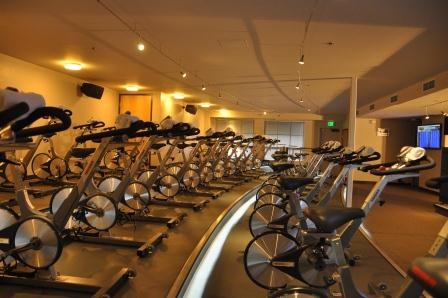
Bill Pryor has an interesting article in the latest addition of Club Industry's online magazine.
Indoor cycling isn't what it used to be, and for traditional health clubs, as well as the hundreds of brand new dedicated cycling studios popping up around the world, this is turning out to be a good thing. Technology and innovation, especially in electronics and fabrication, are revitalizing the venerable indoor cycling workout in dramatic ways while reducing the headaches and costs that club and studio owners dread.
Using Technology to Measure Performance and Motivate
Outdoor cyclists have long had access to tools such as Computrainers that allow them to measure and analyze their efforts. For indoor cyclists, these kinds of tools are a recent addition, and club and studio owners are finding them to be an effective way to build and grow attendance. Dozens of studios are using performance metrics technology in their group exercise cycling programs, and many more are coming online soon.
Performance Metrics for Cycling Classes
In just the past few years, most major bike manufacturers have started offering metrics capabilities or consoles as a built-in feature or as an add-on option in their top bikes. These systems provide the rider with some combination of performance-related metrics: pedal cadence, heart rate, power (watt) output, calories burned and estimated mileage. In some cases, this information also can be automatically transmitted and stored for later viewing. Several third-party suppliers and web developers have built systems to measure, present, store and track performance data. In essence, this information can now be viewed in several important ways:
- On each bike. With this, individual class visitors can view real-time data, and class instructors can coach to that data.
- In front of the class on a monitor. Classmates can see their own performance data as well as data on fellow class participants.
- After the class on the web (data tracking). Performance data can now be stored online so riders can view and compare historic performances.
In some cycling studios, the instructor uses this data as a primary tool for coaching and motivation. In others, the data is there purely for the user to review, and they often can choose the metric of their choice–heart rate, watts, calories burned, etc. In any case, just having this information available is a far cry from the traditional cycling class. Music and cult instructors remain the primary draw for most classes, but performance technology has added an appealing new dimension to the mix.
You can read the rest here.
