Kathy Helmuth and I have just received confirmation that our ACE approved Parkinson's Indoor Cycling Coaching program has been accepted by the SilverSneakers organization!
Now, Parkinson's Cycling Coaches will now receive reimbursement directly from SilverSneakers, through their FLEX Instructor Program.
I am planning an interview with the SilverSneakers National Program director that will explain exactly how the FLEX program works.
My short description: a FLEX Instructor can walk into any studio and teach a SilverSneakers approved class and it's free to SilverSneakers members. SilverSneakers then compensates the Instructor directly.
To become a SilverSneakers group exercise class instructor, one must:
Be at least 18 years of age.
Maintain current CPR certification.
Hold a two or four year degree in health, exercise science, recreation or physical activity related field or maintain a nationally recognized certification (for example, ACE, AFAA, YMCA).
Attend a SilverSneakers instructor training workshop for the specific SilverSneakers class one would like to teach.
SilverSneakers classes are available in 12,000 locations and the FLEX Instructor program allows you to easily (and at no cost) add SilverSneakers classes to your studio 🙂
Merrill Richmond with StairMaster | Schwinn send me a press release about how the Schwinn Class Tamer iPhone App had won an Outstanding Achievement Award. Pretty cool:)
Schwinn developed this as their gift to Instructors – and an expensive gift at that. I don't know exactly what they've spent on the design and ongoing maintenance of the Class Tamer App. I have looked into contracting with an App development company, to build something similar and was quoted “around” $40,000.
STAIRMASTER AND PINCKNEY HUGO GROUP WIN INTERACTIVE MEDIA AWARD
SYRACUSE, N.Y. — Pinckney Hugo Group, a full-service marketing communications firm, and StairMaster, which markets and distributes Schwinn indoor group cycling bikes to commercial health clubs, were awarded an Outstanding Achievement Award by the Interactive Media
Awardsâ„¢ for the Schwinn Class Tamerâ„¢ App.
The Outstanding Achievement Award recognizes that the app surpassed the basic standards of excellence that comprise the web’s most professional work. The app was honored for excellence in the sports category. “It was truly a collaborative effort that led to the Schwinn Class Tamer App,” said Merrill Richmond, vice president of sales and marketing, StairMaster. “Together, with Pinckney Hugo Group, we were able to develop the premier music player for group exercise professionals. It is a tool organized intuitively with large, easy-to-read fonts and controls to help them stay organized while they energize their classes.”
Designed with input and insight from Schwinn’s global team of Master Instructors, Pinckney Hugo Group created the app to serve as the premier music player for group exercise professionals. The app is a one-of-a-kind music player that enables instructors to create and save ride playlists by accessing songs, playlists, albums and artists directly from iTunes. After a playlist is created, the instructor can input a set of commands, cueing notes, music tags and beats per minute (BPM) for each song within the playlist. Playlists can then be saved for future use in class.
The judging consisted of various criteria, including design, usability, innovation in technical features, standards compliance and content. To win, the app had to meet strict guidelines in each area. Other entries in the sports category that received an Outstanding Achievement Award include the NCAA website and the World Anti-Doping Agency — Play True Quiz. Best In Class, the highest honor of the competition, went to ESPN World Cup Essentials, Everton Football Club and Warrior Dash websites.
The Interactive Media Awards is an international awards competition that was started in 2006. Each year the awards honor the best website designs in a multitude of categories throughout the year and are designed to elevate the standards of excellence on the Internet.
DJ Scott Melker playing the Red Rocks Amphitheatre in Golden, CO
Time for another Profile Contest!
My friend , professional DJ Scott Melker send me an awesome playlist to use in my 45 minute Evolution Cycle class at Life Time. I had asked Scott for this because quite frankly; there are times when my personal choices of music, aren't exactly what my class wants to hear 🙁
So I occasionally solve that by using OPM (Other Peoples Music) – Amy's music has been heard in my class on occasion, as has Chrispins and others to fabulous effect.
If you don't know him – Scott Melker is the creative genius behind The Melker Project. Beyond rocking clubs and amphitheatres, Scott is a mashup and remix artist. His music is used by some of the hottest Indoor Cycling Studios and Instructors in NYC.
Instead of keeping this playlist all to myself – I thought I should share it – which lead to the idea; why not have another profile contest?
The rules are pretty simple:
Create a fun and entertaining class profile using the playlist as provided > no substitutions or re-ordering please.
Create a .pdf of your completed playlist.
Upload it to the Celebrate Indoor Cycling Facebook group's file section before the end of Saturday February 6th.
Between Scott and myself, we'll pick three as winners on Sunday 2/7. 1st place wins $300, and the top three each receive a one year subscription (or extension) to ICI/PRO! All winners will have the option to be recorded as an official Audio Profile.
Once you've downloaded the file > Extract the files in your download folder or move them into where you keep your other music files. If you have your settings in Spotify correct, you should see all of them in your Local Files.
Once that's done, click ICI/PRO Scott Melker DJ Mix to open the Spotify playlist. This will ensure you have the playlist configured correctly.
I'm super excited to announce that ICI/PRO is teaming up with the owners of Full Psycle Indoor Cycling; Paul Harmeling & Shelly Scott. We are hosting our first Full Psycle/PRO Performance IQ Training on February 14th at the Full Psycle Studio in the Lincoln Park area of Chicago, IL.
1/20 update: There's just two open seats remaining.
I've taken over a dozen classes that incorporate PIQ Display Training – at studios across the country. In only one did I feel like the Instructor really understood how to effectively integrated PIQ into the class. That class was Paul Harmeling's and you now have the chance to learn from the person I see as the expert in teaching Display Training Indoor Cycling classes!
Can't make this workshop? If you would like to receive notifications of future events join this email list.
Listen to this short interview with Paul, where we discuss the details of the training we're providing February 14th.
This 6 hour, comprehensive training workshop will include two complete master classes. They'll be taught by Paul Harmeling & Shelly Scott – co-owners of Full Psycle.
To complement the Master Classes, we will be offering the following:
Understanding the basics of PIQ – presented by Tae Yoo
Troubleshooting and Best Practices
Training With Power for Indoor Cycling Classes – presented by Me John Macgowan 🙂
Maximising the functionality of Performance IQ and effectively class presentation using:
Power Screen/Race Mode
Heart Rate Training Screen
PTP (Personal Threshold Power) Screen
Watts/Lb – Weighted/Leveling/Handicapping Mode
Teams Screen
Building Entertaining Display Training Class Profiles
Creating Speciality Classes with PIQ
Get people excited about Display Training with Social Media
Using PIQ data to bring consistency to your Indoor Cycles
We are limiting attendance so we can include multiple opportunities for participants to demonstrate what they've learned. Instructors will need to conduct teach-backs throughout the workshop.
Tae Yoo is taking us all out for dinner Saturday night as the end of a great day of PIQ!
It’s New Year’s resolution time again. For some of your participants, that may mean weight loss goals. Don’t worry; there’s no list of weight-loss tips below to pass along to your classes.
But I have been thinking about eating behaviors.
Grazing is one eating behavior that can impact weight significantly. I’m convinced that grazing is a type of binge eating, and that sugar may prompt it.
Grazing is characterized by “repetitive eating of small or modest amounts of food in an unplanned manner.” Because the behavior has yet to be fully defined, clarified and classified, there are some vague aspects to it.
Most of the research on grazing has been done on obese individuals, but my doctoral research and clinical experience indicate that non-obese people also graze.
Is Grazing a Form Of Binge Eating?
Binge eating doesn’t always fall into distinct binge episodes. In my study on women with binge eating disorder, participants were asked to log their food intake for 8 weeks and circle any binge eating episodes.
In the logs of several participants, and on more than one occasion, an entire day’s food intake had been circled — one big circle around the whole page.
Binge eating typically involves eating more food in a specific time period than most people would under similar circumstances. It also involves a lack of control — being unable to stop eating or control how much or which foods.
DSM-5 Criteria
The DSM-5 cites a 2-hour time period for a binge — but only as an example, not a strict criterion. If we expand the binge period to 24 hours, grazing could definitely fit the criterion.
Grazers may also experience a lack of control, along with other behaviors typically linked with binge eating — eating lots of food when not hungry; eating alone due to embarrassment over the eating; feeling disgusted, depressed or guilty afterwards.
Comments by the women who circled entire pages showed they felt their eating was out of control on those days. The amount they ate during each “grazing” might have been small or modest as defined above, but the overall amount of food eaten over the day was large.
So What Does All of This Have To Do With Sugar?
We’ve just made it through what might have been (for some of your participants) a high-sugar holiday season. The effects of sugar on our eating, though, don’t always disappear on January 1.
My dissertation suggested that standard criteria for addiction could be seen as “explaining” binge eating disorder, with sugar as the addictive substance.
I would modify this explanation for grazing: it isn’t limited to sugar addicts. As covered in a previous post — endorphins (beta-endorphin) triggered by sugar could, and would, inhibit the feeling of satiety in the main satiety center of the brain (the VMH). So sugar can make us want to eat more — not just at the moment but even days later.
As also covered previously, endorphins change food preferences toward sugars and fats, which may not only contribute to weight gain, but also increase the endorphin in a self-perpetuating cycle.
What Should Participants Do?
If any of your participants are struggling with grazing while trying to lose weight, they might need to change some things in their diets. Let’s keep this ridiculously simple for now.
One step is to stop eating sugar. The other is to eat protein throughout the day. Both could help them stop grazing and stick with their weight loss resolutions.
Sometimes, research language can be revealing and amusing. In animals (don’t run away yet!), sugar triggers beta-endorphin — linked with “continuance of ingestion and sustained consumption once begun.”
Is it just the geek in me, or does that sound to anyone else like grazing and the inability to stop eating?
A recently published survey by ACSM about trends in fitness has spawned a number of articles; here, here and here. ACSM's top 20 fitness trends makes no mention of Indoor Cycling – going so far as to suggest its inevitable demise. My review of the survey finds it wanting > no, actually I see it as utter nonsense BS based on both sample size and respondents.
Pilates, indoor cycling, stability ball, and balance training again failed to appear on the list of top 20 trends in the health and fitness industry, which supports the theory that these were fads and not trends. [Really? 20 years of Spinning® is just a fad?]
Some of the survey respondents still argue that the persistent sluggish economy has influenced the results of this survey and that training programs requiring expensive equipment or technical instruction are not supported because of the increased cost. Still others argue that Zumba®, indoor cycling, and Pilates have run their useful course.
Where do I even begin?
The purpose of this survey is to: guide health fitness programming efforts for 2015 – and – developed a systematic way to predict health and fitness trends
During the last 8 years, the editors of ACSM’s Health & Fitness Journal® have disseminated this electronic survey to thousands of professionals worldwide to determine health and fitness trends. The survey in this issue of the Journal helps to guide health fitness programming efforts for 2015. The first survey (1), conducted in 2006 (for predictions in 2007), developed a systematic way to predict health and fitness trends, and surveys have been done annually since that time (2—8) using the same methodology. As this was a survey of trends, respondents were asked to first make the very important distinction between a “fad” and a “trend.”
The potential benefit to commercial health clubs (those that are for-profit) is the establishment (or maybe the justification) of new markets, which could result in a potential for increased and more sustainable revenue. Community-based programs (typically not-for-profit) can use the results to continue to justify an investment in their own markets by providing expanded programs serving families and children. Corporate wellness programs and medical fitness centers may find these results useful through an increased service to their members and to their patients. The health and fitness industry should apply this information to its own unique settings.
OK, So exactly who, and how many did they survey?
Using Survey Monkey ( www.surveymonkey.com), the online survey was sent to 28,426 health fitness professionals….
After 3 weeks and 2 additional notices, 3,403 responses were received, which represents an excellent return rate of 12%, which is very similar to previous surveys.
While 3,400 isn't a small number, I don't know that I would be too proud of a 12% return rate. I get that people are busy. That often means that the people who do respond could have some additional time on their hands.
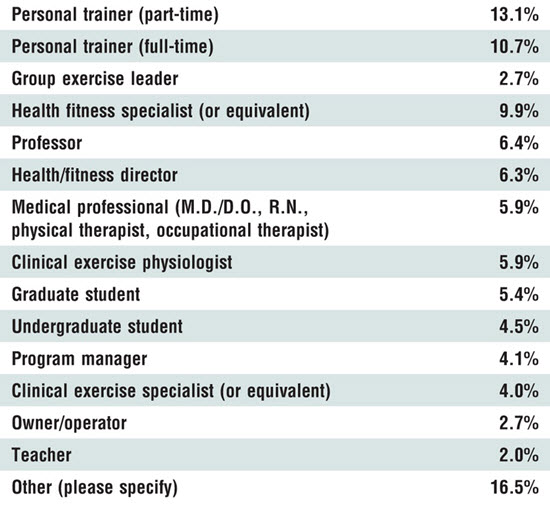
Here's the breakdown of survey participants. Notice anything strange?
If you thought (as I did); that's a lot of personal trainers (23%) – I wonder if they could have skewed the results to personal trainer-ish activities?
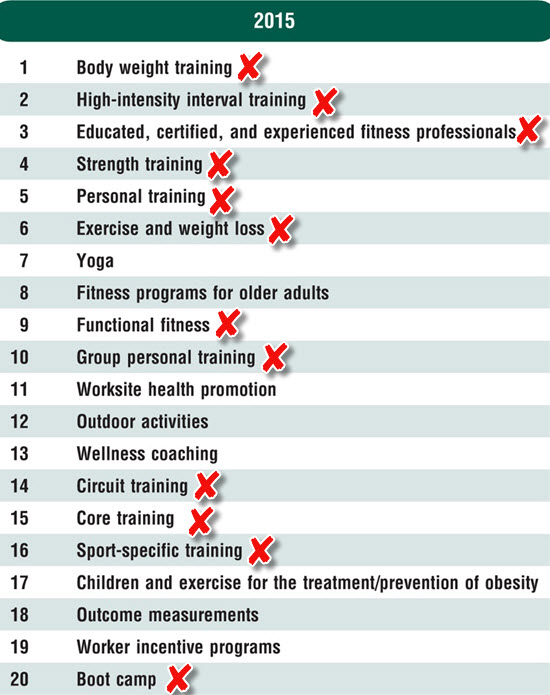
I added the red “X” next to each “trend” that would apply to personal training. Twelve of the twenty “trends” identified are what I would expect a personal trainer to list. Really?
The summary of the survey includes this observation:
Pilates, indoor cycling, balance training, and use of the stability ball continue to exist in the health and fitness industry but with not as much popularity according to the ACSM trends survey.
I'll leave you with this pearl of wisdom from one of ACSM's INTERNATIONAL EXPERTS
Yves Vanlandewijck, Ph.D., professor, Faculty of Kinesiology and Rehabilitation Sciences and program director of the Education Board of the Erasmus Mundus Masters in Adapted Physical Activity, KU Leuven, Leuven, Belgium.
During the last 9 years, the ACSM Worldwide Survey of Fitness Trends has been established as the primary mechanism by which the fitness industry has set its standard for the coming year. Around the globe, owners of clubs look forward to the survey to have a better understanding of market direction and emerging trends. That was true in the past, and it continues to be that way today. The survey was sent to thousands of health fitness professions, with 12% responding. That is a remarkable return rate for a survey of this type, demonstrating beyond any doubt that it reflects an accurate picture of the industry. Owners, operators, fitness staff, and sales professionals should pay attention to the results of the survey.
Good Grief… the only thing beyond a doubt is that you're clueless 🙁
No Ms. Vanlandewijck, owners, operators, fitness staff, and sales professionals should pay attention to what the 75 million participant/users of the MyFitnessPal App are doing for exercise.
We were curious to see what fitness trends we could see among the 75 million MyFitnessPal users, so we sat down with our fitness and nutrition experts to take a look at the hot workouts from 2014. The mission: to predict what 2015’s hottest workouts will be.
We took the total number of minutes logged for each of these activities and divided by the number of active users on the app over the period of Jan-Nov of 2013 vs. Jan- Nov 2014. We did have a growth in our database over that time, so we corrected for the number of daily active users.
Here’s what MyFitnessPal’s coaching lead, Glennis Coursey, and our Registered Dietician, Elle Penner, have deemed the workouts to watch in 2015:
Although there are fewer than 40 studios in the US, it’s undeniable that there’s a tremendous buzz around SoulCycle. We anticipate this class (and cycling workouts inspired by it) will be in big demand in 2015. The celeb fave is up 78.3% since 2013.
So to answer ACSM's question; What’s Driving the Market? Participants are, not Personal Trainers.