Are you going to be in Miami for WSSC? I'll be there all weekend and would love to meet you while I'm there.
There are a bunch of sessions that I'm excited to see:
On Friday our very own Barbara Hoots is giving a presentation: Studio Design: Empowering Emporiums to Increase Profits
Presented by Barbara Hoots Whether opening a new studio or renovating an existing one, this lecture will offer new trends in studio design. Evaluate common design flaws that lead to lawsuits and slow growth, and explore the latest in sound systems, lighting, wall treatments and marketing.
I'm really excited to take these Ugi classes – from what I can see, Ugi could be a great strength compliment to any boutique Indoor Cycling Studio
Ugi® Fit Presented by Sara Shears Undo your laces and strip off your socks! Join Ugi creator Sara Shears for the ultimate 30- minute barefoot workout. A series of 30 one-minute intervals combining strength, core and cardio are efficient enough to change your body completely. From warm-up to cool down Ugi is fun, challenging and makes U feel good about your body, energy and health.
U-SPIN Me Right Round Presented by Nadine Stewart “Combine the benefits of a high-cadence endurance ride with non-linear sculpting exercises using the Ugi® ball. This well-rounded workout will cover your cardio and cross-training needs and give you new ideas to change up your Spinning® and resistance training classes.
My main focus will be the Spin Power sessions and there's a lot of them on the schedule! Especially those that are including a specially designed Performance IQ display system, customized for the Spin Power Program.
Team Time Trial with Performance IQ Presented by Angie Sturtevant In team time trials, riders take turns either at the front or ‘sitting in’ behind, conserving enough team energy for an all-out pull toward the finish. In this workout you will compete as part of a team, as accumulated power output is displayed on the big screen using Performance IQ. This gives all teams the energy to chase and spectators something to cheer about!
Spinpowerâ„¢: Personal Spinning® Threshold Presented by Martin Timmerman The Personal Spinning Threshold (PST) is the key to Spinpower success–once PST is determined, you have a baseline threshold marker that can be used to create a unique training program and track student progress. This workshop will teach you the protocol of the Personal Spinning Threshold test and how to administer this test to your students. You will establish your own Spinpower Zones and then experience a ride which will criss-cross these zones. WS NEW
Spinpowerâ„¢ Race Day Winners Presented by Dino Pedras All athletes know that we must be efficient and well-organized to get the most out of our training, and a Race Day ride is how we see the results of that hard word. In this workshop, you will learn how to create a successful Race Day using Spinpower to help you determine what variables you should integrate into your training program and how to best periodize your time to reach your maximum potential and find the way to victory!
And that's just Friday's sessions – I'll be reporting more from WSSC as time permits. If you'll be there any of the three days, please text me so we can connect 612-868-0064!
This Podcast is was originally published on December 30, 2008, I have updated it with our new Podcast host information and I am representing it now. I hope you enjoy it, Joey
Welcome Spinning News Readers!
Would a mentor have helped you when you first started teaching Indoor Cycling? Or are you interested in developing a mentoring program for your club? Jennifer Sage and I discuss the benefits of mentoring with Bob Rebach, or SpinBob as he is known on the forums. Bob has written two articles for the Spinning Newsletter about mentoring; Overcoming Uncertainty: Finding a Mentor and an upcoming article Starting a Mentoring Program in your club. Link to article.
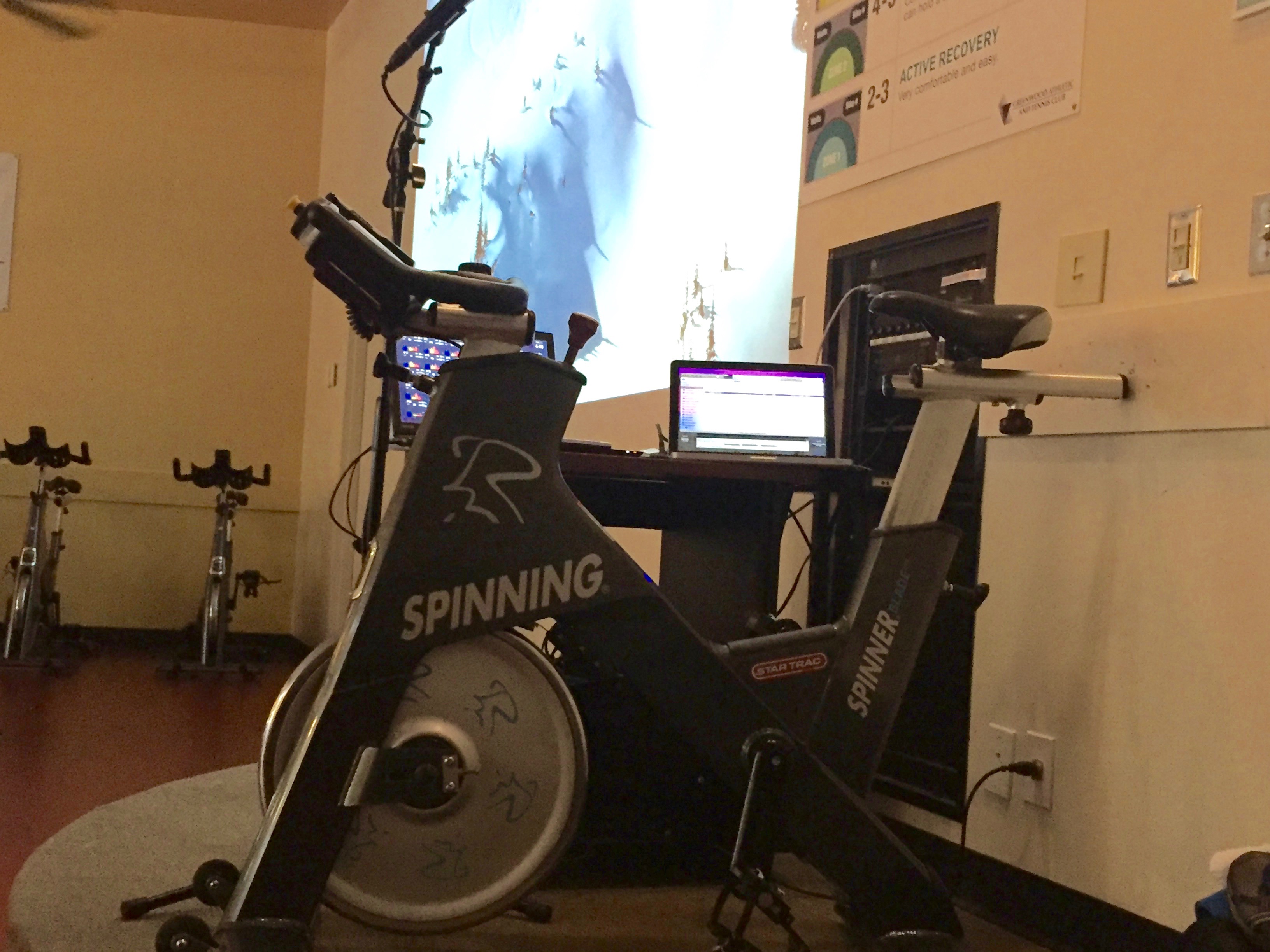
Today I ended a turbulent 3 year relationship with the Spinner Blade Ion. A courtship that began with high aspirations for a long, happy and powerful future has deteriorated into one complication after another and I no longer have the energy to keep the blue light burning.
About 3 years ago management announce that we were going to be the first club in the United States to receive the brand new Spinner Blade Ions, this was Spinning's first foray in the new world of power. Though I personally was hoping for a different choice I was excited to finally be teaching on a bike that would express work output in watts. Now instead of spending so much time cuing how each interval should feel I was going be able to use each rider's personalized power zones. The idea of personalized training zones is not new, the fitness industry has been trying to use them with heart rate for nearly 25 years. The problem with heart rate training is that all participants need to be using heart rate monitors for it to be effective and as any experienced fitness professional knows we are lucky to have 20% of our participants wearing monitors in any class. The beauty of leading a power based indoor cycling class is that ALL participants have a power meter on their bike!
A few weeks before delivery the instructors started receiving various training manuals and information about the features of this new bike. This is when I started getting worried. The first problem I saw was the continued use of a chain. Why would any new bike continue to use a chain when belts, both Poly V and Carbon Drive, have proven to be a much better option. Belts don't stretch or break, they are so strong that many motor cycle manufactures use them. The second flaw I noticed was the continued use of a friction breaking or resistance system. Friction resistance has been the bane of instructors and bike techs since the inception of indoor cycling. I still remember the days of walking around the cycling room with a bottle of silicon lubricant spraying the squeaky brake pads then having to endure the smell of the same burning silicon. There were also the times I would sweat or spill water, from my water bottle, on the flywheel and lose most of my resistance. Why would anyone want to build a new bike with old friction resistance technology when magnetic resistance has been proven to be so much better. I'm not an engineer but the only time I can think that excessive friction is a good thing is when trying to build a fire. The third and final concern I had when looking through these training manuals was the console. The layout was, to be honest, stupid!
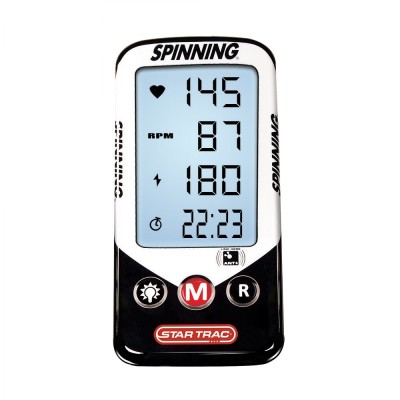
First, why would you not put wattage on the top? The new and special aspect of these bikes was power, why would you hide it in the middle? Why give heart rate the most prominent line on the console when so few people actually wear heart rate monitors? Also, any instructor with 1 month's experience teaching with power understands the importance of seeing real time AND average wattage when performing intervals. Why are they not available on the same screen? The only way to see average wattage on this console is to push the “M” button and scroll through the four different screens, something everyone wants to do when they are working hard. The word “Simple” kept coming up in the literature. Well when it comes to console design, I think Simple=Stupid. After the initial learning period of how to use power, participants and instructors want a console that gives them all the metrics they need to take and teach an effective class not a simple one. Finally, this bike was being released at the beginning of the wearables craze. Everyone wanted to track and log every aspect of their workout. With the Spinner Ion Blade there was no way, beyond taking a picture of the console, to track your workout, no USB port, no phone app, no open protocol that would let the console communicate with the many fitness apps that were available. I teach in Denver Colorado, the riders here are some of the most sophisticated indoor and outdoor riders in the world, they know power and want a way to use it to it's fullest potential. If there isn't a way to track real time wattage throughout a ride there is no way to determine Normalized Power, Intensity Factor or Training Stress Score. Again, Simple=Stupid.
So, the bikes finally arrive and EVERYONE was so excited! We had been riding Spinner NXT bikes and these new Ions felt very familiar but what everyone was psyched about was the power. I had been lucky enough to be teaching with power for a few months on the Keiser M3 and the Freemotion bike. I've also been coaching some athletes who use power meters and I've read Hunter Allen and Andy Coggan's Training and Racing with a Power Meter. So I felt like I had a pretty good understanding of how power works. On my very first ride I noticed something very disturbing, my wattage was 20-40 watts lower on these bikes then the M3 and Freemotion bikes and people who were riding with power on their outdoor bike were noticing the same thing. Then, as I rode different bikes I found huge wattage variations from bike to bike. Understanding that this was a very subjective test a few instructors decided to ride ALL 56 bikes while wearing heart rate monitors. We would work up to a specific heart rate that was in our Aerobic Zone then take note of the wattage. This wasn't the most scientific test, but it was the best we could do without being able to hook the bikes up to a dynamometer. The results were SHOCKING! More than half the bikes weren't even close to each other, they varied by as much as 100 watts. We explained this issue to the bike manufacture and asked if there was a way to recalibrate the bikes in order to assure consistency from bike to bike. The answer we received was even MORE shocking then the amount of bike to bike variation. THERE WAS NO WAY TO RECALIBRATE THE POWER. Are you kidding me? Every indoor cycling bike whether direct power or measured and every outdoor power meter has a way to recalibrate! This was our “Oh Shit” moment and when I started thinking of “work arounds” to this fatal flaw.
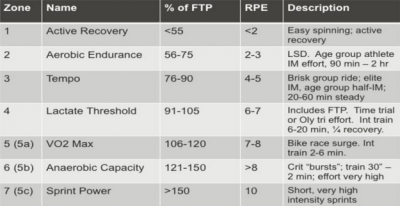
The foundation of training and coaching with power is finding one's FTP, Functional Threshold Power. This is simply the maximum power a rider can average for 1 hour. Since a one hour test would not be practical in most indoor cycling settings the next best test is a 20 minute “best effort” ride where 95% of the 20 minute average wattage is calculated as the FTP. We then use the FTP to determine power training zones.
Since the variation from bike to bike could be as much as 100 watts, unless I could guarantee that every rider would be able to ride the same bike in ever class the FTP test results were useless. So my workaround was to perform a modified FTP test at the beginning of every class. This way we could find an estimated FTP for each rider on each bike for each class. I would cue what threshold was supposed to feel like, have my class ride at that “feeling” and take note of the wattage their bike read when they “felt” like they were at threshold. Unfortunately this was not very scientific but it was the best I could do in the situation we were in. At least this let me speak the language of power and riders could be accountable from interval to interval even if the numbers weren't exactly correct.
As I gained more and more experience teaching with power I realized the importance of Average Wattage when coaching interval based profiles. If riders are told to focus on average wattage for each interval, they are forced to work for the full length of each interval. Riders learn very quickly if they “sandbag” the beginning of an interval they need to work extremely hard at the end of it to reach their goal average wattage. Many of the top indoor cycling bikes with power show real time and average wattage on the same screen, not the Ion. Riders have to cycle through the four available screens to see real time and/or average watts.
The power meter and the console were by far the two biggest mistakes made with the Ion, but there were more. The friction resistance was a problem that was made obvious when combined with the use of a power meter. Friction causes heat and heat causes the brake pad to work less efficiently, so if I asked my riders to find specific wattage and rpm and to hold it for a few minutes over time the brake pad would heat up, work less efficiently and wattage would drop. Riders were constantly forced to adjust their resistance throughout each interval to maintain current or goal power output. Threadless (Morse Taper) pedals became a problem since they were virtually impossible to remove. Chain instead of belt also added to maintenance requirements and the inability to capture workout metrics through a usb storage device or app became very frustrating to our riders who wanted to track their progress.
The breaking point came when we added a group display system, Performance IQ. These systems display metrics on a TV or are projected onto a screen. Now every rider's metrics were visible for the world to see. It quickly became obvious that we had to do something about the incredible variation in wattage numbers from bike to bike. Now that we were focused exclusively on wattage we needed to find a bike that was much more accurate and consistent so our leader board, races and zones displayed correct metrics.
I'm happy to report that on March 30th we are receiving a shipment of 46 Stages SC3 indoor cycling bikes and these problems should be a thing of the past.
So, as I bid farewell to my Spinner Blade Ion, a bike that I have sat on for nearly 1000 hours over the past 3 years, I am a bit sad. It's not the Ion's fault that this relationship didn't work out. Maybe it was a rush to market, lack of foresight, not realizing that Simple = Stupid, or just plain ego that let it arrive in my club with all these fatal flaws. I'm thankful that it challenged me to become a better instructor by working through all it's various issues, but eventually it became exhausting and I just don't have the will to keep the blue light burning anymore.
If you're new to the whole “Spinning” thing, this video from 1995 featuring Johnny G is an amazing look at the beginning of his new concept of riding indoors. This was posted over at pedal-on. It's interesting to see Johnny's early manufacturing partner Schwinn and the original Johnny G Spinners. If you watch carefully you'll see a few things that some would consider “contraindicated” movements. If Johnny G is doing them… are they wrong?
When I heard about a SPINNING® Certification Workshop being offered just minutes from my home-base in Eden Prairie, Minnesota, I jumped at the opportunity to sign up. Believe it or not, I have been teaching indoor cycling for nearly four years, but never received formal training on the bike. The workshop I attended was held in Minnetonka, Minnesota, on July 23rd, 2011, and was led by Seth Dedmon, from Tennessee. Seth epitomizes what it means to be a great workshop facilitator. His energy, sense of humor, and thick Tennessee accent made me want to listen, and his knowledge base from years of experience had me jotting down notes and quotes almost non-stop.
The nine-hour event was broken down into four sections:
– Bike Setup/Safety
– Form
– Heart Rate Training
– Class Design
Bike Setup/Safety
We spent the early part of the workshop learning how to properly set someone up on the bike. Because I had never been formally trained to teach indoor cycling; I knew that the bend in the knee should not be more than 25 degrees, but not much else. After completing this portion of the workshop, I now have a systematic approach to bike setup and feel completely confident with the entire process.
Form
Second on the agenda was form. During this part of the workshop, we were on the bikes for over an hour with absolutely no music (Imagine that!) and Seth led us through a series of drills while teaching us proper form for seated and standing flats, climbs, jumps, sprints, and running with resistance. Many of the participants — including me — realized form is something even we need help with from time-to-time.
Heart Rate Training
As someone who does not own a heart rate monitor, this was the time of the day when Seth convinced me to buy one. Additionally, he discussed the five types of cycling workouts — recovery, endurance, strength, interval, and race day — and their corresponding heart rates. Seth’s instruction helped me understand the benefit of workout periodization and encouraged me to make certain each class has a specific purpose.
Class Design
Finally, we learned about class design. As a team, we worked together to build unique profiles (workout routines) and also talked about the importance of using music to create feeling and emotion in class. It has always been a personal priority of mine to consistently create new playlists, but Seth encouraged me to broaden my horizons and search for songs from a wider spectrum of genres — from reggae and classical to tribal and alternative.
Sample Class
To top off the day’s experience, Seth had us get back on the bikes for a sample class, and he actually instructed off the bike. To our surprise, he encouraged us to do the same from time-to-time, as it allows the instructor to give riders personal attention, correct form when necessary, and check in on participant heart rates. Quite honestly, his brief, 30 minute class was one of, if not the best, cycling experiences I have ever had because of the ambience he created in the room. It motivated me to become a better instructor.
The Takeaway
In addition to what I learned about bike setup/safety, form, heart rate training, and class design, I learned two things. First, I discovered that indoor cycling is very much a mind/body form of exercise and have a stronger desire to encourage visualization through music, class design, and my words. Additionally, I realized that instructors reach plateaus in their teaching just as the everyday exerciser reaches ruts in their training. The entire day left me feeling empowered to continually improve my teaching so that participants — our number one priority — remain excited about their health and fitness.
*Jennifer Lintz is a Nutritionist, AFAA Certified Group Exercise Instructor, Certified SPINNING® Instructor, and ACE Certified Personal Trainer. Visit her web site at www.wellnessbyjennifer.com.
This Podcast is was last published on Oct 14, 2009, I have updated it with our new Podcast host information and I am representing it now. I hope you enjoy it, Joey
One of the things that most excites me about the potential here at ICI and the technology we are tapping into, is that we have created a platform that allows us to seek out and interview some of the most progressive and experienced people in indoor cycling and bring them to you, our listeners and members. Where else can you hear interviews with the pros on subjects that help you grow as an instructor? (Except at an expensive conference once a year!)
We certainly do not know everything there is to know about indoor cycling, but we know how to seek it out and bring it to you. I have so many mentors I've learned from over the years who I would like to bring into the discussion at ICI. With every new person we interview, you will learn a different style, a different approach, or perhaps a new twist on something you haven't considered.
Today we are speaking with Master Instructor Janet Toussaint from the Boston area.
One of Janet's expertises is teaching endurance. She ran the Spinning program for years at the Boston Athletic Club and not only got the instructors to buy into the concept of teaching a moderate intensity ride, but the large member base as well. Now that is a tough challenge when all they seem to want is high intensity all the time - I am sure many of you are faced with a similar challenge.
In January of 2003 Janet came out to visit me in Vail on a ski vacation with her son JP. When we weren't skiing, I made her teach Spinning at my club! We were in the middle of a base building program at the time so I had her teach an Endurance workshop to my instructors. She had such a positive impact on our instructors and our program and I still use some of her special cues and metaphors that she used to motivate riders.
When you hear Janet's passion, I am sure she will inspire you too!
John and I enjoyed this discussion so much that we decided to go deeper into the subject of endurance and scheduled even more time with Janet. For ICI/PRO members, we will offer two additional podcasts that you will receive in your Super-Secret iTunes feed. The next interview will go more deeply into the essence of teaching an endurance ride. Even more exciting, the second one will be an audio PROfile on Janet's own favorite endurance ride, The Endurance Connection, replete with her all-star cueing, coaching and playlist.
If you have difficulty coming up with motivational things to say in your endurance classes, you won't want to miss any of these podcasts!
Listen to the Podcast below or subscribe for free using iTunes or Zune.


 Are you going to be in Miami for WSSC? I'll be there all weekend and would love to meet you while I'm there.