
by | Oct 26, 2010 | Health and Wellness, Instructor Training, Melissa Marotta
By Melissa Marotta
In mid October, the American Heart Association (AHA) released updated guidelines for the practice of cardiopulmonary resuscitation (CPR). The guidelines, which are updated every five years to reflect the latest efficacy research, were published in Circulation: the Journal of the AHA (1), and endorsed by the American Red Cross (2).
What we’ve known for a long time:
1. The #1 predictor of survival is how fast you can apply the automatic external defibrillator (AED), a device that comes with easy to follow instructions (even for a layperson) to affix to the victim, analyze his or her heart rhythm for the presence of the fatal arrhythmia called ventricular fibrillation, and use electrical voltage (“shock”) the heart back into normal (“sinus”) rhythm.
2. Chest compressions are vital if circulation has collapsed (evidenced by a lack of pulse).
3. Delaying chest compressions is bad.
So, the new guidelines (1):
1. You still start off by “activating the emergency response system” (i.e., calling for someone to get the AED) and use it as soon as it arrives.
2. We cut out anything that risks delaying chest compressions (i.e., rescue breaths, checking for a pulse). That is, we start with chest compressions.
3. Thus, the age-old (40+ years, at least) sequence of “ABCs” (airway → breathing → circulation) has been replaced with “CAB” (compressions → airway → breathing).
Why? According to one of the new guidelines’ authors, the previous protocol was off-putting to a lot of the general public: too much to remember, too confused about counting, too wary of “mouth to mouth” (3). As a result, the potential Good Samaritan is up against too much adversity to even begin to get involved to help, and potentially save the life of, a stranger.
Studies have shown that the lay public has a very hard time finding a pulse (i.e., verifying whether circulation has collapsed and, thus, whether chest compressions are necessary (4). Healthcare professionals often take too long to find one, too (5). So, in the new guidelines: non-healthcare professionals are not to waste time looking for a pulse altogether – just start chest compressions; healthcare professionals can take 10 seconds to find one; otherwise, they should just start chest compressions.
(Note: there is no evidence demonstrating greater efficacy of chest compressions alone to the old standard CPR protocol. According to the AHA, the evidence that starting chest compressions sooner is sufficiently compelling (1).)
Much like understanding the new healthcare bill, sometimes all we need in the world is a set of “How Does This Affect Me?” bullet points. Done, and done:
The new guidelines make a distinction between whether you’re a healthcare professional vs. a trained non-healthcare professional vs. an untrained layperson.
FOR UNTRAINED LAYPERSONS
If this is you, it is strongly encouraged that you to get certified in CPR/AED for at least adults… for the safety of your riders!
1. Yell out to someone to “get an AED!” (activate your emergency response system)
2. Initiate chest compression: Place the heel of one hand over the middle of the victim’s chest (the sternum), midway between the nipples. Stack your other hand on top of the first hand and interlace your fingers for greater force/support. Push hard and fast (think: the tempo of “Stayin’ Alive,” which is 100 beats per minute). Push down hard enough for the chest to sink 2 inches down, and give time for the chest to rise to baseline before pushing again.
3. Continue until AED arrives or EMS takes over
FOR TRAINED NON-HEALTHCARE PROFESSIONALS (“trained laypersons,” in the guidelines)
“Trained” implies that you have had CPR/AED certification. This is probably you, unless you’re also a healthcare professional.
1. Activate emergency response system: “get the AED!”
2. Do not check for pulse
3. Begin chest compressions immediately.
4. If able to give rescue breaths, add rescue breaths in ratio of 30 compressions to 2 breaths
5. Continue until AED arrives or EMS takes over
FOR HEALTHCARE PROFESSIONALS
* Follow BLS protocol as per usual
1. Alert emergency response system… “get the AED”
2. Take 10 seconds only to find pulse; otherwise, move to Step 3.
3. Chest compressions 30: 2 ventilations until advanced airway placed. Then, continuous chest compressions with ventilation rate of 8-10 breaths per minute.
4. AED when available
5. If lone healthcare provider, for child victim: follow protocol; for adult, may give 5 cycles of CPR before activating emergency response system
If you want more information than this brief synopsis I’ve provided, click here for the full text of the 2010 guidelines.
Click here to view a short video on the new guidelines, including a demonstration of chest compressions:
In an upcoming article, I will pay more attention to AEDs themselves. Using one is super-easy: 1) turn it on, 2) follow the diagram to attach the stickers to the patient, 3) listen to the prompts. It talks to you, and walks you through anything it wants you to do.
But in the meantime, the single best thing you can do as an instructor is find out exactly where the closest AED is located to the cycling studio where you teach. Develop a plan for EXACTLY what you’d do in the event that a student has a cardiac emergency. How would you instruct someone to fetch the AED? How far are you from the front desk? Who would you ask to call 911? Is there a phone in the studio?
We hope you’ll never need to use this information — but in the event that you do, you’ll be grateful you took the time to track down these details in advance. As will your student/client!
About the Author
Melissa Marotta, ICI’s medical research correspondent, is a third-year medical student at the University of Vermont College of Medicine. She is also a STAR 3 Spinning® instructor and a Certified Personal Trainer (American Council on Exercise). She is author of the popular blog, Spintastic (http://spintastic.blogspot.com), themed on motivational coaching strategies, which she promises to actually update now that her surgery rotation is over. Her research interests include the psychological effects of heart rate training, and the application of heart rate training to the treatment of anxiety.
References
(1) Berg RA, Hemphill R, Abella BS, Aufderheide TP, Cave DM, Hazinski, Lerner EB, Rea TD, Sayre MR, Swor RA. 2010 American Heart Association Guidelines for Cardiopulmonary Resuscitation and Emergency Cardiovascular Care: Part 5 — Adult Basic Life Support. Circulation. 2010;122:S685-S705.)
(2) American Red Cross. Revised American Red Cross Statement on 2010 CPR guidelines. 21 Oct 2010. www.redcross.org/
(3) Gordon S. New CPR Guidelines Emphasize Compressions First. Business Week. 18 Oct 2010. http://www.businessweek.com/lifestyle/content/healthday/644464.html
(4) Bahr J, Klingler H, Panzer W, Rode H, Kettler D. Skills of lay people in checking the carotid pulse. Resuscitation. 1997;35:23—26
(5) Ochoa FJ, Ramalle-Gomara E, Carpintero JM, Garcia A, Saralegui I. Competence of health professionals to check the carotid pulse. Resuscitation. 1998;37:173—175
by | Aug 2, 2010 | Health and Wellness, Melissa Marotta
“Help! One of my Indoor Cycling students told me that he is taking meds for his blood pressure, and he’s asking questions about what this means for his training. I have no idea! What should I know about this?”
– K.P., Phoenix, AZ
Melissa Marotta writes:
Since ICI launched its medical research column, we have received dozens of questions from instructors all struggling with the same issue: “How do blood pressure-lowering (“antihypertensive”) medications affect the “bread and butter” of what we do?” Yours is an extremely common predicament, and we congratulate you for empowering yourself to seek out the information you need to best serve your clients.
While many group exercise instructors and personal trainers are certified through programs designed to prepare them to train folks without major medical problems (with perhaps cursory mention of some common medication names on a single page in a manual), it doesn’t take long before they get thrown a curveball. And while we may be very responsible in a) providing information limited to the scope of our expertise and b) securing that a client has received physician approval before engaging in exercise, this doesn’t do much to alleviate the anxiety we feel in that moment where we haven’t a clue how to even begin to answer the question at hand.
This article is not meant to take the place of advanced certification in working with special populations; however, I hope it will be a helpful reference to acquaint you with how to approach a rider who asks you how to make sense of how antihypertensive medications may impact training.
What is Hypertension?
(more…)
by John | May 22, 2010 | Barbara Hoots

I love hard working entrepreneurs! ICI/PRO team member Barbara Hoots has launched IndoorCycleDesign.com her Spinning® Indoor Cycling Studio design service.
Barbara recently designed the Spinning® Studio for the very exclusive Half Moon Bay Resort in Jamaica – click here > then click Travel Spots for info about teaching opportunities at Half Moon Bay Resort.
by Ben Greenfield | May 7, 2010 | Ben Greenfield
 It doesn't matter how much you exercise, how well you eat, or how strictly you control your caloric intake — your body is constantly stressed or your sleep is inadequate, you will constantly fail in pursuing your health, wellness, or performance goals. But if these barriers are removed, you will vastly improve your ability to gain maximum benefits from a good nutrition plan.
As you explain the importance of stress and sleep to your class, here is what to tell them:
The body has several neurotransmitters that are actively involved in control of appetite and mental motivation. Dopamine, one neurotransmitter, is your body's pleasure molecule, acting to significantly affect desire for activity, eating satisfaction and food cravings. Inadequate dopamine increases the chances that you will have a decreased drive to exercise and be less effective at regulating your nutritional intake.
(more…)
by Ben Greenfield | Apr 26, 2010 | Ben Greenfield

It starts with a good breakfast!
For your class to truly reap the full benefits of any workout, they must fuel and re-fuel properly — and a full understanding of pre and post-workout nutrition is one of the best gifts you can give your indoor cycling students!
It is important to understand that if the body’s carbohydrate stores are depleted, then fewer overall calories are burnt during the workout, more stress hormones are released during and after the workout, and the overall fitness response is hampered. Furthermore, if carbohydrate and protein levels are not replaced within 20-60 minutes following the workout (shorter periods of time applicable to individuals with higher metabolisms), then recovery is diminished, and a crucial window of time for the muscles to uptake sugar and proteins into muscle is missed.
Despite this fact, many students feel that in order to lose weight or burn fat, they must starve themselves both before and after their indoor cycling session. These individuals must be reminded that they are slowing their progress and wasting much of their workout benefit.
The best place to begin teaching your class about pre and post-workout nutrition is to give them several simple rules to follow:
(more…)
by | Apr 15, 2010 | Health and Wellness, Melissa Marotta
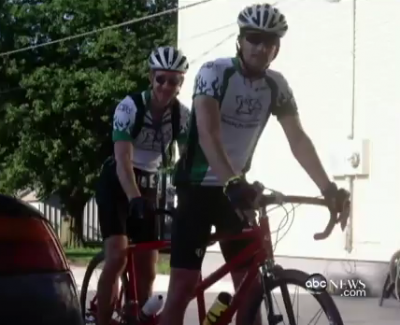
Dr. Jay Alberts and friend on his tandem bicycle
Last week, the new York Times ran a fascinating article describing the case of a man with severe, debilitating Parkinson’s disease — who, while remaining largely able to walk, can ride his bike for several miles every day. Here is a link to a video showing him riding.
Since the article ran, I’ve received several emails from ICI subscribers, students, and classmates alike — all asking the same thing: “What’s the deal with this? How is this possible?” Truth be told, I had no idea. So, I decided to find out.
UPDATE: 2/10/14 There has been considerable research done to quantity the symptom relief experienced by people suffering with Parkinson's disease, by riding a tandem bicycle or on Indoor Cycles. Learn more by listening to this interview with Dr. Jay Alberts with Pedaling for Parkinson's.
UPDATE September 25 2014:
We are now offering an ACE approved Parkinson’s Cycling Coach training program. To learn if you qualify click here.
Background
What is Parkinson’s Disease?
Parkinson’s disease is a neurodegenerative condition (primarily affecting older people, though can occur any time) characterized by progressive destruction of part of the brain called the substantia nigra, which is responsible for the production of a brain chemical signaling molecule (see also: neurotransmitter) called dopamine. Since dopamine is the primary neurotransmitter of movement, Parkinson’s disease is marked by gradually worsening motor function. Its cardinal signs include difficulty initiating movements (“akinesia”) and slowness in maintaining movements (“bradykinesia”), including swallowing and speaking. Problems with balance, gait, and tremor are also very common1.
Current treatment options include Levodopa (essentially, synthetic dopamine) with supplemental use of drugs that boost dopamine or block its breakdown. Deep brain stimulation of the affected portions of the brain has also shown promising results. Still, even with treatment, the disease often causes significant disability and decreased quality of life2.
The Role of Exercise
The focus of treatment for Parkinson’s disease is largely medication-based. While a role for supplemental therapy with non-medication treatments (including exercise) has been thought to be important, most research over the years has focused on its effects on quality of life, not motor symptoms directly. In recent years, this is changing. There have now been recent studies demonstrating improved independent functioning3, balance and gait4, and walking endurance with exercise therapy5. In animal models, exercise has been thought to contribute protection against further brain deterioration6 — and even to potentially induce repair at the level of the brain7.
Can’t Walk but Can Ride a Bike?
Although exercise is recommended for patients with Parkinson’s disease to supplement their treatment with medications, the scenario described in the new York Times article is not the norm. What appears to be at play here is not merely a success story of exercise therapy; rather, it is a specific neurological phenomenon. Bike-riding, in this case, is not functioning merely as exercise. It is actually a mechanism whereby damaged brain pathways are being overridden. Allow me to explain.
You see, movement initiation can be in response to either an external (“exogenous”) or internal (“endogenous”) stimulus. Turns out, “akithesia” (lack of movement initiation) in Parkinson’s disease is largely a failure of ability to respond to endogenous stimuli. The exogenous pathway, however, remains intact8.
A phenomenon called “akinesia paradoxa” (like it sounds: paradoxical akinesia) has been well-described in the neurological literature since the late 1960s. This refers to the ability of people who have difficulty initiating movement somehow being able to move in the presence of visual cues (lines, objects, colors) at their feet8. Remove visual cues? “Frozen” again.
There is no research specifically on cycling-supplied visual cues responsible for akinesia paradoxa. It is reasonable, however, to think that perhaps it is the repetitive linear road markings that might be at work here. Or perhaps the cue isn’t visual at all — like music, which has also been studied in relationship to akinesia paradoxa, any one of the sounds (gliding, scraping, squeaking, etc.) we hear our bikes make as we ride can also be thought of as a repetitive cue. What may go unnoticed to us and our preoccupied senses may indeed be responsible for creating movement in the movement-less.
As amazing as this sounds, we must be careful not to go too far in our interpretations. All we know is that akinesia paradoxa happens — in response to a visual cue that generates a brain signal for movement, movement can happen. Research is still lacking as to whether these successful “cued movement” episodes have any long-term impact on disease severity. Still, this is an active and fascinating area of ongoing research. We’ll see what happens…
The writer is a third-year medical student at the University of Vermont College of Medicine. She is also a STAR 3 Spinning instructor, Certified Personal Trainer (ACE), and author of the popular blog Spintastic (http://spintastic.blogspot.com/), which applies patient-centered medicine to motivational coaching..
References
Crizzle M, newhouse IJ. Is Physical Exercise Beneficial for Persons with Parkinson’s Disease? Clin Jl Sport Med. 2006. 16(5): 422-425.
2 Rao SR, Hofmann LA, Shakil A. Parkinson’s Disease: Diagnosis and Treatment. American Family Physician. 2006. 74:2046-54,2055-6.
3 Yousefi B, Tadibi V, Khoei AF, Montazeri A. Exercise therapy, quality of life, and activities of daily living in patients with Parkinson disease: a small scale quasi-randomized trial. Trials. 2009. 10:67.
4 Gobbi LT,Oliveira-Ferreira MD, Caetano MJ, Lirani-Silva E, Barbieri FA, Stella F, Gobbi S. Exercise programs improve mobility and balance in people with Parkinson's disease. Parkinsonism Relat Disord. 2009: 15(Suppl 3):S49-52.
5 White DK, Wagenaar RC, Ellis TD, Tickle-Degnen L. Changes in Walking Activity and Endurance Following Rehabilitation for People with Parkinson Disease. Arch Phys Med Rehabil. 2009. 90:43-50.
6 Zigmond MJ, Cameron JL, Leak RK, Mimicks K, Russell VA, Smeyne RJ, Smith AD. Triggering endogenous neuroprotective processes through exercise in models of dopamine deficiency. Parkinsonism Relat Disord. 2009. 15(Suppl 3):S42-5.
7 Hirsch MA, Farley BG. Exercise and neuroplasticity in persons living with Parkinson’s disease. European Jl of Phys and Rehab Medicine. 2009. 45(2): 215-29.
8 Kaminsky TA, Dudgeon BJ, Billingsley FF, Mitchell PH, Weghorst SJ. Virtual cues and functional mobility of people with Parkinson's disease: a single-subject pilot study. J Rehabil Res Dev. 2007;44(3):437-48.
9 KM & Valenstein E. Clinical neuropsychology.. 2003. Oxford Univ Press: 4th Ed. p 299.
