
by Ben Greenfield | Apr 8, 2010 | Ben Greenfield
 So if your indoor cycling students eat your fruits and vegetables, expose yourself to adequate sunlight, get plenty of sleep, and stay well hydrated, their body shouldn't really need a supplemental source of vitamins and minerals, right? Wrong.
Here are 5 powerful reasons that you explain to your students about why they need to take a multi-vitamin, no matter how healthy their lifestyle may be.
- Nutrient depletion in the soil. Modern farming techniques utilize fertilizers that actually deplete the soil of essential nutrients. Agriculture relies on the elements in the soil for absorption of proper amounts of minerals, and when this process is interrupted, the plant does not contain essential minerals and cannot form essential vitamins. And if the plant doesn't have it then you're not going to get it from eating the plant!
- Your ability to absorb nutrients from food actually decreases as you age. So while growing children should absolutely be taking a multivitamin to support healthy tissue and bone formation, supplementation becomes equally important for the older population. Sure, you could just eat more food, but this introduces a problem with caloric balance. Beware that many medications also interfere with proper nutrient absorption.
(more…)
by Ben Greenfield | Mar 29, 2010 | Ben Greenfield

When if comes to fiber, the benefits are numerous, but the simple fact is that most of the people in your class are probably not getting enough of it, although they will most likely think that they are getting enough.
Nine time out of ten, I’ll perform a nutritional analysis on an individual who tells me they’re “eating their fiber”, and this consists of a bowl of oatmeal in the morning, a small salad with lunch, and some roasted veggies with dinner. With all the benefits that fiber gives, there’s no excuse not be eating more of it. Unfortunately, it’s a rare person that has time to actually count how many grams of fiber they’re getting, so general recommendations make a lot more sense.
Not that your class participants have to stock their refrigerator with wood chips, dump a gallon-size ziplock bag of flax seed on their morning cereal, or stroll around chewing on a crumpled wad of paper, but proper fiber intake *is* important – and offers free health benefits that shouldn't be ignored. If they can decrease how much they spend on health care, increase the benefit of their exercise routine, and feel more energy and less stress, then they should take that extra step to hunt down some fiber! In case you want some pointers on how your class can get more fiber, at the end of this article, I'll explain how I get mine — but first, you’ll need to explain the benefits to your class. Here is what you can tell them: the 5 rock solid reasons to eat fiber.
(more…)
by Ben Greenfield | Mar 22, 2010 | Ben Greenfield
 In the last article of this series, you learned about the importance of water. But ultimately, it doesn’t matter how much water your students are drinking if they are not consuming adequate electrolytes.
When you consider the fact that over 75% of athletes are deficient in magnesium, – an electrolyte that is crucial for muscular contraction, the pacemaker activity of the heart, and muscle repair and recovery — it becomes pretty easy to understand why so many individuals just aren’t able to perform to their desired capabilities during indoor cycling class, and why they just don’t recover properly afterwards.
So what is the best way to explain electrolytes to your indoor cycling class?
In order to educate you on electrolytes, I have actually prepared a special slideshow, entitled “6 Things Water Can’t Give You”.
You can access this slideshow, along with the crucial notes that accompany it, at the following URL:
http://www.slideshare.net/bengreenfield/6-things-water-cant-give-you
If you’re lucky enough to have a project in your indoor cycling room, you can even show this slideshow to your class during warm-up and cool-down! Enjoy.
by Ben Greenfield | Mar 5, 2010 | Ben Greenfield
 Consider the following facts:
* Your speed on a bike decreases about 2% for each 1% of body weight lost through dehydration
* By the time you feel thirsty, you can already be at 2% body weight loss
* A 3% weight loss indicates dehydration has occurred
* Loss of fluid during exercise varies, but averages about 34 ounces per hour (3x that much in hot and humid conditions!)
* Hyponatremia, which is just as dangerous as dehydration, is a term used to describe “water intoxication” and can occur with excess water intake
* Acclimatized individuals who are used to training in hot climates or hot rooms can reduce fluid loss by up to 50%
Based on these facts, it would pretty important to make sure your indoor cycling class knows all about proper water intake.
After you’ve introduced the facts above, teach your class the proper formulas and rules for determining regular daily hydration and exercise hydration:
(more…)
by | Mar 3, 2010 | Health and Wellness, Melissa Marotta
“Sometimes I can’t catch my breath when I’m riding, especially in the winter. I’ve never been told that I have asthma before — but could that be what this is?”
– J.S., Asheville, NC
Melissa Marotta writes:
First off, sorry to hear about your discomfort! Feeling like you can’t breathe is an incredibly scary experience for a lot of people. There are a number of conditions that could produce symptoms like yours, including the “exercise-induced bronchospasm” (formerly called “exercise-induced asthma”) phenomenon that I will describe in this article — so I encourage you to see your physician to help you figure out what’s going on for you, personally. This way, you can sooner get the appropriate treatment you need.
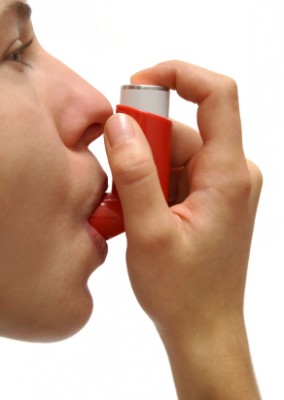 Many people have heard of exercise- or exertion-induced bronchospasm (EIB) but there is often some confusion about what the term actually describes. It refers to narrowing of the airways in association with exercise, both amongst people who have asthma (90% of patients with asthma experience an exacerbation of symptoms with exertion) and amongst people who do not. Research suggests that greater than 10% of general population may also suffer from EIB. Studies of elite athletes report a prevalence of EIB between 11-50%1. At particular risk are those athletes engaged in activities that require large volumes of air to be moved (i.e., cyclists, runners, swimmers, skiers, rowers, etc.) and those who exercise in cold, dry, or polluted (i.e., indoor rinks) conditions2.
Symptoms of EIB can be quite varied, let alone vague (i.e., non-specific discomfort, breathlessness, fatigue that might be “expected” under conditions of heavy exertion). Thus, EIB often goes undetected. Athletes, in particular, may be less likely to complain about discomfort1. That’s why it’s extremely important that you are aware of this phenomenon, so as to help those you coach (or yourself!) to recognize it and seek appropriate diagnosis and treatment.
What are the symptoms of EIB?
(more…)
by John | Feb 25, 2010 | Barbara Hoots, Latest News
Our very own ICI/PRO Team Member Barbara Hoots announces;
First Officially Licensed Spinning® Resort in Caribbean
(I know how hard she worked and all the hurdles she overcame to make this a reality. I'm very proud of her + it's going to be a great place to teach! Info about teaching here in exchange for an all-inclusive vacation HERE – John)

Find a hammock for after your class...
From their press release:
Rose Hall, Jamaica (February 2009) – Half Moon, the luxury resort located in Rose Hall, Jamaica, has teamed up with internationally acclaimed STAR 3 Spinning instructor Barbara Hoots and Mad Dogg Athletics, developers of Spinning® to offer guests the popular cycling-inspired Spinning® classes. This will make the luxury resort the only Caribbean resort to offer this popular fitness programme.
Equipped with 10 custom-designed Spinner® bikes and state of the art sound system in specially-designed Spinning studio, guests of the 400-acre resort can choose from three unique tours that invite them on a virtual experience of Jamaica.
The programmes Climb to Blue Mountain, No Problem Tour and Adventures in Negril were developed by Spin veteran Barbara Hoots and feature specially created soundtrack to inspire and energize riders.
(more…)
