Do you have a persistent health issue that hasn’t responded to your nutrition efforts? More and more people are using nutrition and fitness to help them overcome problems that used to send them to doctors and pharmacies.
If you’ve been working on the problem for a while — weight loss, high glucose, headaches — you probably have tried many strategies. But others may exist. Don’t assume you’ve tried everything.
Here are 3 tips to help you get the most from your nutrition appointments — and your nutritionist’s suggestions.
– Don’t improvise.
Instead: Follow instructions to the extent you can.
A recent client had been to doctors, but now wanted to treat her diabetes without meds. She was taking 31 (really!) different supplements, and some of the supplements were for health issues she didn’t even have, like liver and thyroid.
She had poor results — her fasting glucose was not dropping any lower — but she kept taking every supplement.
Among other things, I suggested she lighten the stress on her liver and kidneys by eliminating any supplements that were not designed to lower glucose. We met a week later, and she told me her glucose had gone up, not down.
It turned out she had eliminated ALL the supplements, including the glucose-lowering ones.
– Don’t reject an idea for a ridiculous reason.
Instead: Be willing to try something new. Your health comes first.
The same client above was in terrible shape physically. Her workouts were barely getting her heart rate to 95 — and she was exercising only 3 times a week. She needed to work out with some serious intent.
She couldn’t exercise more frequently because it caused pain in her legs. I suggested she buy a Krankcycle — an absolutely brilliant piece of exercise equipment. I even found a certified, refurbished one for her at a terrific price. It would have enabled her to work out additional days each week by using her upper body instead of her legs.
Alternating the 2 types of cardio could (and would) have sensitized both upper- and lower-body muscle to insulin and produced solid results.
Why did she reject it? She said they didn’t have room. Her beautiful home is huge, so that made no sense. She wouldn’t consider putting the Krankcycle in any room but one — and wouldn’t consider putting it in the large garage. Who knows? Maybe 8 cars lived in it — or perhaps a family of 6.
Either way, the answer was “NO,” and the reason seemed ridiculous. The result? Again, her glucose didn’t move.
– Get out of your comfort zone.
Self-honesty is key here. Discomfort can be part of one’s comfort zone. Some people even cling to it, possibly thinking that the devil they know is better than the devil they don’t know.
Instead: Decide to do what it takes to move forward. And do that.
A former client had a sleep issue that was medically diagnosed as a deficit of serotonin, a brain chemical that can promote relaxation and is the direct precursor of melatonin, the sleep hormone.
This client rejected every suggestion I made to increase her bedtime serotonin levels — and, by the way, that’s an easy thing to do. My suggestions even made her angry, and they simply involved food.
The behavioral psychologist on our team informed me that this client seemed to feel “special” because of her sleep problem.
A comfort zone isn’t always the best place to be. For your health, do what it takes to move forward, even if it causes temporary discomfort.
Think of starting to exercise — it’s uncomfortable at first because it’s new. As we continue, we adapt to it, and that’s when the magic happens. Food is the same way.
If you’d like help with nutrition to improve your health and energy, perfect. That’s what I do. Just visit www.FoodAddictionSolutions.com/Coaching and request your FREE Eating Empowerment Consult. Find out how easy it can be to move forward and enjoy great health.
When you're reaching the end of your class and your riders look like their losing their motivation, throw this song their way and they are sure to gain their second wind. You and your riders will love the amazing beat that trails in and out as the song progresses. (67 rpm) To use these teaching notes, make sure you are using the original version which clocks in at 6 minutes and 26 seconds. Here's the rundown:
Obviously, it’s not necessary to know how caffeine works to be able to use it. It can be helpful in boosting pain relief from other pain-relievers or by itself. It’s especially good for muscle pain relief — great news if you work out hard.
Scientists speculate that caffeine’s pain-relieving power comes from 3 mechanisms:
– It blocks release of adenosine.
Adenosine is a brain chemical that carries pain signals to the brain.
– It activates adrenalin pathways in the brain.
Those pathways include the body’s own pain-killing mechanism.
– It stimulates the central nervous system in a way that changes the processing of pain signals.
Of the 3, I like the first one best. The second 2 don’t actually explain clearly (at least to me), but the first does. Here’s why.
Adenosine prevents the release of 2 brain chemicals — norepinephrine and dopamine — presumably so the amounts available at a given time are kept within control.
When we consume caffeine, the caffeine blocks adenosine. It occupies the adenosine receptors and prevents adenosine from “getting in.” As a result, dopamine and norepinephrine are released in larger amounts. That’s why coffee makes us feel alert.
But norepinephrine also has analgesic power, so it offers a bonus — it wakes us up and helps to relieve pain.
Norepinephrine is made when we eat protein foods: fish, eggs, chicken, beef, lamb, pork, turkey, shrimp, crab, yogurt (with 18-22 g of protein per serving). For non-animal protein, use high-quality vegan protein powders from peas, hemp and other vegetable sources. (Kale, for example, doesn’t have enough.)
The take-away? Be sure to eat protein foods regularly, so your norepinephrine stores are adequate when you need to release them by consuming caffeine.
For additional tips like these — or for more serious health issues — visit www.FoodAddictionSolutions.com/Coaching and request your free Eating Empowerment Consult. Find out how easy it can be to get your nutrition and your health back on track.
Do Indoor Cycling Classes really need to be 45-60 minutes – to provide the health and fitness benefits expected by our participants?
Asked another way: If your studio offered classes that were shorter (say 30 minutes), while still just as effective as 3/4 or a full hour, could an “express class” attract people who feel time strapped?
Of course anytime you use the words “just as effective” smart Instructors are going to ask; “show me the research”!
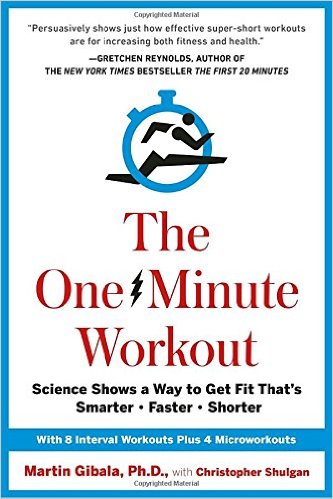
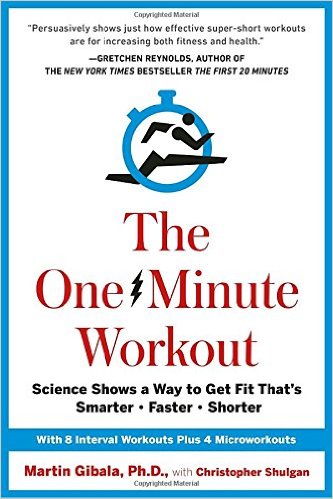
Martin Gibala, Ph.D. is my guest, for this episode of the Podcast. Dr. Gibala has done the research (and I'm quoting from the back cover of his new book – The One Minute Workout) “As the world's foremost expert in high-intensity interval training, Martin Gibala has pioneered the study of new and remarkably time-efficient type of workout, making available the benefits of exercise in a fraction of the time.
Listen to our conversation in the Podcast below to learn more about the science of HIIT and how you could use this information to improve your classes and attract more participants.
Here's a short video featuring Martin Gibala, Ph. D.
I'm sure you've been hearing this song on the radio and in commercials recently and maybe you've considered using it in your next profile. I gave it a try last week and I'm here to tell you it was a huge hit! You will love the drum beat and the explosive chorus. We rode on a hill (64 rpm) and added resistance throughout. Add cadence in the final 30 for a big finish. Another option is to climb and then explode on the chorus (adding cadence at :56, 1:56 and 2:50).
With over 1800 articles in our archives there's a good chance that our ICI/PRO members may have missed some of our best stuff. So every Wednesday we are republishing some of our favorite articles and podcasts – enjoy!
By Team ICG® Master Instructor Jim Karanas
What is Beatmatch?
A beat is the regular, rhythmic unit of time that makes up music structure. Beatmatch matches cycling cadence to the beat of the music, so that one leg pushes down and the other pulls up every time there’s a beat.
When cycling in time with the music, each beat matches up with one pedal rotation. The beat always occurs on the same leg, and the offbeat, the unaccented beat between counts, always occurs on the other. Beatmatch can be done in three ways: 1 beat = 1 rotation, 2 beats = 1 rotation, or 1 beat = 2 rotations.
Beatmatch can give rise to strong aversions. “Aerobics on a bike!” “You’re putting the students in a box!” “Let the students find their own rhythm!” These comments support a Freestyle approach to music, which I too support — but not all of the time.
What’s Good About Beatmatch?
Matching cadence to the beat teaches timing. It makes the pedal stroke smoother, more consistent and fluid. It can help students who lack an innate sense of rhythm FEEL rhythm. It‘s a powerful tool for teaching effort and commitment. It’s ergogenic. I think it teaches how to ride more efficiently.
Say the class is riding at 80 rpm, and you cue them to add resistance without changing cadence. An untrained student will unconsciously slow the cadence, which offsets the work. It’s a typical response by someone who has not yet learned to put out, or build, effort. Beatmatch can help prevent that slow-down.
Or have more advanced students jog at 95 rpm for 5 minutes. That’s challenging. Many, when near exhaustion, can’t maintain the cadence. Looking at a computer won’t help much, but keeping up with the beat can be more effective.
I think of timing as our interaction with the world. With good timing, there’s “flow”. The world seems to work: watch a bike messenger weave through busy urban traffic. Bad timing is the opposite, out of sync. We hit every red light on the ride home. The most basic lesson in developing good timing is consistency. If we’re unaware of our inconsistent timing to begin with, how can we ever sense flow? Musicians develop consistency by using a metronome. That’s Beatmatch.
Other benefits of Beatmatch include greater sensitivity to gear selection and cadence, finding the rhythm at which you create power effortlessly, and a stronger connection with your bike.
When Is Freestyle Beneficial?
Freestyle uses a range of cadences for whatever terrain you’ve cued, so the pedal stroke is not always in time with the music. There are advantages to this approach under certain circumstances. For one thing, Freestyle’s easier on the instructor. If you can’t find the perfect music, you can cue by feel, nuance and cadence range.
More importantly, Freestyle can help students. If the student isn’t yet fit enough to handle fast cadences, especially standing, Freestyle permits success. If the student isn’t strong enough to handle very slow cadences with high resistance at high heart rates, Freestyle permits success. When the pattern calls for lots of changes — e.g., from seated to standing and back with resistance changes at frequent intervals — Freestyle permits success.
While Beatmatch can be mentally exhausting because of the structure and constant need for control, Freestyle allows the student to relax and focus more on heart rate and terrain changes without counting. It may evoke emotion more easily because it demands less vigilant attention.
Emotion Revisited
Slid Fluke
L.A. Woman Billy Idol
This Is Us Mark Knopfler & Emmylou Harris
Stevenson George Winston
I’ve played these four songs, listed last week, for hundreds of instructors and asked for their emotional responses. The comments never vary.
“Slid” is great electronic music, but no one can pair an emotion with it. That’s typical with Electronic, Techno or Dance music — good workout music that doesn’t generate much emotion.
When I play Billy Idol, most of the instructors smile and often don’t know why. Rock ‘n’ roll just makes people happy.
“This Is Us,” a country rock song, is usually described as love, warmth, affection or sincerity. A good country song is like a hug.
Last, I play “Stevenson” by George Winston. It’s 1:57 long, classified as New Age, and on the Hurricane Relief Benefit collection that raised money for Katrina survivors. To start, people may chat, but within seconds the room is silent. To describe their emotions, they use words like sad, upset, depressed.
Stevenson Palfi was a documentary filmmaker who made a name for himself among the jazz musicians of New Orleans, his primary film subjects. He took his own life after losing everything in Katrina. The song ends abruptly and feels unfinished, like Stevenson’s life. It may leave you raw, sad and contemplative.
If your class is truly about delivering an experience, music can bring both emotion and structure. When selecting music, don’t always go for the obvious workout music or the ambiguity of Freestyle. The same song can be perfect for a tough Freestyle climb or a hard flat road in Beatmatch. Try music that makes you feel. See what impact Beatmatch can have. Use unexpected music at unexpected points in the class.