If you hate how you look in pictures, or wonder if you appear confident on the bike, I suggest watching the video below.
If you–or the people you take photographs of–always look bad in images, then help is at hand. Professional portrait photographer Peter Hurley suggests you squinch next time you have your picture taken.
If you're unaware what squinching is, join the club! Merriam Webster defines it as:
SQUINCH
transitive verb 1: to screw up (the eyes or face); squint 2: to make more compact.
But in fact Hurley has taken the word and used it to describe the “action of squinting your eyes in such a way as to portray confidence and self-assurance as opposed to the fear and uncertainty that you project when you stare wide-eyed at the camera.” Crucially, it's a little different to squinting, which leaves you looking a bit… odd. Instead, you lift and tighten your lower eyelids, and let the top ones come down just a fraction.
The results are actually quite impressive. Indeed, this video shows how you can get your squinch on, and the benefits it will have–as do the images below, pre- and post-squinching. And you just know that even the least vain of us are gonna give it at least a little try.
… I'm giving this to you as a gift, you can look awesome!
Sometimes a girl needs a little inspiration! And when I do, I simply run back to the dock at Nordstrom. Honestly, Tony (yes, his real name!), has the best music jamming at all times as he keeps things copacetic at the Mall of America ! In his own words, today he was on a roll!
Quincy Jones hired this group of brothers (and one cousin) in the 70's. Please, don't let that discourage you from reading on and using this ‘record', as Cee Lo Green calls them…. Your class will recognize it and love it. Having heard this again today and recalling how much I love it, I'm using it for the first time in class on Saturday, as a 91 rpm flat road locking in at 5:00 early in.
I'm anxious to hear you and your class's reaction to The Brothers Johnson ‘Strawberry 23'. I don't think I've ever introduced a tune I've not used and pre-approved in class before, but most will recognize this and the beat is wonderfully strong for a flat road.
You never know when something you say, will resonate with your class.
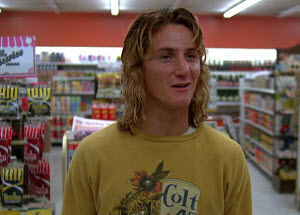
I subbed yesterday morning – a climbing day. I'm not sure where it came from*, but as I was encouraging everyone to recruit their hamstrings during one of a series of intervals above PTP** (Personal Threshold Power) I mentioned that our hamstrings are a bit like slacker teenagers – they'll do just about anything to avoid work. Then I started in with the excuses, using my best Spicoli voice :
WHAT! – why doesn't Carly have to do it?
Can't you see I'm sleeping?
Leave me alone!
I don't see you doing it!
What, exactly, is preventing you from changing the laundry?
That's crap, I always help out… I just don't want to right now.
Big smiles from many in the room.
Then a few started yelling out their own:
It's fine like it is Mom.
Why are you so mean to me?
I'll do it latter
Why is it only YOU notice?
Going with it I offered that as the ADULTS in the room, it's our responsibility to demand encourage our teenagers/hamstrings to pull their weight, especially when there's a big job/effort in front of us. We need to focus on the bottom of our pedal stroke. As we crosses it we need to reach down, grab the blanket, pull it off and feel the slacker becoming productive.
You'll know if you're doing it right… if you start hearing/feeling the slacker complaining – which you of course, ignore.
If you're teaching to a group with nearly grown kids, this maybe fun for you to play with. Let us know if it does.
*If I were to guess, it would have come from the frustration I felt coming home the previous night. Older daughter had stopped by to get her snowboard – they're already making snow here in MN. In order to retrieve her board from the garage rafters, she needed to move a bunch of summer stuff that I had neatly placed in a corner. Which was fine, except she didn't bother to put any of it back 🙁
** I incorporate a 3-5 minute Best Effort in each class, at around the 15 minute mark. Using the stage button to set the average, we use that wattage as each rider's PTP for the class. Not a true FTP, but a personal number everyone can work from when I cue them to be Below, @ or Above PTP.
Question…can you direct me to the profiles/playlist that are more pop music? Or is there a way for me to search vs. going through each one? Thank you!
My response was: Most of our 60 Audio Class PROfiles are an eclectic composition of music, from many different genres. So there's no easy way to sort/search for playlists that are primarily pop songs. Unfortunately you will need to sample each playlist to learn if the music is to your taste.
I enjoy sampling music – what I do is:
NOTE: This all applies to Deezer as well.
I subscribe to a bunch of playlists > and set them as Available Offline.
Listen to each as I'm driving, working or some other activity when I'm alone.
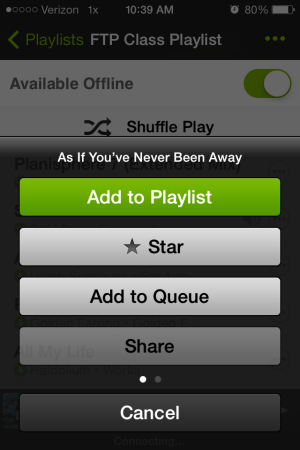
When I hear one I like I click the little circle with the three dots —
That opens the sharing options:
Add to Playlist > and I add it to a special playlist I've created “Future to Use” – I keep at the top of my playlist column so it's easy to find. That's my go-to list (along with my Shazam Tags) when I'm ready to build a new class.
Or you can “Star” the track > which adds it to your starred list > left hand sidebar has a “Starred” display option.
Or if you swipe left, you'll see an option to; Go To Album, Go To Artist and Start Radio.
I enjoy the Radio feature a lot. Spotify will begin playing songs that are similar to the one you started with.
Diet isn’t the only reason your students may suffer from PMS symptoms. But it could be a big one. If the women in your classes approach you for help with PMS (or even complain about it), you’re in a great position to offer good advice.
Premenstrual syndrome includes a long list of symptoms and signs: anxiety, depression, irritability, mood swings, nervousness, angry outbursts, fatigue, fluid retention, bloating, weight gain, backache, cramps, headaches, joint pain, breast pain, insomnia, acne, and cravings. Whew.
Factors that contribute to PMS include hormone or neurochemical shifts, diet deficiencies, stress, and lack of exercise. (That last one certainly won’t apply to indoor cycling students.)
Two important brain chemicals associated with PMS are serotonin and beta-endorphin. Both chemicals drop pre-menstrually — with interesting effects.
The first, serotonin, promotes relaxation, calm and satiety, the feeling that we’ve had enough food. It can reduce depression, stress, anxiety, and pain. During PMS, the drop in serotonin can lead to irritability, pain, depression, mood swings, impulsivity, increased appetite, and cravings, especially for carbs.
Second, beta-endorphin reduces pain and emotional distress, while it promotes wellbeing, euphoria, and brain “reward”. When beta-endorphin drops during PMS, we feel more pain and have “low” moods and cravings, especially for sugars and fats.
Serotonin and beta-endorphin are strongly influenced by diet and exercise. How does repeated sugar consumption affect this?
Women with PMS tend to have higher intakes of sugar, alcohol, white flour, salt, saturated fat, caffeine, and dairy products. From the other side, PMS is linked with low levels of B vitamins, protein, essential fatty acids, and fiber. These dietary habits tend to be either/or. One cancels out the other.
Let’s focus on high sugar intake. Sugar increases the intensity of PMS symptoms. It increases breast tenderness, congestion and pain; abdominal bloating; and swelling of the face and extremities. Sugar increases magnesium excretion, which in turn results in irritability, anxiety, depression, low brain reward, and insomnia.
Sugar triggers high insulin secretion. Insulin affects hormones known as prostaglandins (as explained in a previous post), and increases the ones that cause pain and inflammation. Sugar increases appetite for junk food, cravings, and hypoglycemia in people who are susceptible. Alcohol does these things, too, and can decrease serotonin besides. Not a good mix of effects from either of these substances.
The best plan is for your students to get off sugar (and alcohol, which is essentially the same thing health-wise). Recommend that they eat protein throughout the day, preferably with each meal and/or snack. They can replace sugar and white flour with complex carbs — sweet potato, quinoa, turnips, lentils, pumpkin and other squash, and vegetables — and eat unsaturated fats (avocado, olive oil, nuts, seeds) with each meal.
Supplements can help your students feel better. Flaxseed oil and fish oil capsules are good to take every day. Magnesium improves mood. B-complex can help restore healthful hormone and neurochemical levels. Vitamin D3 is needed for uptake of magnesium, as well as for calcium.
Make sure they keep coming to your classes. Working out at least 3-4 times a week relieves many symptoms, and is as important as all of the other suggestions combined.
Many other nutrition and supplement suggestions exist for dealing with PMS — not to mention making it through menopause without discomfort. I’ll be back to cover these topics in future posts. Meanwhile, if your students could use help in ending sugar addiction, they can contact me at www.foodaddictionsolutions.com.
We were just learning (and getting excited) about Spotify in the Fall of 2011. The promise of another similar service gave me hope that competitive pressure between these two would lead to continuously improving service = a better product for us to use in class.
I have to admit that until I received an alert about this, I had forgotten all about Google music. Spotify, now that the playlist timer is back, has been working very well for me.
So today there are a bunch of articles excitedly talking about the new Google Music All Access iPhone App. So right after my FTP class this morning, I downloaded the new App to my iPhone. Because I have a Google ID, my phone recognized me right away and…
then the confusion began 🙁
The App didn't work. It would show songs, but trying to play them, I kept getting an error message; unable to stream.
I must need to log in to the actual All Access service or something, I thought. Searching through every button or link I could find on the App relieved nothing. So I did a search on my computer (using Google) for Google Music All Access, which brought me to this page for Google Play Music. This is a big deal, so I figured they would have a large banner saying “Click Here to make your new App work”, but they didn't. You need to scroll way down the page to find anything – I had actually scrolled past it at first, left the page, then came back and then found the mauve banner that finally linked to where I could subscribe.
Why isn't there a way to subscribe right on your phone? Or at least a “this won't work without an All Access subscription, silly” notification. It would have prevented me wasting 20 minutes of my life.
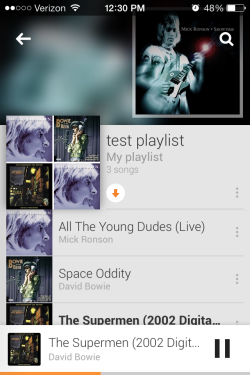
Thankfully it's free for the first 30 days – then $9.95 a month. All Access offers a way to download a playlist for off-line use, which is good, but that's it for the functionality important to us. There's no option to change the order of songs on your iPhone – only on the desktop. There's no crossfade, or gapless playback options.
It may be that Google Music All Access was designed specifically to go against iTunes Radio. Unfortunately it has a long way to go before it will be of any value to me.
NOTE: If you found this looking for help with Spotify, we have lots of tutorials and informational articles here.



 Sometimes a girl needs a little inspiration! And when I do, I simply run back to the dock at Nordstrom. Honestly, Tony (yes, his real name!), has the best music jamming at all times as he keeps things copacetic at the Mall of America ! In his own words, today he was on a roll!